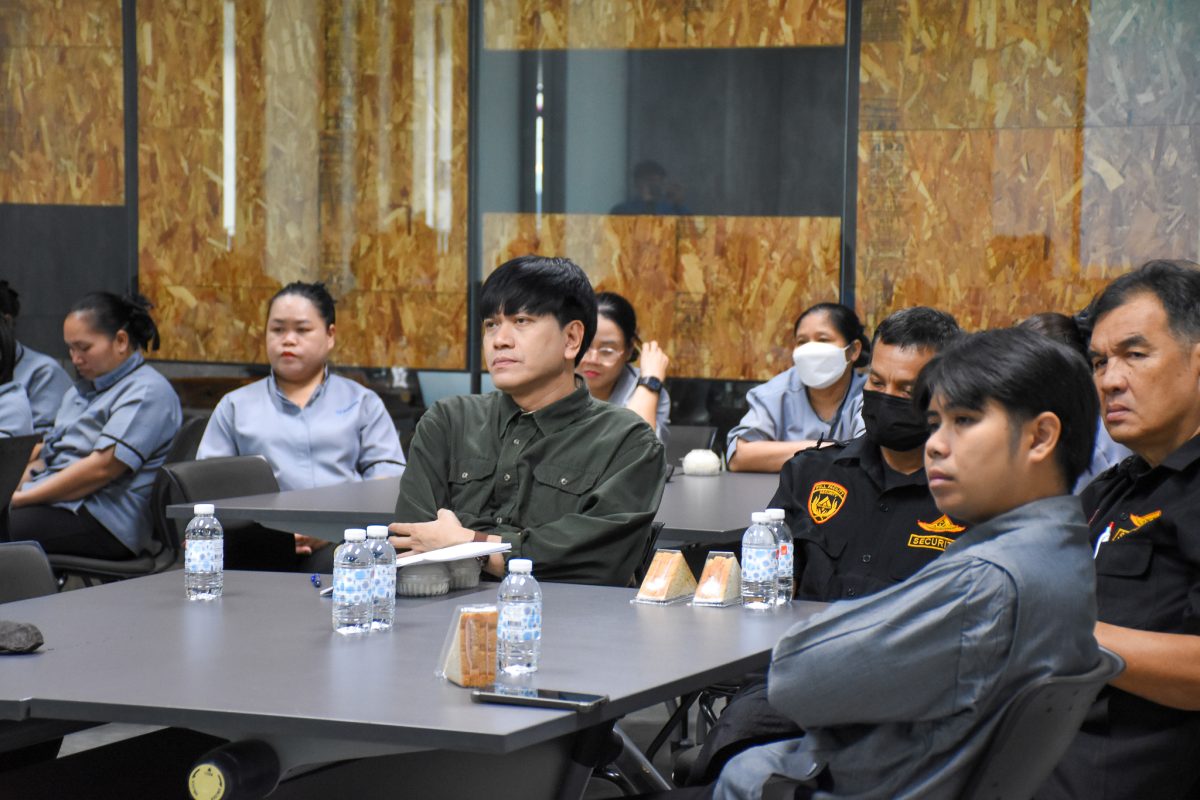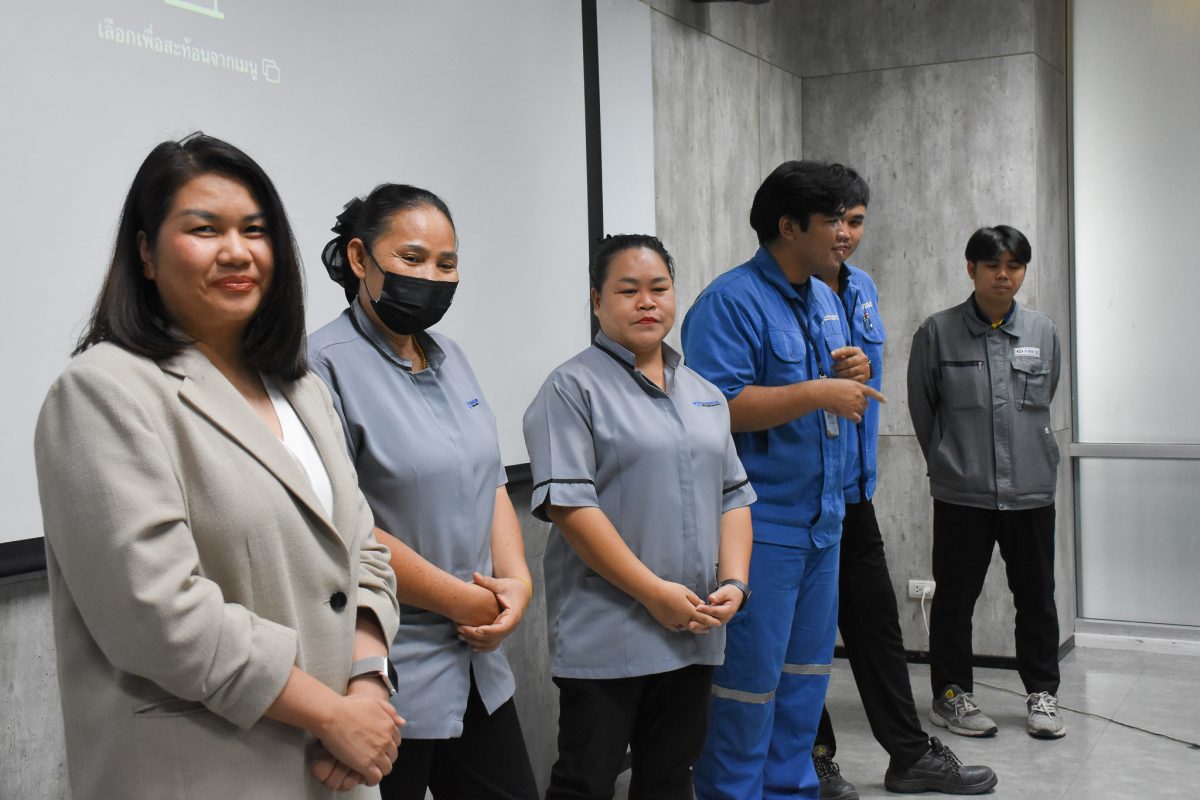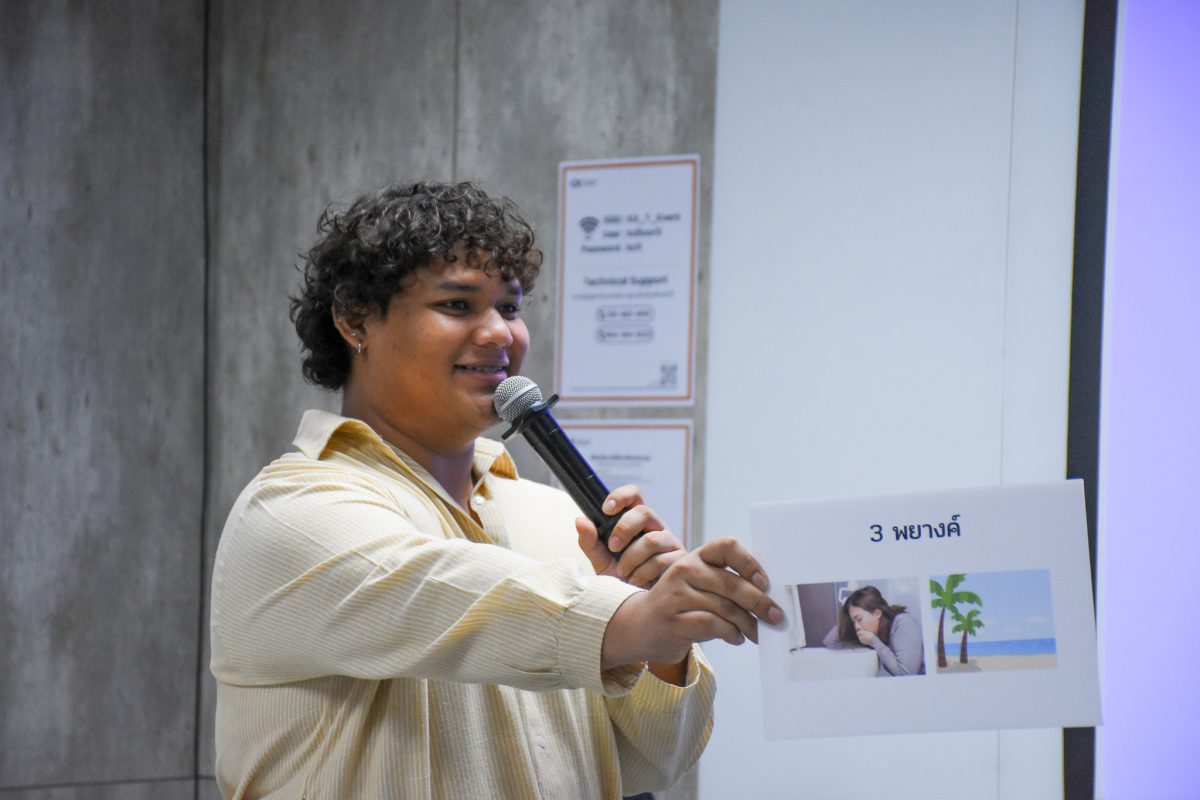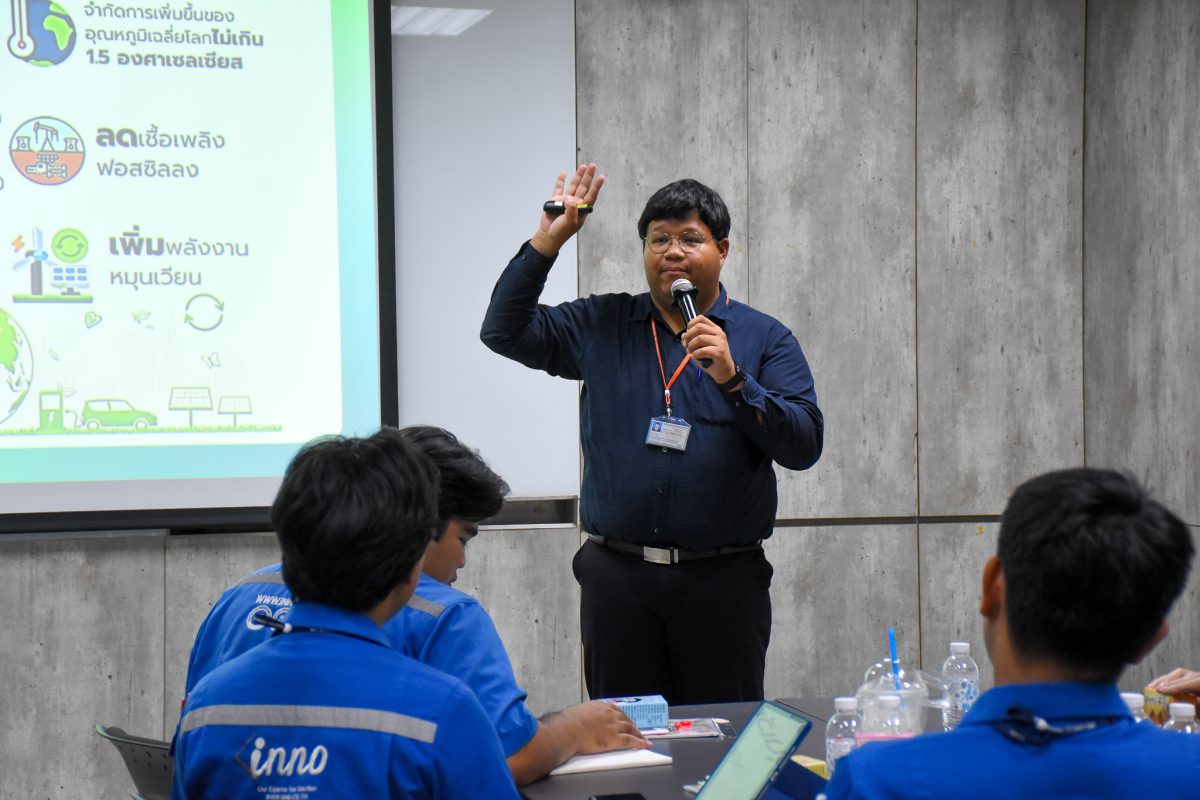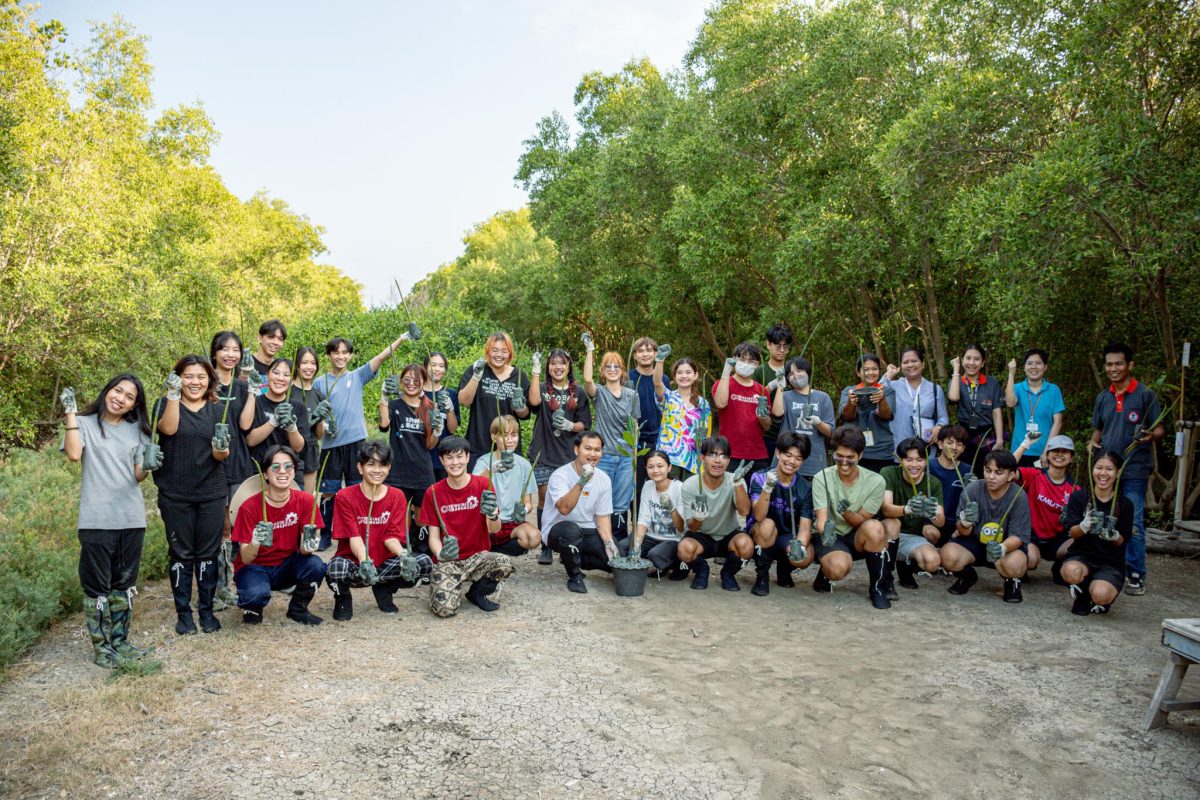
Goal 13: Climate action

Take urgent action to combat climate change and its impacts.

13.2 CARBON ENERGY USE

1. of low-carbon energy used

King Mongkut’s University of Technology Thonburi (KMUTT) is committed to becoming a sustainable, low-carbon university through the implementation of a comprehensive Greenhouse Gas (GHG) Emissions Reduction Program. This initiative forms a key component of the university’s long-term sustainability strategy and its commitment to achieving Carbon Neutrality by 2040, ahead of Thailand’s national carbon neutrality target of 2050.

Annual carbon footprint

Electricity and transport components · metric tonnes/year. The reporting year is not specified in the supplied update.

Electricity usage14,238.77metric tonnes/year
Bus0metric tonnes/year
Cars192.08metric tonnes/year
Motorcycle97.99metric tonnes/year
Carbon footprint per year14,528.84 metric tonnes/year

GHG emissions over time

Full-year totals for 2019–2025. The scope inventory below is a separate reported dataset from the electricity-and-transport footprint above.

020,000 tonnes CO₂e

2019

18,727

2020

16,547

2021

13,290

2022

16,130

2023

17,837

2024

18,060.27

2025

16,731.22

The 2026 record covers Q1–Q3 only: 13,443.26 tonnes CO₂e. It is kept out of the full-year comparison.

Full inventory by scope and reporting period
Organisational GHG emissions · tonnes CO₂e
PeriodScope 1
Direct emissions
Scope 2
Energy use
Scope 3
Indirect emissions
Reported total
20192,33115,74565118,727
20202,25213,77152416,547
20212,02910,87838313,290
20222,02513,58052516,130
20232,15414,93175117,837
20242,169.6815,266.43623.9218,060.27
20251,803.0514,238.77689.3916,731.22
Q1–Q3/2026*1,266.7511,702.32474.1813,443.26

Reported totals are transcribed as supplied. Differences from the sum of the three displayed scopes are retained: 2023, 1.00 tonne CO₂e; 2024, 0.24; 2025 and Q1–Q3/2026, 0.01 each. The source’s asterisk on Q1–Q3/2026 is retained; no further footnote was supplied.

Solar power, site by site
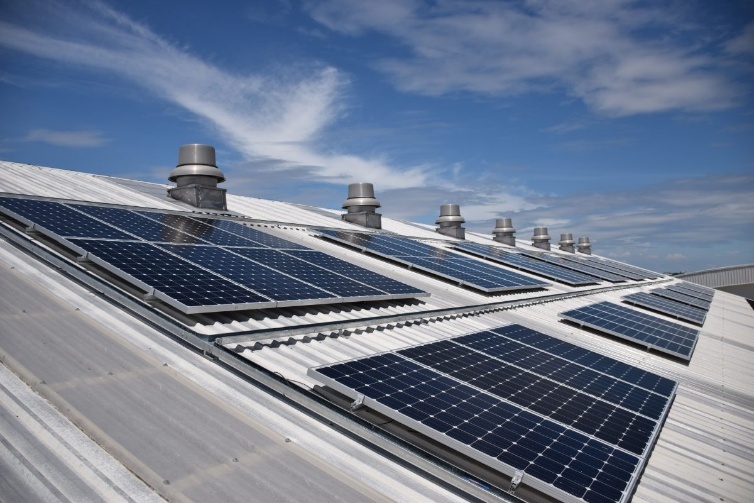
Rooftop solar photovoltaic panels in the supplied campus energy photograph.
Installed capacity in the register337.12kWp
Energy production in the register492,195.2kWh · reporting period not stated
Complete solar installation register

15 sets of solar cell have been installed in KMUTT including

The source introduction says 15 sets, while its table contains 16 numbered records. All 16 records are retained below, and both totals reconcile with those rows.

Solar installation register
No.SiteInstallation size
(kWp)
Energy production
(kWh)
1Research Building (EXC)3.124,555.2
2Research Building (EXC)4.166,073.6
3Media Technology Building (MTA)4.166,073.6
4Research Building (EXC)4.236,175.8
5Energy Environment and Material Building2.423,533.2
6Energy Environment and Material Building2.23,212
7BKT Energy Park4.366,365.6
8BKT Energy Park5.768,409.6
9BKT Energy Park2.713,956.6
10Ces Solar cells Testing Center (CSSC)6290,520
11Sport Complex93135,780
12Pilot Plan Sevice(PIP)5073,000
13NET ZERO Energy House57,300
14Floating Solar22,920
15Utility Exchange5275,920
16Learning Exchange4058,400
Total337.12492,195.2
Renewable energy programmes and further photograph

1.2 Low-Carbon Energy Transition and Renewable Energy Integration

Energy transition is one of the most important components of KMUTT GHG emissions reduction strategy. The university continuously promotes the transition from conventional energy sources toward cleaner and more sustainable energy systems by combining renewable energy generation, energy conservation, and advanced energy management technologies.

Renewable Energy Generation

KMUTT has progressively expanded the installation of solar photovoltaic (PV) systems across its campuses, including Bangmod, Bang Khun Thian, and Ratchaburi Learning Park. Rooftop solar installations on academic buildings, research facilities, and other campus infrastructure generate clean electricity for on-site consumption and help reduce dependence on conventional grid electricity.

As of 2025, the university reported an installed rooftop solar capacity of approximately 337.12 kW. Further renewable energy development and expansion projects are being pursued to increase the proportion of clean electricity in the university's overall energy portfolio.

In addition to solar energy, KMUTT promotes research and development in other renewable energy technologies, including wind energy, biogas production, and energy storage systems. These technologies provide opportunities to diversify energy sources, improve energy security, and support the development of an integrated renewable energy ecosystem.

The university also works toward greater integration of campus-based renewable electricity with the electricity grid through collaboration with the Metropolitan Electricity Authority (MEA). This approach supports the development of a more flexible and reliable energy system while facilitating the wider adoption of renewable energy.

Renewable Energy

King Mongkut’s University of Technology Thonburi (KMUTT) has been a leading institution in Thailand’s transition toward sustainable and renewable energy utilization. With its strong commitment to achieving carbon neutrality by 2040, KMUTT has continuously developed, implemented, and promoted renewable energy systems across its campuses. These initiatives not only contribute to environmental sustainability but also serve as a practical learning platform for research, innovation, and community engagement.

KMUTT integrates various renewable energy technologies within its infrastructure. The university has established solar photovoltaic (PV) systems on rooftops and open spaces to generate clean electricity for academic and residential buildings. The energy produced is managed through smart energy systems to optimize load distribution and minimize dependency on fossil fuels.

In addition, solar thermal energy is utilized for water heating and drying processes, particularly in research related to solar drying technologies for agricultural products.
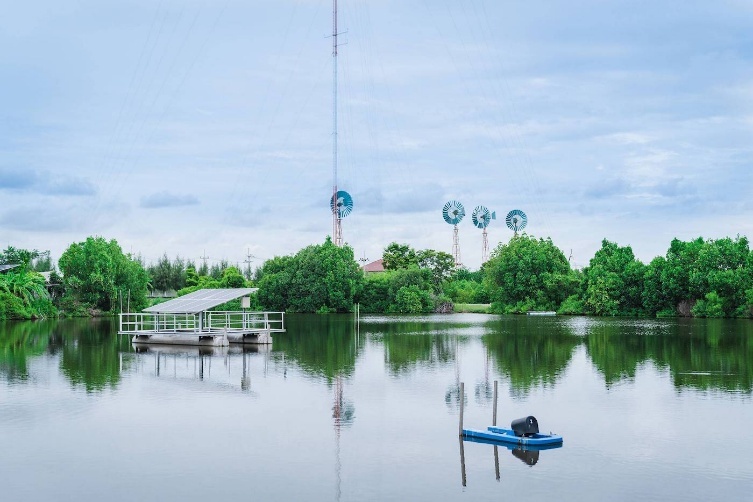
Wind-energy and waterside research infrastructure in the supplied renewable-energy photograph.

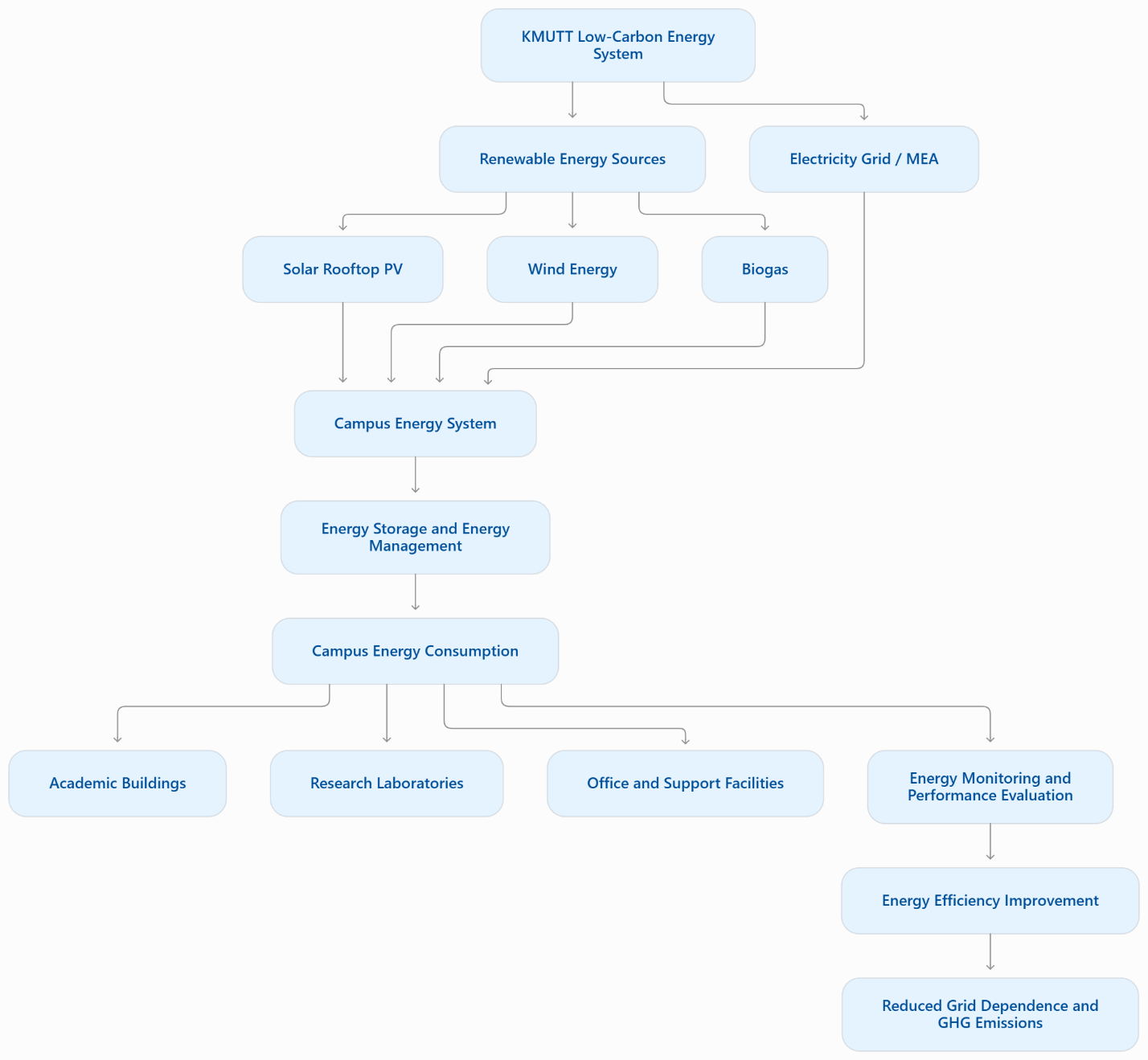
How campus energy connects

Original KMUTT Low-Carbon Energy System diagram, with renewable sources, the electricity grid and the monitoring branch
Original KMUTT Low-Carbon Energy System diagram, with renewable sources, the electricity grid and the monitoring branch. The original blue artwork is preserved unchanged.
Energy efficiency measures and participation

Energy Efficiency and Advanced Energy Management

Renewable energy development is complemented by systematic energy efficiency measures. KMUTT implements energy conservation programs across buildings, laboratories, and administrative facilities, including:

  • Replacement of conventional lighting with energy-efficient LED systems.
  • Installation and promotion of high-efficiency electrical appliances and equipment, including products certified under Thailand's Energy Label No. 5 program.
  • Improvement of air-conditioning and cooling systems through high-efficiency technologies.
  • Optimization of building operating schedules and electrical equipment usage.
  • Implementation of energy monitoring and performance evaluation systems.
  • Development of Energy Management Systems ( EnMS ) in accordance with ISO 50001 principles.

The university also strengthens the capacity of building-level Energy Conservation Teams and Working Groups through regular training sessions and workshops. These activities encourage participation from academic personnel, administrative staff, students, maintenance personnel, and other campus stakeholders.

Through the integration of renewable energy generation and energy efficiency, KMUTT aims to reduce energy-related GHG emissions while establishing a more sustainable and resilient campus energy system.

Three routes to lower emissions

The GHG emissions reduction framework is structured around three complementary strategies:
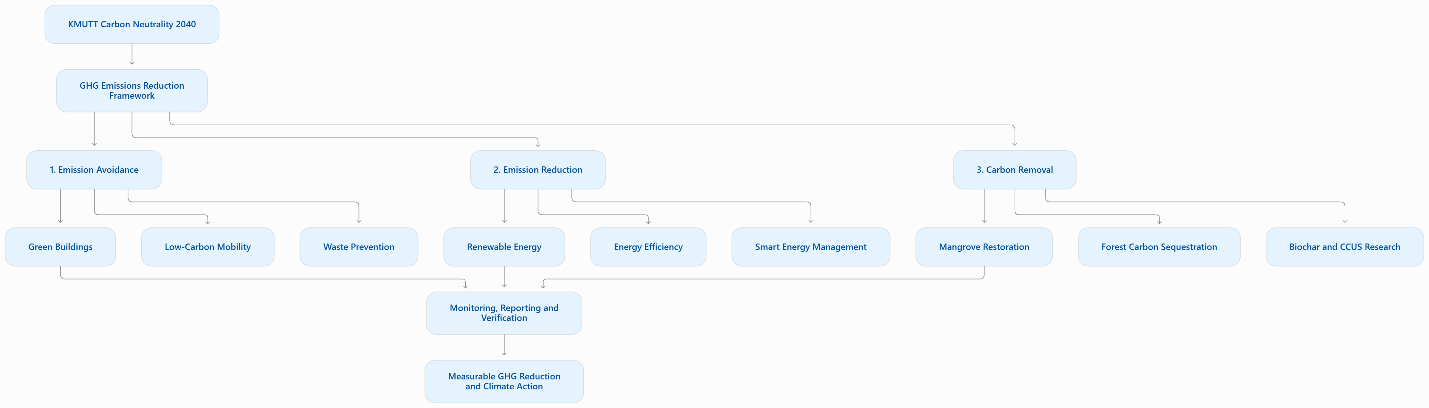
Original GHG Emissions Reduction Framework: emission avoidance, emission reduction and carbon removal
Original GHG Emissions Reduction Framework: emission avoidance, emission reduction and carbon removal. The original blue artwork is preserved unchanged.
  • Emission Avoidance: Preventing or avoiding GHG emissions through energy-efficient buildings, sustainable transportation, resource conservation, and low-carbon operational practices.
  • Emission Reduction: Reducing existing emissions through renewable energy integration, energy-efficient technologies, improved energy management, and cleaner production processes.
  • Carbon Removal and Sequestration: Enhancing natural and technological carbon removal through mangrove restoration, forest conservation, biochar research, and carbon capture, utilization, and storage (CCUS) research.
Strategic vision and full framework context

1.1 Strategic Vision and Greenhouse Gas Emissions Reduction Framework

KMUTT recognizes that universities have an important responsibility to accelerate the transition toward a low-carbon society through education, research, technological innovation, and sustainable institutional management. Accordingly, the university integrates GHG emissions reduction into its campus operations, infrastructure development, energy management, resource utilization, and research activities.

The university's approach extends beyond reducing energy consumption. It emphasizes the systematic transformation of energy systems, the adoption of renewable energy technologies, improvements in operational efficiency, sustainable mobility, circular resource management, and the enhancement of natural carbon sinks. These actions are supported by data-driven management, institutional participation, and continuous performance evaluation.

Through these interconnected strategies, KMUTT aims to establish a practical and replicable model of a low-carbon university that contributes to global climate action and the United Nations Sustainable Development Goals (SDGs), particularly SDG 7 (Affordable and Clean Energy), SDG 9 (Industry, Innovation and Infrastructure), SDG 11 (Sustainable Cities and Communities), SDG 12 (Responsible Consumption and Production), SDG 13 (Climate Action), and SDG 15 (Life on Land).

The path to 2040

1.7 KMUTT Carbon Neutrality 2040 Roadmap

KMUTT has established Carbon Neutrality 2040 as a long-term strategic objective, demonstrating its commitment to accelerating institutional decarbonization and contributing to Thailand's transition toward a low-carbon economy.
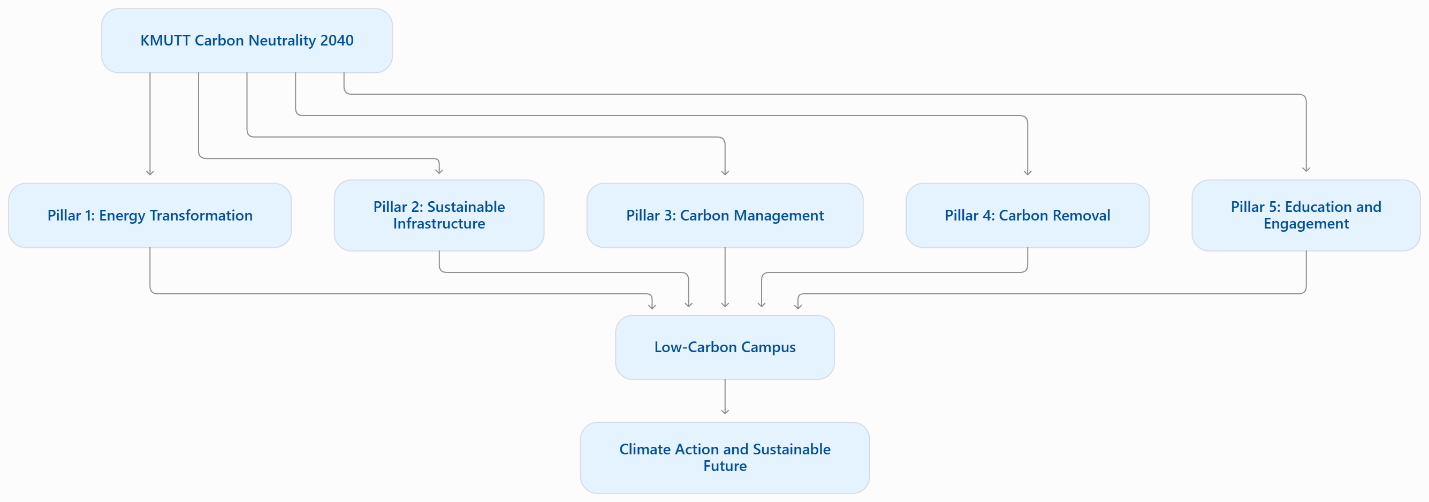
Original Carbon Neutrality 2040 roadmap with five strategic pillars
Original Carbon Neutrality 2040 roadmap with five strategic pillars. The original blue artwork is preserved unchanged.
Five pillars and implementation

The roadmap is based on five interconnected strategic pillars:

1. Energy Transformation

Accelerating the transition toward renewable energy, improving energy efficiency, expanding solar PV installations, and promoting advanced energy management systems.

2. Sustainable Infrastructure

Integrating green building principles, energy-efficient technologies, sustainable campus design, and resource-efficient infrastructure into the development and operation of university facilities.

3. Carbon Management and GHG Accounting

Strengthening institutional GHG inventories, energy monitoring, carbon accounting, emissions reporting, and performance evaluation to ensure that reduction measures are measurable and transparent.

4. Carbon Removal and Nature-Based Solutions

Enhancing carbon sequestration through forest conservation, mangrove restoration, soil carbon management, biochar research, and other appropriate carbon removal approaches.

5. Education, Research, and Stakeholder Engagement

Integrating sustainability into education, research, campus activities, and community partnerships while strengthening environmental awareness and carbon literacy among students, staff, and external stakeholders.

The roadmap emphasizes the importance of prioritizing direct emissions avoidance and reduction before using credible carbon removal and offset mechanisms to address residual emissions.

Buildings that use less

1.3 Green Buildings and Sustainable Infrastructure

KMUTT promotes sustainable building development by integrating energy efficiency, environmentally responsible design, and resource conservation into the planning, construction, renovation, and operation of campus facilities.

Buildings such as the Learning Exchange (LX), Utility Exchange (UX), Knowledge Exchange (KX), and Bioprocess Research and Innovation (BRI) facilities demonstrate the university's commitment to developing infrastructure that supports sustainable campus operations.

Green building principles and relevant assessment frameworks, including Leadership in Energy and Environmental Design (LEED) and the Thai Green Building Institute (TGBI) standards, provide guidance for improving building performance and environmental quality.

LXUXKXBRI
Building design and operational approaches

Key approaches include:

  • Energy-Efficient Building Design: Incorporating appropriate building orientation, shading, daylight utilization, and efficient lighting systems to minimize energy demand.
  • High-Efficiency Cooling Systems: Applying efficient air-conditioning technologies, improved cooling systems, and optimized thermal management to reduce electricity consumption.
  • Natural Ventilation and Indoor Environmental Quality: Improving indoor comfort and air quality through appropriate ventilation and environmental design.
  • Renewable Energy Integration: Installing rooftop solar PV systems and considering renewable energy integration during building development and renovation.
  • Sustainable Water Management: Promoting water-efficient fixtures, water conservation, and appropriate water reuse systems.
  • Green Spaces and Ecological Design: Increasing vegetation and green areas to improve the campus environment and contribute to urban climate resilience.

These measures help reduce operational energy demand, improve resource efficiency, and minimize indirect GHG emissions associated with electricity consumption and building operations.

Lower-carbon ways to travel

1.4 Low-Carbon Transportation and Sustainable Mobility

Transportation is another important consideration in reducing the university's overall carbon footprint. KMUTT encourages sustainable mobility by promoting transportation options that reduce dependence on conventional fossil-fuel-powered vehicles. The university supports the development of a more environmentally responsible campus transportation system through initiatives such as:

  • Promoting electric vehicles (EVs) and the development of EV charging infrastructure.
  • Encouraging shared transportation and carpooling among university personnel and students.
  • Supporting shuttle transportation and other efficient campus mobility services.
  • Promoting walking and cycling through improved pedestrian access and campus facilities.
  • Encouraging low-carbon travel behavior through environmental awareness campaigns.

These initiatives aim to reduce fuel consumption, lower transportation-related emissions, improve local air quality, and create a safer and more accessible campus environment.

KMUTT also recognizes the importance of integrating sustainable mobility into long-term campus planning to support the transition toward low-emission transportation systems.

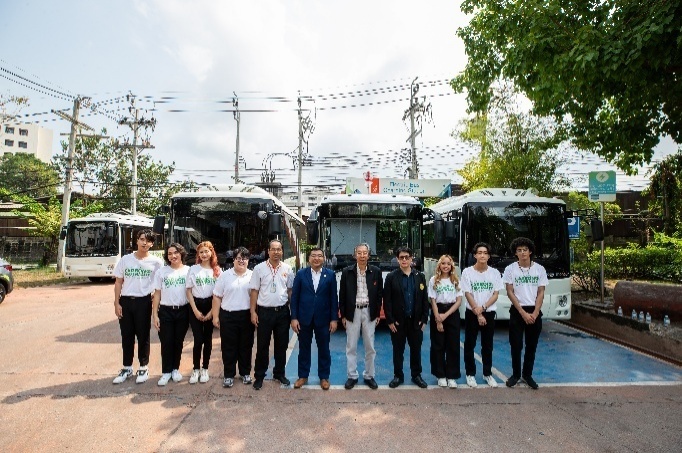
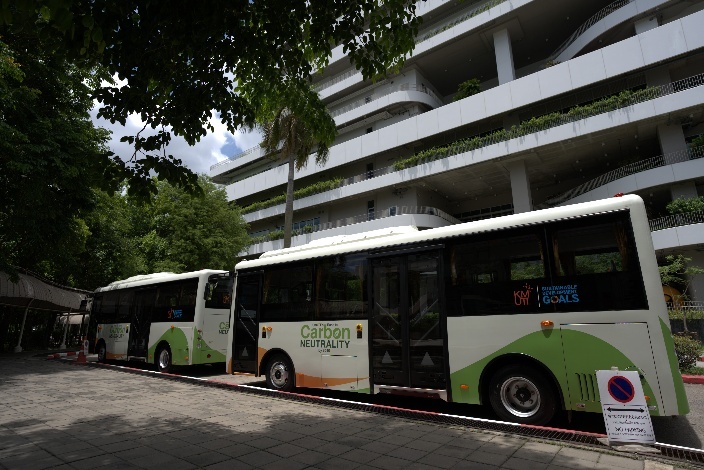
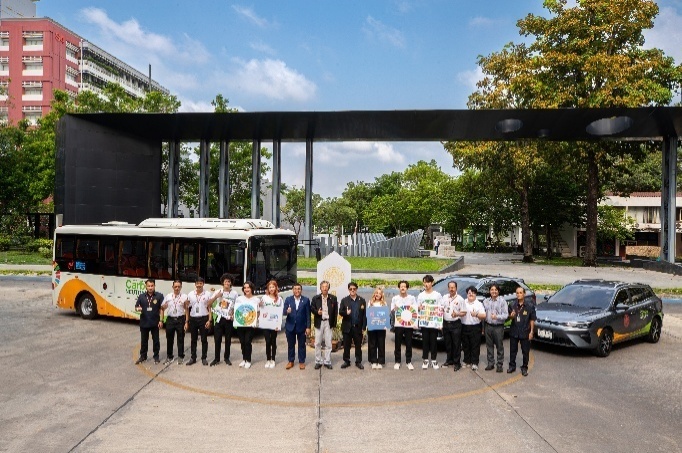
Electric Vehicle Bus (HOP OFF- HOP ON)
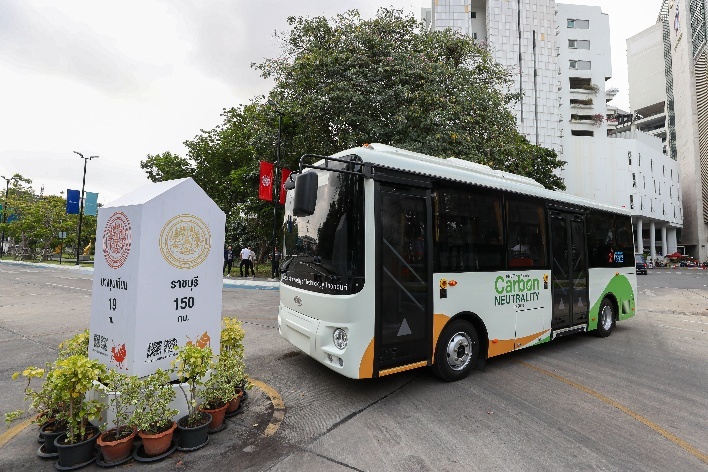
Campus electric bus displaying the Carbon Neutrality 2040 identity.
Electric bus service and further photographs

King Mongkut’s University of Technology Thonburi (KMUTT) has consistently positioned itself as one of Thailand’s leading green universities, dedicated to promoting sustainability and carbon neutrality within its campuses.

As part of KMUTT commitment to achieving Carbon Neutrality by 2040, the university has introduced several innovative transportation initiatives designed to reduce carbon emissions, energy consumption, and pollution. Among these initiatives, the Electric Vehicle Bus (Hop On–Hop Off) system has emerged as one of the most prominent and visible symbols of KMUTT sustainable mobility transition.

The project aims to provide a zero-emission, convenient, and inclusive mode of transportation for students, staff, and visitors across the Bangmod and Bangkhunthian campuses.

The “Hop On–Hop Off” concept refers to a flexible, open-route transportation system that allows passengers to board or leave the bus at any designated stop along a fixed loop.

Unlike conventional bus services that follow fixed point-to-point schedules, the Hop On–Hop Off model provides more convenience and freedom for users moving between academic buildings, dormitories, canteens, and laboratories within the university area.

The introduction of electric buses reflects KMUTT strategy to integrate clean energy technology, low-carbon mobility, and smart campus management into everyday university life.

This system not only reduces the dependency on private vehicles but also enhances accessibility and safety for the university community, while aligning with the global Sustainable Development Goals (SDGs), particularly SDG 7 ( Affordable and Clean Energy), SDG 11 ( Sustainable Cities and Communities), and SDG 13 ( Climate Action).
Bike sharing and rental
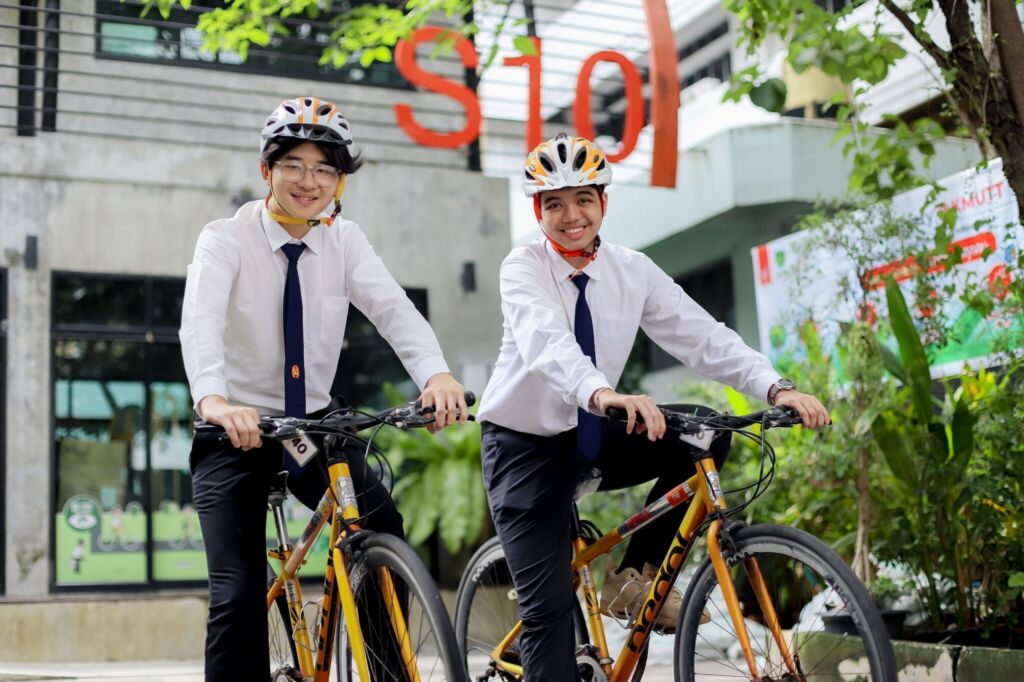
Students cycling in the supplied campus bike-sharing photograph.

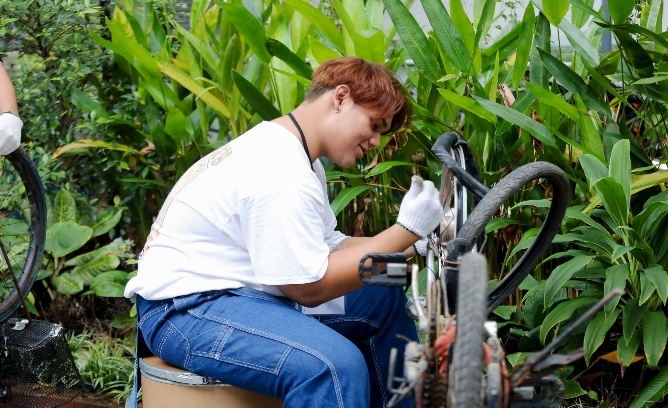
Zombike

Repairing a bicycle in the supplied Zombike reuse activity photograph.
Bike sharing, rental and reuse records

King Mongkut’s University of Technology Thonburi (KMUTT) has long been recognized as a leading university in Thailand promoting sustainable mobility and environmental consciousness. Among its many green initiatives, the Bike Sharing and Rental System stands out as one of the most successful programs integrating eco-friendly transportation with community engagement, energy efficiency, and health promotion. This initiative aligns with KMUTT broader sustainability policy and its Carbon Neutrality 2040 goal, reflecting the university’s dedication to reducing greenhouse gas emissions and fostering a sustainable campus lifestyle.

Shared bicycles at a campus bicycle station.

King Mongkut’s University of Technology Thonburi (KMUTT) has long been recognized as one of Thailand’s leading green universities, integrating sustainability into its academic, operational, and social practices. One of the most creative and impactful initiatives that reflects KMUTT strong environmental commitment is the Zombike Project, a campus-wide bicycle reuse and sharing program designed to promote sustainable mobility and reduce the environmental footprint of university transportation.
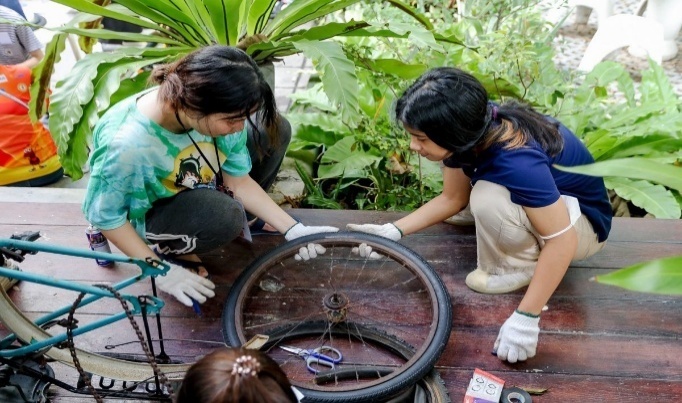
Participants working together to repair reused bicycles.

Charging and shared travel

Charging facilities and full source records

Charge Parking
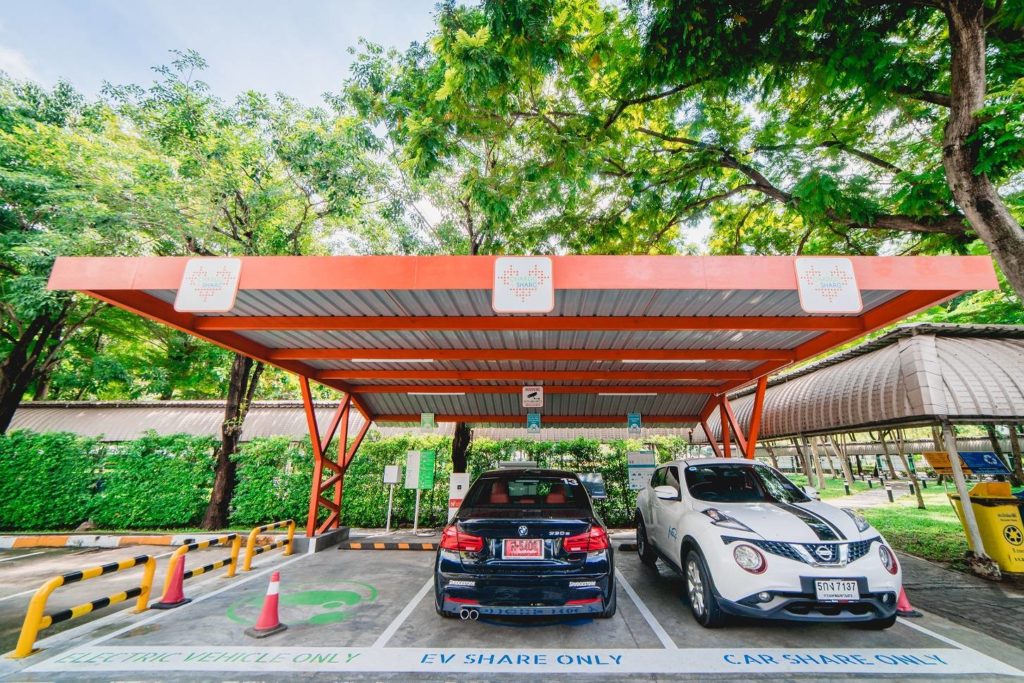
Parking bays marked for electric-car sharing in the supplied campus photograph.

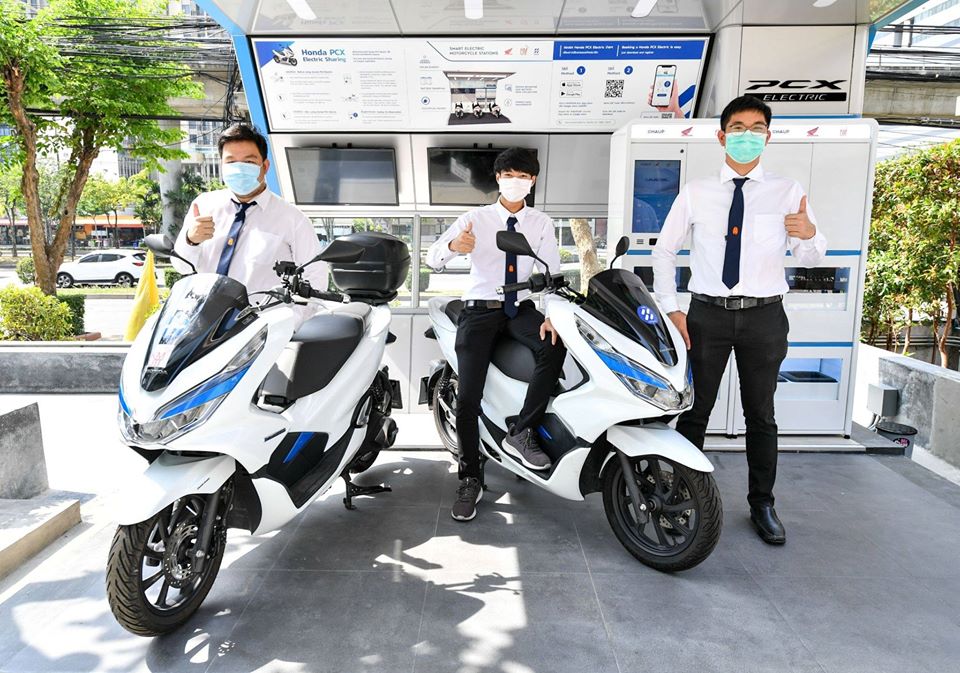
Electric Motorcycle Charging Station

King Mongkut’s University of Technology Thonburi (KMUTT) has long been recognized as a leading institution in promoting sustainability, clean energy innovation, and environmentally responsible mobility solutions. One of its remarkable initiatives under the university’s Carbon Neutrality 2040 Policy is the development of the Electric Motorcycle Charging Station, a project designed to support the growing number of electric vehicle (EV) users and to encourage the transition toward low-emission transportation within the campus.

The Electric Motorcycle Charging Station project is part of KMUTT broader Green Campus and Smart Mobility Program, which integrates renewable energy systems, digital monitoring, and sustainable transportation management. The charging stations are strategically installed in key areas such as the Student Dormitory Zone, Knowledge Exchange (KX) Building, and School of Energy, Environment, and Materials (SEEM). These stations provide easy access for students, faculty, and staff to charge their electric motorcycles conveniently and efficiently during the day.
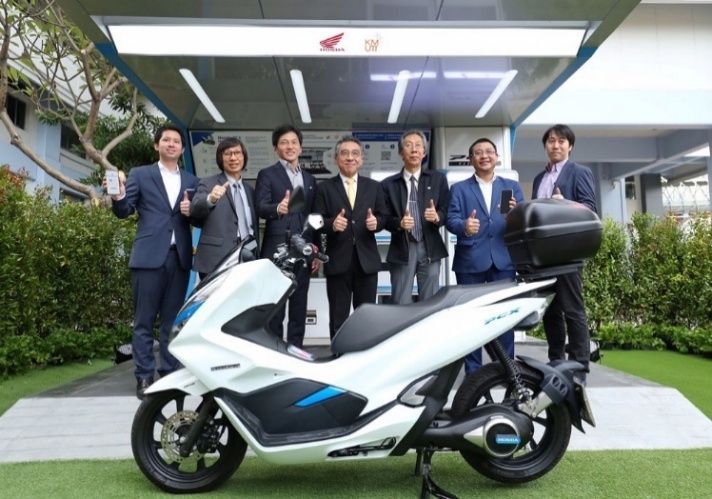
Electric motorcycle and smart-station collaboration photograph.

Electric Car Charging Station

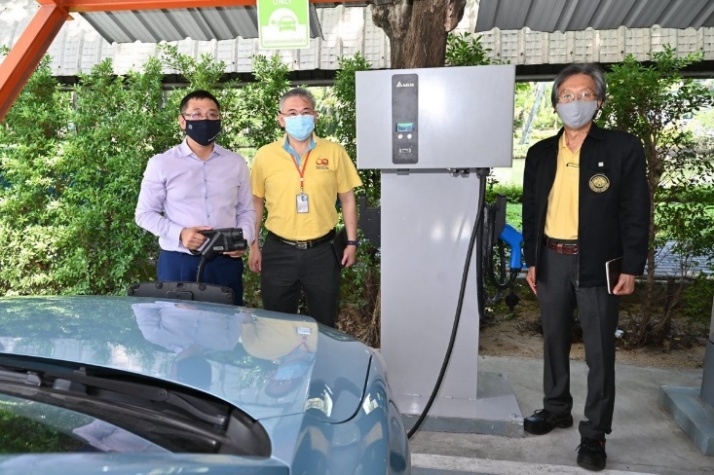
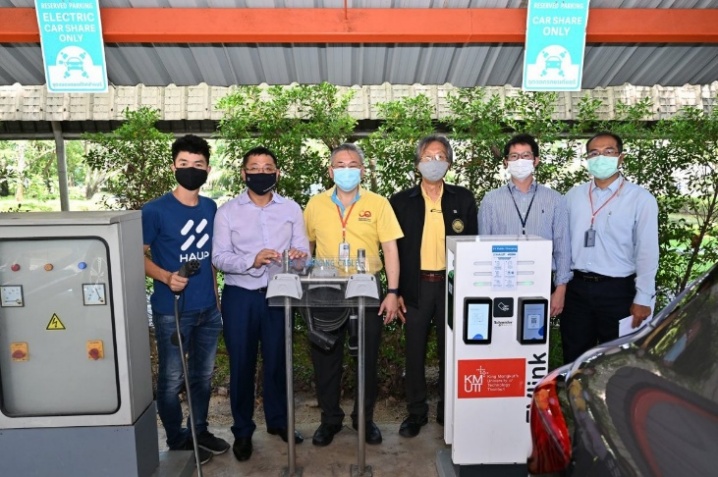
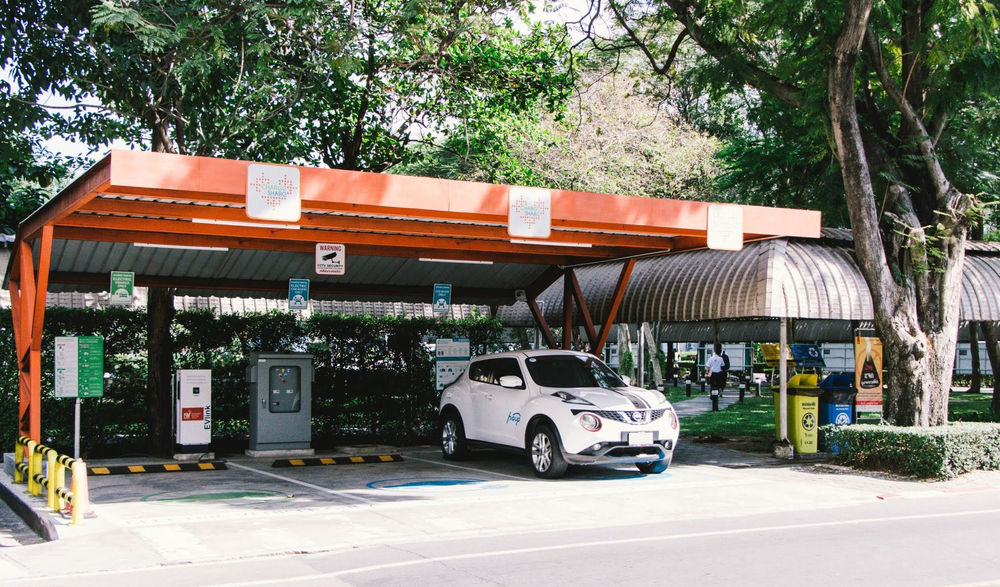
King Mongkut’s University of Technology Thonburi (KMUTT) has emerged as a leader in sustainable transportation within Thailand’s higher education sector. As part of its commitment to achieving carbon neutrality by 2040, the university has developed a comprehensive electric vehicle (EV) infrastructure, including strategically located electric car charging stations across its campuses. KMUTT electric car charging stations are situated in key areas, such as the Knowledge Exchange (KX) Building, the Office of the President, and Energy Environment Safety and Health Center (EESH). These stations are equipped with advanced charging technologies, including Delta DC Wallbox chargers, which were installed in collaboration with Delta Electronics (Thailand).

The installation of these EV charging stations aligns with KMUTT broader sustainability goals, contributing to reduced greenhouse gas emissions and promoting clean energy usage. The university encourages the adoption of electric vehicles among students, faculty, and staff by providing convenient and reliable charging options.

Furthermore, KMUTT involvement in projects like the MEA EV Smart Charging System underscores its role in advancing smart grid technologies and public charging infrastructure
Resources kept in use

1.5 Sustainable Waste and Resource Management

KMUTT adopts sustainable resource management principles to minimize waste generation, maximize resource utilization, and reduce GHG emissions associated with material consumption and waste disposal. The university promotes waste reduction and responsible resource utilization through waste segregation, recycling, reuse, and the appropriate treatment of different waste streams.

Major implementation approaches include:

  • Waste Segregation and Recycling: Encouraging waste separation at the source and increasing the recovery of recyclable materials, including paper, plastic, glass, and metal.
  • Organic Waste Management: Promoting the utilization of food waste and other biodegradable materials through composting, fertilizer production, and appropriate biological treatment technologies, including anaerobic digestion.
  • Hazardous Waste Management: Ensuring that laboratory chemicals, hazardous materials, and other controlled waste are collected, stored, transported, and treated through appropriate and authorized processes.
  • Water Conservation: Improving water-use efficiency through water-saving equipment, monitoring, and appropriate water reuse practices.
  • Circular Resource Utilization: Encouraging the reduction of single-use materials, responsible procurement, and the reuse of resources wherever practical.

These measures support the university's ambition to reduce waste sent to landfill, minimize methane emissions from organic waste decomposition, and promote a circular economy within the campus community.

KMUTT Say no to single-use plastic Project
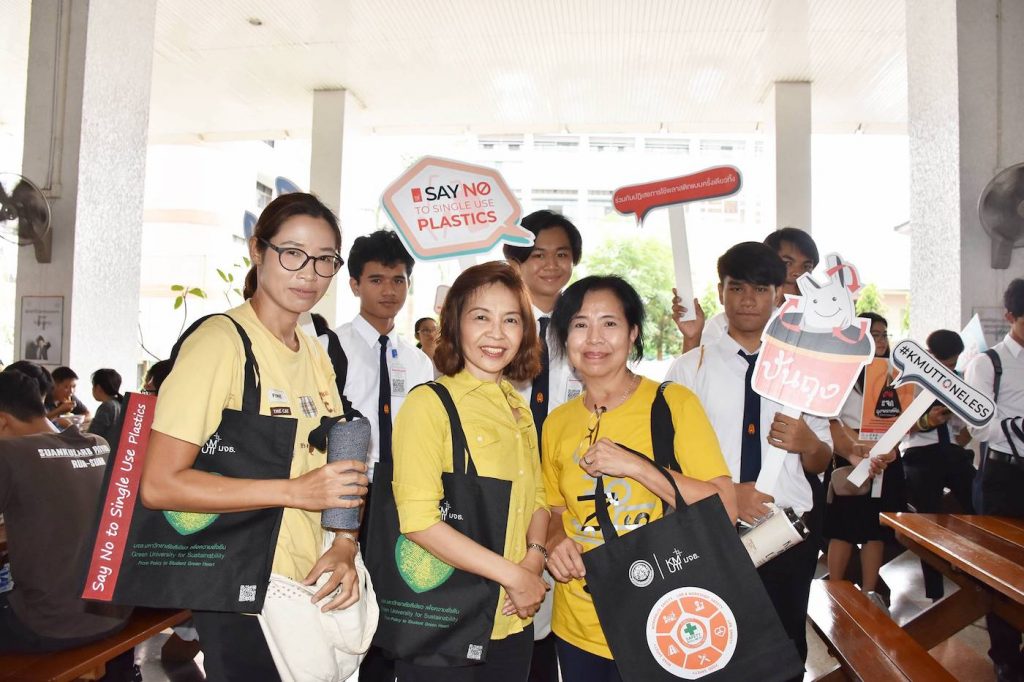
KMUTT single-use-plastic reduction campaign with students and staff.
Further plastic-reduction campaign photograph
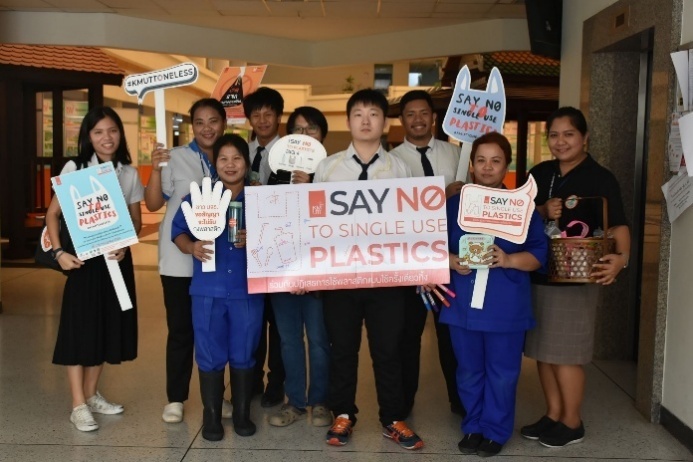
Participants holding Say No to Single Use Plastics campaign materials.

Research and natural carbon sinks

1.6 Research, Innovation, and Nature-Based Carbon Removal

Beyond reducing emissions from its own operations, KMUTT actively utilizes its research capabilities to develop innovative solutions for climate change mitigation, carbon management, and environmental sustainability. The university promotes interdisciplinary research that connects engineering, environmental science, energy technology, and natural resource management to address the challenges of decarbonization.

Capture and utilisation

Carbon Capture, Utilization, and Storage (CCUS)

KMUTT supports research and technological development related to carbon capture, utilization, and storage. These research directions explore opportunities to capture CO 2 from emission sources and convert it into useful products, materials, or alternative energy carriers.

Biochar research

Biochar and Carbon Utilization

Research on biochar production and application explores the potential of biomass conversion to improve resource utilization, support soil quality, and enhance long-term carbon storage. These activities also contribute to the development of sustainable waste-to-resource technologies.

Forest and Mangrove Carbon Sequestration

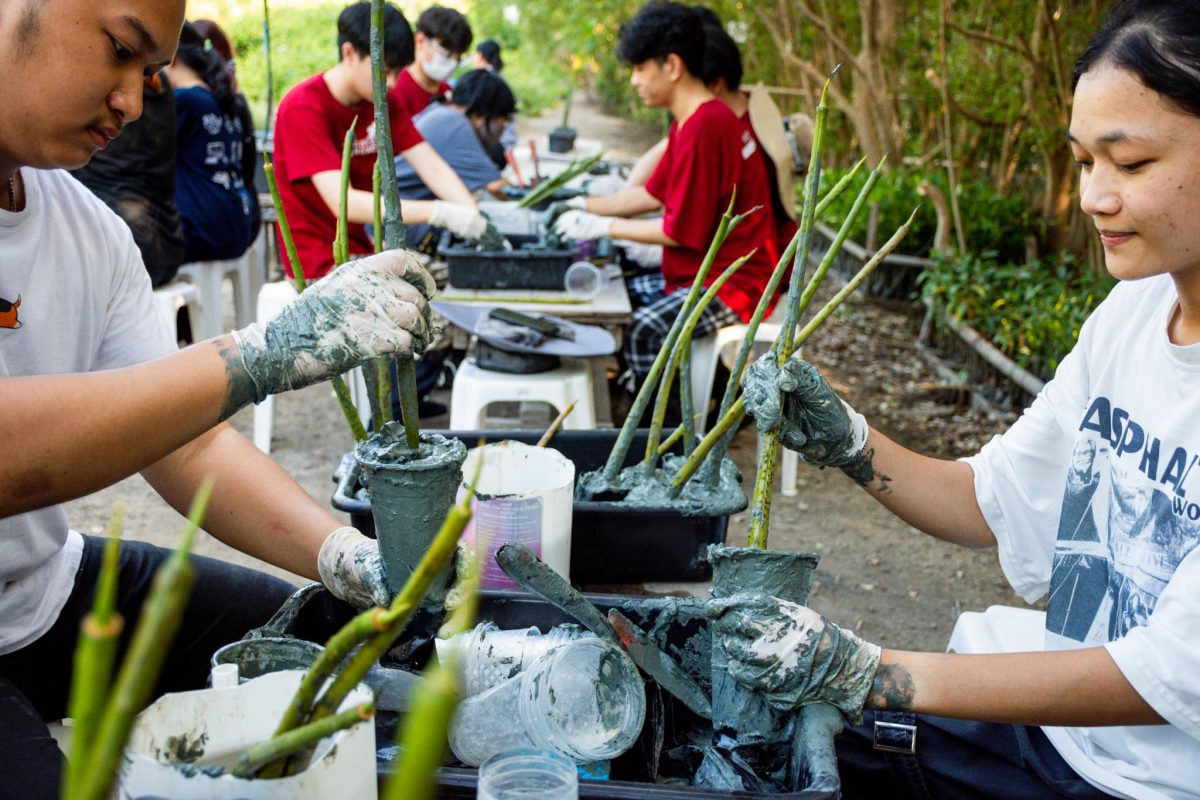
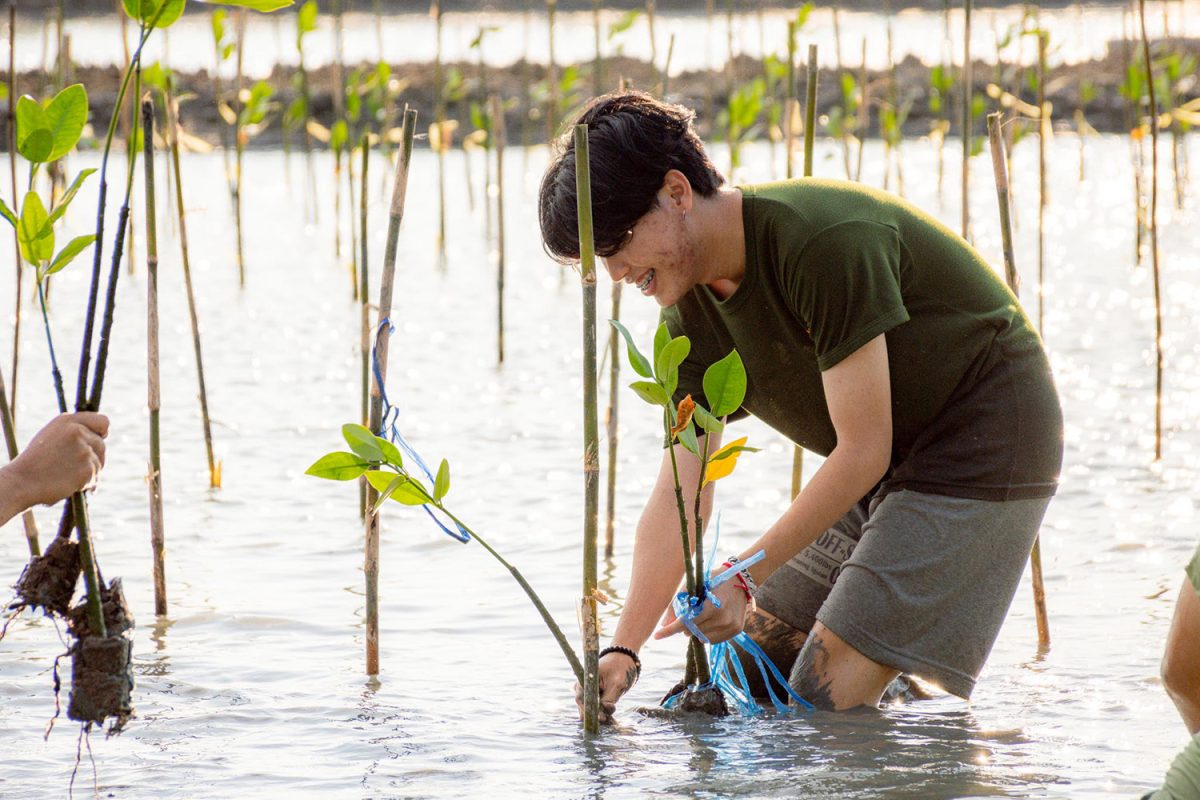
KMUTT implements nature-based carbon management initiatives through forest conservation, ecosystem restoration, and carbon sequestration research.

Cumulative mangrove planting44,295trees · 2022–2025
Estimated carbon sequestration863.75tCO₂e · reported project assessment

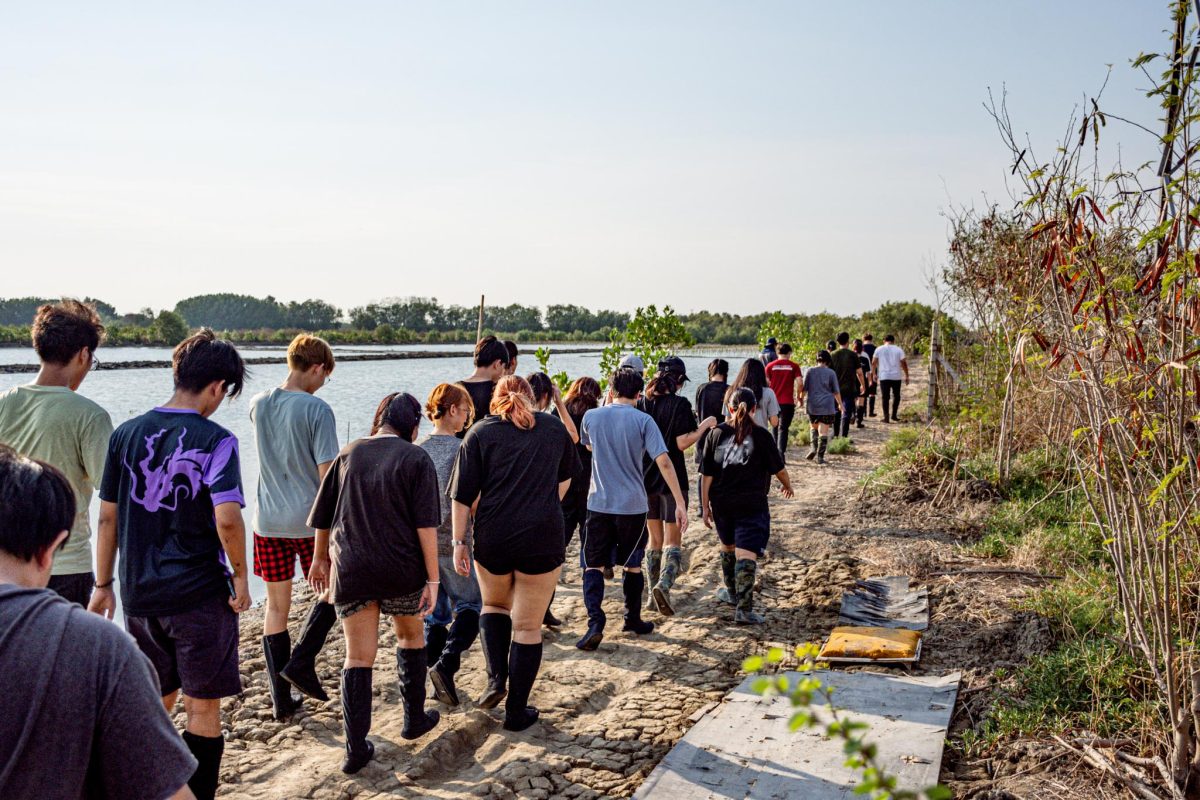
One important initiative is the KMUTT Mangrove Forest Planting Living Lab in Phanthai Norasing, Samut Sakhon, which supports mangrove ecosystem restoration, biodiversity conservation, environmental education, and blue carbon research. The university has progressively undertaken mangrove planting and monitoring activities, with cumulative planting reaching 44,295 trees during 2022–2025.

The associated estimated carbon sequestration is approximately 863.75 tCO 2 e, based on the project's reported assessment.

In addition, KMUTT supports forest carbon research and monitoring activities at its Ratchaburi facilities, including the development of research infrastructure for studying carbon exchange between terrestrial ecosystems and the atmosphere.

These projects demonstrate how research, ecosystem restoration, and community engagement can work together to strengthen natural carbon sinks and contribute to long-term climate mitigation.

People behind the transition

Promotion Activities

King Mongkut’s University of Technology Thonburi (KMUTT) has undertaken a wide range of promotional activities to raise awareness, engage its community, and drive action toward its goal of Carbon Neutrality by 2040.

These activities span policy, student engagement, infrastructure, research, and public outreach.

Below are some of the key promotion activities such as Policy Commitment & Institutional Strategy, Certifications and Recognition, Awareness, Participation & Student Engagement, Campaigns & Behavioral Change and Events, Expos, and Exhibitions etc.
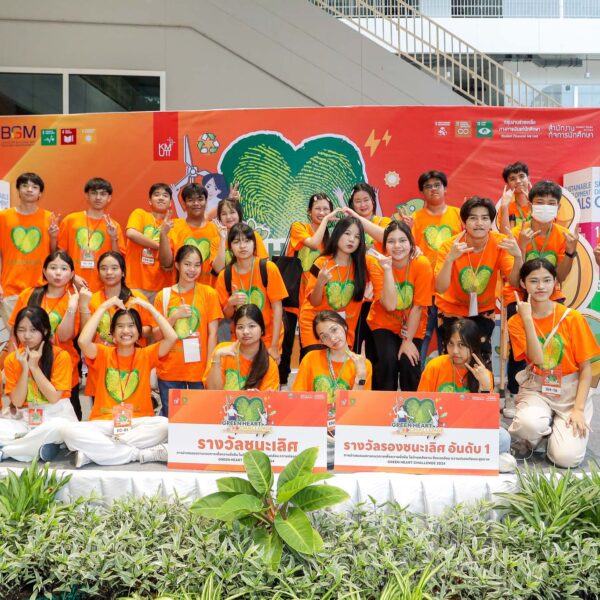
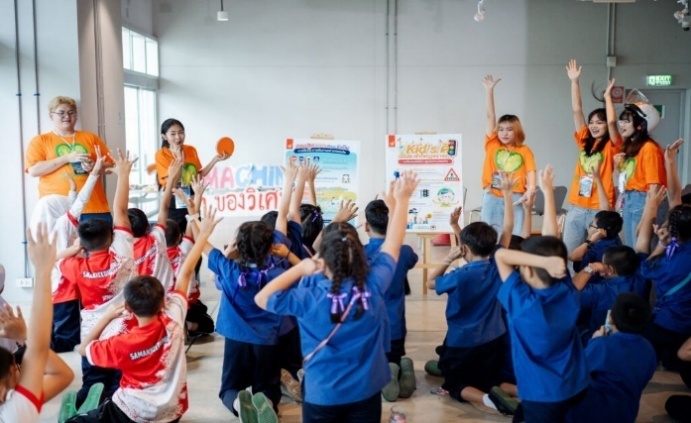
Measure, report, improve

1.8 Monitoring, Reporting, and Verification (MRV)

To ensure the effectiveness and transparency of its GHG reduction program, KMUTT emphasizes systematic monitoring, reporting, and verification (MRV) throughout its sustainability operations.

The university's approach involves:

Monitoring

Monitoring: Collecting and monitoring energy consumption, renewable energy generation, fuel consumption, waste generation, transportation-related information, and other relevant environmental data.

Reporting

Reporting: Compiling institutional GHG inventories and evaluating emissions trends in accordance with applicable GHG accounting principles and national or international guidelines.

Verification

Verification: Improving data quality, documenting calculation methodologies, and supporting independent assessment or verification where appropriate.

Continuous improvement

Continuous Improvement: Using performance results to review reduction targets, identify opportunities for improvement, and strengthen the implementation of the Carbon Neutrality 2040 roadmap. This systematic approach enables KMUTT to evaluate progress, identify emission reduction opportunities, and ensure that sustainability initiatives contribute to measurable environmental outcomes.

Overall institutional commitment

1.9 Overall Commitment to a Low-Carbon University

Through the integration of renewable energy, energy efficiency, sustainable infrastructure, low-carbon transportation, circular resource management, and nature-based carbon removal, KMUTT is transforming its campuses into living laboratories for sustainability and climate action.

The Carbon Neutrality 2040 initiative reflects the university's commitment not only to reducing its own environmental impact but also to advancing knowledge, developing innovative technologies, and sharing practical solutions with society.

By combining institutional leadership, technological innovation, research excellence, and community participation, KMUTT aims to establish a replicable model of a low-carbon university and contribute to a more sustainable and climate-resilient future.

References and source notes
  • KMUTT Carbon Neutrality 2040Institutional target and programme statement

    The institutional statement supports the 2040 target and broad reduction approaches. Historical baseline figures on that page are not substituted into the supplied inventory.

  • Supplied 13.2 evidence and graphic update

    Complete supplied narrative, original source diagrams and tables, and the explicit annual-footprint correction. The three original blue diagrams are retained unchanged, together with the 21 authentic photographs. The inventory table, corrected annual footprint and solar register are native HTML.

  • Periods, units and boundaries

    Installed solar power (kWp), electricity production (kWh), inventory emissions (tonnes CO₂e), and the annual electricity/transport footprint (metric tonnes/year) are distinct. The solar production period and the corrected footprint’s calendar year are not stated. The electricity/transport total is not the total of the separate Scope 1–3 inventory.
13.3 ENVIRONMENTAL EDUCATION MEASURES

1. Related information on our university providing local education programmer or campaigns on climate change risks, impacts, mitigation, adaptation, impact reduction and early warning.

Learning in the community

Practical climate learning for residents, students and the public.

Electric boat learning

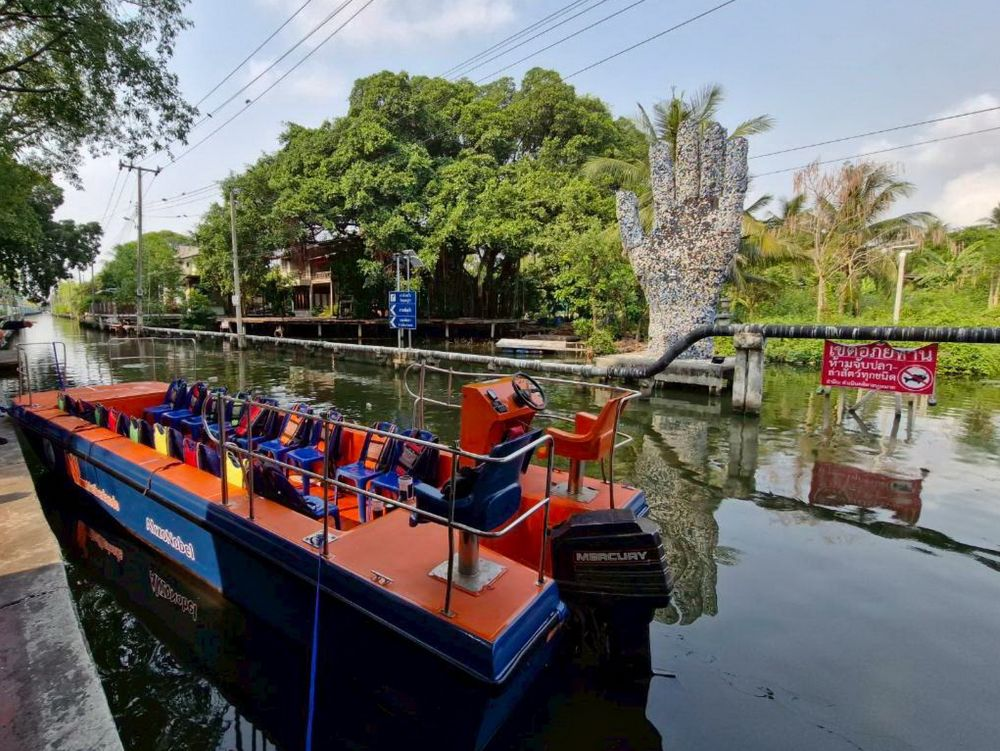
A KMUTT report published on 15 May 2026 describes a community electric-boat learning centre at Baan Khian Wad Lae Phap Phim in Tha Kham, Bang Khun Thian.

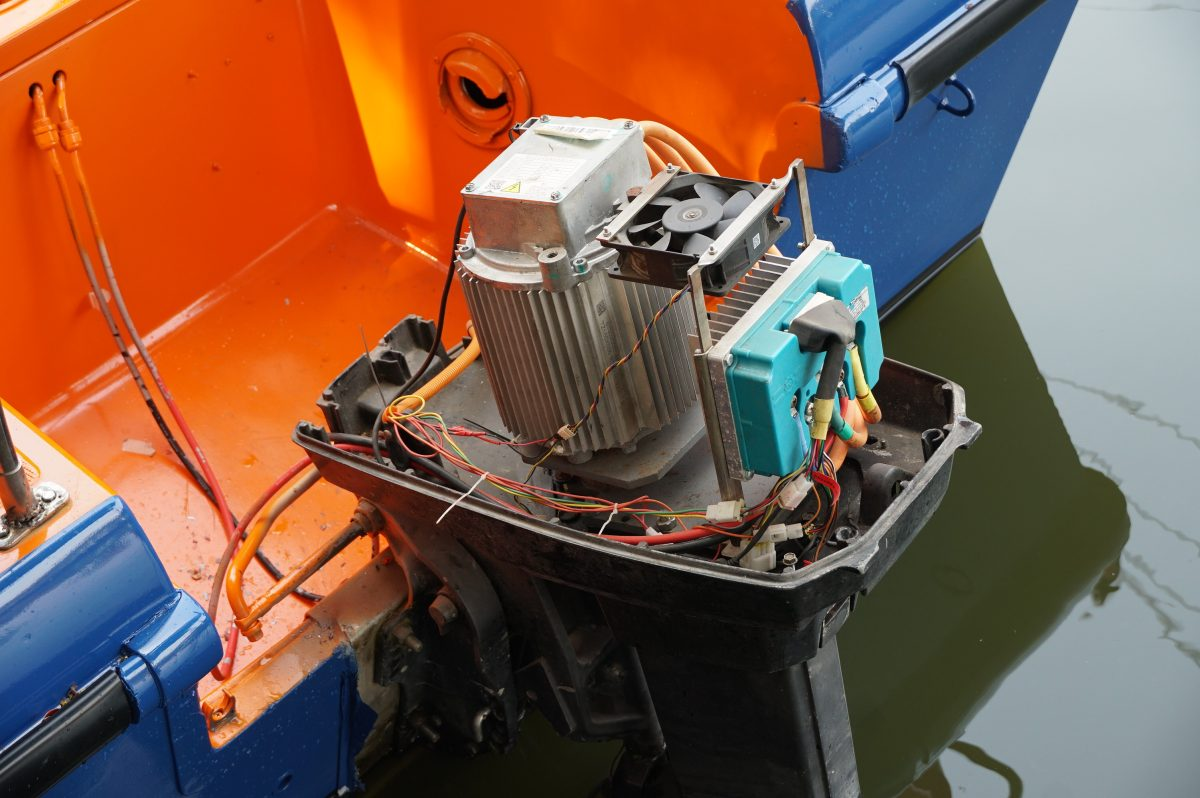
The centre is intended to share boat-conversion and electric-motor maintenance knowledge with residents, mechanics and interested members of the public.

University academic support for community training is part of the reported approach.

Community electric boat on Bangmod Canal, illustrated in the KMUTT report published 15 May 2026.

Who can learn

Residents, local mechanics and interested members of the public.

Practical knowledge

Boat conversion and electric-motor maintenance, supported by university academic expertise.

Electric propulsion equipment on the community boat, illustrated in the May 2026 KMUTT report.

Learning by doing

8 September 2025
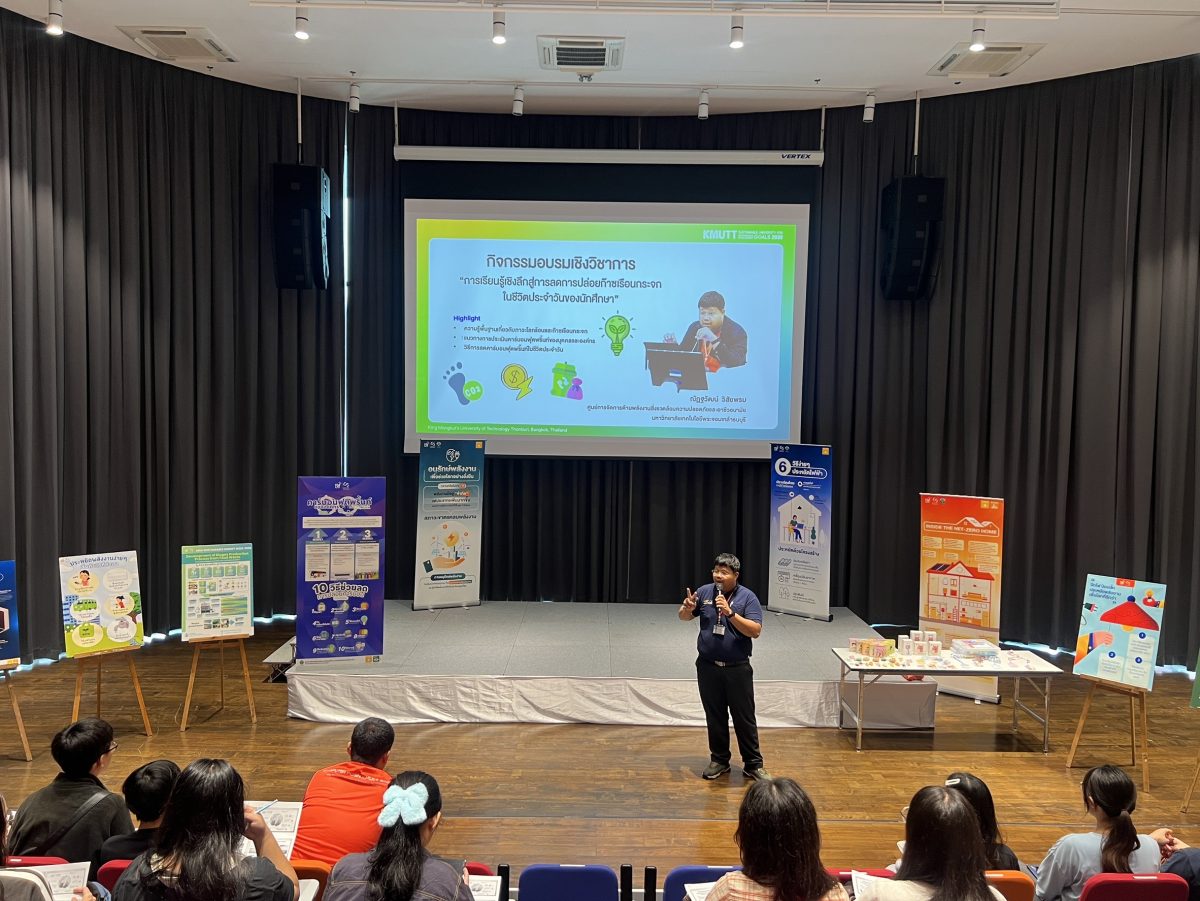
LX Auditorium · student workshop

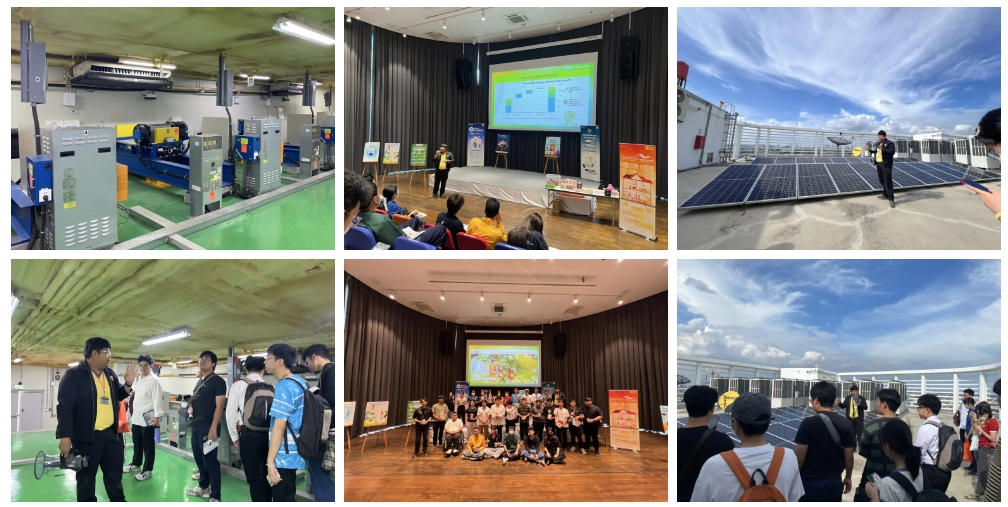
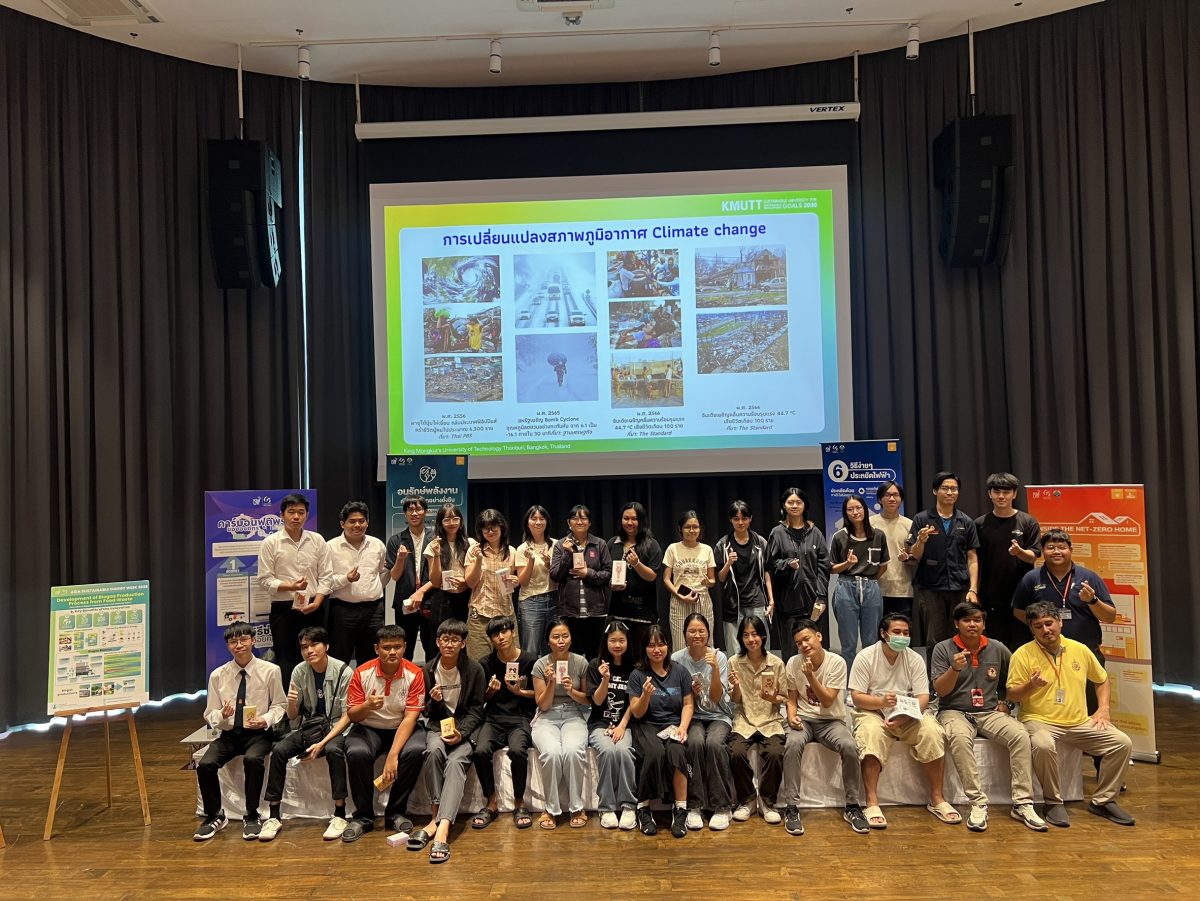
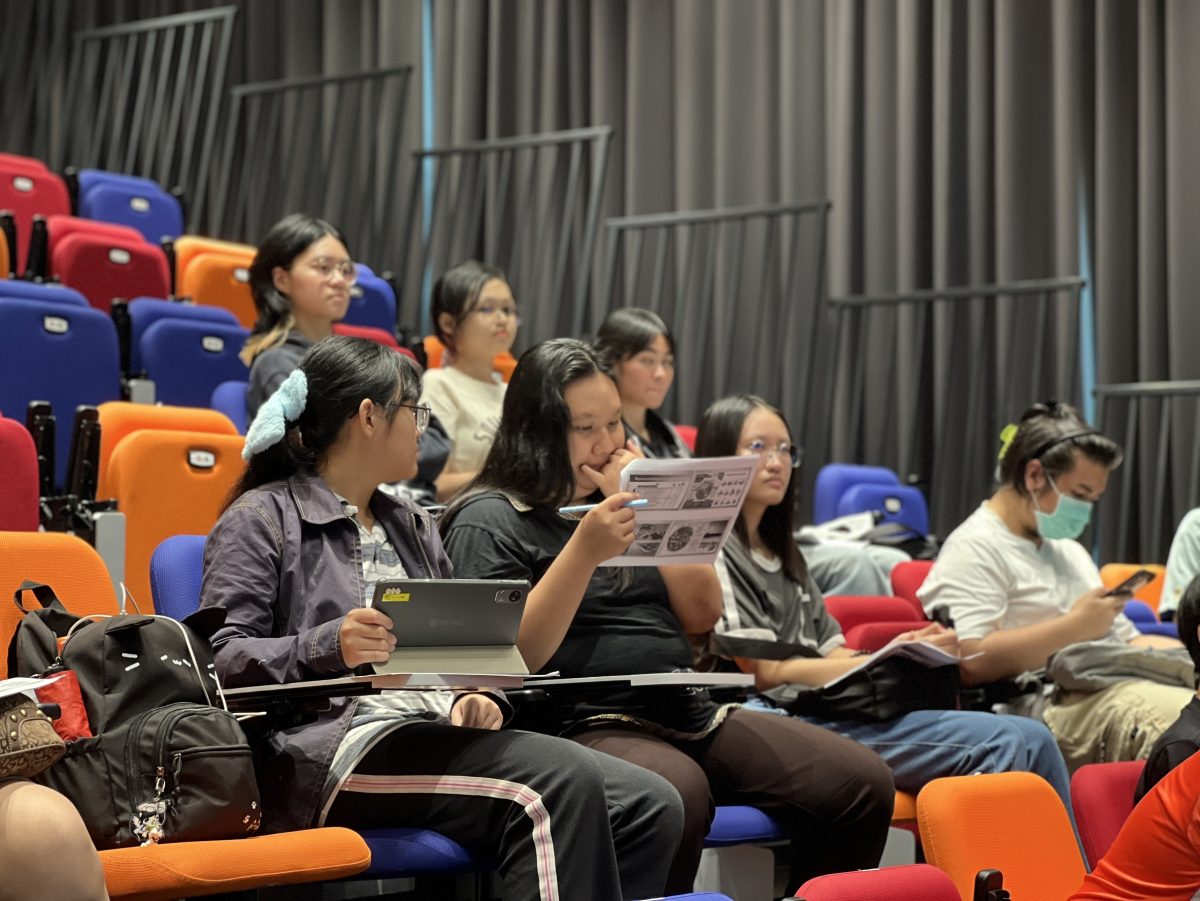
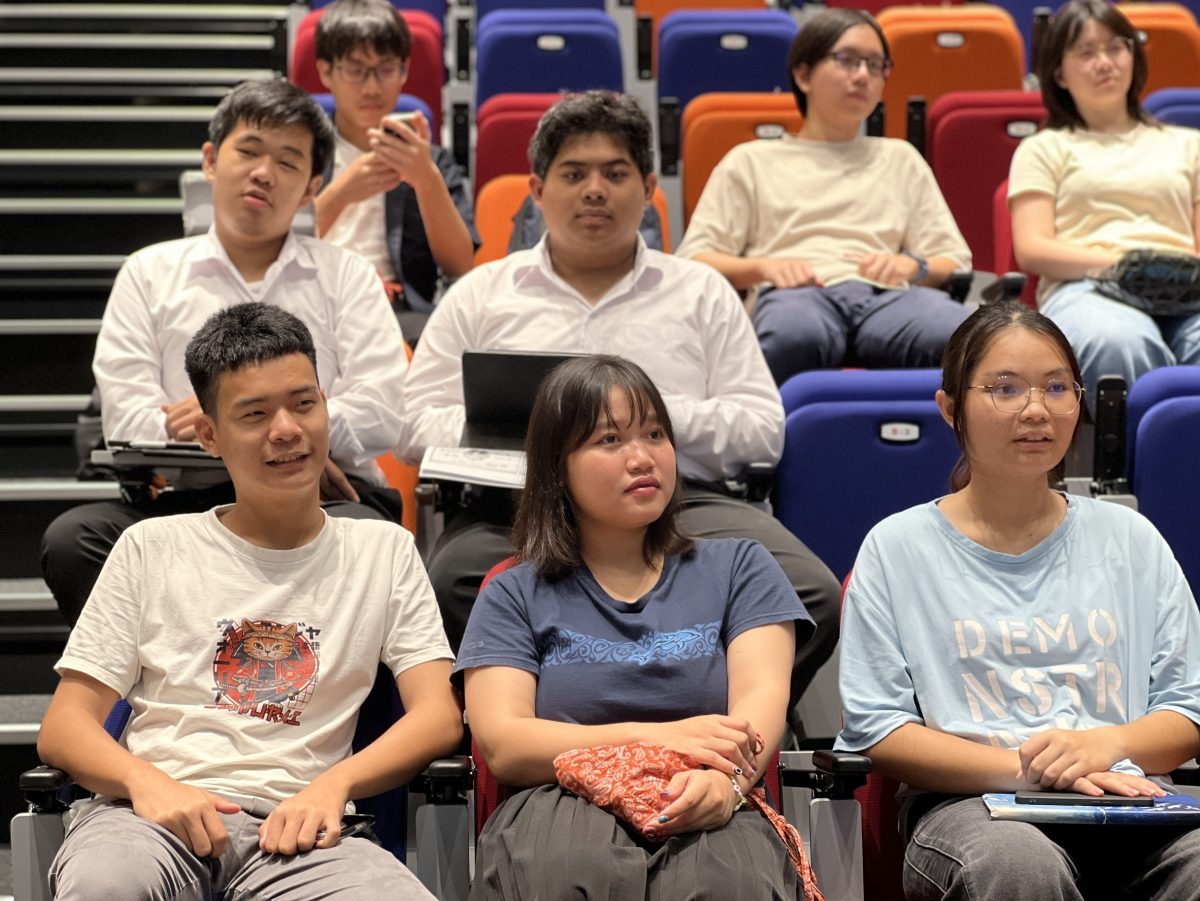
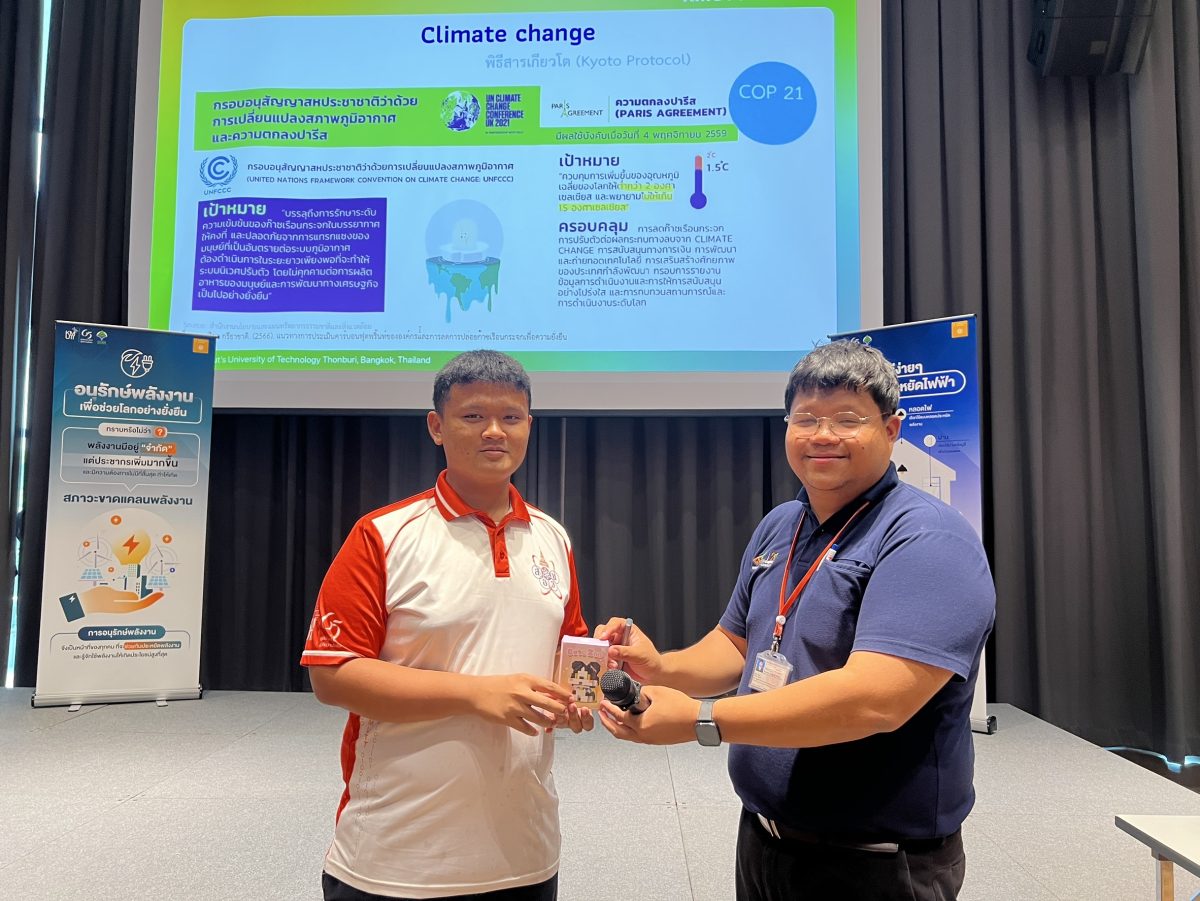
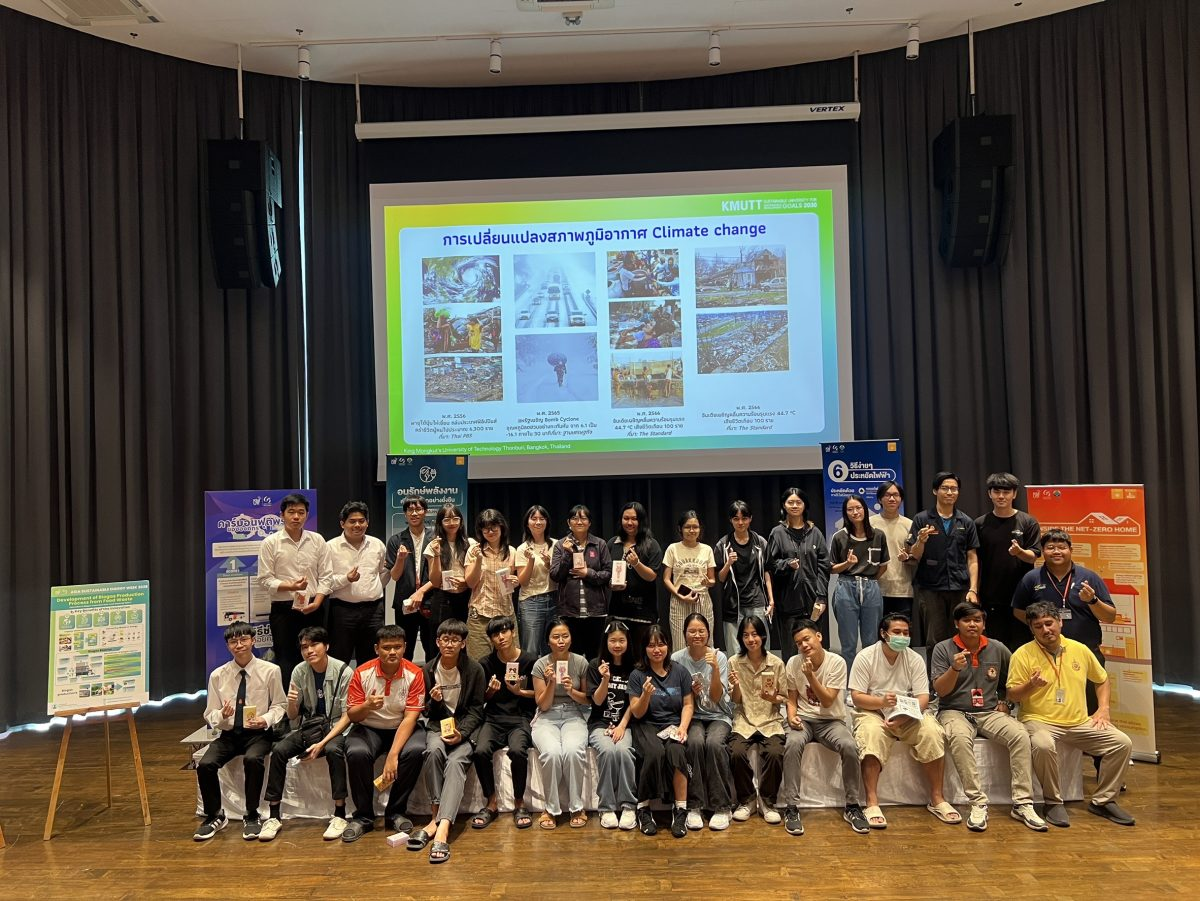
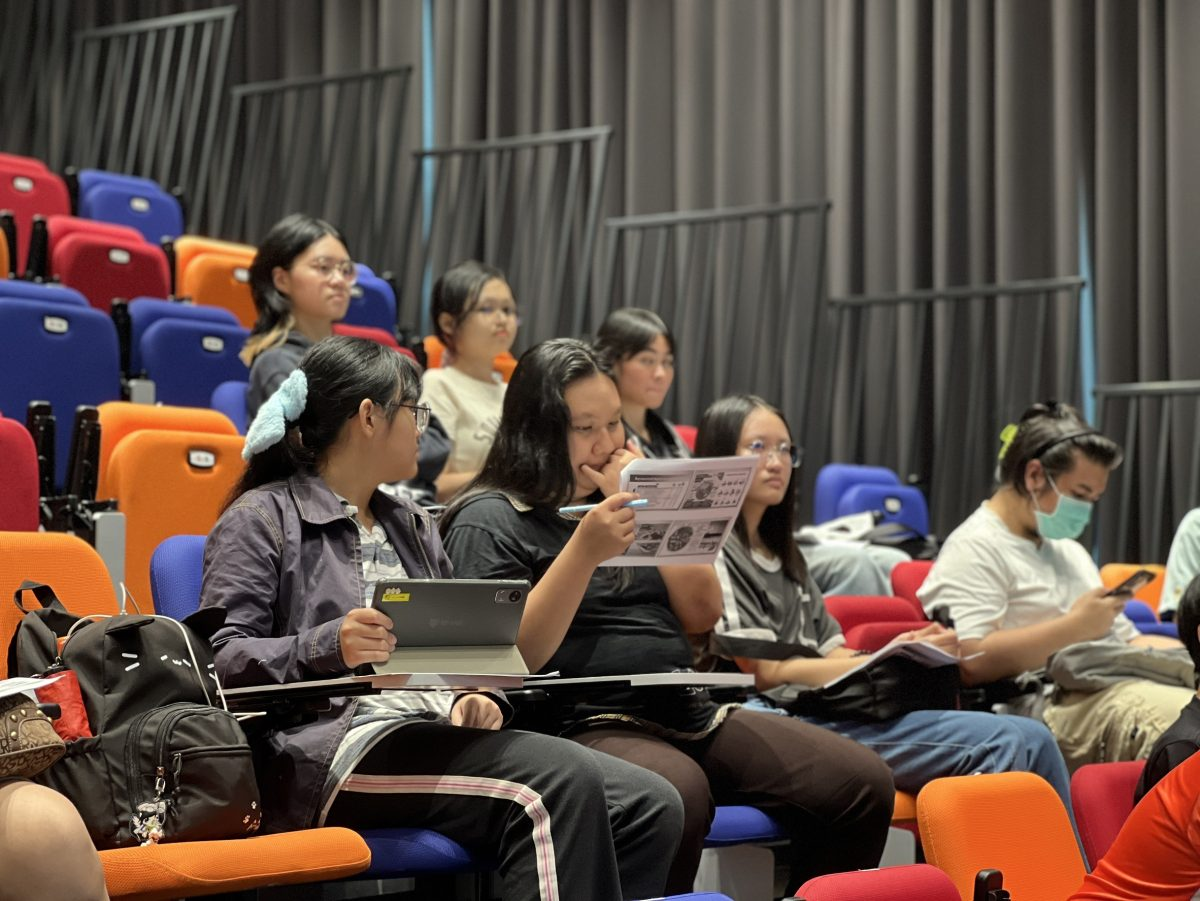
EESH held a student workshop at the LX Auditorium using discussion, group work and simulated situations. Participants explored efficient energy use, avoiding unnecessary resource consumption and appropriate waste management. This is a documented campus learning activity that complements community provision.

Use energy efficiently

Avoid unnecessary resource use

Manage waste appropriately

Group photograph from the active learning workshop on greenhouse gas reduction, 8 September 2025. KMUTT institutional photograph.
Workshop photographs

Open climate learning

Cassava and climate

27 March 2025 · 09:00–12:00

Free registration advertised
Zoom and Facebook Live

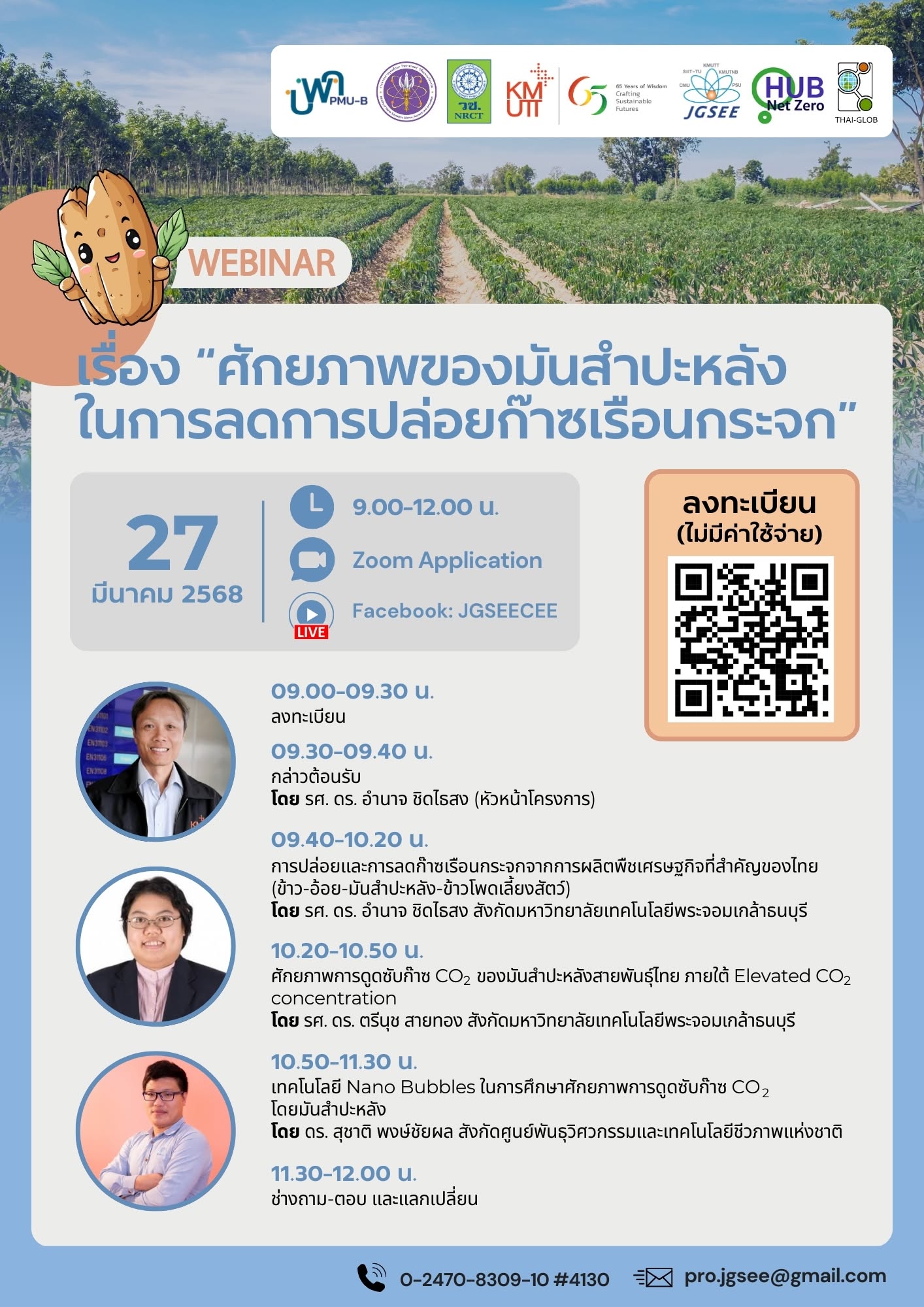
The JGSEE webinar invitation addresses the potential of cassava to reduce greenhouse gas emissions.

  • Emissions and reductions from major Thai crops: rice, sugarcane, cassava and feed maize.
  • CO₂ uptake by Thai cassava varieties under elevated CO₂ concentrations.
  • Nanobubble technology for studying CO₂ uptake by cassava.
  • Questions, answers and knowledge exchange.
Webinar invitation27 March 2025
JGSEE webinar invitation: the potential of cassava to reduce greenhouse gas emissions, 27 March 2025, 09:00–12:00. Free registration advertised.

One hour for the planet

28 March 2026

20:30–21:30

Earth Hour public invitation

KMUTT Earth Hour 2026 campaign invited students, staff and the wider community to switch off non-essential lighting from 20.30 to 21.30 on 28 March 2026.

Its educational message connects energy-saving behaviour with climate action and longer-term sustainable habits.

This source documents the public invitation and campaign content.

Who the programmes reach

The programmes serve different audiences. The student workshop is campus provision; the boat centre and Earth Hour invitation address local or public audiences.

Programme audiences and climate-learning focus
ProgrammeLocal or public audienceClimate learning focus

Community electric boat learning centre

Residents, local mechanics and interested members of the public.

Cleaner transport and practical technical knowledge.

September 2025 active learning workshop

KMUTT students.

Energy, resources, waste and everyday greenhouse gas reduction.

Earth Hour 2026 invitation

Students, staff and the wider community.

Energy conservation and public awareness of climate action.

Climate education across KMUTT

King Mongkut’s University of Technology Thonburi (KMUTT) recognizes the importance of climate education in building awareness, strengthening knowledge, and developing the capacity of individuals and communities to address climate change.

The university promotes climate-related education through academic curricula, research activities, professional training programmes, workshops, seminars, and public awareness campaigns.

These initiatives cover key topics such as climate change science, greenhouse gas emissions, carbon footprint assessment, renewable energy, energy efficiency, climate change mitigation and adaptation, sustainable resource management, and ecosystem conservation.

KMUTT encourages students, faculty members, administrative personnel, and local communities to participate in climate education activities. Through interdisciplinary learning and practical training, participants gain an understanding of the causes and consequences of climate change, as well as the importance of reducing greenhouse gas emissions and strengthening climate resilience. The university also promotes experiential learning through research projects, field activities, and practical demonstrations involving renewable energy technologies, energy conservation, waste management, and nature-based solutions.

Approximately 12

training sessions and workshops annually

The Energy, Environment, Safety and Health Center (EESH) plays an important role in supporting environmental education and promoting sustainability awareness throughout the university. EESH organizes approximately 12 training sessions and workshops annually on topics related to renewable energy management, corporate energy management, climate change, sustainable energy conservation, and organizational carbon footprint management. These programs target energy conservation teams and working groups from academic buildings, research centers, administrative units, and other university facilities. Participants include university staff, students, building operators, maintenance personnel, cleaning staff, security personnel, and other relevant stakeholders.

EESH training and participation

KMUTT regularly organizes environmental education and capacity-building activities for faculty members, administrative personnel, students, and other university stakeholders. These activities include training programs, workshops, seminars, and technical demonstrations covering various environmental topics, such as climate change, greenhouse gas emissions, carbon footprint assessment, renewable energy, energy efficiency, sustainable waste management, water conservation, and environmental protection.

Through these training programs, participants acquire practical knowledge and skills that can be applied to their daily activities and professional responsibilities. The programs also encourage active participation in energy conservation, efficient resource utilization, and environmental improvement initiatives across the university.

In addition, KMUTT supports climate education and capacity-building activities through the Energy, Environment, Safety and Health Center (EESH), which organizes training programmes and workshops on renewable energy management, corporate energy management, climate change, sustainable energy conservation, and organizational carbon footprint management. These activities help strengthen the knowledge and practical competencies of university personnel and relevant stakeholders, while encouraging the adoption of environmentally responsible practices at both institutional and community levels.

Environmental education measures

Teaching and research

King Mongkut’s University of Technology Thonburi (KMUTT) places strong emphasis on environmental education as a fundamental mechanism for promoting sustainability, strengthening environmental awareness, and developing responsible global citizens. The university recognizes that education plays a vital role in addressing environmental challenges, including climate change, global warming, air and water pollution, waste management, biodiversity loss, natural resource depletion, and the transition toward a low-carbon society. Accordingly, KMUTT has continuously implemented a range of environmental education measures through academic programs, research activities, training courses, awareness campaigns, and community engagement initiatives. These measures aim to integrate environmental sustainability into all aspects of university operations, teaching, learning, and institutional development.

Integration of Environmental Sustainability into Academic Curricula

KMUTT integrates environmental sustainability, climate change, energy conservation, and resource management into its academic curricula across relevant disciplines. Students are encouraged to develop knowledge and practical competencies in environmental science, renewable energy, sustainable engineering, energy technology, environmental management, and climate change mitigation. Through lectures, laboratory experiments, research projects, field studies, and project-based learning, students gain a deeper understanding of environmental challenges and the technical approaches required to address them.

The university also promotes interdisciplinary learning by encouraging collaboration among students and faculty members from different academic fields. This approach enables students to understand the connections between technological development, environmental protection, economic growth, and social responsibility. In addition, students are encouraged to apply their academic knowledge to real-world sustainability challenges through research projects, innovation development, and practical activities within the university and surrounding communities.

Research-Based Learning and Innovation for Sustainability

KMUTT emphasizes the integration of research, innovation, and environmental education to develop solutions to current and emerging environmental challenges. Faculty members, researchers, and students are encouraged to conduct research on renewable energy, energy storage, bioenergy, waste-to-energy systems, greenhouse gas emissions reduction, carbon sequestration, climate change adaptation, and ecosystem restoration.

Through research-based learning, students gain opportunities to participate in scientific investigations, experimental studies, technology development, and field-based environmental assessments. These activities enhance their analytical thinking, problem-solving abilities, and understanding of the practical applications of environmental technologies.

Furthermore, the university encourages the dissemination of research findings through academic conferences, seminars, publications, exhibitions, and collaborative projects with external organizations. This approach helps transform research knowledge into practical solutions while strengthening the university's contribution to national and international sustainability goals.

Energy and community learning

Education on Energy Conservation and Renewable Energy

Energy education is another essential component of KMUTT environmental education measures. The university promotes knowledge and understanding of energy efficiency, renewable energy technologies, and sustainable energy management through academic courses, technical training, research activities, and practical demonstrations.

Students and university personnel are encouraged to understand electricity consumption patterns, energy-saving technologies, energy-efficient equipment, and the environmental impacts associated with conventional energy sources. The university also promotes awareness of energy labeling standards, including the Energy Label No. 5 program, to encourage the selection and use of energy-efficient electrical appliances.

In addition, KMUTT provides opportunities for students and visitors to learn about renewable energy technologies through the university's solar photovoltaic installations and energy-related research facilities. These installations serve as practical learning resources, demonstrating how clean energy technologies can be integrated into buildings and campus infrastructure to reduce dependence on fossil fuels and greenhouse gas emissions.

Environmental Education through Campus and Community Engagement

KMUTT uses its campus as a living laboratory for environmental education, providing students and personnel with opportunities to learn from actual sustainability practices and environmental management systems. Campus-based activities demonstrate how energy, water, waste, green spaces, and other resources can be managed efficiently to support sustainable institutional development.

The university also extends environmental education beyond its campus through collaboration with local communities, government agencies, schools, and private-sector organizations. Community engagement activities include environmental awareness campaigns, knowledge-sharing sessions, sustainable technology demonstrations, waste management education, renewable energy promotion, and ecosystem conservation initiatives.

In particular, KMUTT supports environmental learning through nature-based activities and research initiatives related to mangrove forest restoration, biodiversity conservation, and blue carbon sequestration. These activities provide opportunities for students and community members to understand the ecological importance of natural ecosystems and their role in mitigating climate change. They also promote public participation in environmental conservation and encourage the adoption of sustainable practices at the community level.

Awareness and participation

Environmental Awareness and Public Engagement Campaigns

KMUTT recognizes that environmental education should extend beyond formal academic instruction. Therefore, the university continuously promotes environmental awareness through communication campaigns, public engagement activities, exhibitions, seminars, posters, digital media, and sustainability-related events. These initiatives aim to encourage behavioral changes and establish environmentally responsible practices among students, personnel, and the wider university community.

One of the important approaches is the Green Heart initiative, which encourages students and university personnel to adopt environmentally friendly lifestyles and actively participate in sustainability activities. Through campaigns and engagement programs, the university communicates the importance of energy conservation, waste segregation, plastic reduction, responsible consumption, and climate action. Environmental information is disseminated through various communication channels to ensure that sustainability knowledge is accessible to different groups within the university.

KMUTT also organizes environmental awareness activities in connection with international environmental campaigns and important occasions, such as Earth Hour and other climate-related events. These activities provide opportunities for the university community to participate in collective actions, share environmental knowledge, and demonstrate their commitment to reducing environmental impacts.

Review and long-term direction

Monitoring, Evaluation, and Continuous Improvement

To ensure the effectiveness of its environmental education measures, KMUTT emphasizes continuous monitoring and evaluation of educational activities, training programs, and awareness campaigns. The university encourages the assessment of participation levels, knowledge development, behavioral changes, and the practical implementation of environmental practices among relevant stakeholders.

Information gathered from training activities, surveys, institutional reports, and environmental performance indicators can be used to identify opportunities for improvement and develop more effective educational approaches. The university also promotes the continuous development of environmental learning materials and communication strategies to ensure that environmental knowledge remains relevant to changing global and national sustainability challenges.

Contribution to Sustainable Development Goals and Carbon Neutrality

KMUTT environmental education measures are aligned with the United Nations Sustainable Development Goals (SDGs), particularly SDG 4 (Quality Education), SDG 7 (Affordable and Clean Energy), SDG 11 (Sustainable Cities and Communities), SDG 12 (Responsible Consumption and Production), SDG 13 (Climate Action), and SDG 15 (Life on Land). By integrating sustainability into education, research, campus operations, and community engagement, the university contributes to building a society that is more environmentally responsible and resilient to climate change.

These educational initiatives also support KMUTT long-term strategic commitment to achieving Carbon Neutrality by 2040. The university recognizes that achieving this target requires not only technological improvements and institutional policies but also active participation, environmental awareness, and behavioral changes among all members of the university community.

Overall, KMUTT environmental education measures represent a comprehensive approach to developing sustainability knowledge, strengthening environmental competencies, and encouraging responsible actions. By combining formal education, professional training, research-based learning, public awareness campaigns, and community participation, KMUTT aims to cultivate a strong culture of environmental responsibility and sustainability. These efforts reinforce the university's role as an institution that not only generates knowledge and technological innovations but also empowers people to become active contributors to environmental protection, climate action, and the transition toward a sustainable and low-carbon future.

Broader SDG 13 context

The wider SDG 13 programme includes actions beyond local climate education.

Overall Contribution to SDG 13

Through the implementation of these five areas of action, KMUTT demonstrates its commitment to strengthening climate education, sharing institutional climate strategies, supporting collaborative disaster preparedness, providing scientific and technical information to government agencies, and promoting environmental education through external partnerships. By integrating education, research, innovation, policy support, and community engagement, KMUTT contributes to the achievement of SDG 13 (Climate Action) and supports the broader transition toward a low-carbon, climate-resilient, and sustainable society.

Courses and research learning

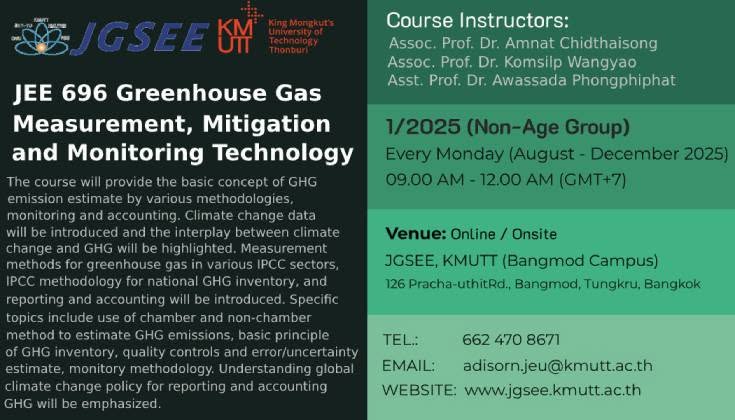
JGSEE advertised semester 1/2025 learning opportunities in greenhouse gas measurement and energy policy.

JEE 696

Greenhouse Gas Measurement, Mitigation and Monitoring Technology

August–December 2025 · Mondays · online / onsite at JGSEE, Bangmod Campus.

JEE 696: Greenhouse Gas Measurement, Mitigation and Monitoring Technology. Semester 1/2025 course advertisement.

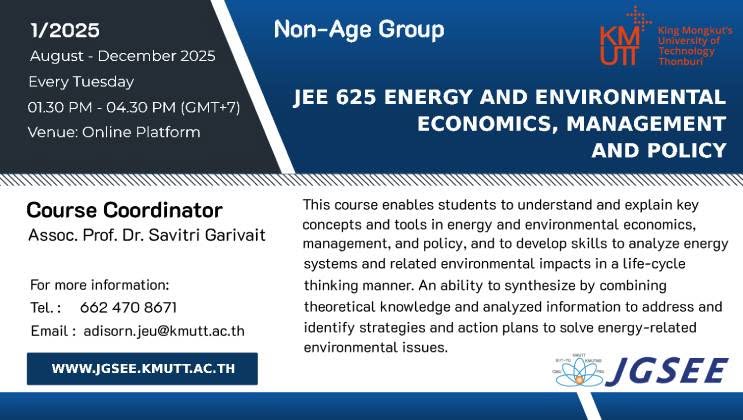
JEE 625

Energy and Environmental Economics, Management and Policy

August–December 2025 · Tuesdays · online platform.

JEE 625: Energy and Environmental Economics, Management and Policy. Semester 1/2025 course advertisement.
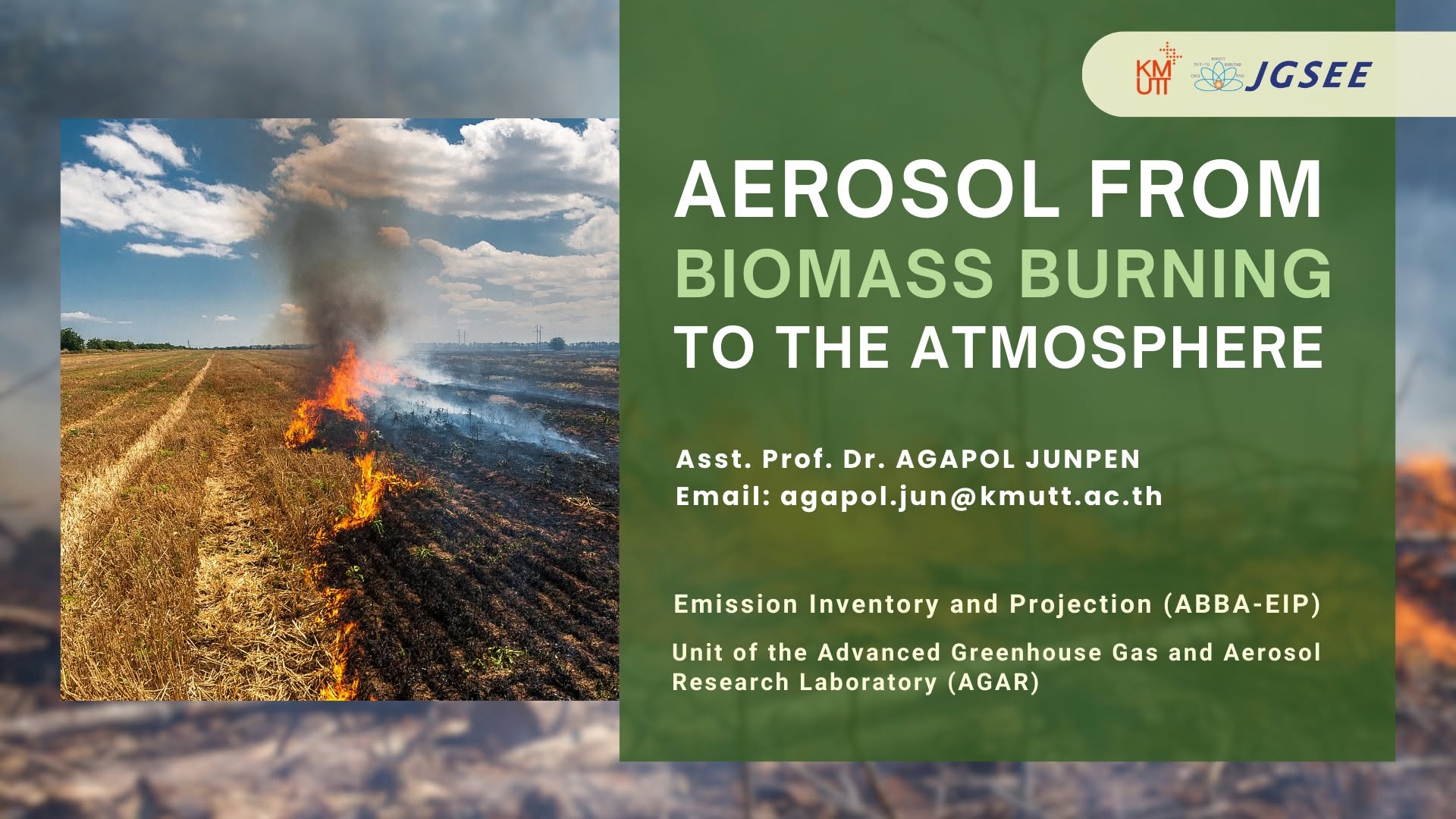
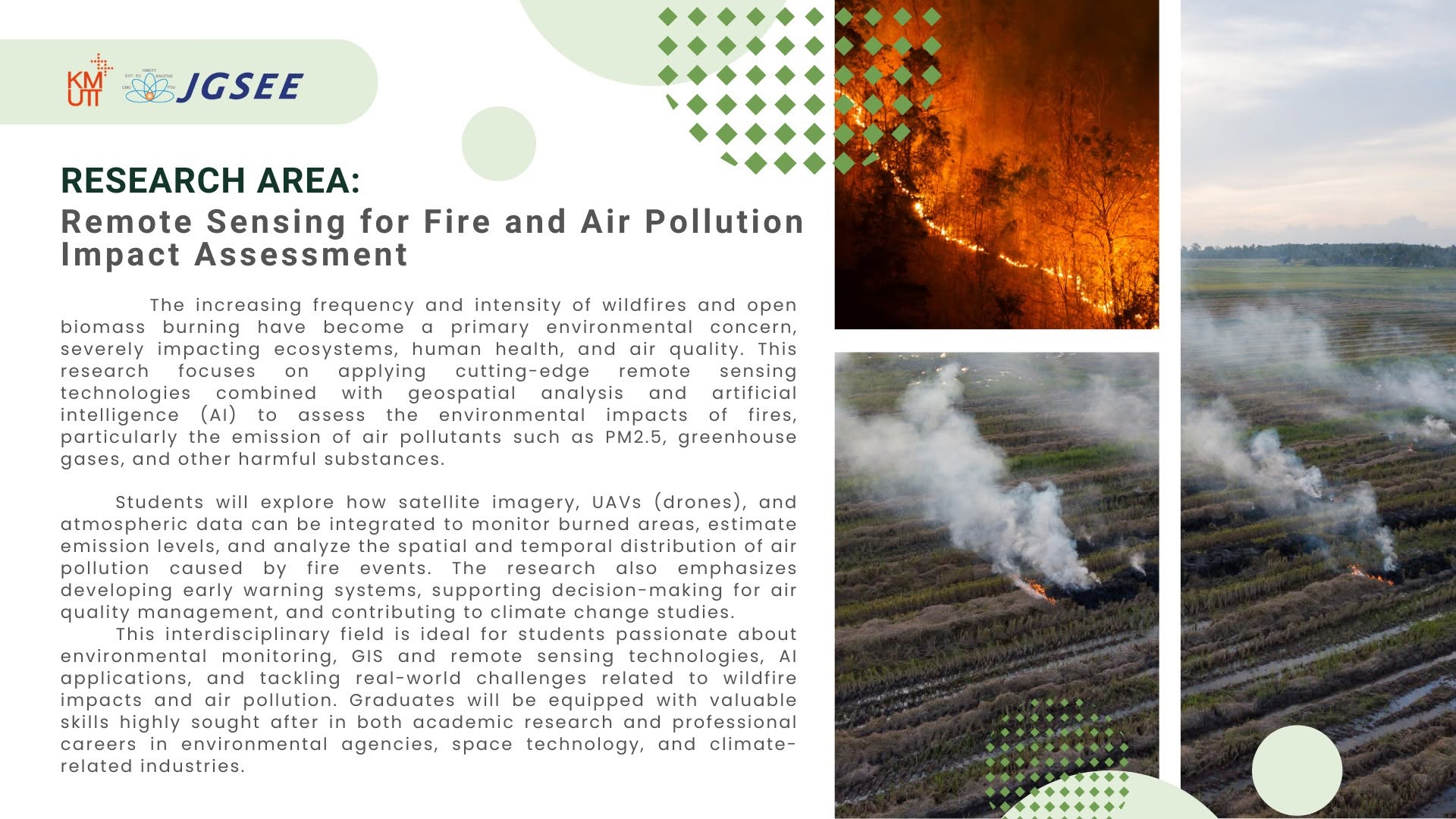
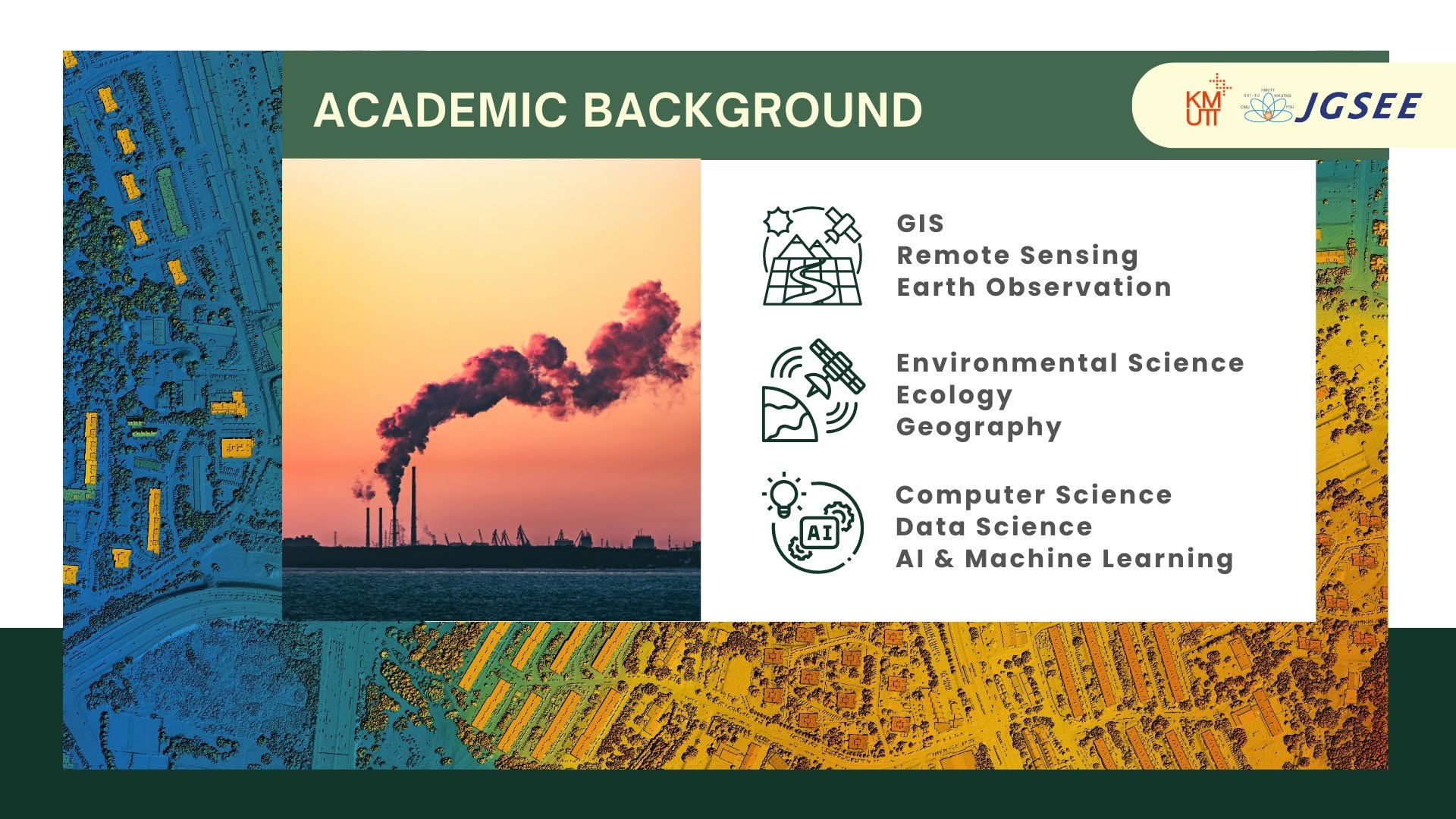
Aerosol and remote sensing research

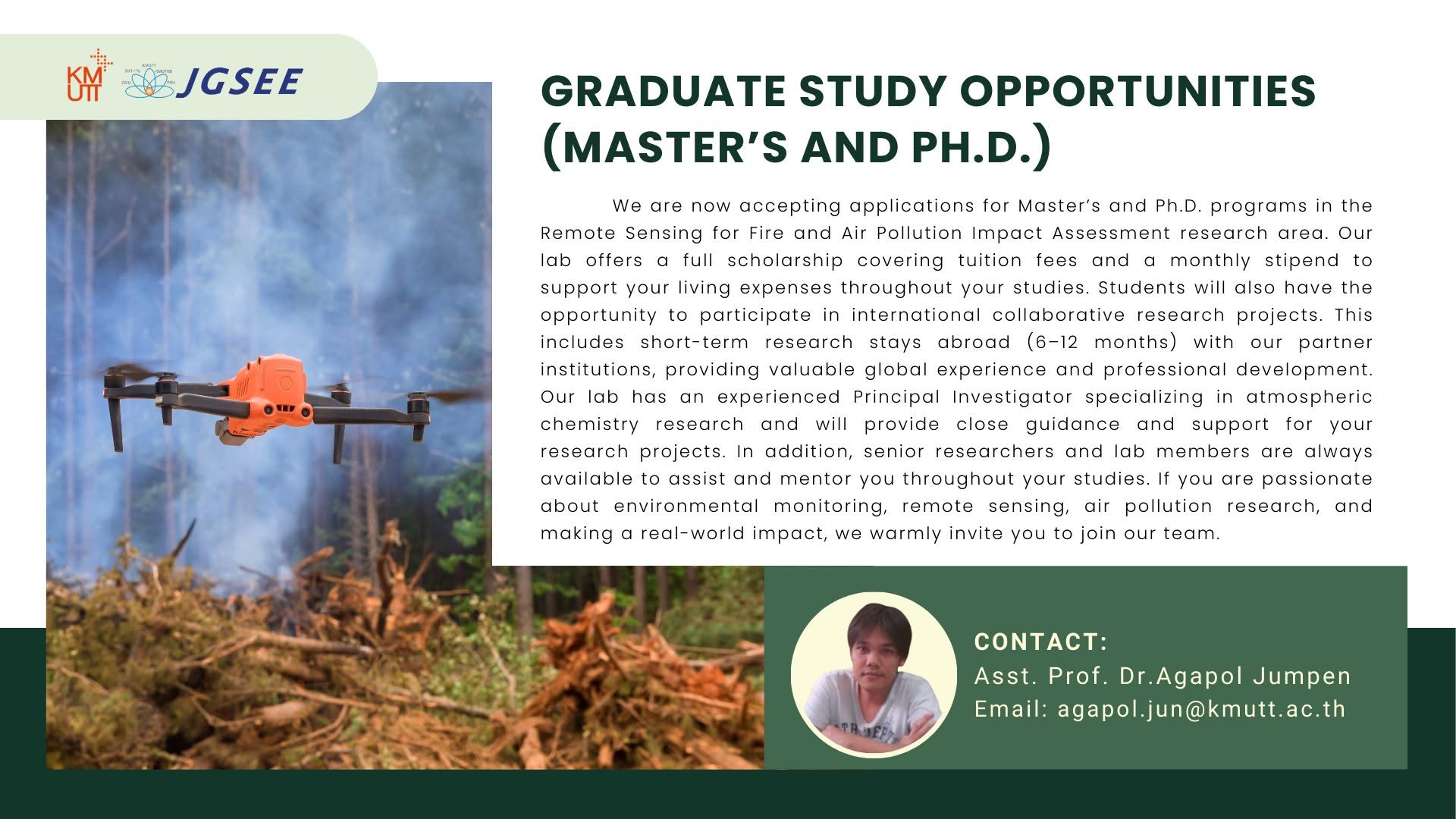
JGSEE research material introduces aerosol from biomass burning, remote sensing for fire and air-pollution impact assessment, relevant academic backgrounds, and graduate study opportunities.

Professional knowledge exchange

JGSEE records add professional training, seminars and research partnerships to the wider climate-learning picture. The audience and location vary by activity; international exchanges are retained as supporting context.

Dates below identify newsletter issues. Event dates appear on the newsletter pages.

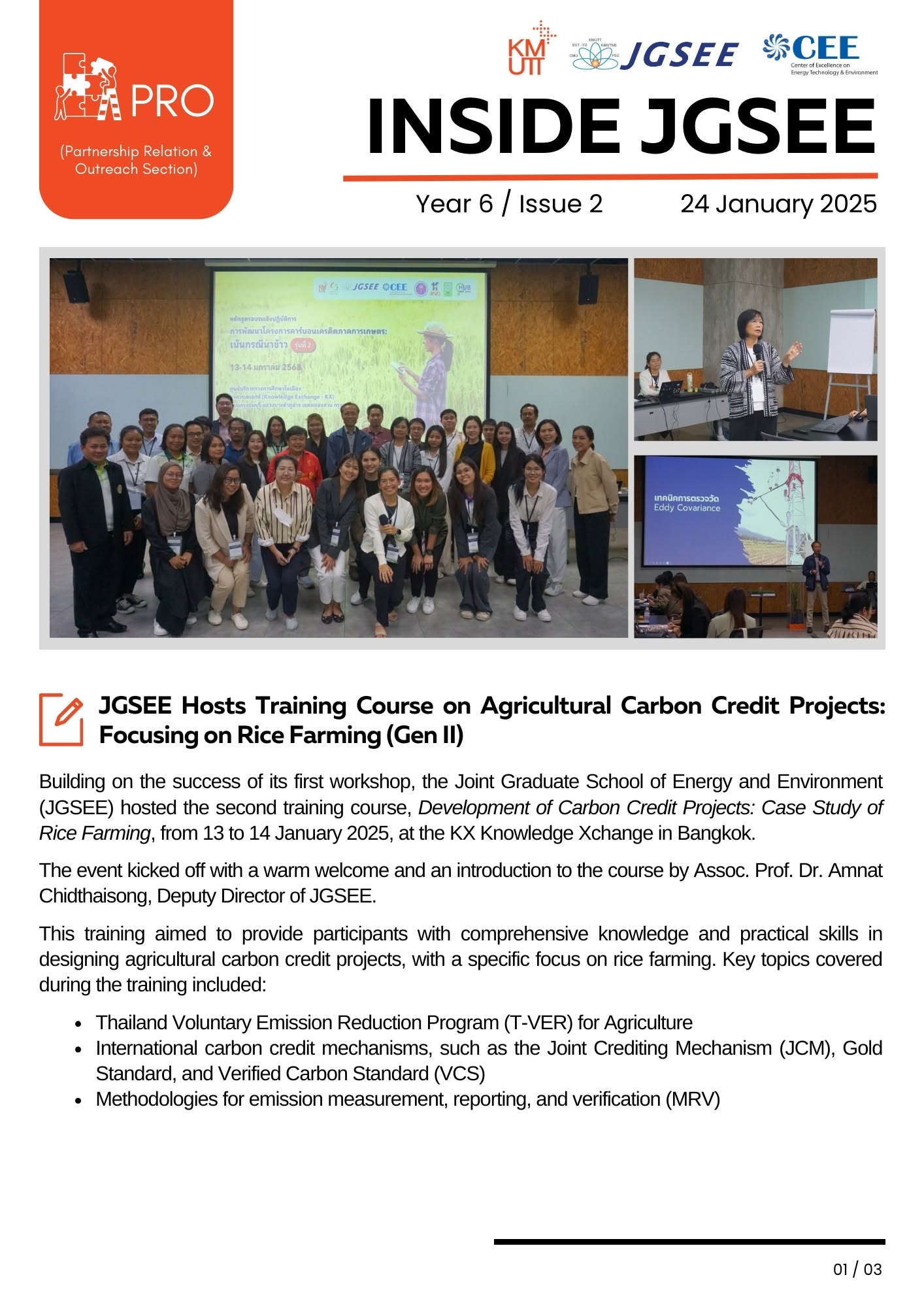
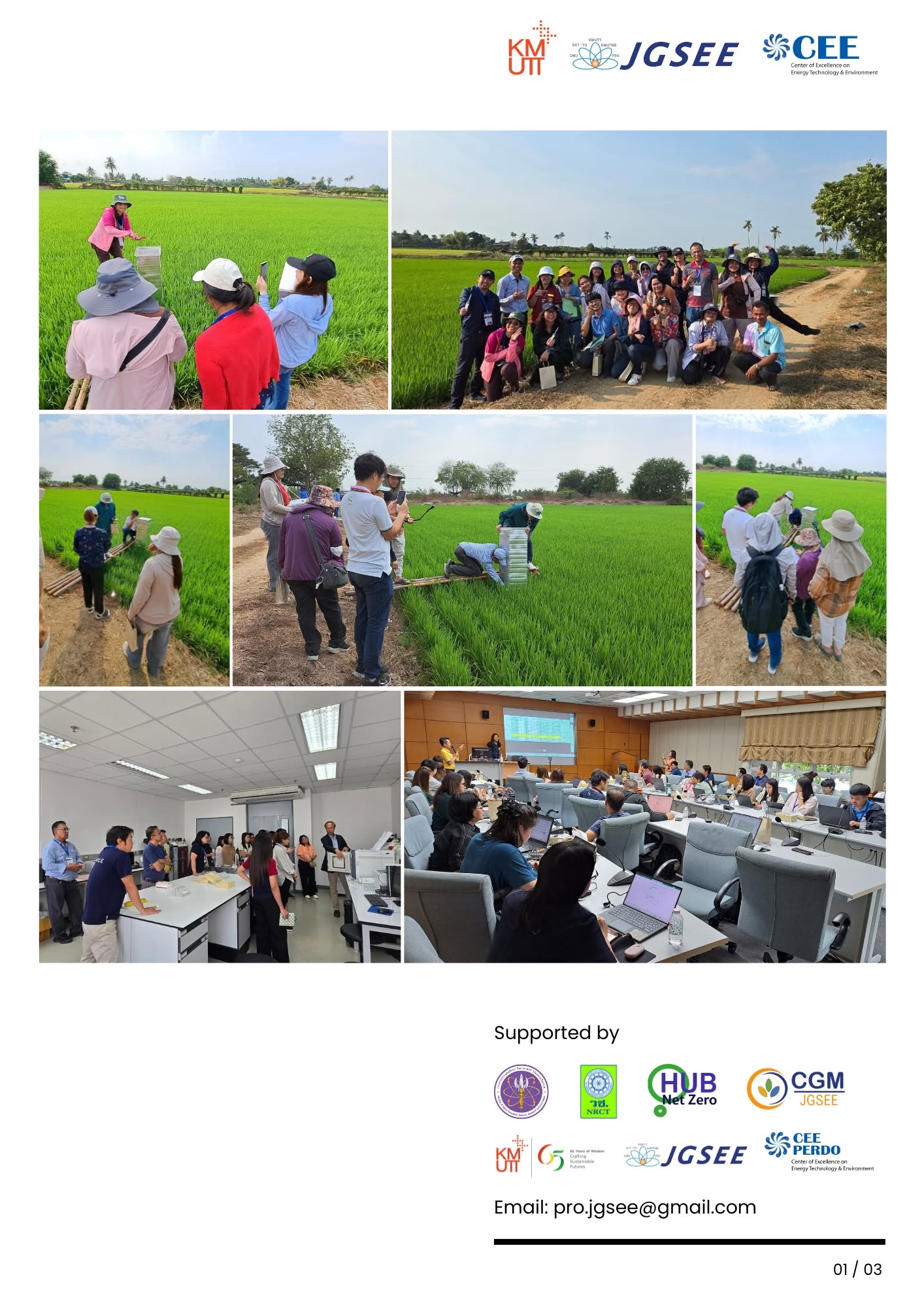
Rice farming carbon credits24 January 2025

Training on developing agricultural carbon-credit projects, focusing on rice farming.

Inside JGSEE issue date: 24 January 2025.

Rice farming carbon credits. Inside JGSEE issue dated 24 January 2025.
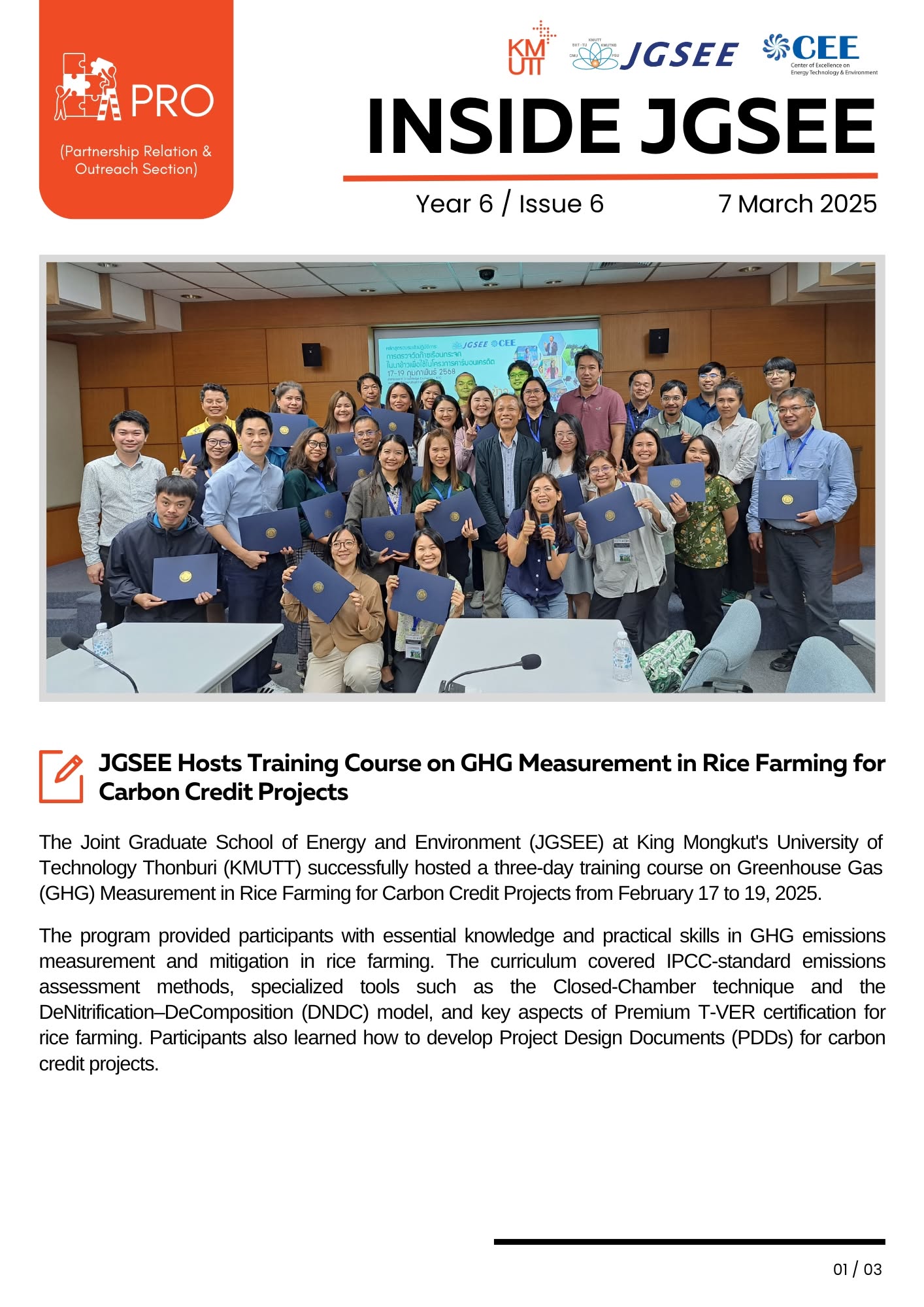
GHG measurement in rice7 March 2025

Training on greenhouse gas measurement in rice farming for carbon-credit projects.

Inside JGSEE issue date: 7 March 2025.

GHG measurement in rice. Inside JGSEE issue dated 7 March 2025.
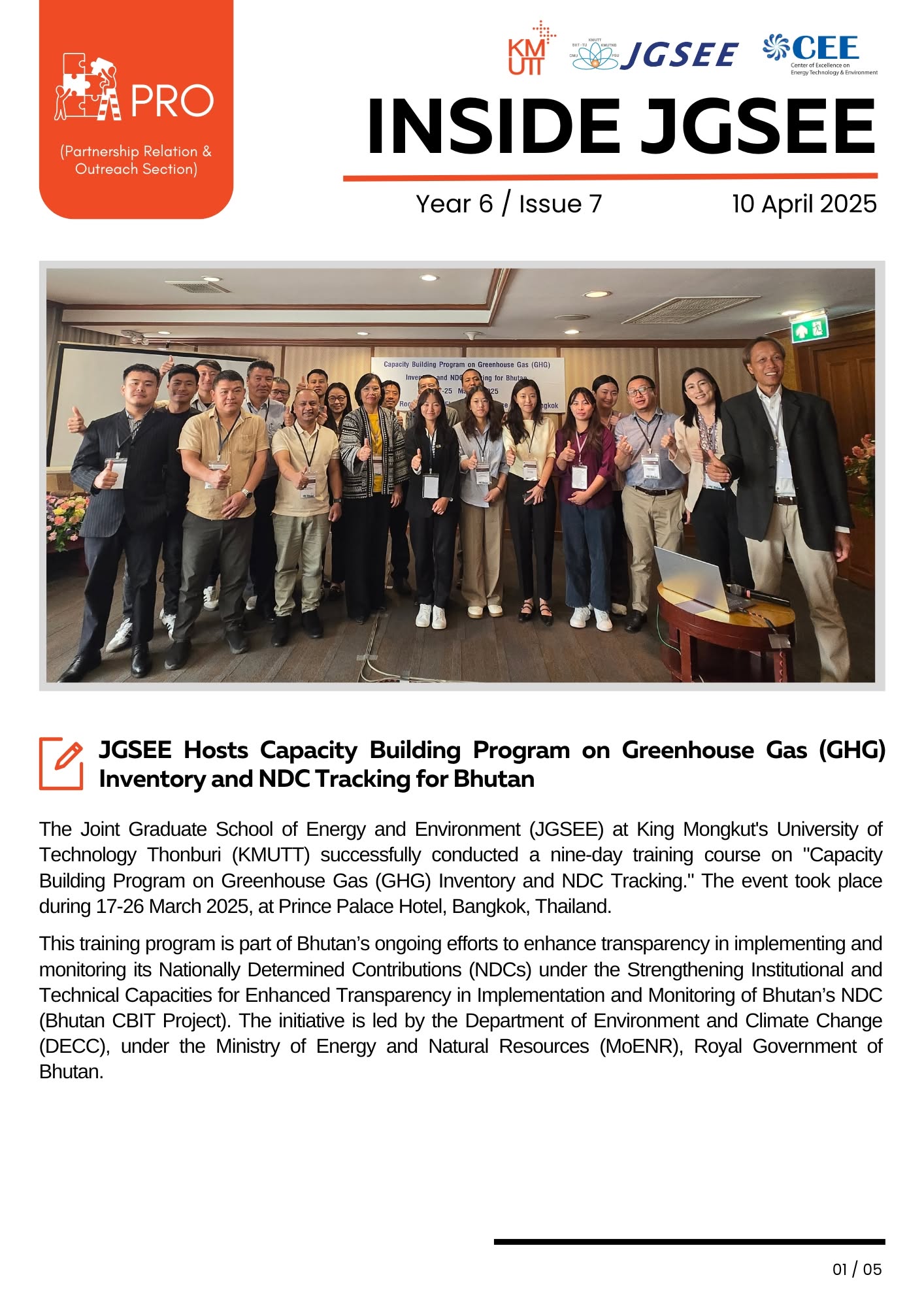
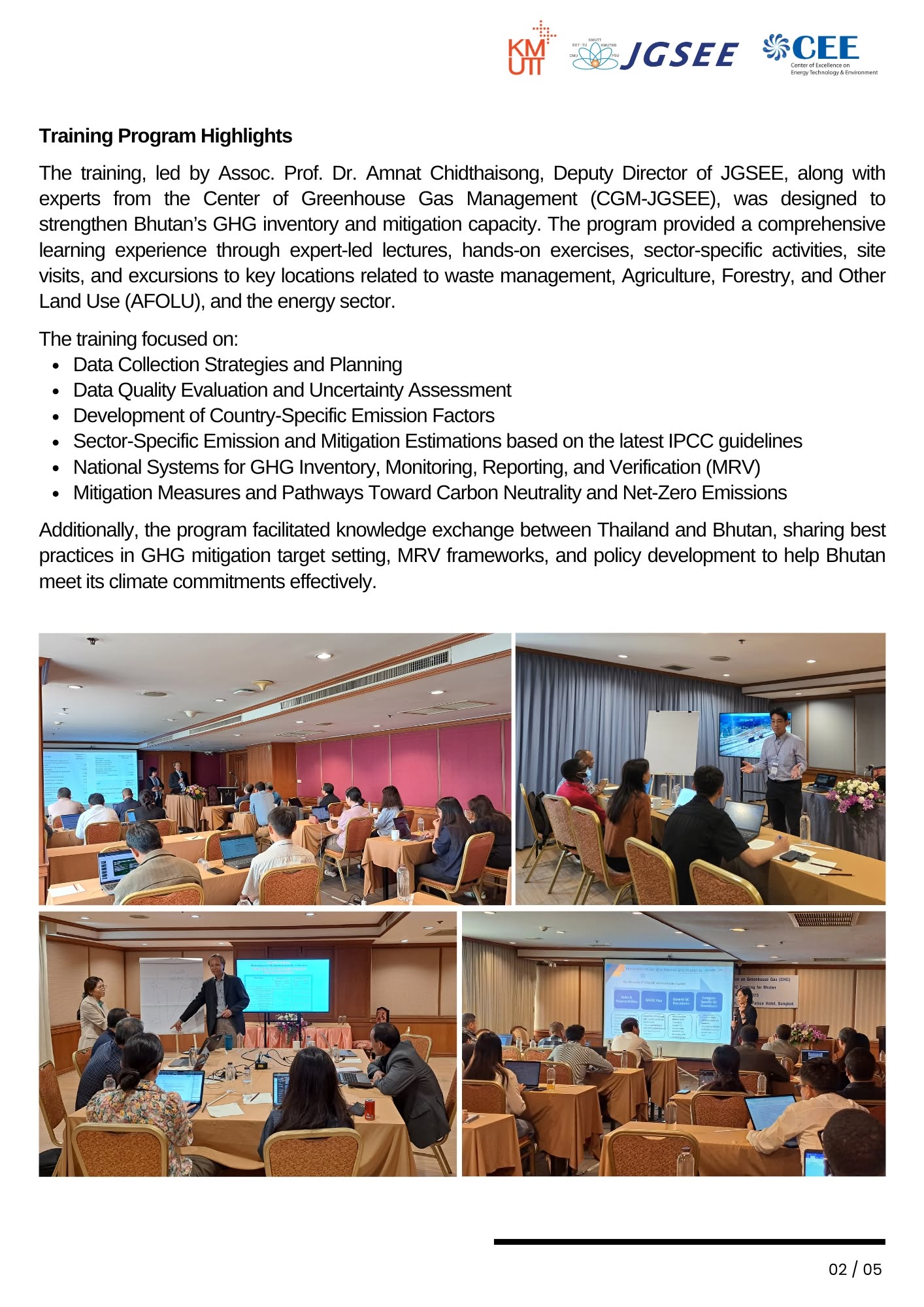
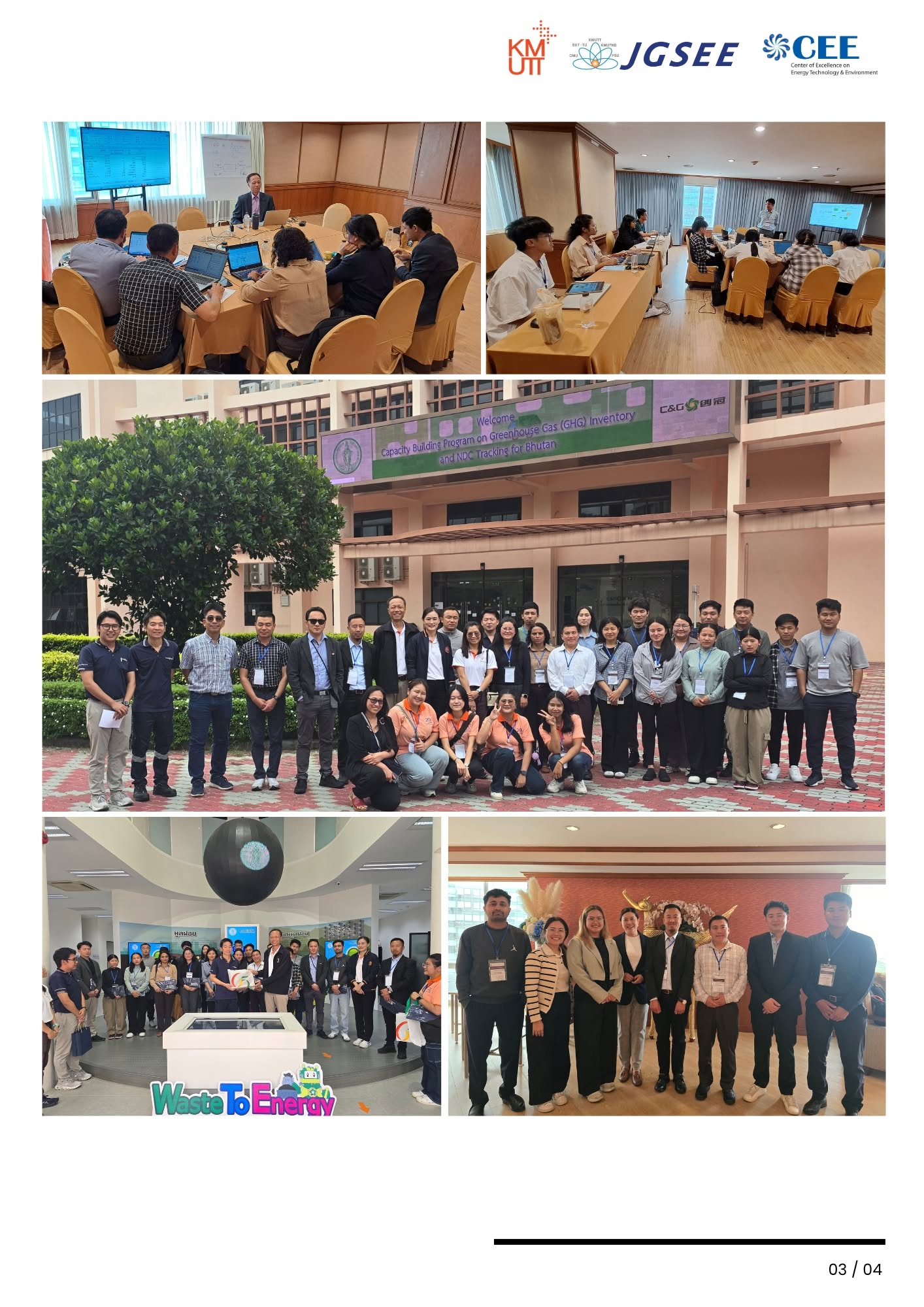
Bhutan inventory training10 April 2025

Capacity building on greenhouse gas inventories and Nationally Determined Contribution tracking for Bhutan.

Inside JGSEE issue date: 10 April 2025.

Bhutan inventory training. Inside JGSEE issue dated 10 April 2025.
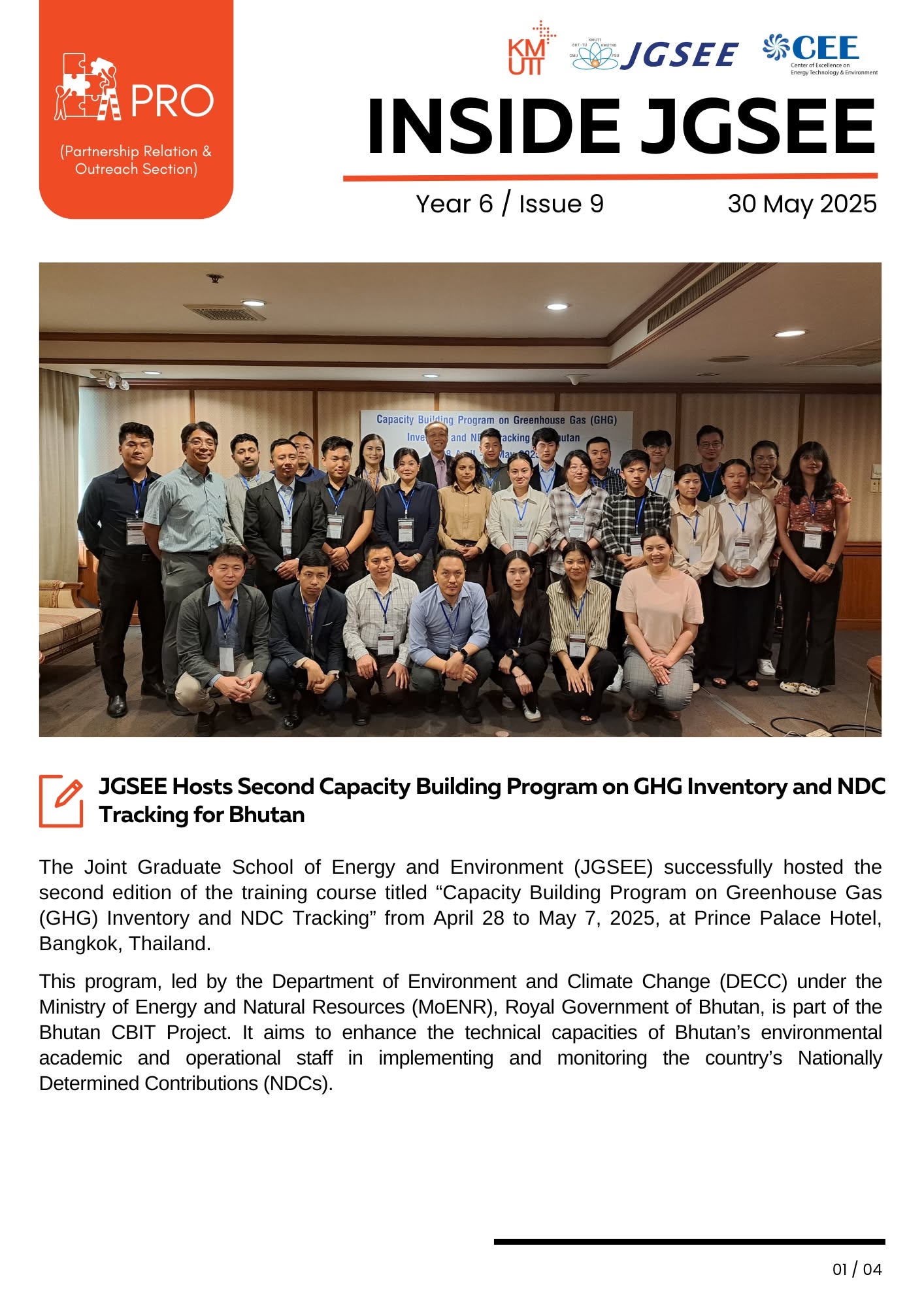
Bhutan follow-up training30 May 2025

Second capacity-building programme on greenhouse gas inventories and NDC tracking for Bhutan.

Inside JGSEE issue date: 30 May 2025.

Bhutan follow-up training. Inside JGSEE issue dated 30 May 2025.
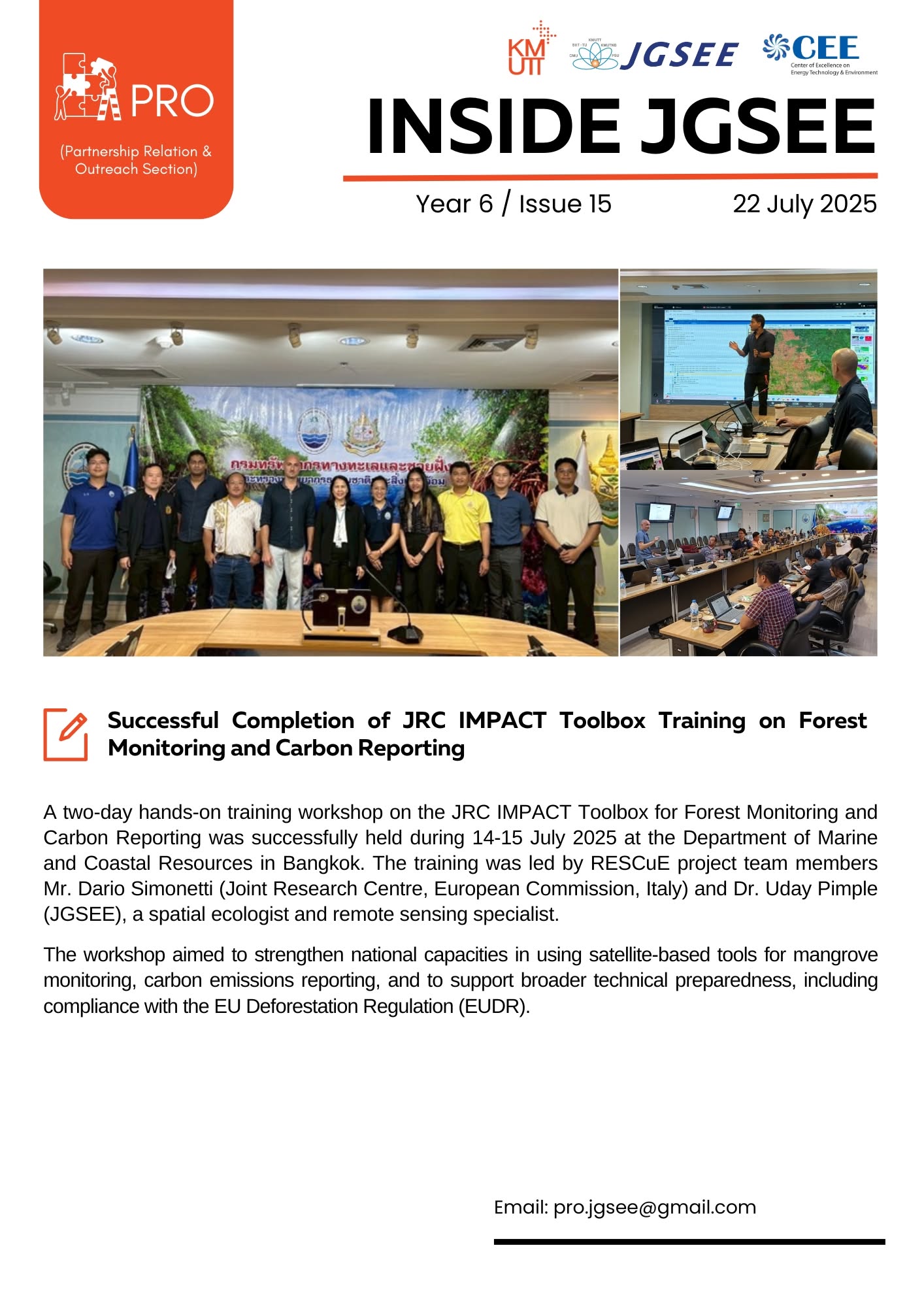
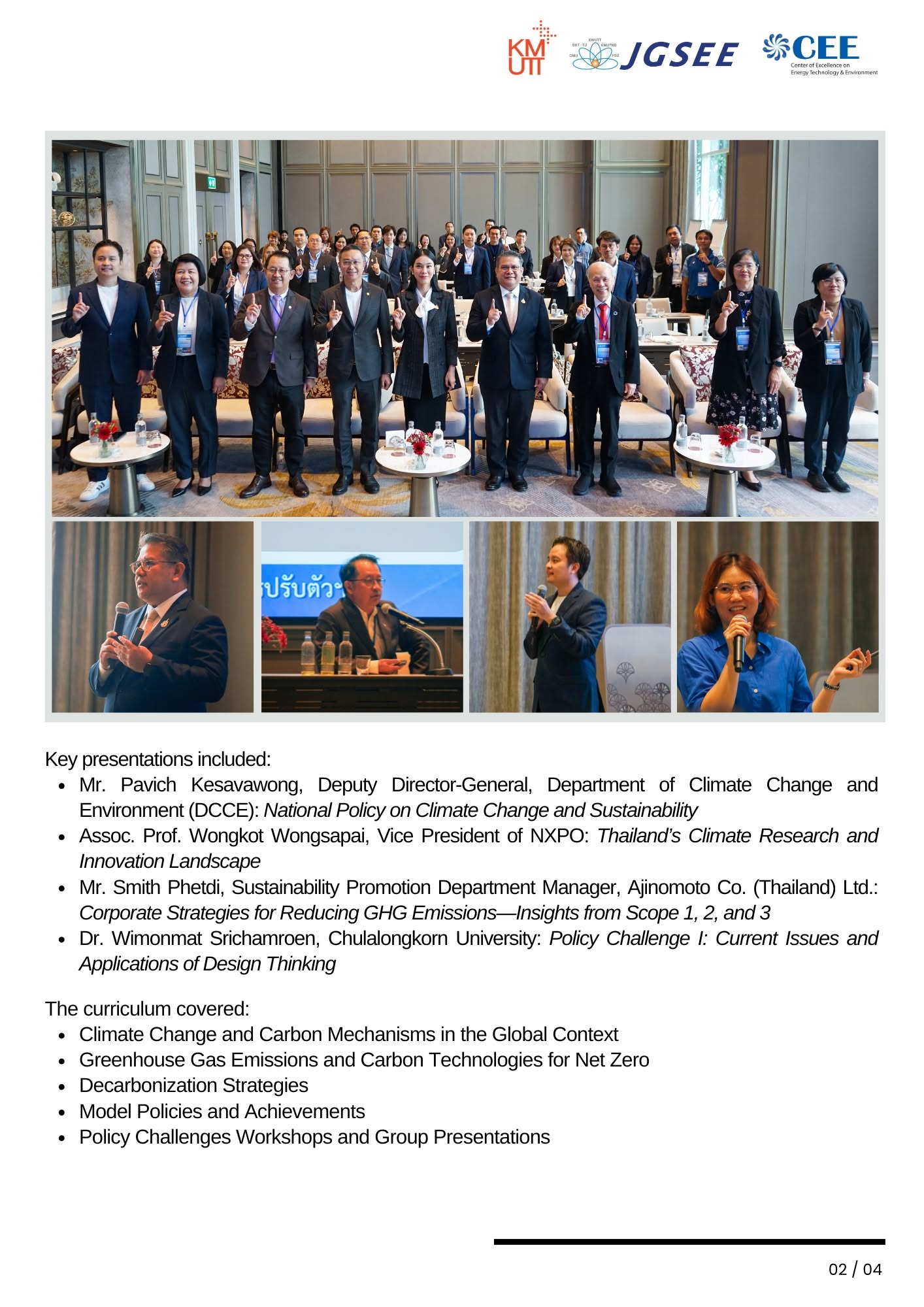
Forest carbon reporting22 July 2025

JRC IMPACT Toolbox training on forest monitoring and carbon reporting.

Inside JGSEE issue date: 22 July 2025.

Forest carbon reporting. Inside JGSEE issue dated 22 July 2025.
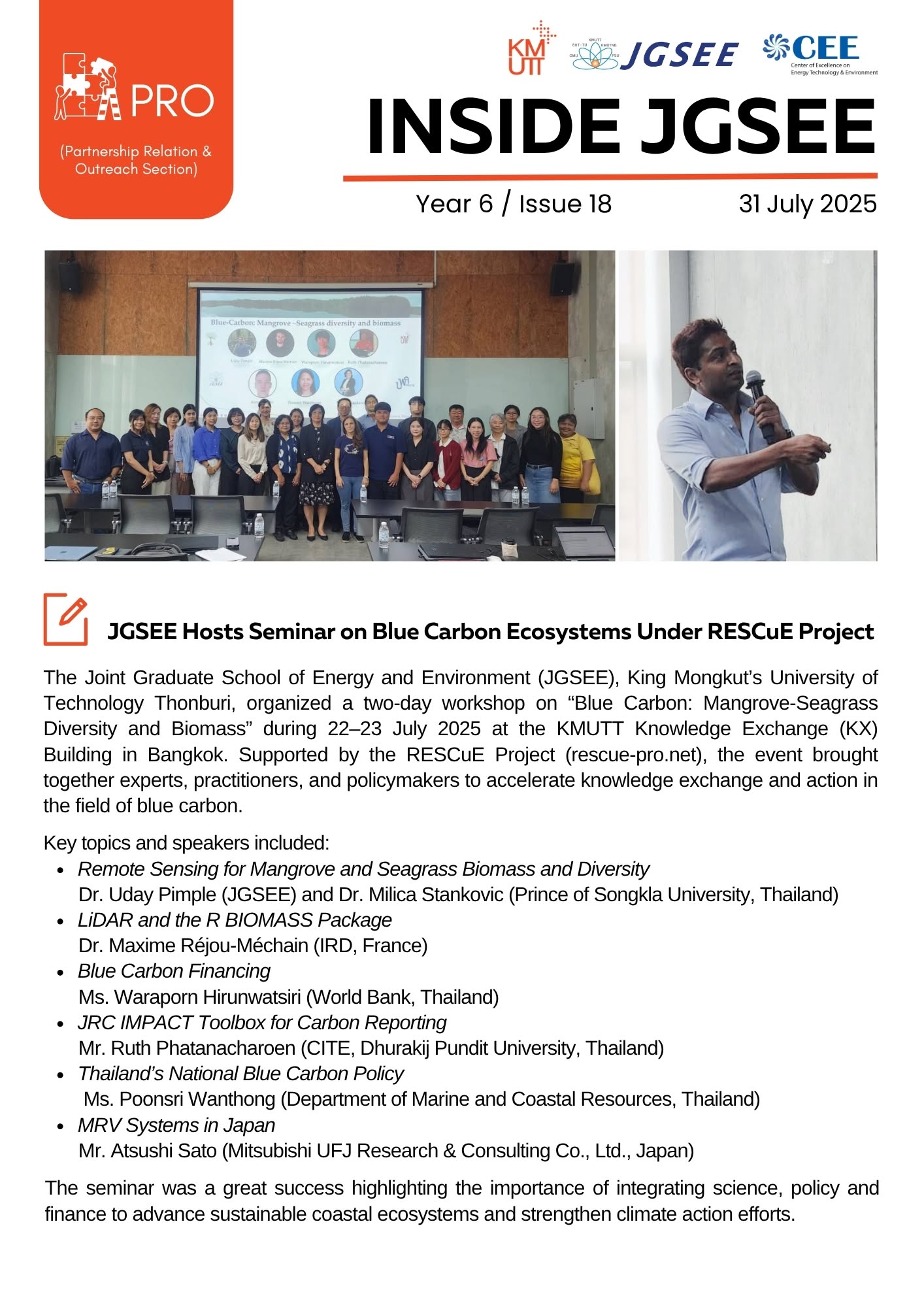
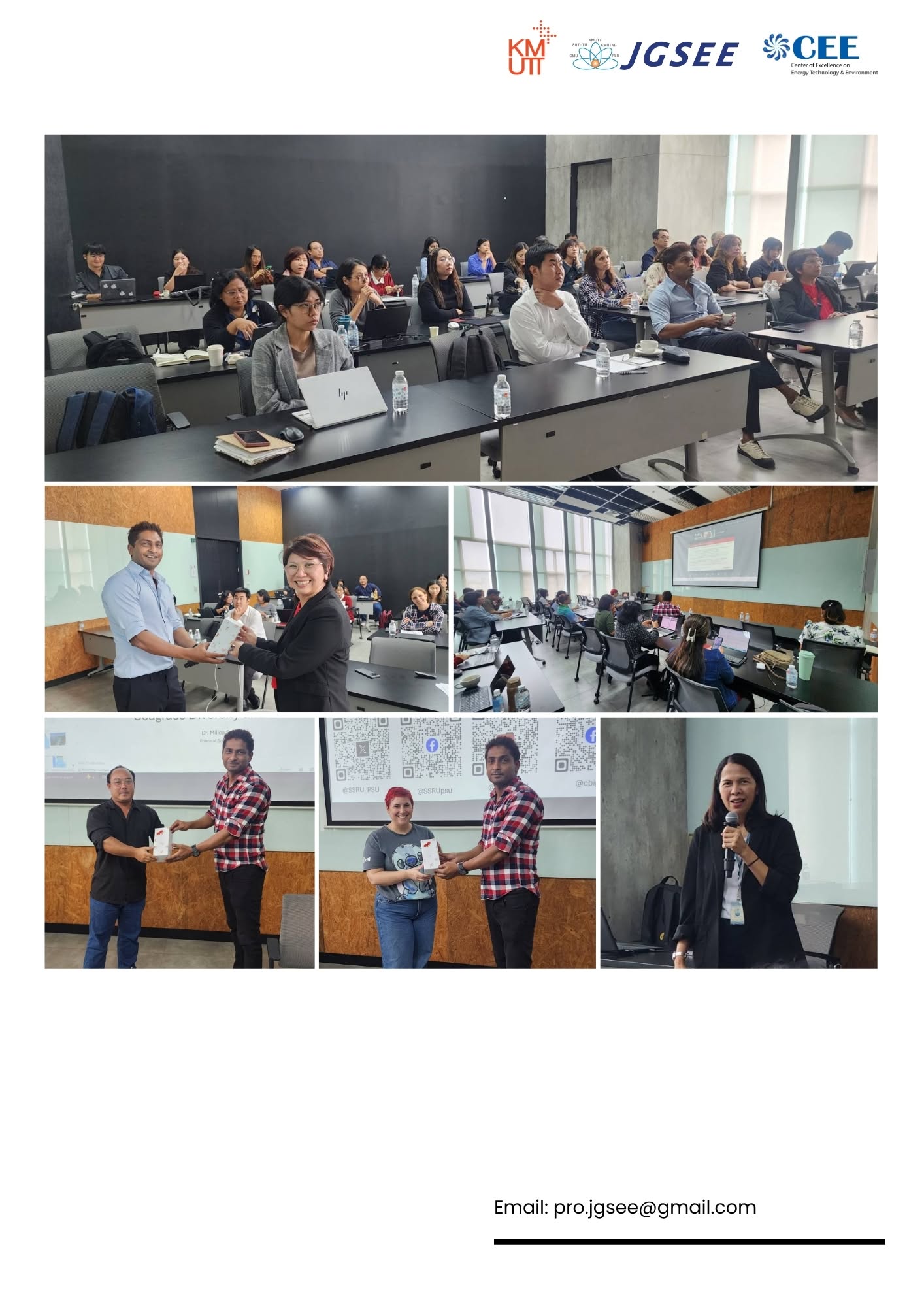
Blue carbon knowledge31 July 2025

Seminar on blue carbon ecosystems under the RESCuE project.

Inside JGSEE issue date: 31 July 2025.

Blue carbon knowledge. Inside JGSEE issue dated 31 July 2025.
Executive carbon course1 September 2025

JGSEE and NXPO executive course on carbon management technology and innovation policy.

Inside JGSEE issue date: 1 September 2025.

Executive carbon course. Inside JGSEE issue dated 1 September 2025.
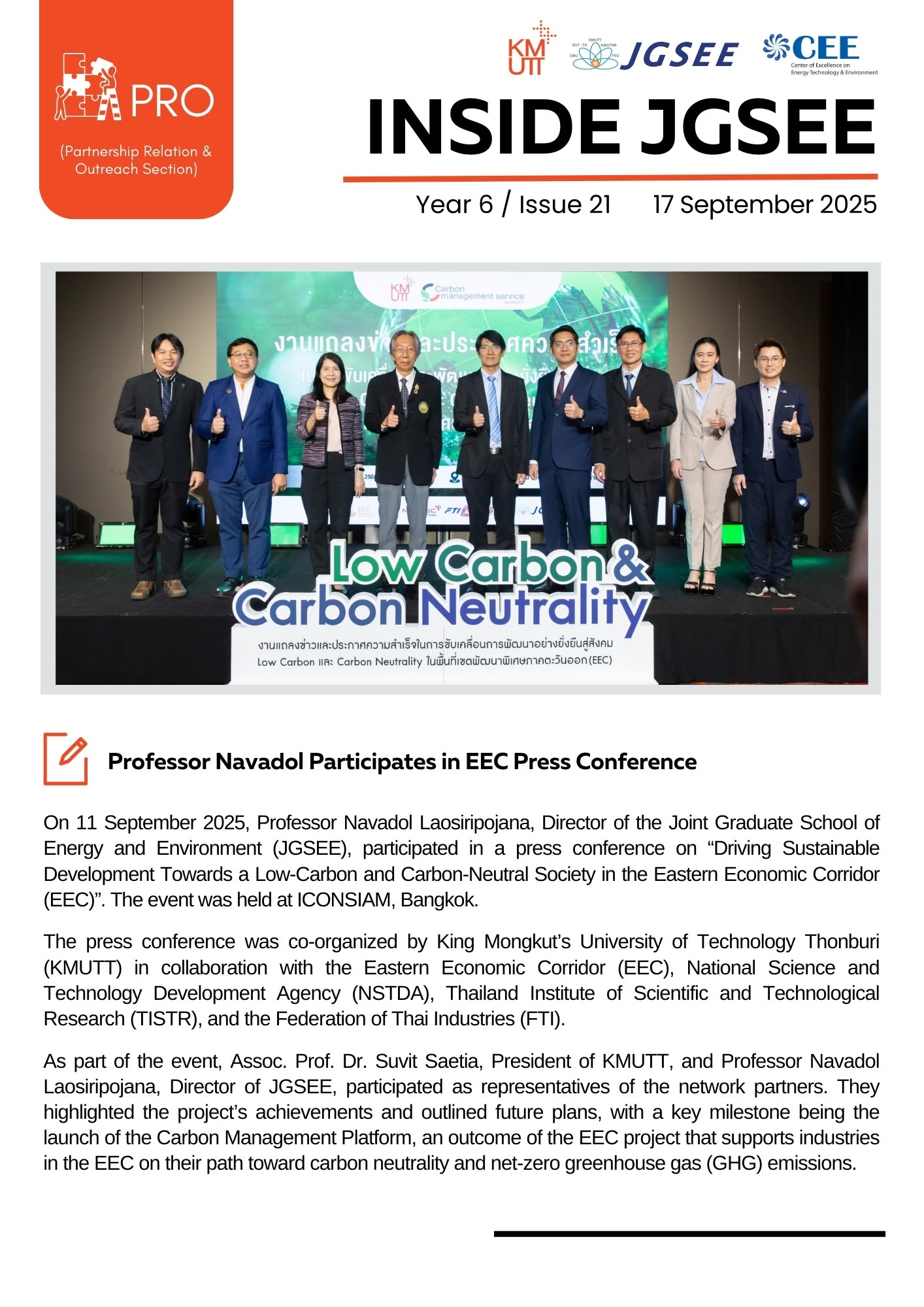
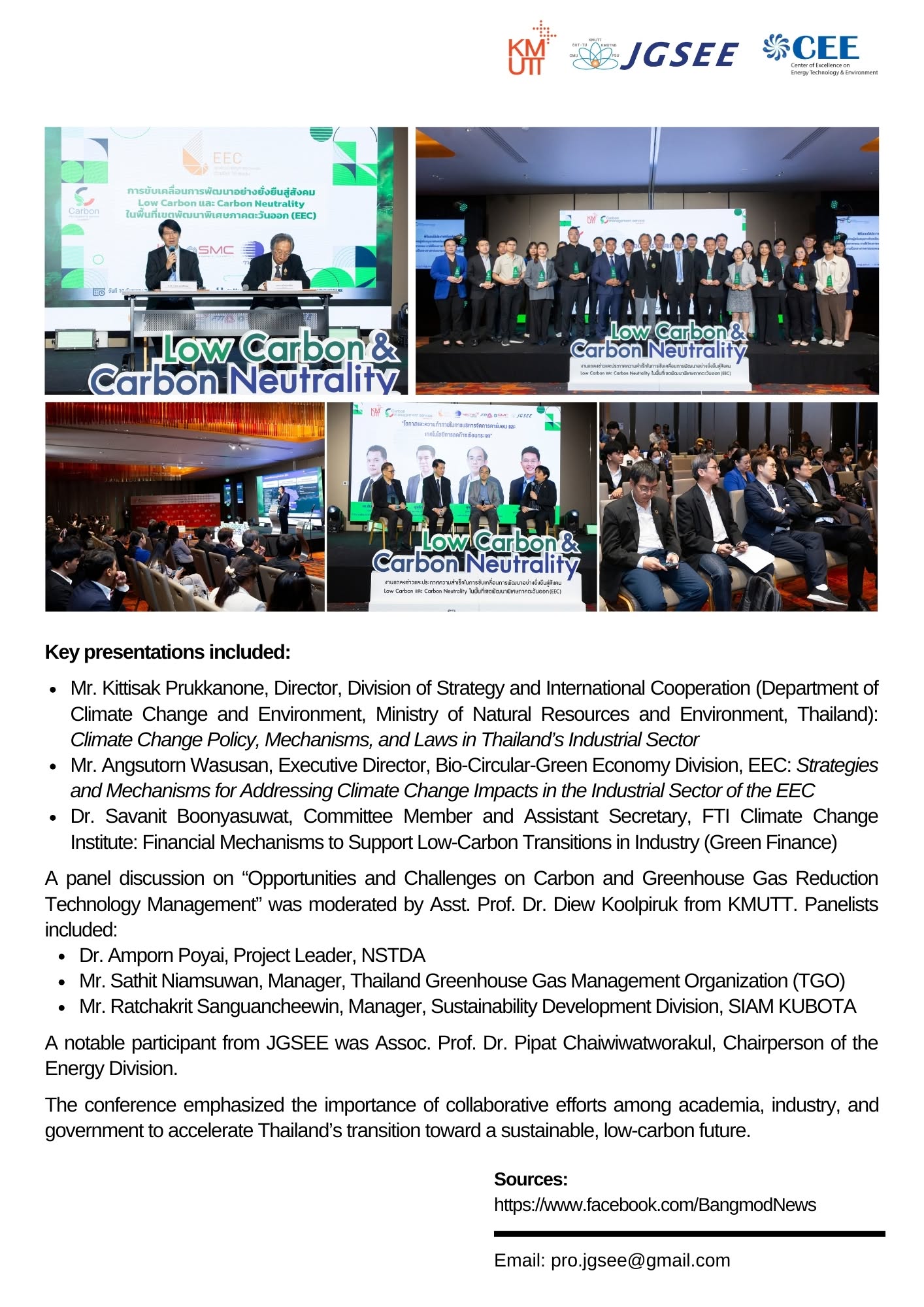
Low-carbon EEC dialogue17 September 2025

JGSEE participation in a press conference on low-carbon and carbon-neutral development in the Eastern Economic Corridor.

Inside JGSEE issue date: 17 September 2025.

Low-carbon EEC dialogue. Inside JGSEE issue dated 17 September 2025.
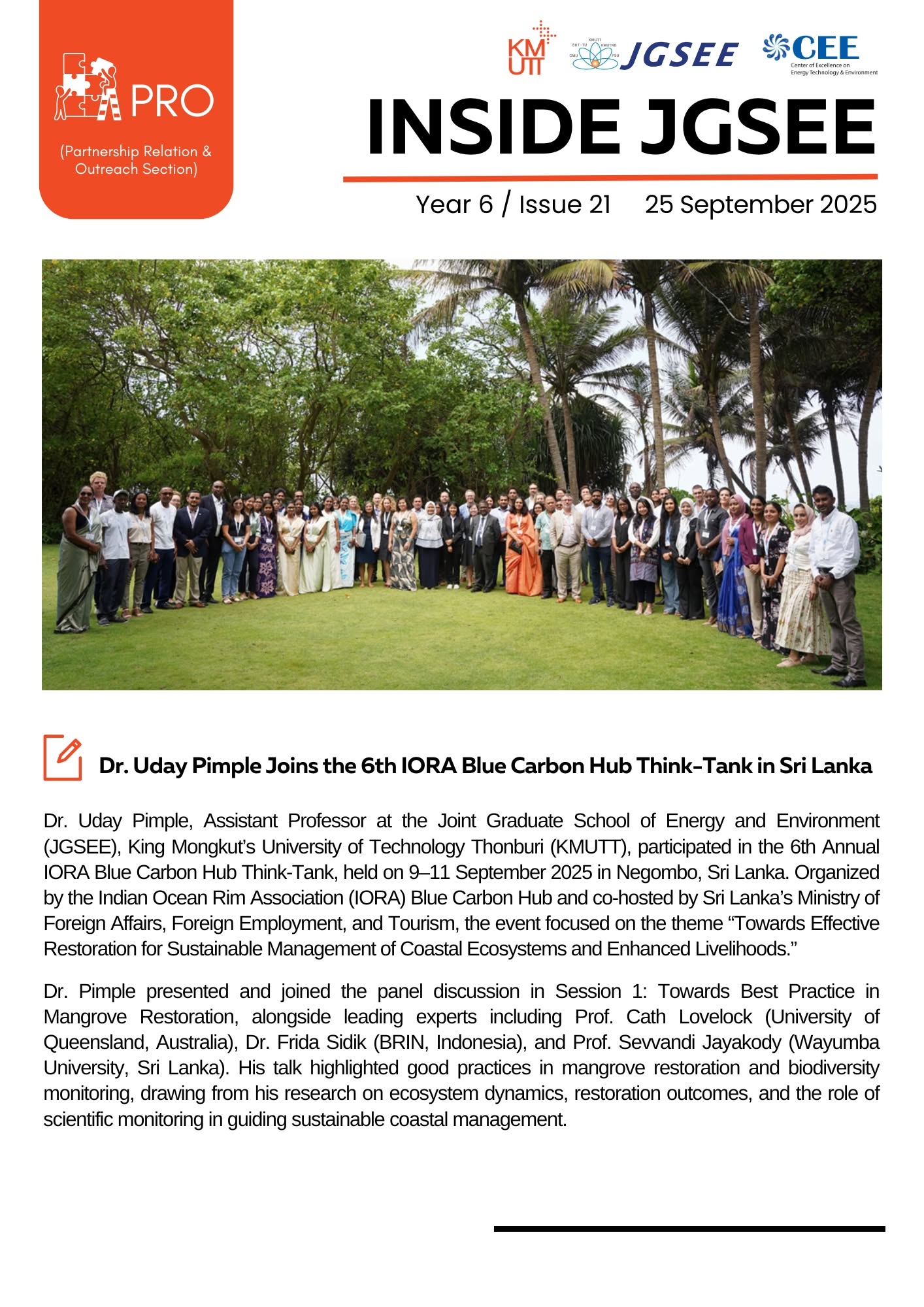
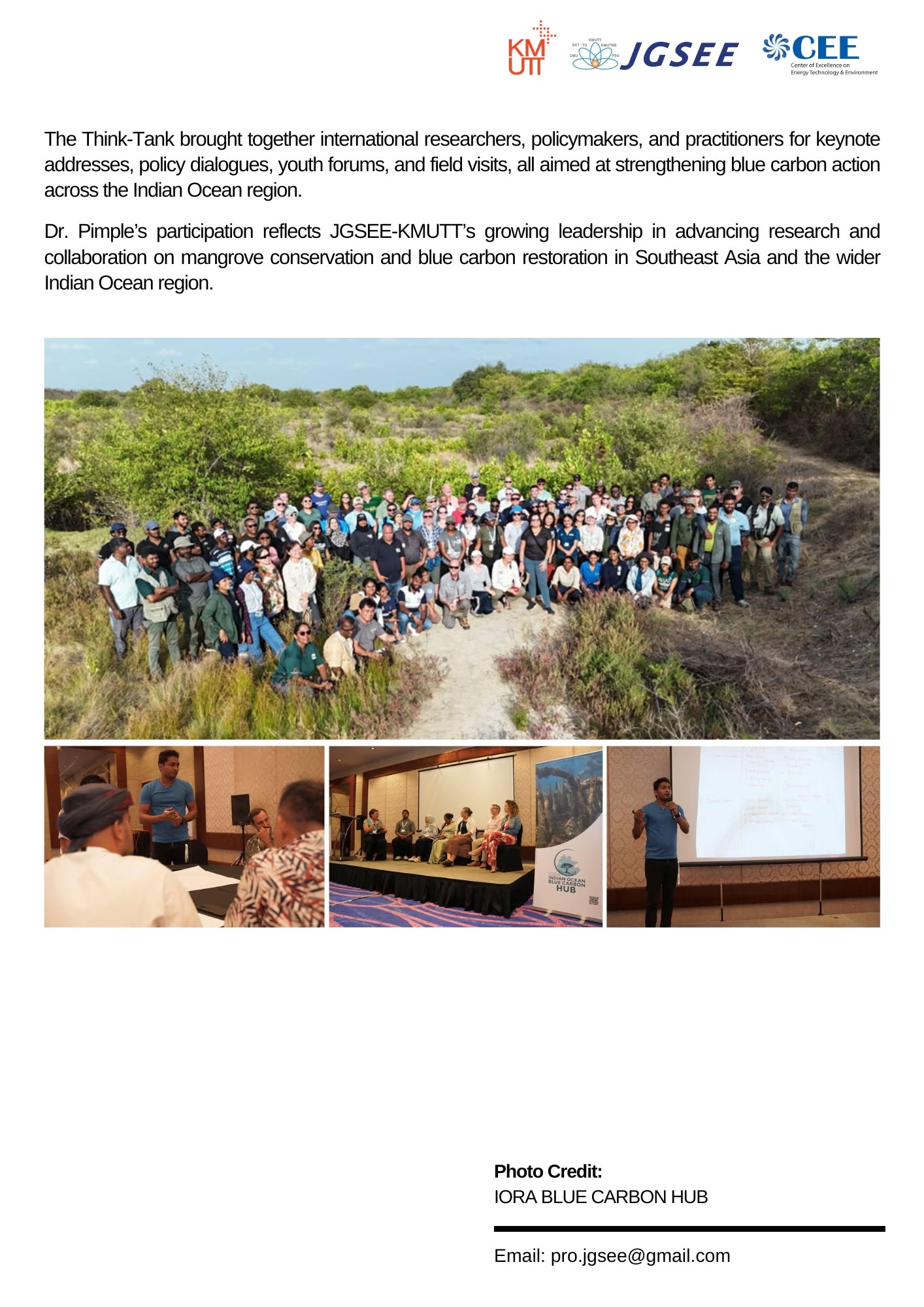
IORA blue carbon exchange25 September 2025

Participation in the IORA Blue Carbon Hub Think-Tank in Sri Lanka; international knowledge exchange.

Inside JGSEE issue date: 25 September 2025.

IORA blue carbon exchange. Inside JGSEE issue dated 25 September 2025.
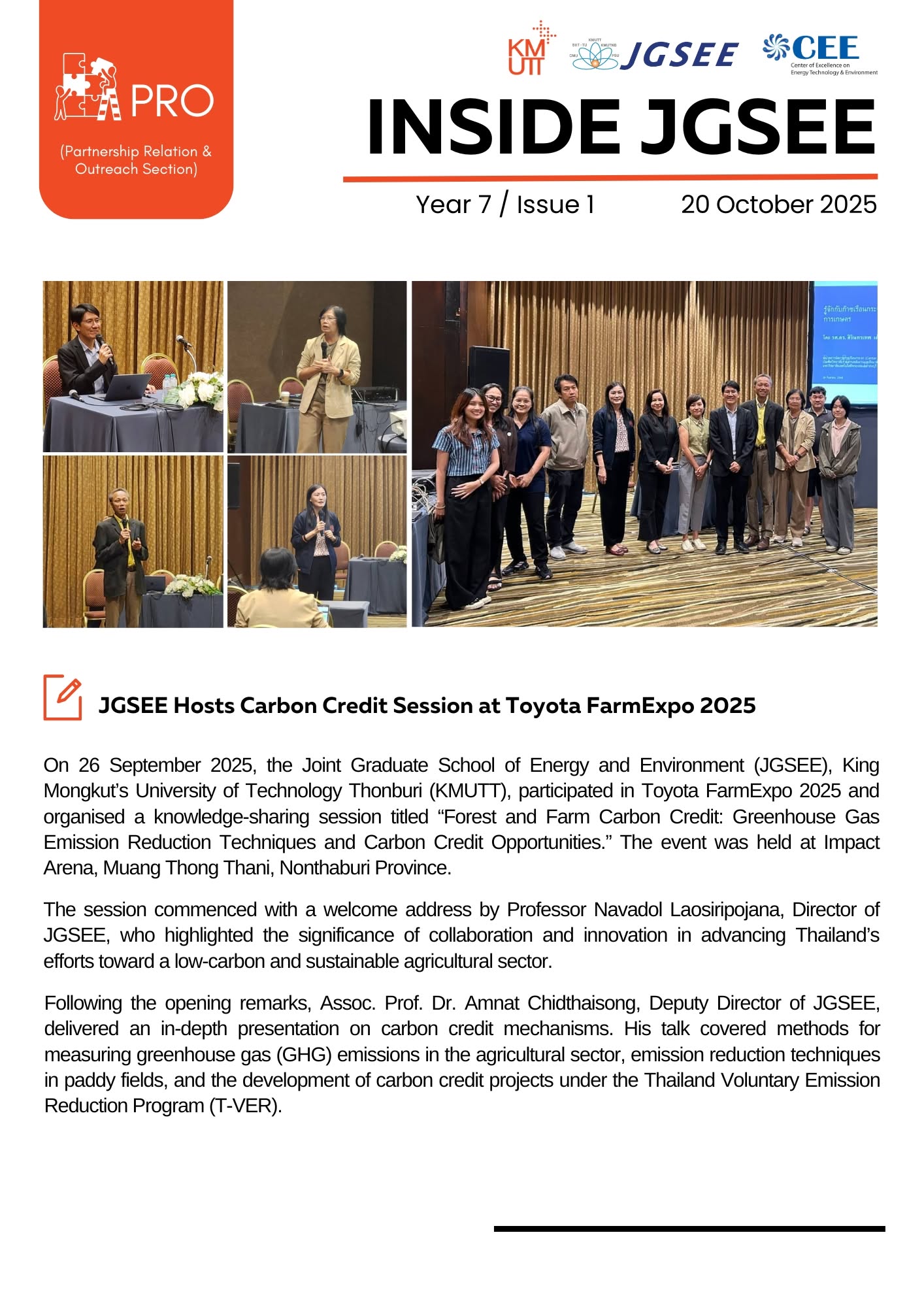
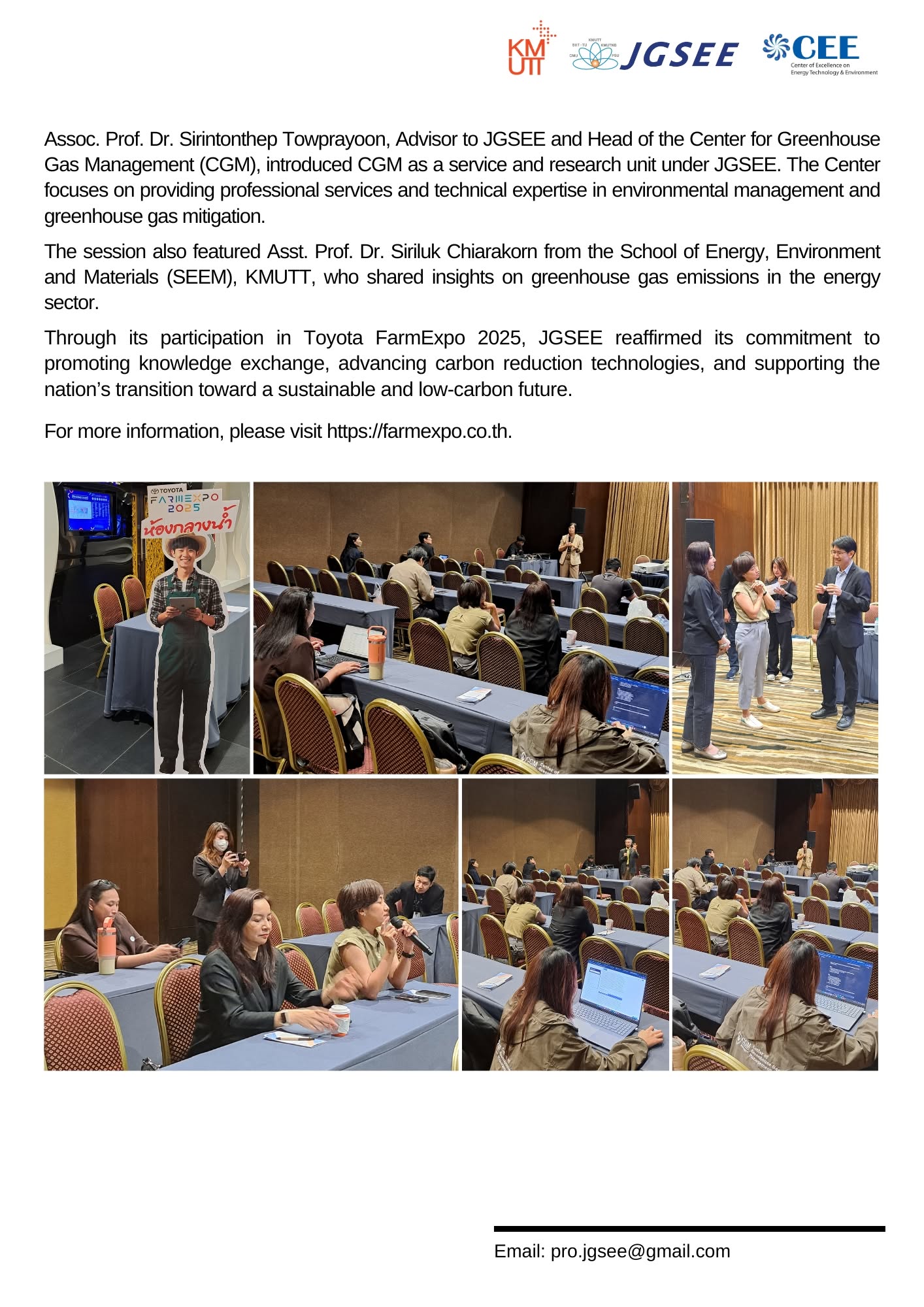
Farm carbon knowledge20 October 2025

JGSEE carbon-credit knowledge-sharing session at Toyota FarmExpo 2025.

Inside JGSEE issue date: 20 October 2025.

Farm carbon knowledge. Inside JGSEE issue dated 20 October 2025.
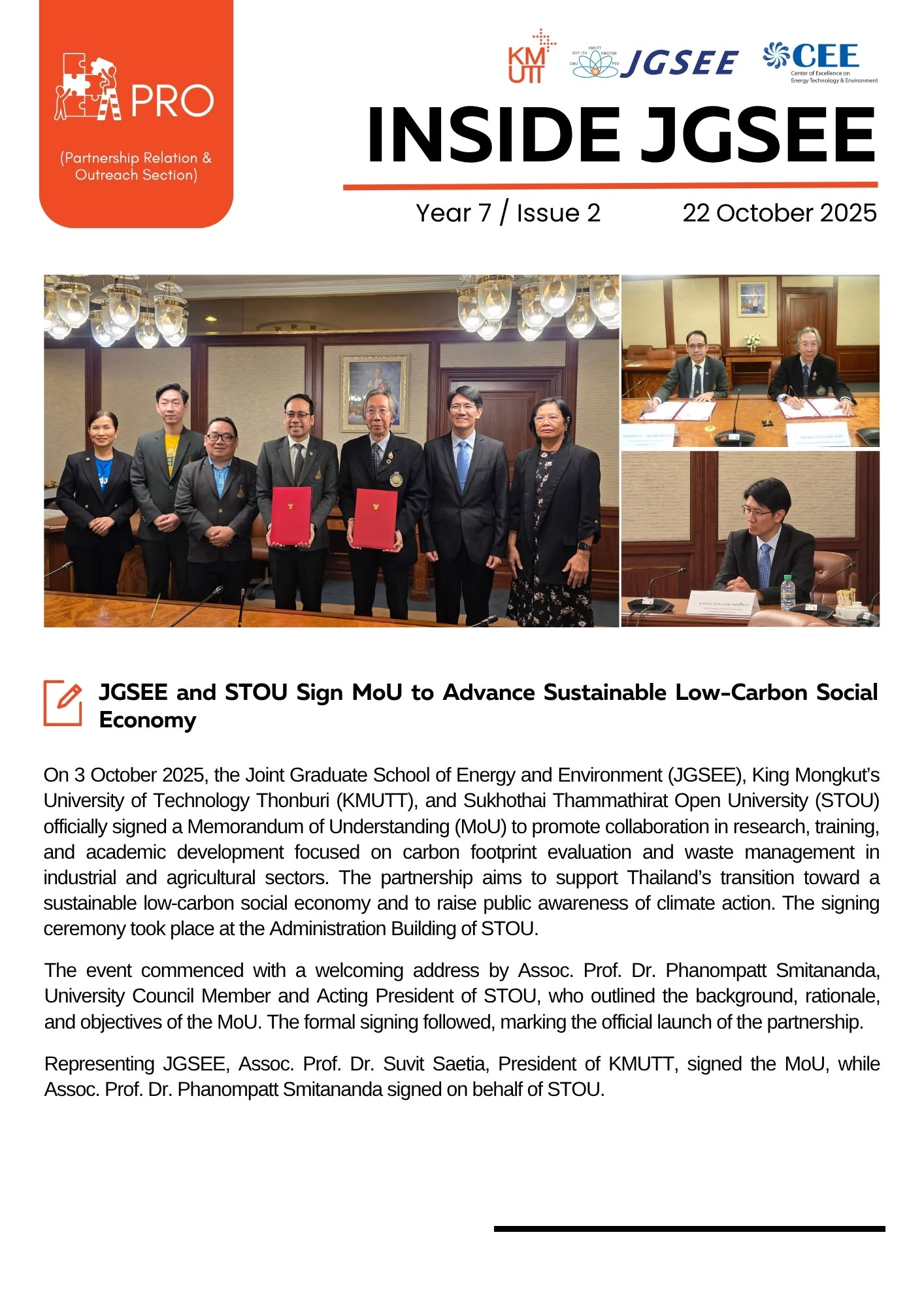
STOU low-carbon partnership22 October 2025

JGSEE and Sukhothai Thammathirat Open University partnership on a sustainable low-carbon social economy.

Inside JGSEE issue date: 22 October 2025.

STOU low-carbon partnership. Inside JGSEE issue dated 22 October 2025.
Low-carbon bioeconomy14 November 2025

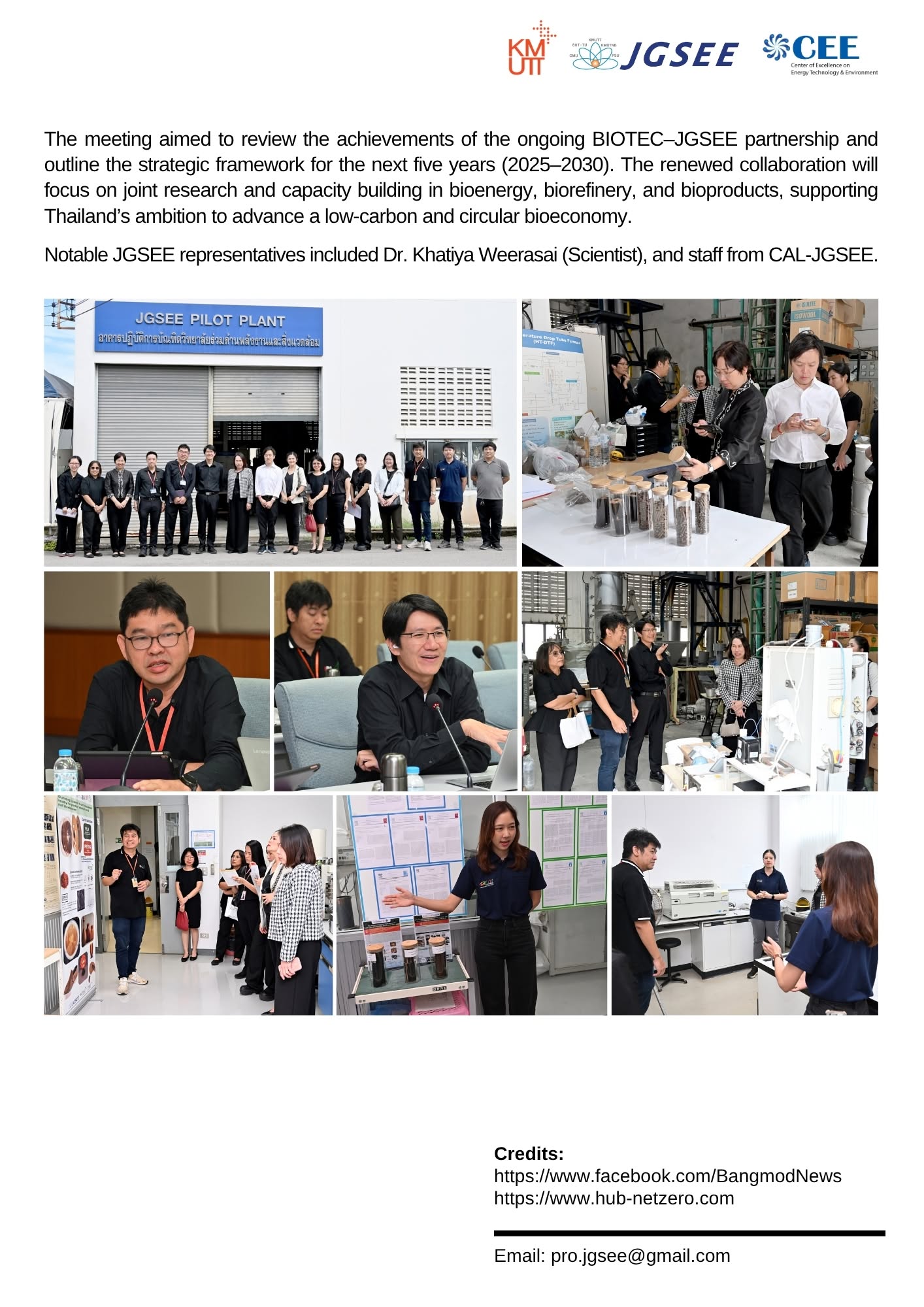
BIOTEC and JGSEE partnership toward a low-carbon and circular bioeconomy.

Inside JGSEE issue date: 14 November 2025.

Low-carbon bioeconomy. Inside JGSEE issue dated 14 November 2025.
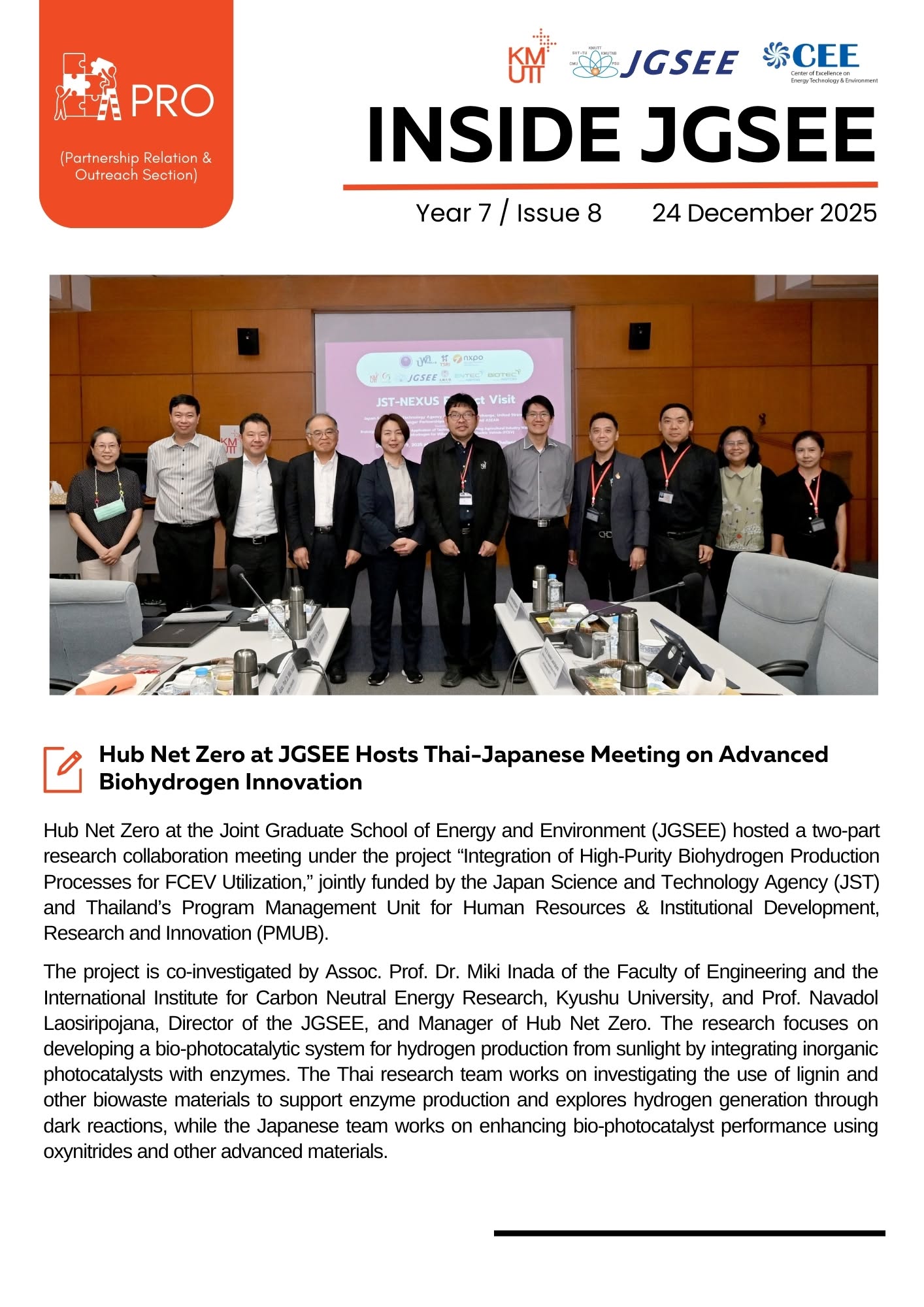
Biohydrogen collaboration24 December 2025

Hub Net Zero Thai–Japanese meeting on advanced biohydrogen innovation.

Inside JGSEE issue date: 24 December 2025.

Biohydrogen collaboration. Inside JGSEE issue dated 24 December 2025.
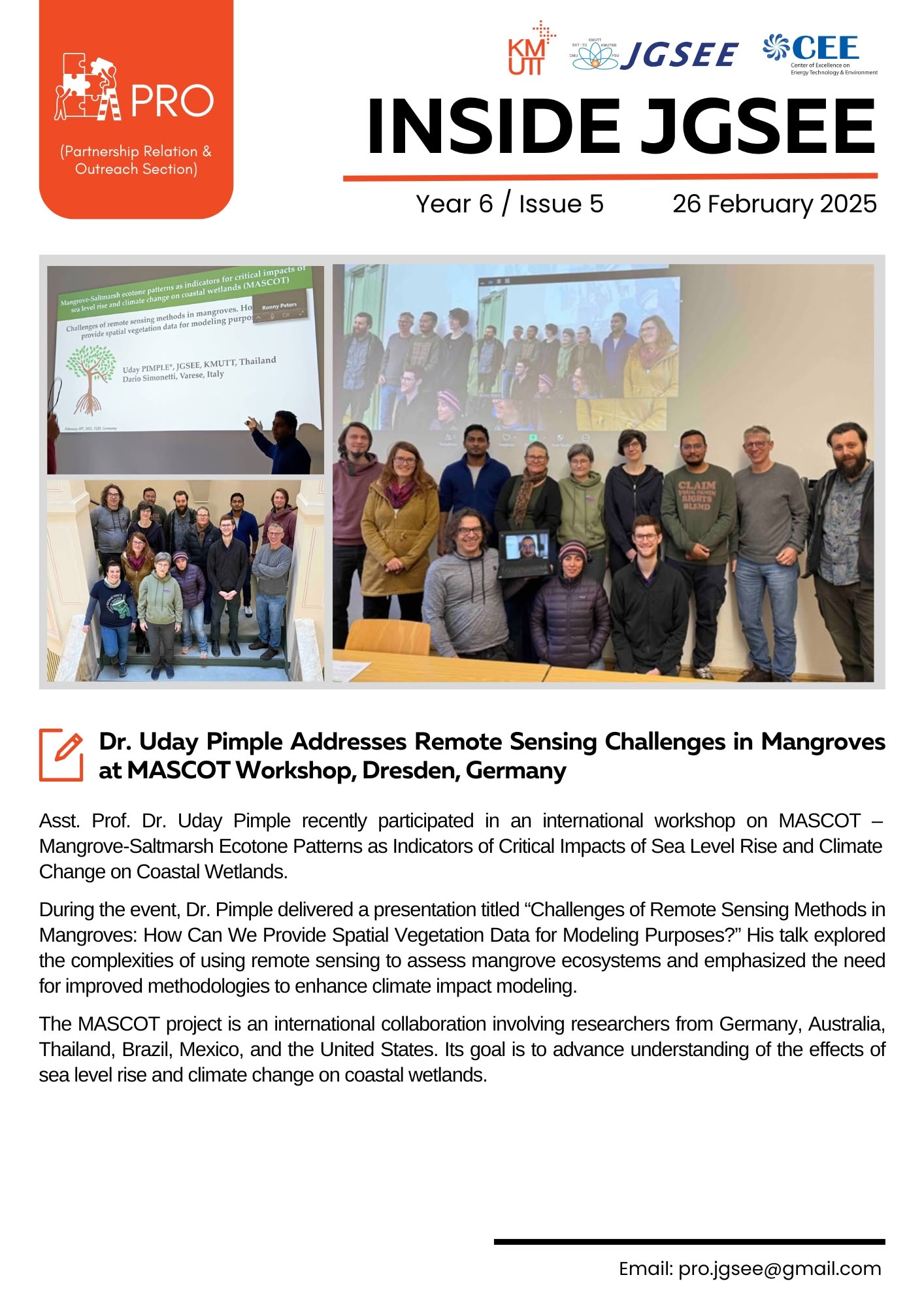
Mangrove remote sensing26 February 2025

Remote-sensing knowledge exchange on mangrove ecosystems at the MASCOT workshop in Dresden, Germany.

Inside JGSEE issue date: 26 February 2025.

Mangrove remote sensing. Inside JGSEE issue dated 26 February 2025.
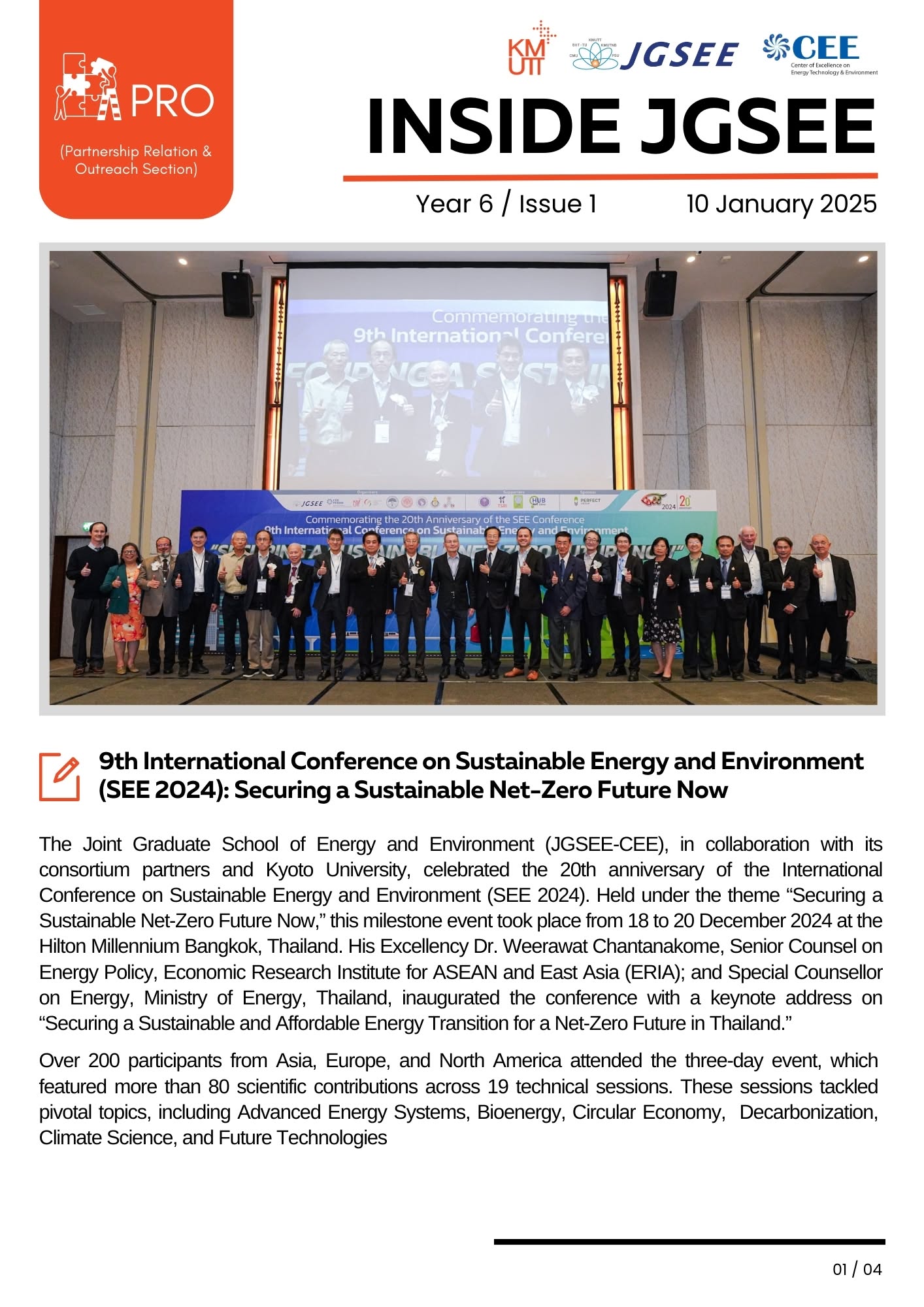
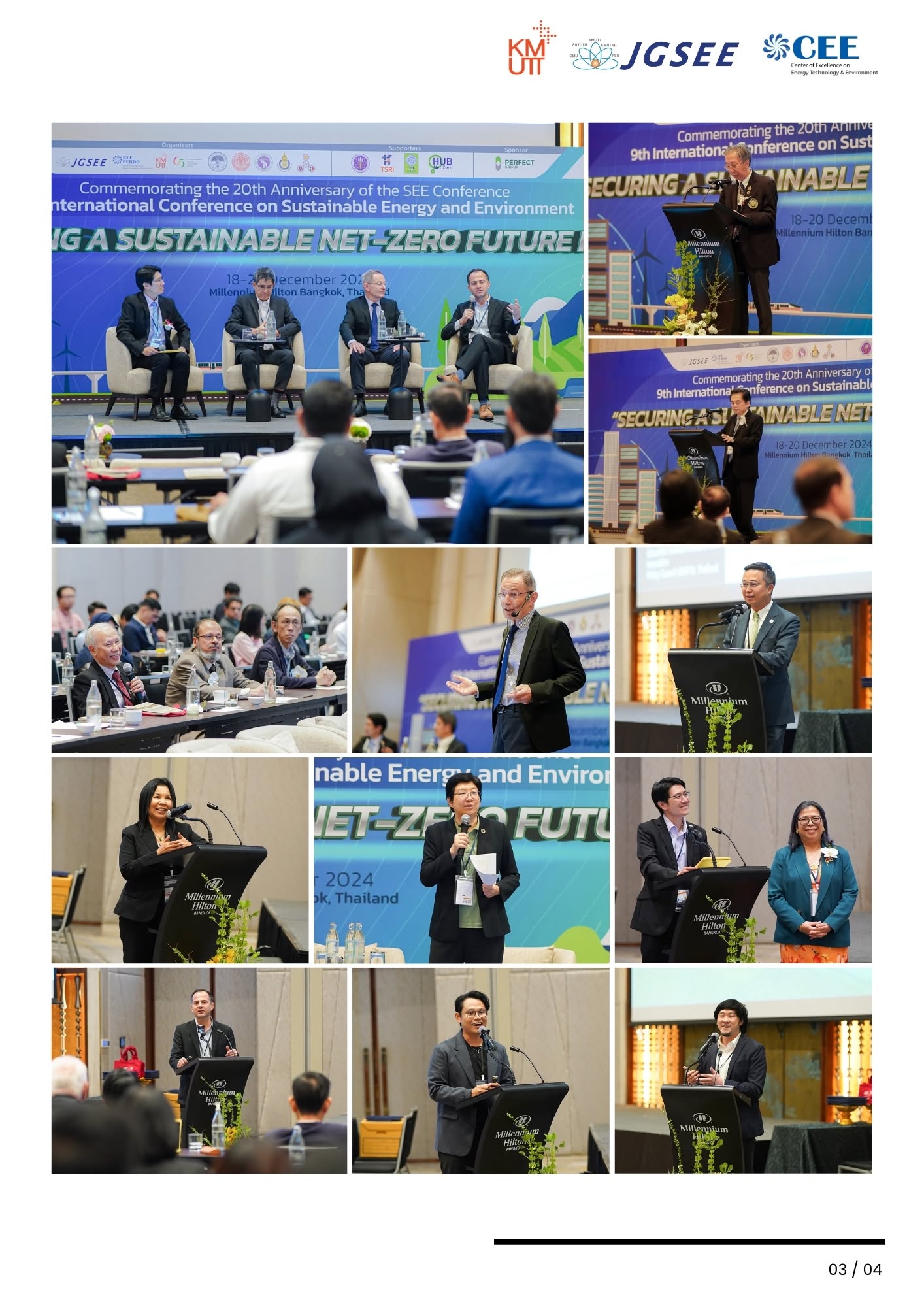
SEE 2024 conference10 January 2025

Historical coverage of the SEE 2024 conference held in December 2024. This is a January 2025 issue, not a 2025 event.

Inside JGSEE issue date: 10 January 2025.

SEE 2024 conference. Inside JGSEE issue dated 10 January 2025.
Sources and supporting links

2. Related information on our university having a university Climate Action plan, shared with local government and/or local community group.

The university climate plan

2040
Carbon neutrality target

KMUTT Carbon Neutrality 2040 framework sets the direction for institutional climate action. Its public roadmap combines energy efficiency, renewable power, transport changes, resource management and carbon sinks. A steering structure coordinates implementation and progress monitoring.

Published KMUTT policy roadmap to 2040. Its base year and projections are planning context, rather than observed 2025–2026 performance.

Plan components · Publicly described directions

Energy and buildings
Improve efficiency and expand renewable energy.
Transport and resources
Promote cleaner mobility and reduce waste through circular resource use.
Carbon sinks and participation
Support forest sequestration and university-wide engagement.

Working with local partners

Local engagement connects climate action with the needs of surrounding communities. The 2026 programme on the following page documents shared implementation with Bangkok’s local government and community partners.

August 2025

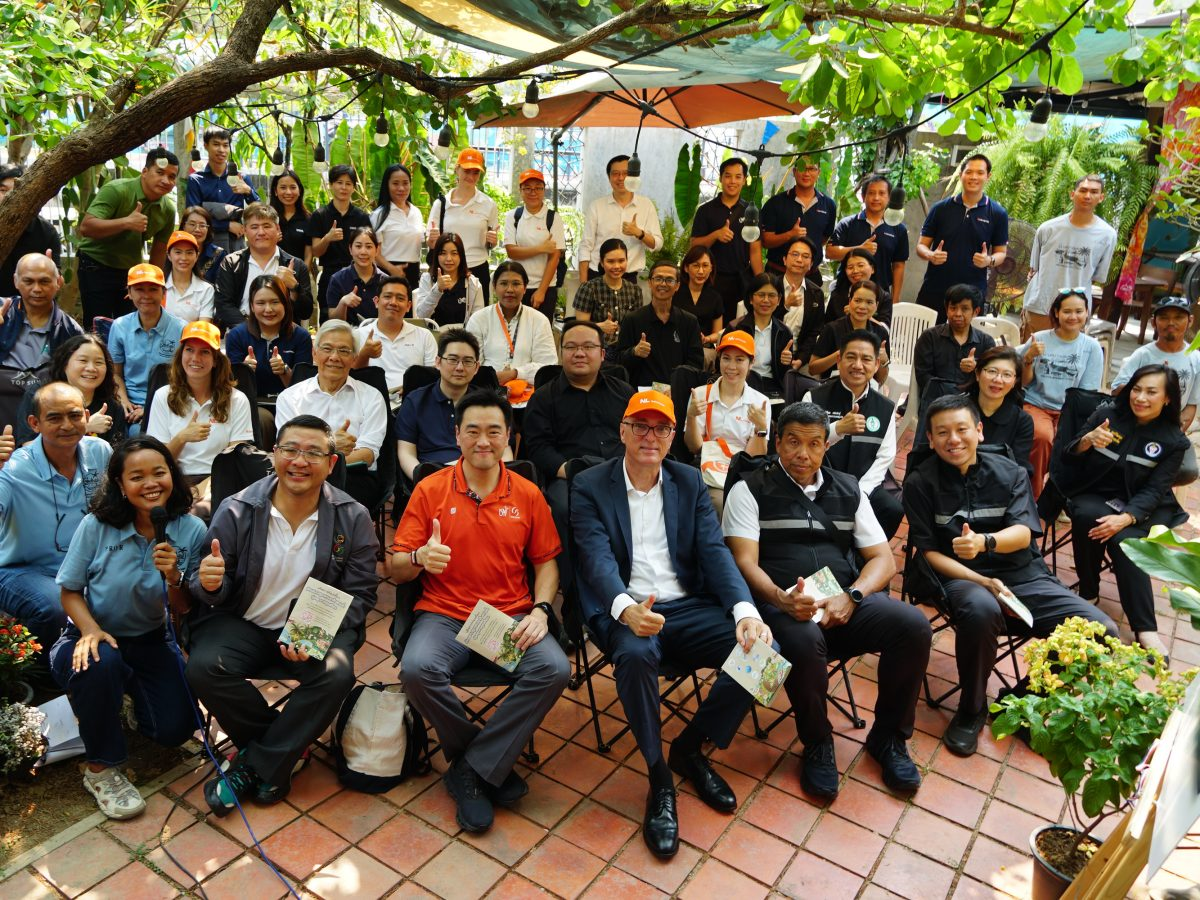
In August 2025, KMUTT launched its co-created low-carbon community programme in Thung Khru and Bang Khun Thian.

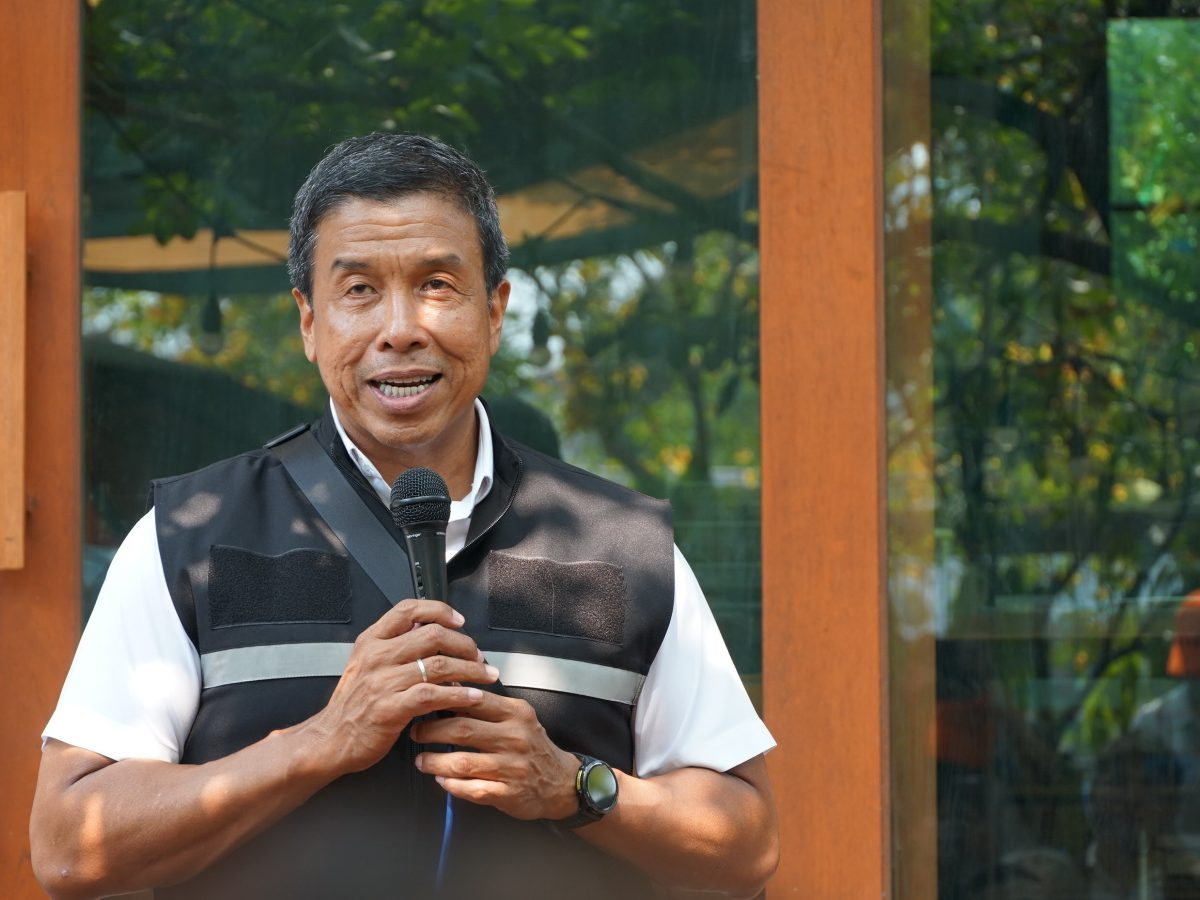
Bangkok’s Deputy Governor joined the briefing and community visit.

University project leaders presented work with eight local operators, while a community-enterprise representative described continuing cooperation.

The reported programme developed 12 low-carbon tourism routes, six in each district.

21 April 2026

The Bangkok Governor subsequently joined the community electric-boat launch on 21 April 2026.

University, city government and community partners

The electric-boat launch is documented in the KMUTT report published 15 May 2026.

12 low-carbon tourism routes

Reported programme across two districts

Thung Khru
6 routes
Bang Khun Thian
6 routes

The institutional roadmap sets the university’s priorities. The local record documents programme communication and collaborative implementation with government and community partners.

Communicating climate action

The university promotes the communication and dissemination of its climate-related strategies, targets, and implementation progress among faculty members, students, administrative units, research centers, and relevant stakeholders.

Climate action information is shared through institutional websites, sustainability reports, seminars, workshops, internal communication channels, and public engagement activities.

This approach encourages collective understanding and participation in achieving the university's climate objectives.

Furthermore, KMUTT encourages collaboration among academic departments, research centers, and operational units to integrate climate action into institutional planning and decision-making.

By sharing knowledge, implementation experiences, performance data, and good practices, the university aims to strengthen collective responsibility and create a coordinated approach to achieving its long-term climate targets.

More knowledge-exchange photographs
Institutional strategy and measures

KMUTT is committed to addressing climate change through institutional strategies, policies, and action plans that support the transition toward a low-carbon and climate-resilient university.

The university has established a long-term strategic commitment to achieving Carbon Neutrality by 2040, providing an institutional framework for greenhouse gas emissions reduction, energy efficiency improvement, renewable energy development, and sustainable campus management.

Key components of KMUTT climate action initiatives include improving energy performance, increasing the utilization of renewable energy, promoting energy-efficient buildings and equipment, reducing waste generation, enhancing resource efficiency, and conserving natural ecosystems.

The university also supports carbon assessment and monitoring to evaluate greenhouse gas emissions and identify opportunities for further reductions.

Sources and supporting links

3. Related information on our university on participating in co-operative planning for climate change disasters, working with government.

Planning for flood risk

Nakhon Pathom
Integrated water management

12 March 2026
Provincial cooperation forum

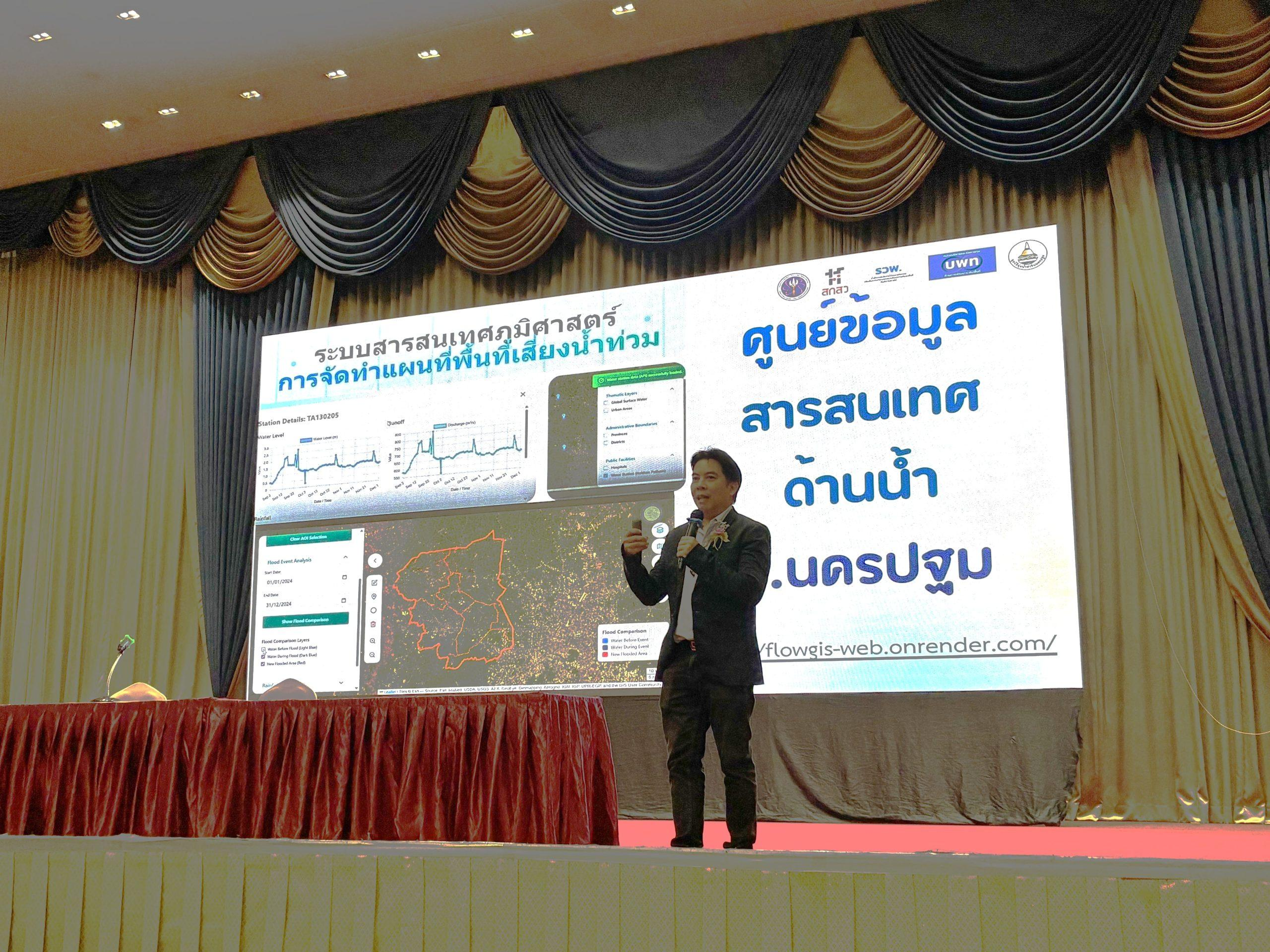
KMUTT KGEO team contributes technical expertise to integrated water management in Nakhon Pathom.

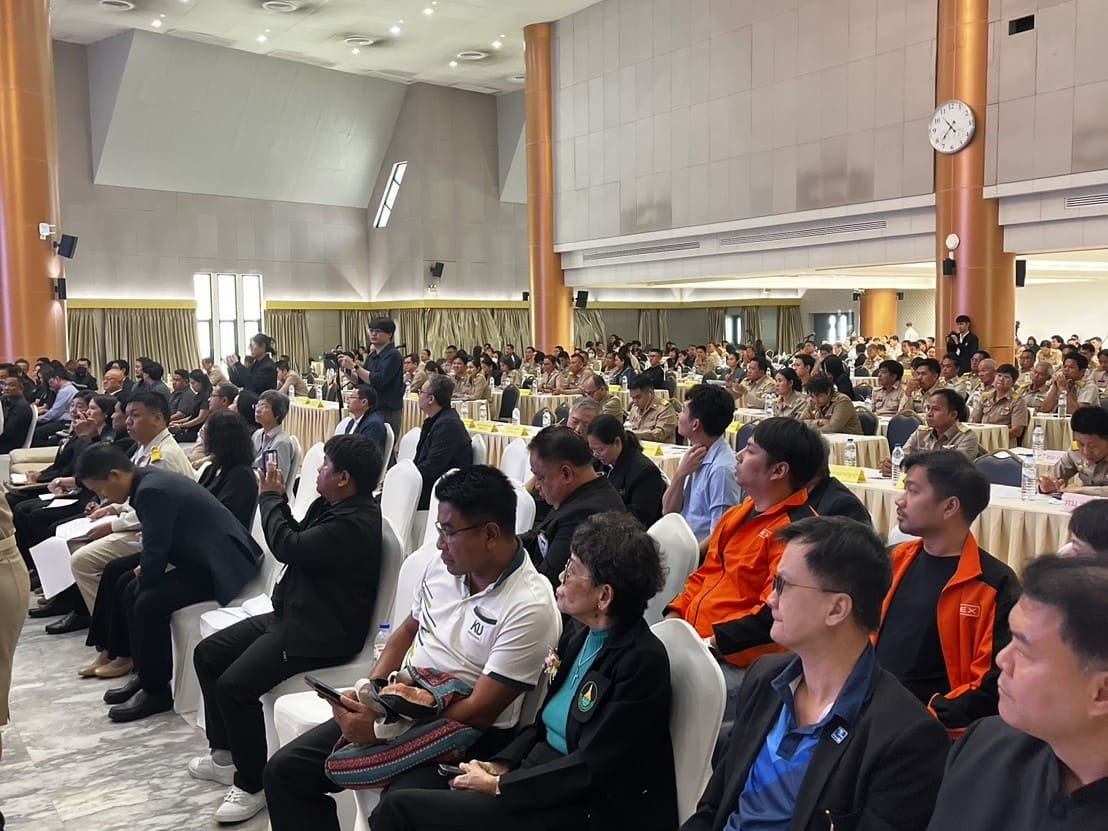
A forum on 12 March 2026 brought the research team, provincial leadership and local authorities together to strengthen cooperation on recurrent flooding and water quality.

Nakhon Pathom water-management forum, 12 March 2026. KMUTT institutional photograph.

Partners in preparedness

Partner or level · Documented role in the collaboration

Provincial government
The Nakhon Pathom Governor chaired the forum.
Local government
Provincial Administrative Organisation and local-authority leaders participated.
National enabling partners
ONWR and PMU A support the area-based water-management framework.
Research and civil society
University researchers and the Tha Chin River Basin Nakhon Pathom Foundation participate.

A shared mechanism

The programme provides a common forum for public agencies, local authorities, businesses and community networks to improve water management.

PMU A identifies Nakhon Pathom as one of five pilot provinces in its cooperation with ONWR, with local ownership and capacity building as central objectives.

The collaboration addresses recurrent flooding alongside water-quality problems.

Integrating information and strengthening local capacity support preparedness for water-related hazards.

The March forum brought provincial leadership and local government into the same planning and knowledge-exchange process.

Research into practice

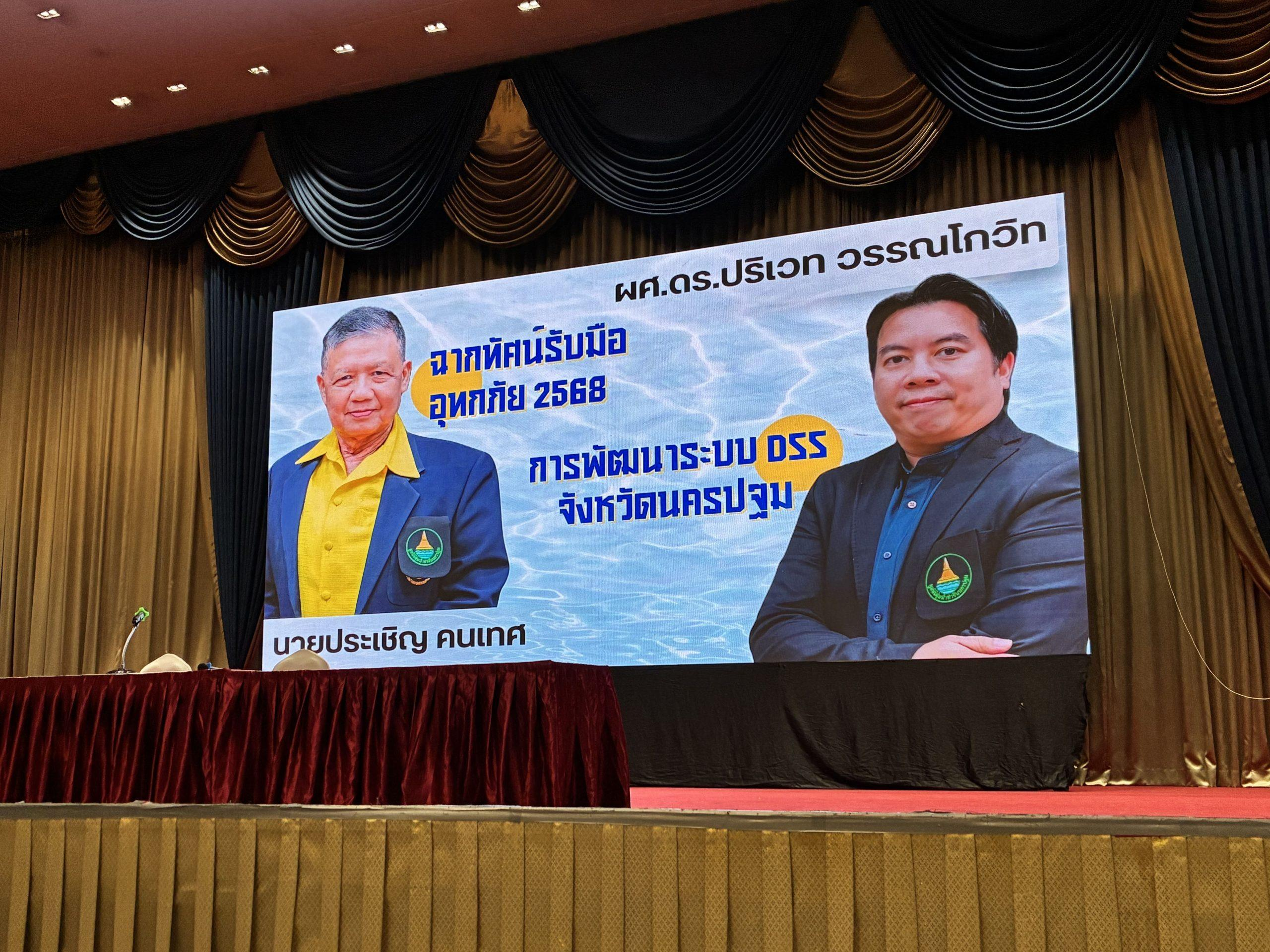
At the March 2026 forum, KMUTT researchers presented “2025 flood-response scenarios” and progress on a decision-support system. The Faculty of Science reports a handover of research knowledge, technical information and policy recommendations to the Governor and the Provincial Administrative Organisation president.

Research for resilience

The university supports research, academic activities, and knowledge exchange related to climate risk assessment, environmental monitoring, sustainable infrastructure, water resource management, and climate change adaptation.

Through its academic expertise and research capabilities, KMUTT contributes scientific knowledge and technological solutions that can support the understanding and management of climate-related risks.

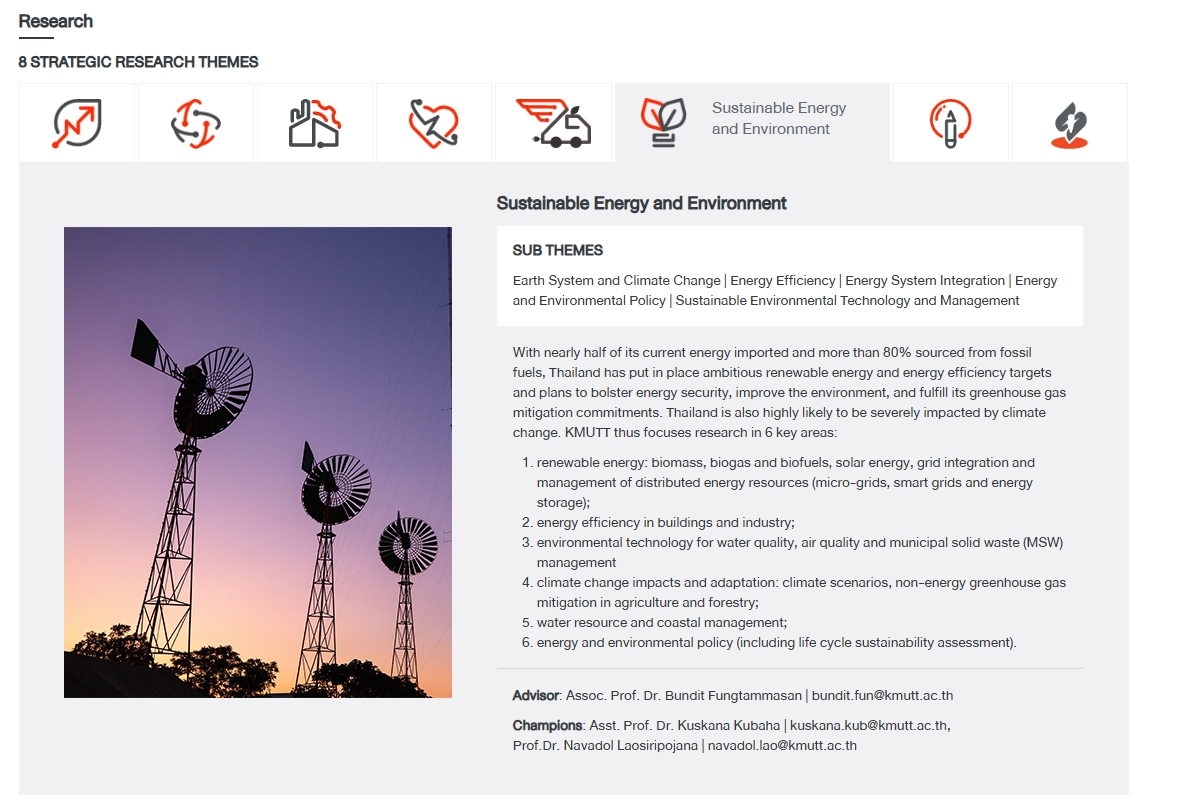
KMUTT research themes covering climate impacts, adaptation and water resources. Standing institutional research context.
Institutional approach to resilience

KMUTT recognizes that climate change increases the frequency and intensity of various climate-related hazards, including extreme rainfall, flooding, heatwaves, droughts, and other environmental emergencies.

These challenges require coordinated planning, scientific knowledge, and collaboration among universities, government agencies, local authorities, and communities to improve disaster preparedness and climate resilience.

KMUTT also promotes cooperation among relevant university departments and external stakeholders to strengthen preparedness and develop appropriate responses to environmental emergencies.

Educational activities and knowledge-sharing programmes help raise awareness of disaster risks, emergency preparedness, resource management, and the importance of community participation in reducing vulnerability to climate-related impacts.

In addition, the university encourages the application of research findings and technological innovations to support climate-resilient development.

These approaches include environmental data analysis, sustainable energy systems, nature-based solutions, ecosystem restoration, and the development of appropriate technologies for communities affected by environmental changes.

Through these efforts, KMUTT aims to contribute to collaborative climate adaptation planning and strengthen the resilience of society to future climate-related disasters.

Sources and supporting links

4. Related information on our university on informing and supporting local or regional government in local climate change disaster/risk early warning and monitoring.

Flood-risk information

Nakhon Pathom
Government-facing technical support

12 March 2026
KMUTT research presentation

On 12 March 2026, KMUTT KGEO team presented work on flood scenarios and a decision support system for Nakhon Pathom.

The university report connects the system with flood forecasting and early warning, and records the transfer of technical information and policy recommendations to the Governor and Provincial Administrative Organisation President.

Water-information presentation, March 2026. Source: KMUTT.

Information into decisions

Support element · Government-facing contribution

Risk information
Geo-Social Maps used to analyse local problems.
Monitoring and warning
DSS development and shared warning information.
Government recipients
Provincial Governor and Provincial Administrative Organisation President.

Preparing local institutions

7 May 2025

An official meteorological report dated 7 May 2025 documents the wider programme’s consultation with the Governor about flood-risk areas for May-October 2025 and project progress.

This provides the preceding government-planning context; KMUTT contribution is documented separately in March 2026.

March 2026

In a March 2026 interview, the head of KGEO described engagement with 117 local authorities in learning and decision-support development.

Community researchers used Geo-Social Maps to analyse problems and connect proposed interventions with Thai Water Plan.

These are reported programme mechanisms for bringing technical information into local decisions.

Interview account published by Thai PBS The Active on 16 March 2026.

Forum participants, 12 March 2026. Source: KMUTT.
Broader research and government support

KMUTT plays an important role in supporting government agencies and public-sector organizations through scientific research, technical expertise, academic services, and policy-relevant knowledge related to climate change and environmental sustainability.

As a technology-oriented university, KMUTT utilizes its research capabilities and interdisciplinary expertise to generate evidence-based information and practical recommendations that can support national climate policies, greenhouse gas emissions reduction strategies, renewable energy development, and sustainable environmental management.

The university conducts research and provides technical knowledge in areas such as greenhouse gas inventory and assessment, carbon footprint management, renewable energy technologies, energy efficiency, carbon sequestration, climate change mitigation, and ecosystem conservation.

These research outcomes can support government agencies in evaluating environmental conditions, identifying appropriate interventions, and developing effective approaches to achieving national climate objectives.

KMUTT also promotes academic cooperation and knowledge exchange with government organizations through research partnerships, technical consultations, seminars, workshops, and collaborative projects.

These activities provide opportunities to share scientific findings, demonstrate innovative technologies, and strengthen the technical capacity of relevant government personnel.

Furthermore, KMUTT research on mangrove restoration, blue carbon sequestration, forest carbon assessment, and renewable energy provides scientific information that can contribute to national environmental conservation and climate mitigation efforts.

Through these academic and technical contributions, the university seeks to support evidence-based policymaking and strengthen cooperation between higher education institutions and government agencies in addressing climate change.

Sources and supporting links

5. Related information on our university on collaboration with NGOs on climate adaptation.

NGO climate collaboration

The Tha Chin River Basin Nakhon Pathom Foundation participates in a programme addressing recurrent floods and water quality.

KMUTT KGEO researcher and the Foundation representative jointly presented flood-scenario and decision-support work in March 2026.

Joint presentation, 12 March 2026. Source: KMUTT.

The NGO partner

Partner identification · Verified information

NGO partner
Tha Chin River Basin Nakhon Pathom Foundation.
Public registration
DCCE environmental NGO register 23/2549; registered 2 November 2006.
University contribution
KGEO research expertise and participation in the water-management forum.
Adaptation focus
Recurrent flooding, integrated information and local capacity for water management.

Working with communities

The government account of the 12 March 2026 forum identifies the province and Foundation as partners, alongside university researchers and local-authority leaders.

Its purpose was to share results and strengthen cooperation on recurring floods and water pollution.

This supports a community-facing approach to water-related climate adaptation.

Water-management forum, March 2026. Source: KMUTT.

Continuing community links

The Foundation manager also joined KMUTT community-development partners at an activity on 1 February 2026.

Activity: 1 February 2026. University news published: 9 February 2026.

Community learning

The university also supports community-based environmental learning through research and conservation activities, including mangrove forest restoration and blue carbon research.

These initiatives provide opportunities for students, researchers, local communities, and external organizations to exchange knowledge and participate in environmental conservation activities.

By integrating scientific knowledge with local experience, such collaborations can strengthen community understanding of climate change and encourage practical environmental action.

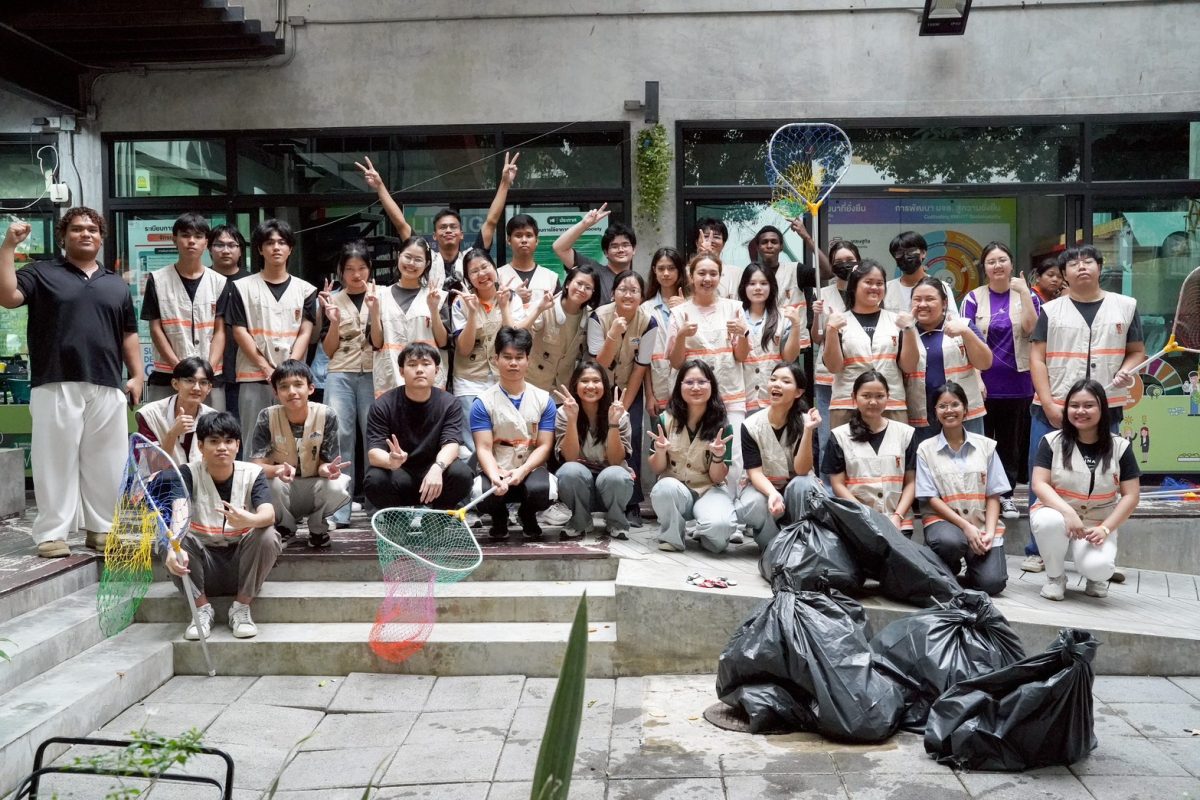
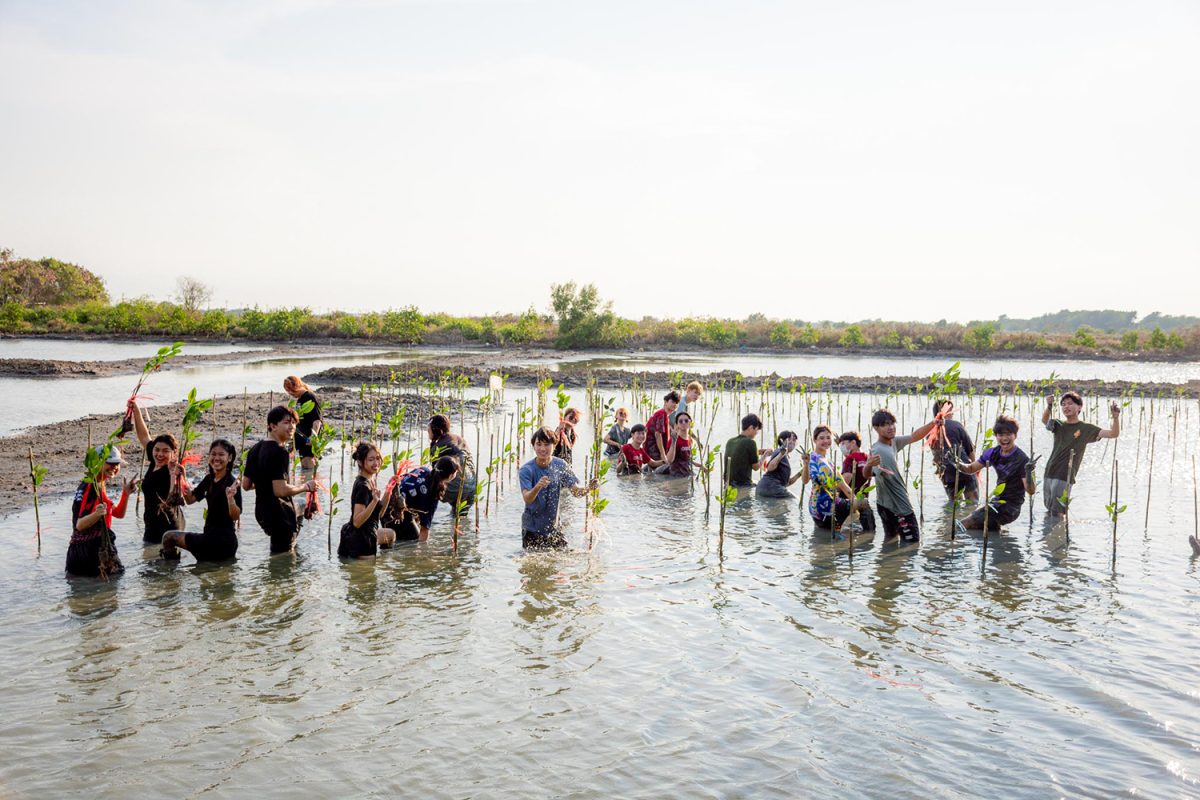
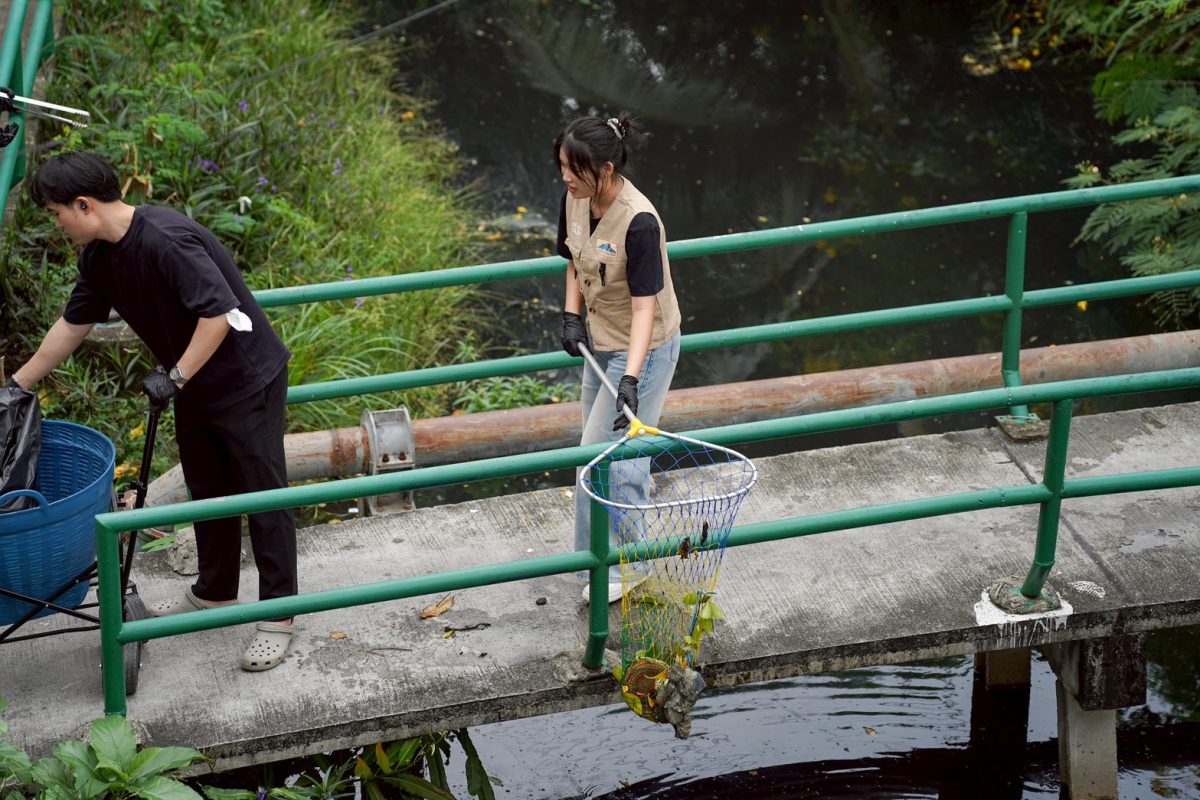
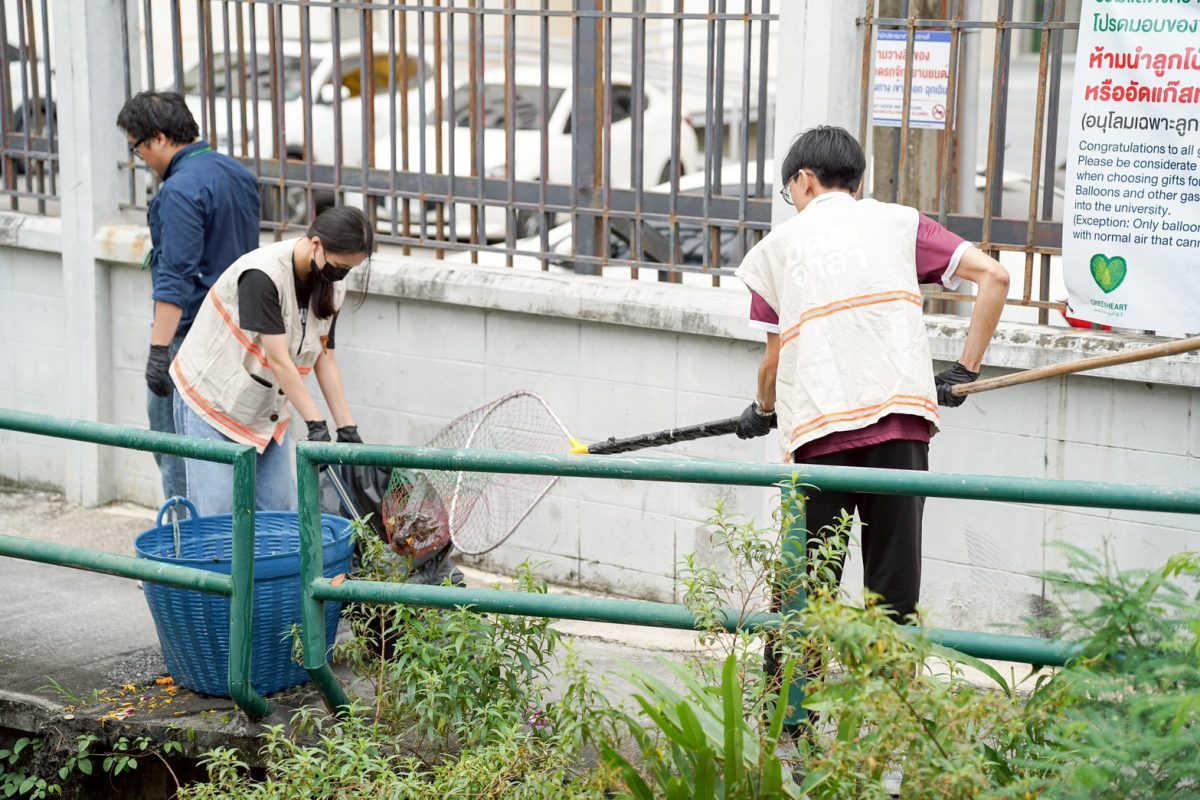
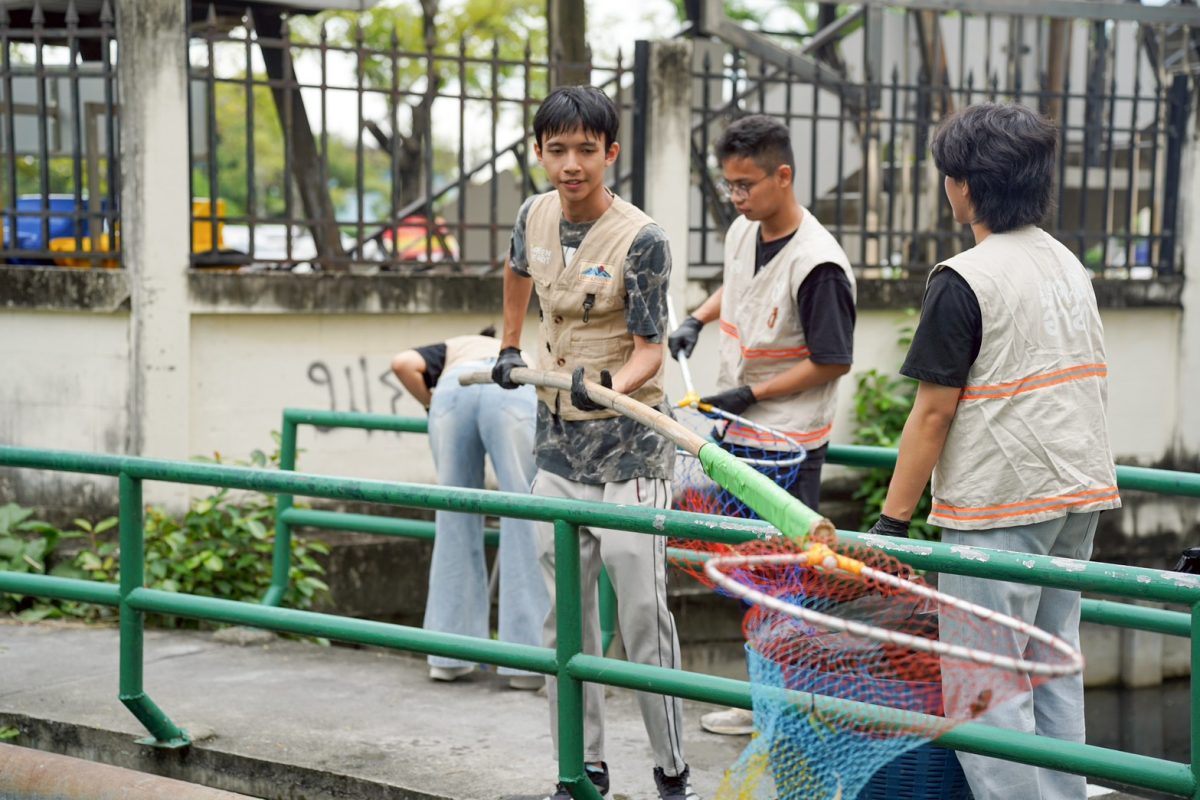
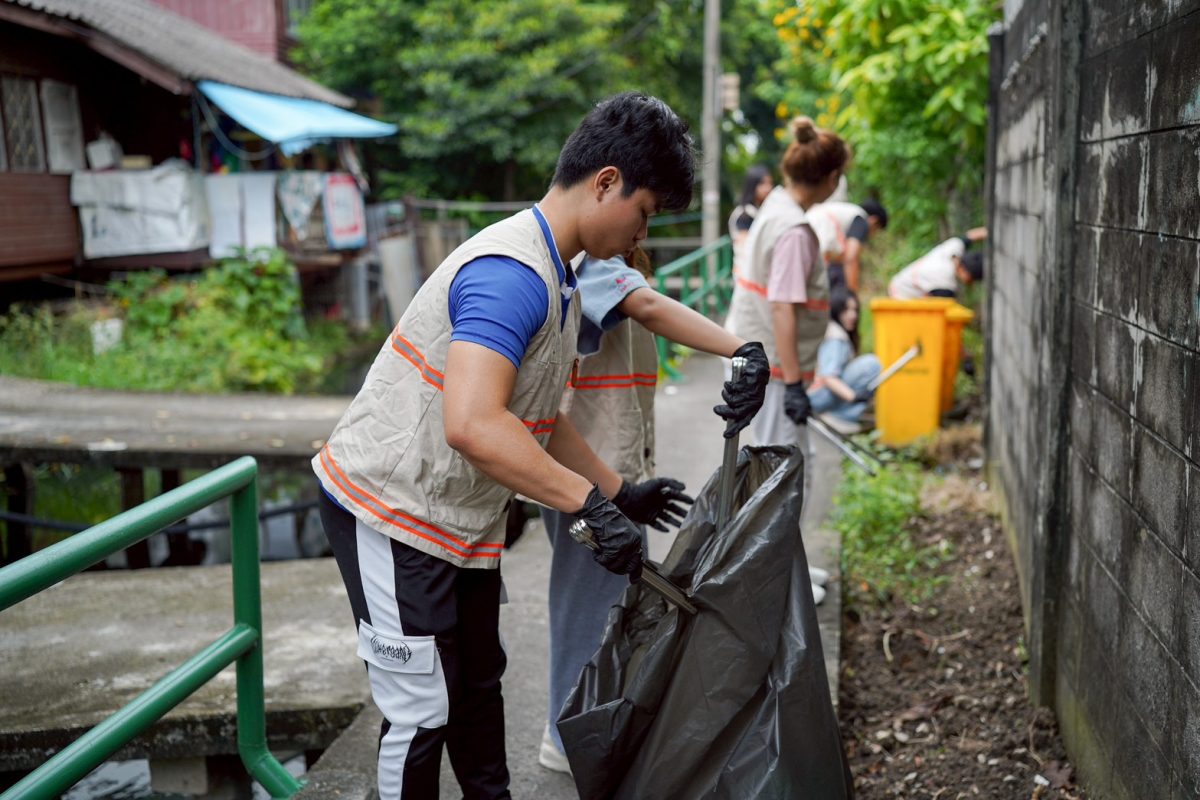
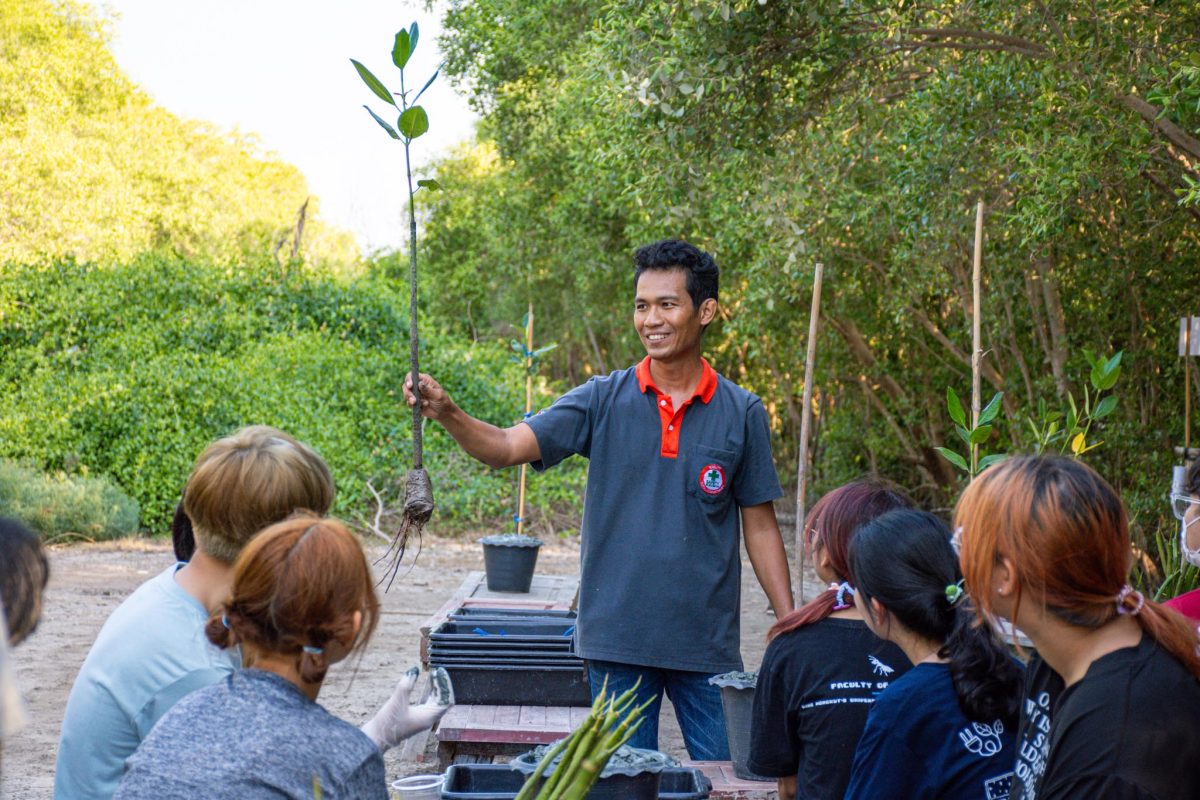
Community environmental learning and conservation photographs from the institutional background record; individual activity dates are not specified.

Environmental clean-up activities
Mangrove learning and conservation
Environmental partnerships and education

KMUTT recognizes the importance of collaboration with non-governmental organizations (NGOs), civil society organizations, local communities, and other external stakeholders in promoting environmental education and advancing climate action.

The university encourages partnerships that facilitate knowledge exchange, public participation, environmental awareness, and the development of practical solutions to environmental challenges.

Through academic networks, community engagement activities, research collaborations, and environmental campaigns, KMUTT promotes opportunities for NGOs and relevant organizations to participate in environmental education programmes.

Collaborative activities may address climate change awareness, renewable energy, energy conservation, waste management, sustainable consumption, biodiversity conservation, forest restoration, and natural resource protection.

In addition, KMUTT promotes the dissemination of environmental knowledge through seminars, public workshops, educational materials, and awareness campaigns.

Cooperation with NGOs and civil society organizations can help extend the reach of these initiatives beyond the university and encourage broader public participation in sustainability activities.

Through these collaborative approaches, KMUTT aims to strengthen partnerships between academia and civil society, support inclusive environmental education, and promote collective responsibility for climate action.

These efforts contribute to building environmentally aware communities and advancing the university's commitment to sustainable development and Carbon Neutrality by 2040.

Sources and supporting links

13.4 COMMITMENT TO CARBON NEUTRAL UNIVERSITY

1. Related information on our university have a target date by which it will become carbon neutral according to the Greenhouse Gas Protocols

A dated commitment

Carbon neutrality target
2040
Official announcement
2 November 2021

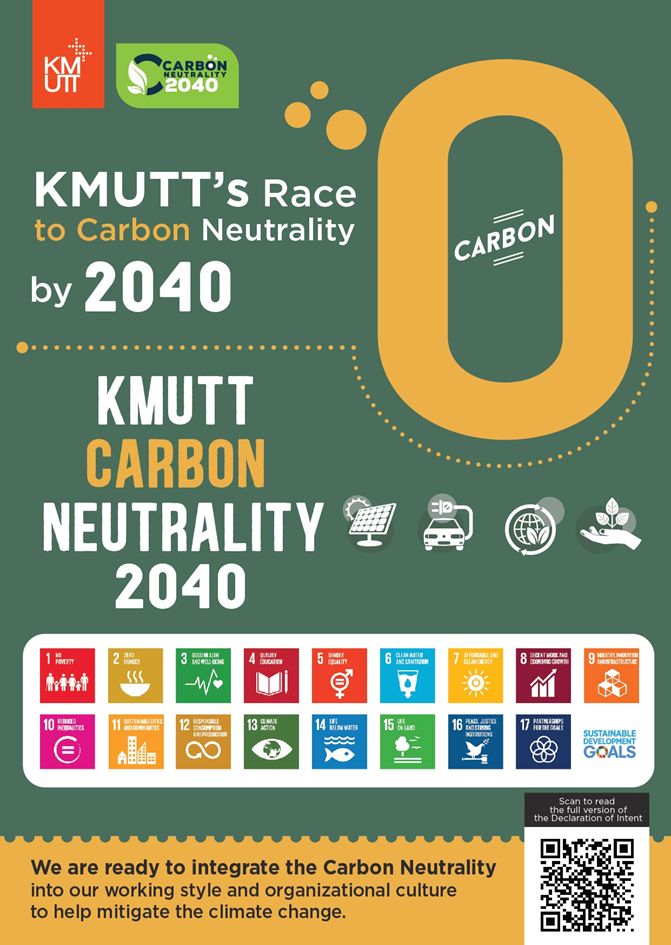
One of the important goals of KMUTT Sustainability strategy is to reduce its carbon emissions to net zero emissions by 2040 under the “KMUTT Race to Carbon Neutrality by 2040” initiative through the increased use of renewable energy, enhancement of energy efficiency in building and transport, efficient use of resource and recycle and forest carbon sequestration.

The November 2021 declaration sets an organisational ambition across all KMUTT campuses, supported by a dedicated committee and working group.

The announcement date is stated in the official English declaration. The supplied attribution is dated November 2021.

KMUTT Race to Carbon Neutrality by 2040 campaign poster
KMUTT Race to Carbon Neutrality by 2040 campaign poster. The original institutional artwork is retained unchanged.
Read the November 2021 declaration

Declaration of Intent ‘KMUTT Race to Carbon Neutrality by 2040’

Climate change is one of the greatest challenges we are facing nowadays. Together with many countries around the world, Thailand has joined the Paris Agreement and put forward its best efforts to reduce greenhouse gas emissions to combat climate change. With the strong intention of Thailand to become a low carbon and climate resilient society, Prime Minister announced at the 2021 United Nations Climate Change Conference (COP26) in Glasgow, Scotland, on November 1st, 2021, Thailand’s commitment to reach Carbon Neutrality by 2050 and to reduce all greenhouse gas emissions to net zero by 2065.

KMUTT has a clear policy to strive to become a Sustainable University based on the Sufficiency Economy Philosophy and the UN Sustainable Development Goals. One of the important goals of KMUTT Sustainability strategy is to reduce its carbon emissions to net zero emissions by 2040 under the “KMUTT Race to Carbon Neutrality by 2040” initiative through the increased use of renewable energy, enhancement of energy efficiency in building and transport, efficient use of resource and recycle and forest carbon sequestration.

The committee and working group to drive KMUTT to net zero carbon emissions, appointed as a special taskforce for this initiative, now develop strategic and action plans as well as monitor and evaluate the plans to reach the expected targets.

The working team will promote, support, and coordinate with all internal units and communities around KMUTT for their participation and cooperation, both in planning and implementation stage.

“KMUTT Race to Carbon Neutrality by 2040” will be a new strategic goal for KMUTT sustainability which is integrated with the other five key strategic goals including student engagement, research and innovation impact, community engagement, green university and infrastructure, and sustainable management.

Carbon Neutrality will become a part of our working style and organizational culture. Everybody will have an understanding and awareness of the climate change and its impact and be willing to help mitigate it.

With the clear intention to move the organization forward to net zero carbon emissions, KMUTT has been invited to be a founding member of RE100 Thailand Club initiated by the Federation of Thai Industries. KMUTT has also joined Thailand Carbon Neutral Network, founded by Thailand Greenhouse Gas Management Organization and the global campaign “Race To Zero”, which emphasize that, as an educational institution, we are ready to commit to the public both in national and international networks that all the KMUTT campuses are trying to achieve net zero carbon emissions at the organizational level.

Assoc. Prof. Dr. Suvit SeaTia President, KMUTT November 2021

From commitment to action

Plan

Develop strategic and action plans through the appointed committee and working group.

Coordinate

Promote, support and coordinate participation by internal units and surrounding communities.

Monitor

Monitor and evaluate plans against the expected targets.

Five connected strategic goals

  • Student engagement
  • Research and innovation impact
  • Community engagement
  • Green university and infrastructure
  • Sustainable management

Networks in the declaration

  • RE100 Thailand Club
  • Thailand Carbon Neutral Network
  • Race To Zero
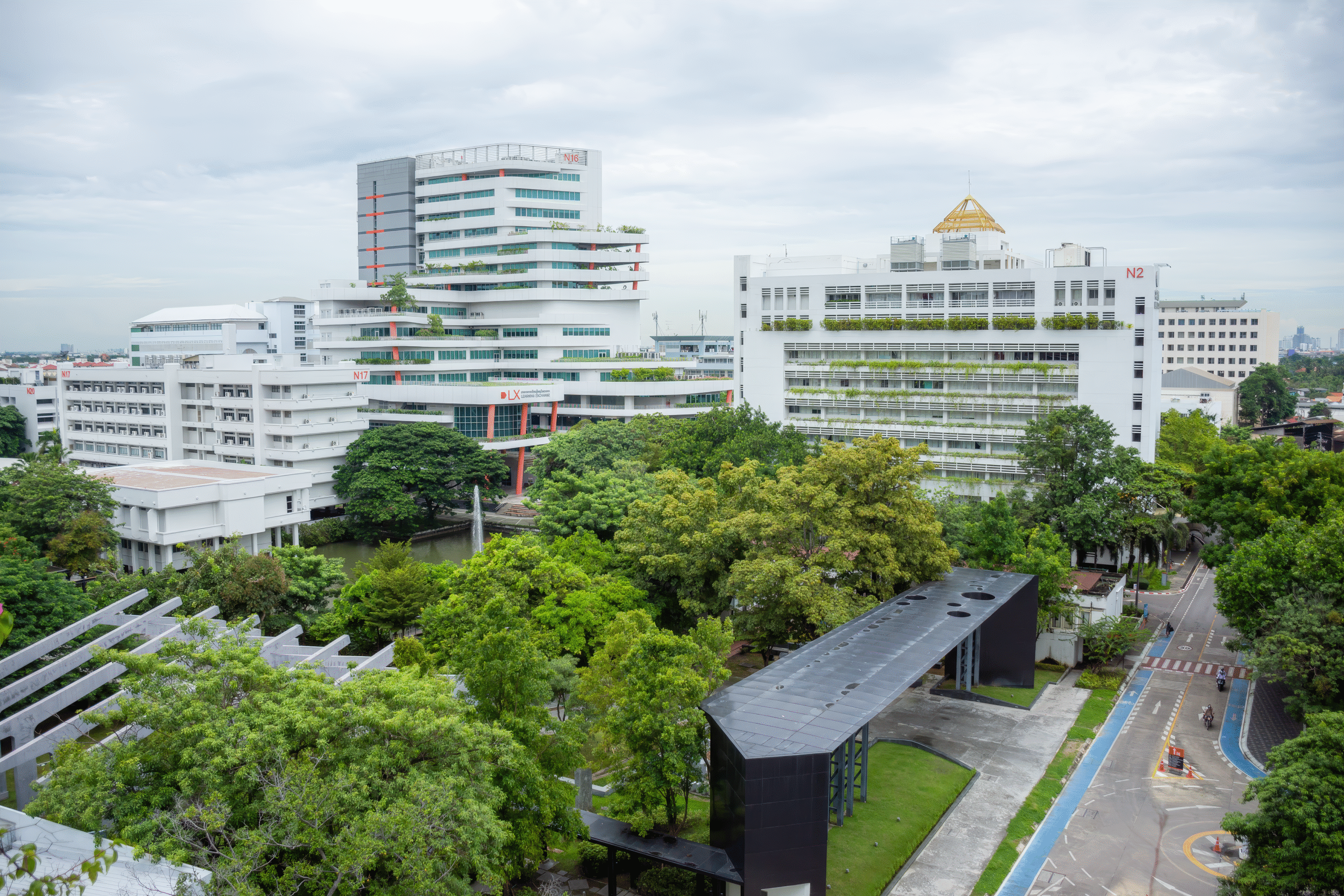
Campus buildings and green space in the photograph supplied with the declaration evidence.

The declaration describes cooperation across the university, including staff, students, internal units and surrounding communities.

Research behind climate action

King Mongkut’s University of Technology Thonburi (KMUTT) recognizes the importance of research and innovation in addressing climate change and supporting the transition toward a low-carbon and climate-resilient society.

The university actively promotes and conducts interdisciplinary research focusing on climate change mitigation, greenhouse gas (GHG) emissions reduction, renewable energy development, energy efficiency, carbon management, sustainable resource utilization, and ecosystem conservation.

These research activities aim to generate scientific knowledge, develop innovative technologies, and provide practical solutions that contribute to addressing the global climate crisis.

Energy and carbon management

KMUTT researchers and research centers undertake various projects to develop and improve clean energy technologies, including solar photovoltaic systems, energy storage, bioenergy, waste-to-energy technologies, and advanced energy management systems. In addition, research is conducted on carbon capture and utilization, carbon footprint assessment, greenhouse gas emissions monitoring, and strategies for enhancing organizational and community-level carbon reduction. These efforts support the development of evidence-based approaches to reducing carbon emissions and improving energy and environmental performance.

Ecosystems and carbon storage

Furthermore, KMUTT emphasizes nature-based solutions and ecosystem restoration as important components of climate action. Research on mangrove forest restoration, blue carbon sequestration, forest carbon assessment, biodiversity conservation, and ecosystem services contributes to understanding the role of natural ecosystems in absorbing and storing atmospheric carbon dioxide. The university also supports the application of scientific methods and advanced monitoring technologies to evaluate carbon sequestration potential and assess the long-term environmental benefits of ecosystem conservation and restoration.

Collaboration and student learning

Through collaboration among academic departments, research centers, government agencies, private-sector organizations, and international partners, KMUTT promotes the transfer of research findings into practical applications, policy recommendations, and sustainable technologies. The university also encourages student participation and capacity building through research-based learning, academic collaboration, and knowledge-sharing activities to strengthen climate awareness and engagement across the university community.

These research initiatives are closely aligned with the United Nations Sustainable Development Goal 13 ( Climate Action), as well as SDG 7 ( Affordable and Clean Energy), SDG 11 ( Sustainable Cities and Communities), SDG 12 ( Responsible Consumption and Production), and SDG 15 ( Life on Land). Ultimately, KMUTT aims to strengthen its role as a leading research and innovation institution that contributes to national and global climate action while supporting Thailand’s transition toward a low-carbon society and the university’s long-term commitment to achieving Carbon Neutrality by 2040.

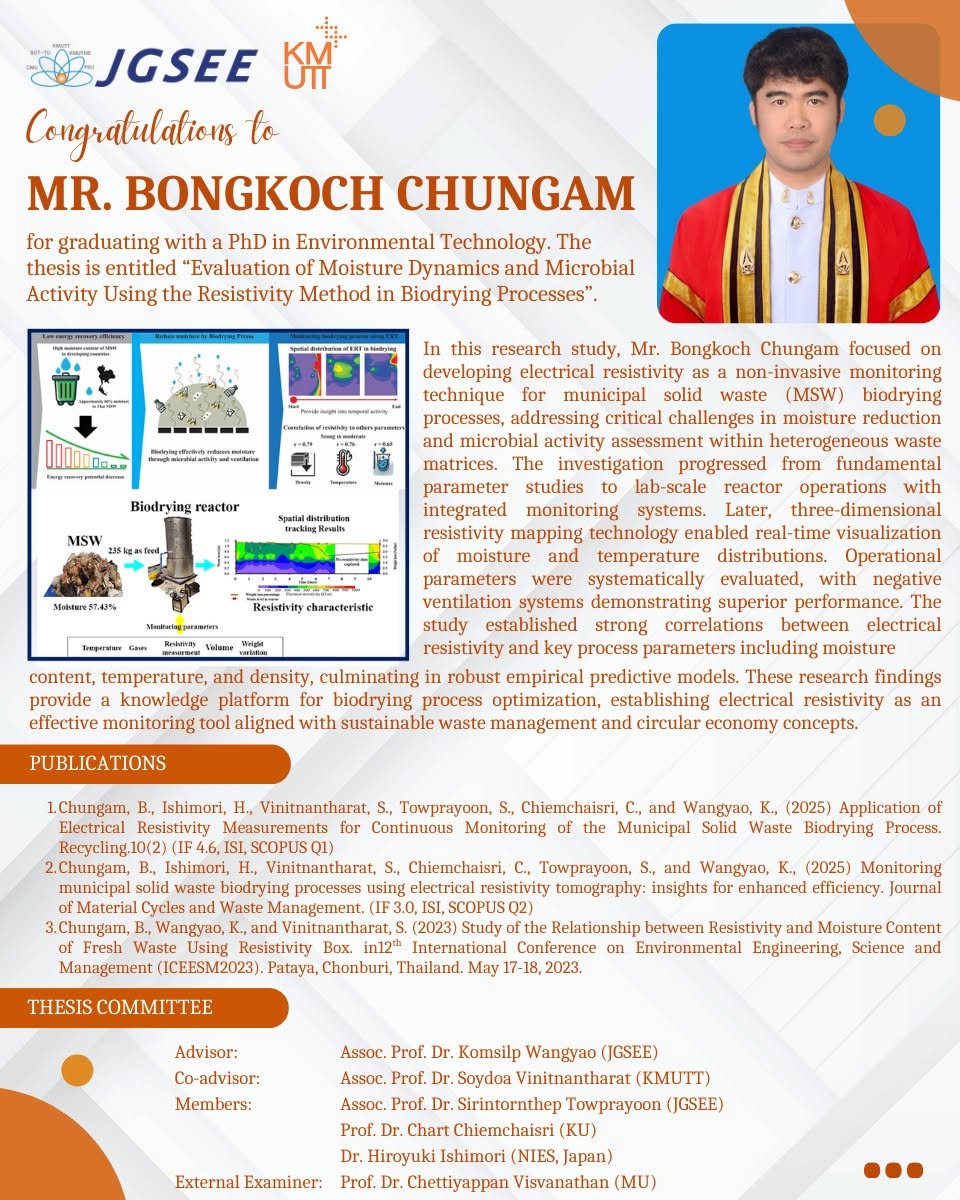
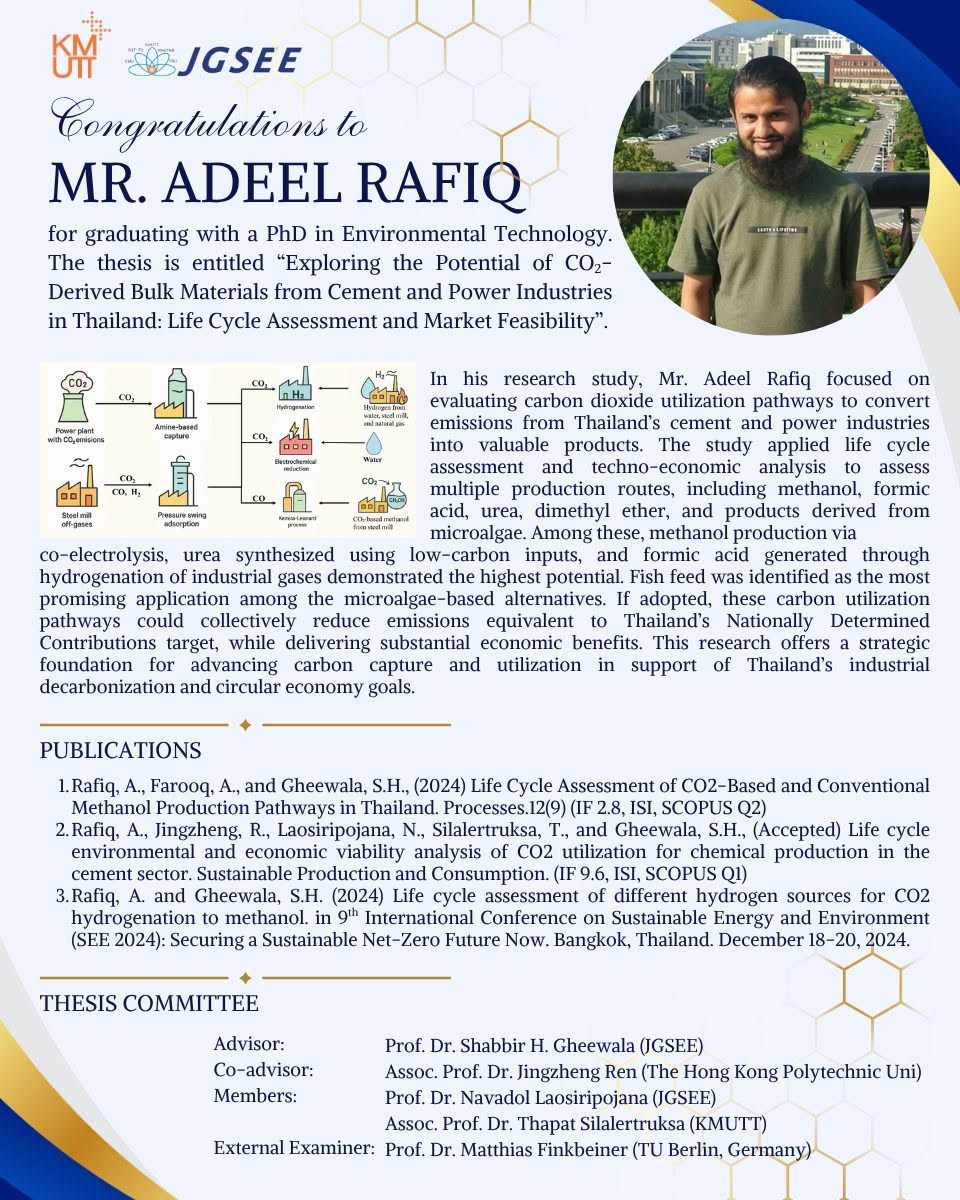
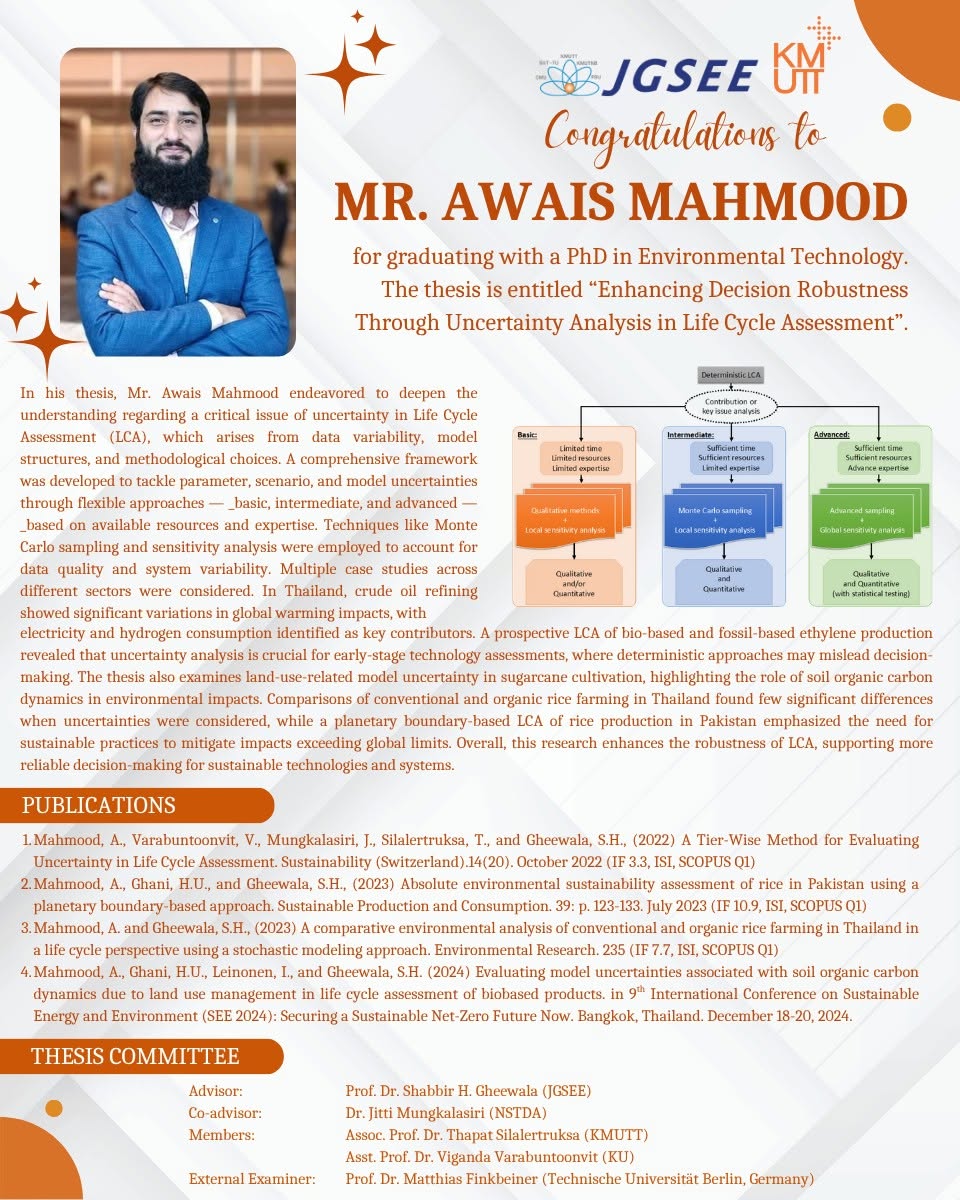
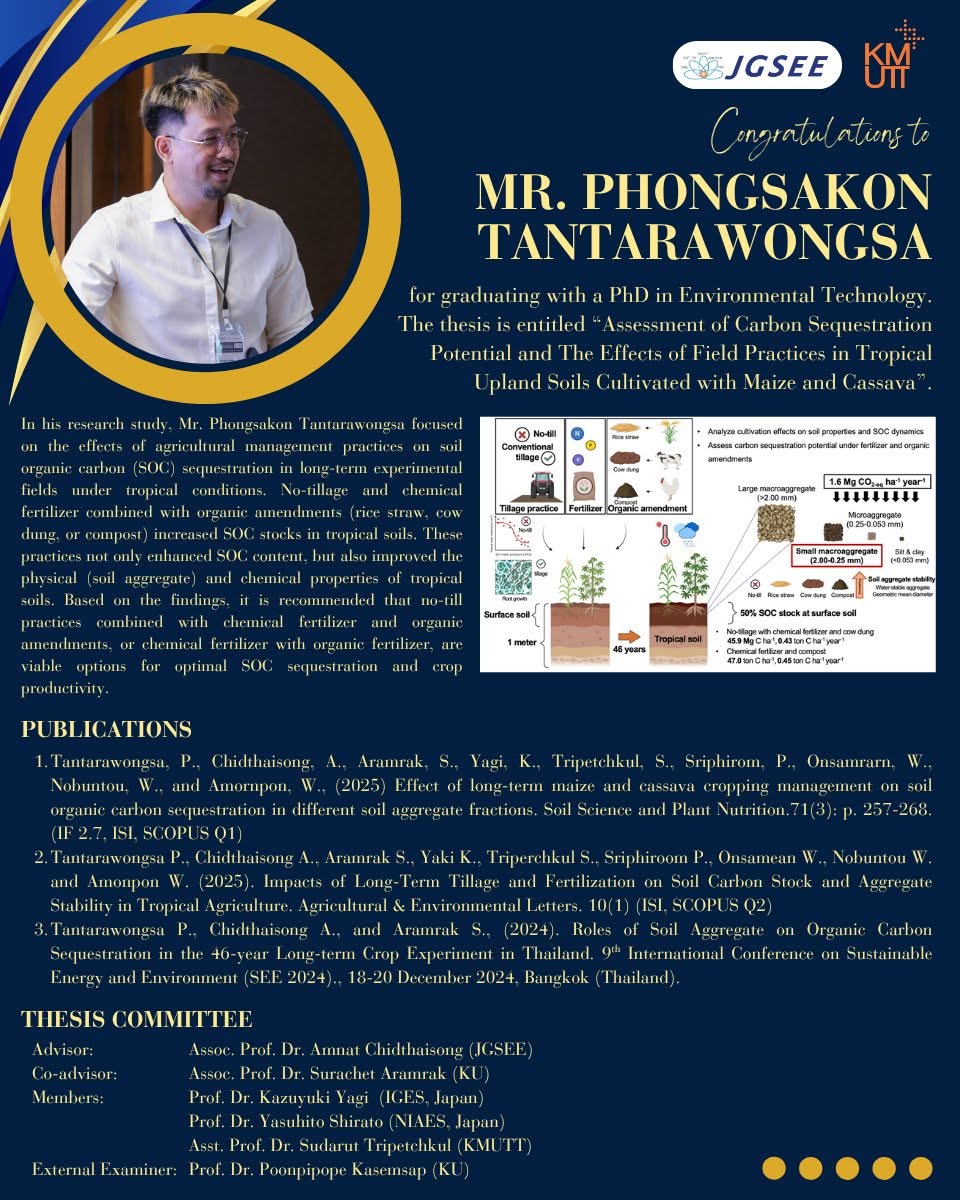
Research profiles

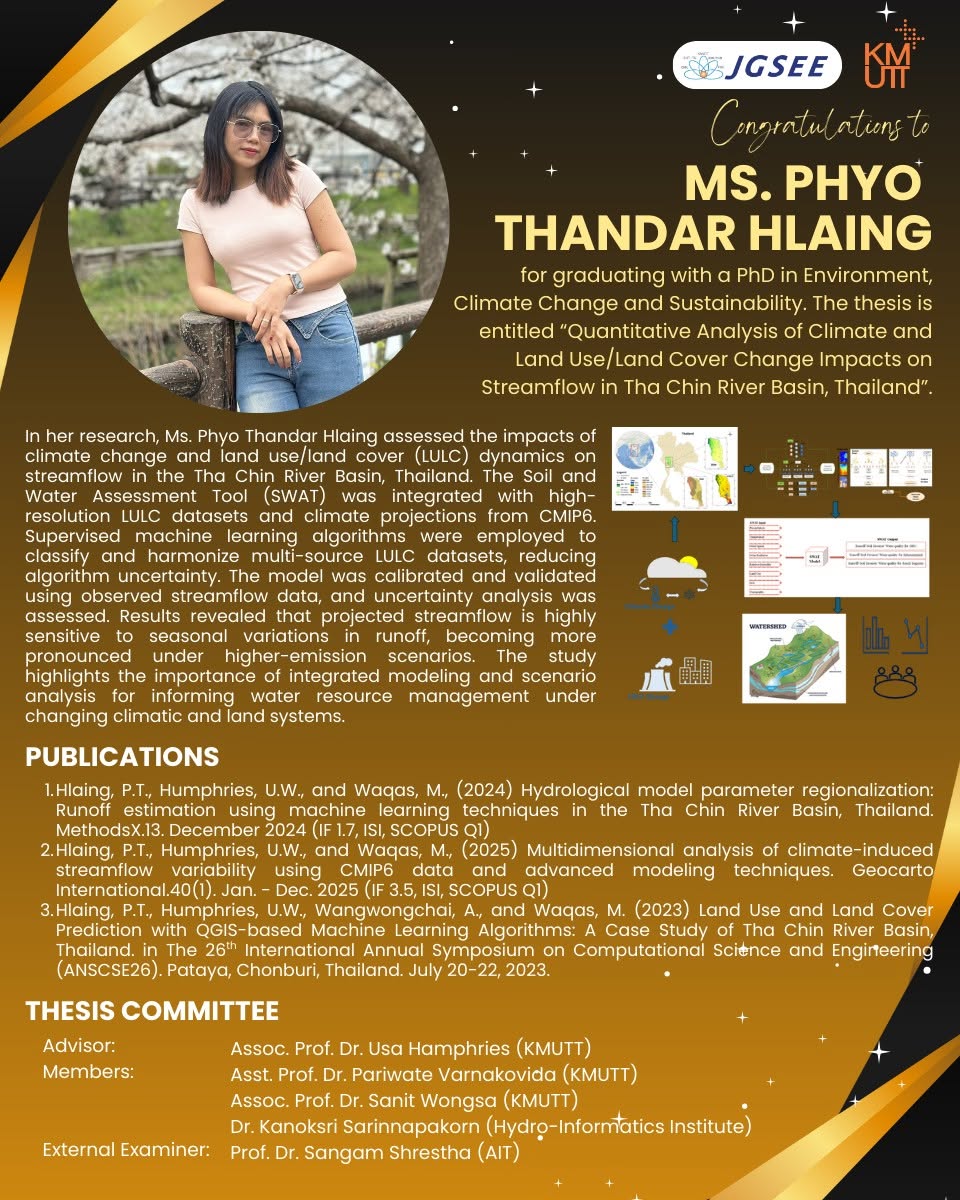
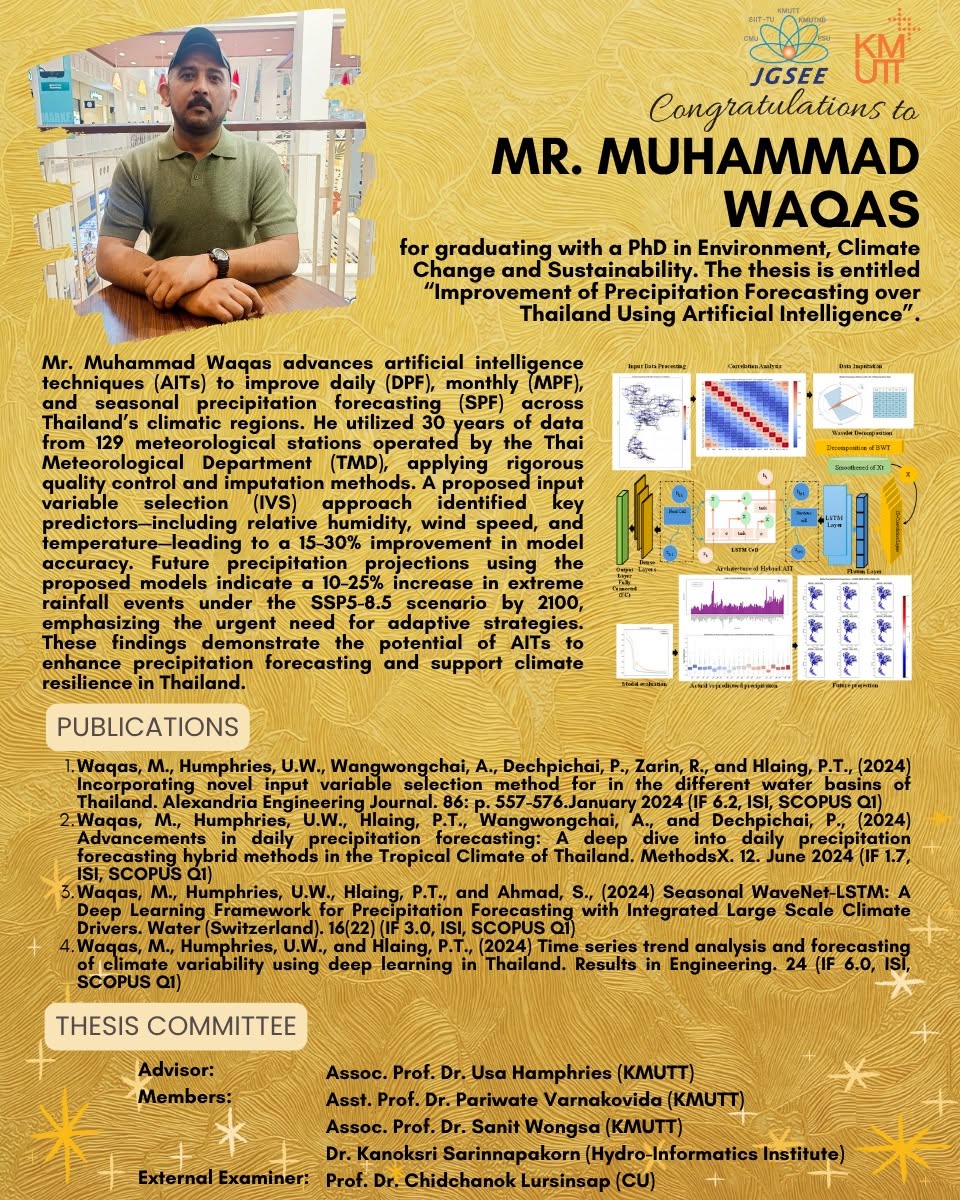
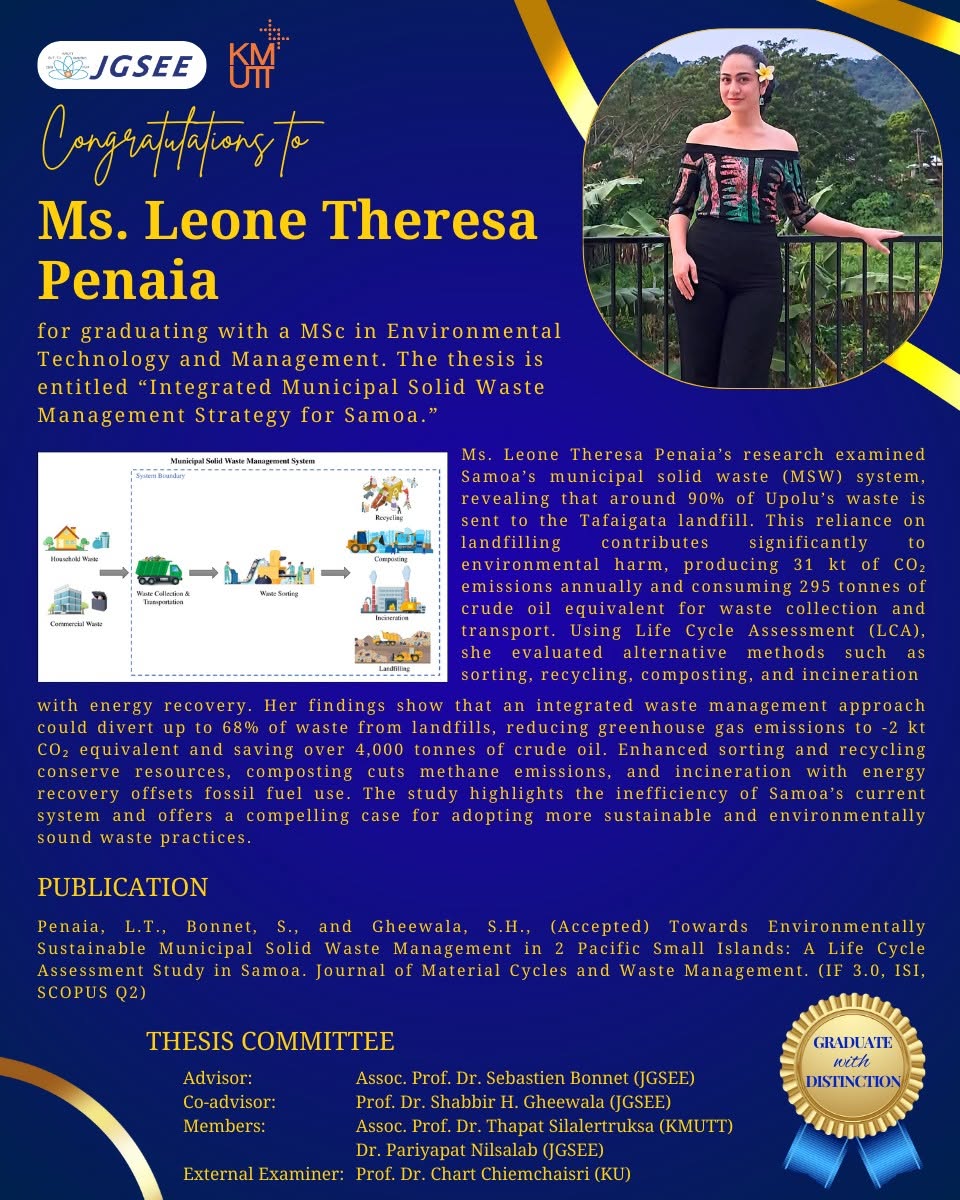
The supplied JGSEE posters present research topics and graduate profiles. Thesis titles are reproduced below as readable text; the original posters retain their full explanations, figures and references.

Climate modelling and water

Phyo Thandar Hlaing

PhD in Environment, Climate Change and Sustainability

Thesis: Quantitative Analysis of Climate and Land Use/Land Cover Change Impacts on Streamflow in Tha Chin River Basin, Thailand

Phyo Thandar Hlaing research profile poster
Phyo Thandar Hlaing research profile poster. The original thesis summary, research figures and publication list are retained complete.

Muhammad Waqas

PhD in Environment, Climate Change and Sustainability

Thesis: Improvement of Precipitation Forecasting over Thailand Using Artificial Intelligence

Muhammad Waqas research profile poster
Muhammad Waqas research profile poster. The original thesis summary, research figures and publication list are retained complete.
Resources and carbon utilisation

Leone Theresa Penaia

MSc in Environmental Technology and Management

Thesis: Integrated Municipal Solid Waste Management Strategy for Samoa

Leone Theresa Penaia research profile poster
Leone Theresa Penaia research profile poster. The original thesis summary, research figures and publication list are retained complete.

Bongkoch Chungam

PhD in Environmental Technology

Thesis: Evaluation of Moisture Dynamics and Microbial Activity Using the Resistivity Method in Biodrying Processes

Bongkoch Chungam research profile poster
Bongkoch Chungam research profile poster. The original thesis summary, research figures and publication list are retained complete.

Adeel Rafiq

PhD in Environmental Technology

Thesis: Exploring the Potential of CO₂-Derived Bulk Materials from Cement and Power Industries in Thailand: Life Cycle Assessment and Market Feasibility

Adeel Rafiq research profile poster
Adeel Rafiq research profile poster. The original thesis summary, research figures and publication list are retained complete.
Assessment methods and soil carbon

Awais Mahmood

PhD in Environmental Technology

Thesis: Enhancing Decision Robustness Through Uncertainty Analysis in Life Cycle Assessment

Awais Mahmood research profile poster
Awais Mahmood research profile poster. The original thesis summary, research figures and publication list are retained complete.

Phongsakon Tantarawongsa

PhD in Environmental Technology

Thesis: Assessment of Carbon Sequestration Potential and The Effects of Field Practices in Tropical Upland Soils Cultivated with Maize and Cassava

Phongsakon Tantarawongsa research profile poster
Phongsakon Tantarawongsa research profile poster. The original thesis summary, research figures and publication list are retained complete.
References and source records
  • Official declaration of intentRead the official English declaration

    Announcement made on 2 November 2021. The document states the 2040 target, organisational ambition across campuses, governance and cooperation.

  • Institutional explanationKMUTT Carbon Neutrality 2040

    University explanation of the target and broad implementation measures. Its historical baseline figures are not substituted into this article.

  • Supplied research context

    SDG 13 Climate action

    Complete supplied narrative, institutional poster, campus photograph, seven research-profile posters and two search captures. Search-result totals are not presented as verified publication counts.

ScienceDirect search capture using the query Climate change KMUTT
ScienceDirect search capture using the query Climate change KMUTT. This is an original search record, without a verified institutional publication total.
Google Scholar search capture using the query Climate change KMUTT
Google Scholar search capture using the query Climate change KMUTT. Search counts and ordering are retained only in the original capture.

Climate action and resilience at KMUTT

Measure emissions, reduce operational impacts, study natural carbon sinks and work with communities and public agencies on climate learning and preparedness.

Inventory, direction and nature-based action

Each record retains its own period

Reported annual GHG emissions
16,731.22tonnes CO₂e · 2025
Carbon neutrality goal
2040Future institutional target
Reported mangrove planting
44,295Trees · cumulative 2022–2025

Emissions are the reported organisational total. The 2040 goal is not an achieved result. Tree planting is a cumulative project record, not a survival census or verified offset total.

Reported full-year GHG inventory · tonnes CO₂e · 2019–2025
2019
18,727
2020
16,547
2021
13,290
2022
16,130
2023
17,837
2024
18,060.27
2025
16,731.22
020,000 tonnes CO₂e

Printed annual totals are retained. Q1–Q3/2026 is a partial-year entry and is excluded from this full-year comparison.

Mitigation, ecosystems and climate knowledge

Avoid and reduce emissions

Campus operations

Efficient buildings, renewable electricity, energy monitoring, cleaner mobility and circular resource use support the reduction programme. These are implementation mechanisms; the 2040 goal remains a future target.

Restore and study carbon sinks

Mangrove and forest research

The Mangrove Living Lab supports restoration, biodiversity, learning and blue-carbon research. The portfolio estimates about 863.75 tCO₂e of sequestration; it is not treated as a certified offset or subtracted from annual emissions.

Learn and participate

Campus and public learning

A student workshop on 8 September 2025 used active learning on energy, resources and waste. Earth Hour invited the wider community to participate on 28 March 2026. Invitations and learning activities are not measured emissions savings.

Turn climate knowledge into shared local action

Flood preparedness

Nakhon Pathom · 12 March 2026

Technical information for provincial and local decisions

KGEO presented flood scenarios and decision-support work to the Governor and Provincial Administrative Organisation. Reported engagement covered 117 local authorities, with community researchers and the Tha Chin River Basin Nakhon Pathom Foundation contributing to shared planning. This does not establish 117 completed warning systems.

Community climate action

2025 programme · 2026 boat launch

12 tourism routes + practical clean-transport learning

The co-created programme reported six low-carbon tourism routes in Thung Khru and six in Bang Khun Thian. The community electric boat launched on 21 April 2026 connects cleaner transport with learning about conversion and motor maintenance for residents, mechanics and interested visitors.

Sources and reporting notes
  • Supplied organisational GHG inventory

    Original institutional graphic previously transcribed in the completed criterion. Reported annual totals for 2019–2025 are retained exactly. The Q1–Q3/2026 value is a partial year. Some displayed scope-component sums differ from the printed totals; no reconstructed total replaces them.

    Open source
  • Carbon Neutrality 2040 framework

    A future institutional goal, supported by energy, buildings, transport, resource management, carbon sinks and participation. The roadmap is planning context, not observed future performance.

    Open source
  • Mangrove Living Lab: project context

    The supplied portfolio reports cumulative planting of 44,295 trees during 2022–2025 and estimated sequestration of about 863.75 tCO₂e. The linked Living Lab account corroborates project context; those figures are attributed to the portfolio assessment, not independently verified by that article. Neither is a certified offset or a deduction from the gross inventory.
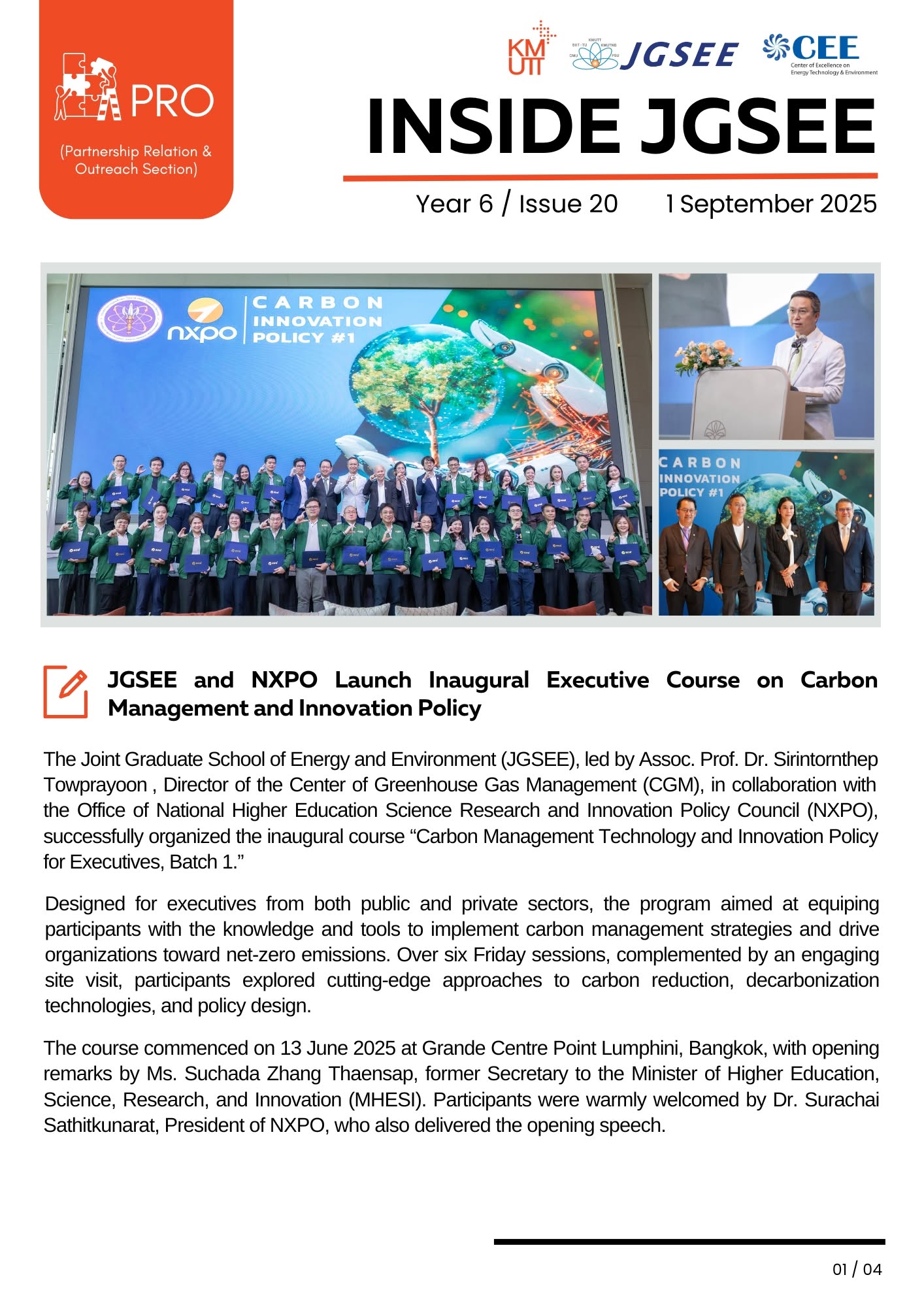
    Open source
  • Active learning on greenhouse-gas reduction

    Student workshop on 8 September 2025 at LX: discussion, group work and simulated situations addressing energy, resources and waste. No new participant count or emissions-saving result is inferred.

    Open source
  • Earth Hour 2026 public invitation

    Invitation for students, staff and the wider community on 28 March 2026, 20:30–21:30. Campaign content is not an audited electricity or carbon reduction.

    Open source
  • Community electric boat and learning centre

    Launch on 21 April 2026, reported 15 May. Community knowledge sharing covers electric conversion and motor maintenance; no verified carbon-saving total is assigned.
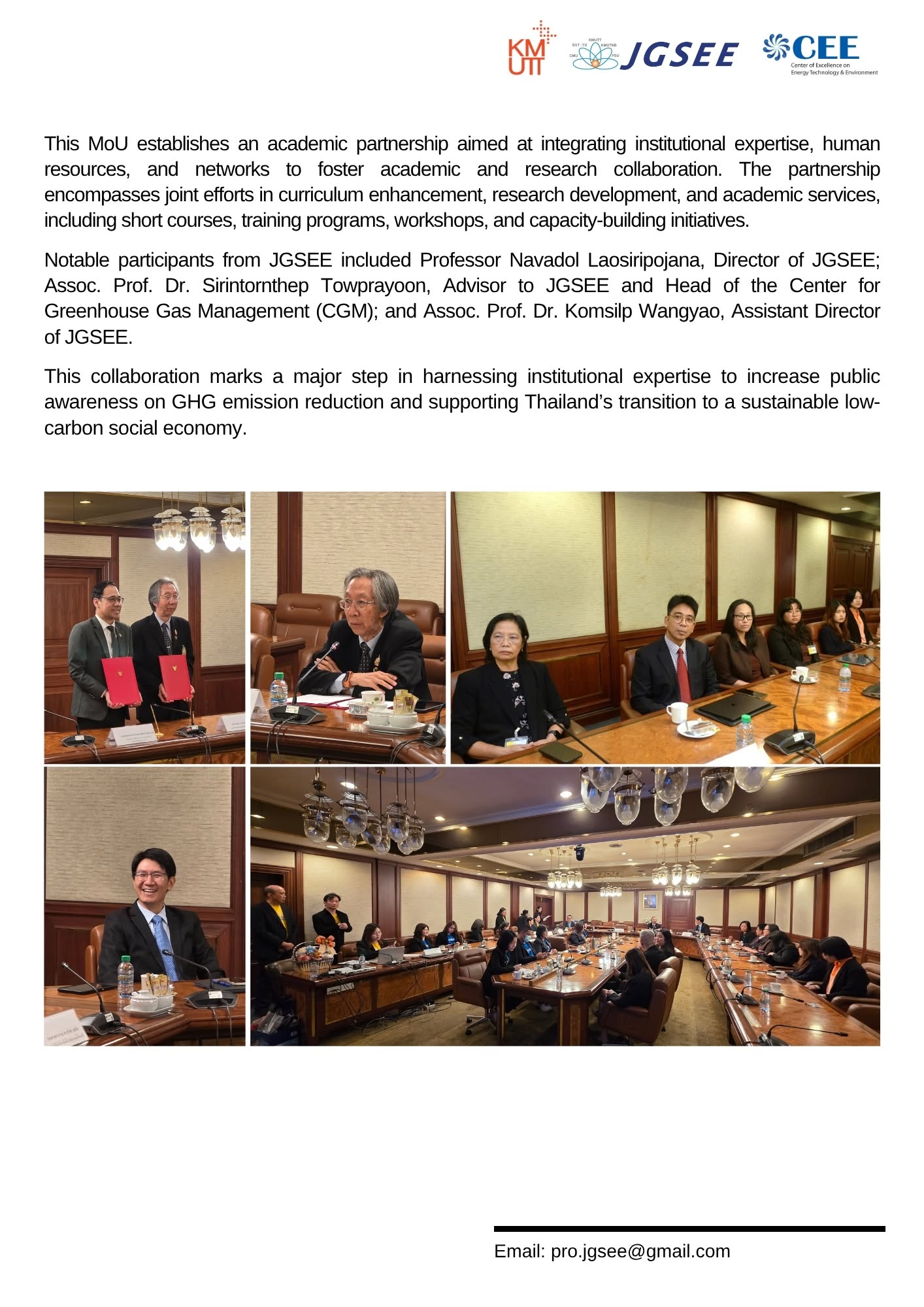
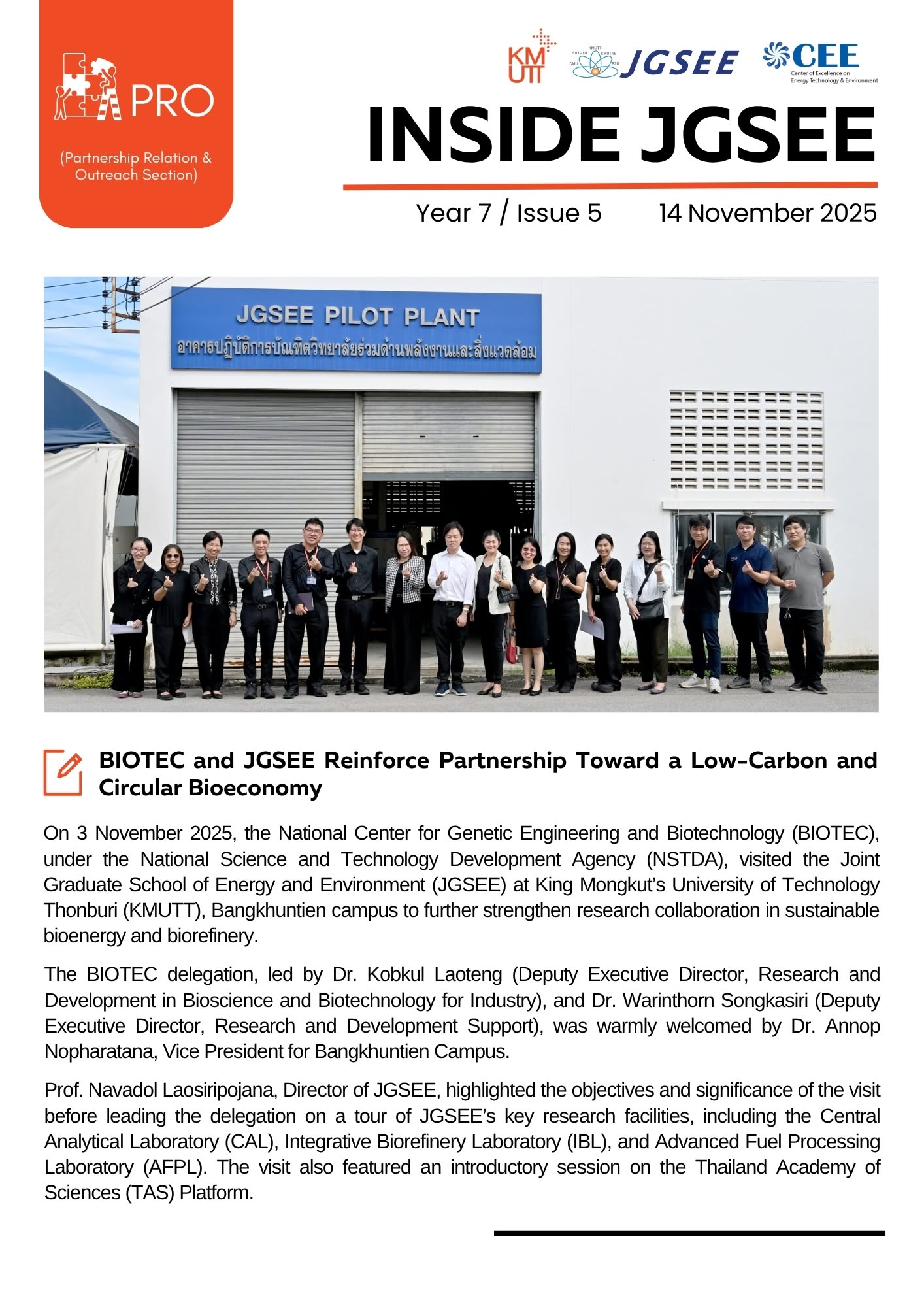
    Open source
  • Low-carbon community programme in 2025

    The account records eight local operators and 12 programme-labelled low-carbon tourism routes, six in each district. These are reported programme outputs, not independently certified carbon-neutral routes or a monetary/emissions outcome.

    Open source
  • Nakhon Pathom flood scenarios and decision support

    12 March 2026: KGEO technical work, flood forecasting/early-warning purpose and transfer of information and policy recommendations to provincial leadership. No avoided-loss or fully deployed warning-network count is inferred.

    Open source
  • Local-authority engagement and Geo-Social Maps

    March 2026 interviews describe engagement with 117 local authorities and community researchers. Authorities are organisations, not 117 people or 117 completed warning systems.

    Open source
  • ONWR and PMU-A water-management cooperation

    Area-based water planning, pilot-province cooperation, local ownership and capacity building. Participation and planning are distinct from measured disaster-loss reduction.

    Open source
  • Civil-society partner registration

    Tha Chin River Basin Nakhon Pathom Foundation: environmental NGO register 23/2549, registered 2 November 2006. The actual partner status is retained rather than applying the NGO label to all public agencies.

    Open source

Carbon Neutrality 2040

A clear commitment to achieve net-zero carbon emissions by 2040 through renewable energy and efficiency.

7
11
12
13
15
17

Energy & Climate

A sustainable energy management system to conserve energy and address climate change directly.

7
13

Walking & Cycling

Promotes a campus culture of walking and cycling to enhance health, safety, and reduce emissions.

3
11
13

Green University

Commits to leadership in sustainability, creating mechanisms to develop change agents for a better quality of life.

11
12
13
15
17
×