
Goal 5: Gender equality

Achieve gender equality and empower all women and girls.

5.3 STUDENT ACCESS MEASURES

1. Systematically measure/track women’s application rate, and acceptance/entry rate

KMUTT’s evidence brings together applicant records, selection milestones and recurring entry reports. The Join KMUTT profile records sex/gender, while dated Registrar reports show new entrants by sex, degree level and faculty.

The figures below describe women’s representation among new entrants. Application volumes, admission offers and actual entry remain separate measures.

  • Sex/gender is recorded at the applicant-profile stage.A required field supports disaggregation of applicant records. Interface observation: 9 November 2026.
  • Application, selection and confirmation are identifiable stages.The 2026 SIT recruitment example publishes separate dates for these steps.
  • Entry outcomes are reported repeatedly by sex.The two Registrar snapshots are dated 23 September 2025 and 18 March 2026.

Verified entry snapshots

44.66%female entry share

Semester 1/2025 · all degree levels

1,913 women / 4,283 new entrants

Snapshot: 23 September 2025.

45.65%female entry share

Undergraduate subset · semester 1/2025

1,622 women / 3,553 new entrants

Snapshot: 23 September 2025.

36.51%female entry share

Semester 2/2025 · all degree levels

88 women / 241 new entrants

Snapshot: 18 March 2026.

Headcounts. The undergraduate row is a subset of semester 1’s all-degree total and must not be added to it.

Reading the reporting period. Academic year 2568 corresponds to 2025. The second-semester snapshot was published in calendar year 2026. Public-interface observations are separately dated 2026; earlier-year activity is not used as core evidence.

Evidence at each access stage

The Join KMUTT member-profile form includes a required sex/gender field alongside personal, contact and education information. Its instructions explain that degree applicants complete all profile sections.

This supplies a recorded field for disaggregating applicant records. The interface observation is dated 9 November 2026; sex is not inferred from a name or photograph.

  1. Applicant profile

    A required sex/gender field and personal, contact and education sections are documented in the public Join KMUTT profile.

  2. Selection and confirmation

    A 2026 SIT recruitment project separately publishes application, eligibility and confirmation milestones.

  3. Transition to a student record

    The semester 1/2025 student-ID verification instructions provide Join KMUTT as an alternative lookup route.

  4. Published entry outcomes

    Registrar reports publish male/female new-entrant counts by degree level, faculty and programme.

The Good University Report 2025 also identifies admissions and Customer Relationship Management systems, alongside the New ACIS student information system, within KMUTT’s educational administration. Printed page 13.

A dated 2026 recruitment example

Round 2 Active Recruitment for the School of Information Technology, academic year 2569, publishes the following milestones. They describe process dates for this project.

  1. 9 March – 7 April 2026Application window
  2. 21 April 2026Selection-examination eligibility announcement
  3. 27 April 2026KMUTT confirmation of admission rights
  4. 29 April 2026Application / selection-examination payment for successful candidates

Source page update recorded as 8 October 2026. This example illustrates separable stages; it is not a university-wide count of women admitted and does not establish same-cycle record linkage across these sources.

Application volume and recurring reporting

The Good University Report 2025 reports applications at bachelor’s, master’s and doctoral levels. The published applicant counts are not disaggregated by sex in the figures used here.

29,826published applications

Bachelor’s level

1,559published applications

Master’s level

222published applications

Doctoral level

Total: 31,607 published applications in 2025. The total reconciles as 29,826 + 1,559 + 222. These figures do not identify women applicants and are kept separate from the semester entrant cohorts.

Printed page 15. The figures do not establish the number of women applicants or cross-programme de-duplication.

A traceable reporting series

The Registrar’s statistics index links Student Insight Hub dashboards and semester reports. The reports used here are separately dated 23 September 2025 and 18 March 2026, providing a repeated reporting basis for examining female representation among entrants.

New students, semester 1/2025Sex × faculty × degree level
23 September 2025
New undergraduate students, semester 1/2025Sex × faculty × programme
23 September 2025
New students, semester 2/2025Sex × faculty × degree level
18 March 2026
Measure used throughout: female entry share.
Female new entrants ÷ all new entrants in the same semester, degree level and reporting snapshot × 100. A female share among entrants does not establish the probability that a woman applicant received an offer.

Who entered in semester 1/2025?

The Registrar’s report dated 23 September 2025 records 2,370 male and 1,913 female new entrants. The three degree-level rows reconcile to the all-degree total of 4,283.

Semester 1/2025 — new entrants by degree level
Degree levelMaleFemaleTotalFemale share
Undergraduate1,9311,6223,55345.65%
Master’s39826165939.61%
Doctoral41307142.25%
All degree levels2,3701,9134,28344.66%

Headcounts from the official one-page new-student report. Female shares are recalculated from the displayed headcounts and rounded to two decimal places.

How the reporting dimensions are made visible

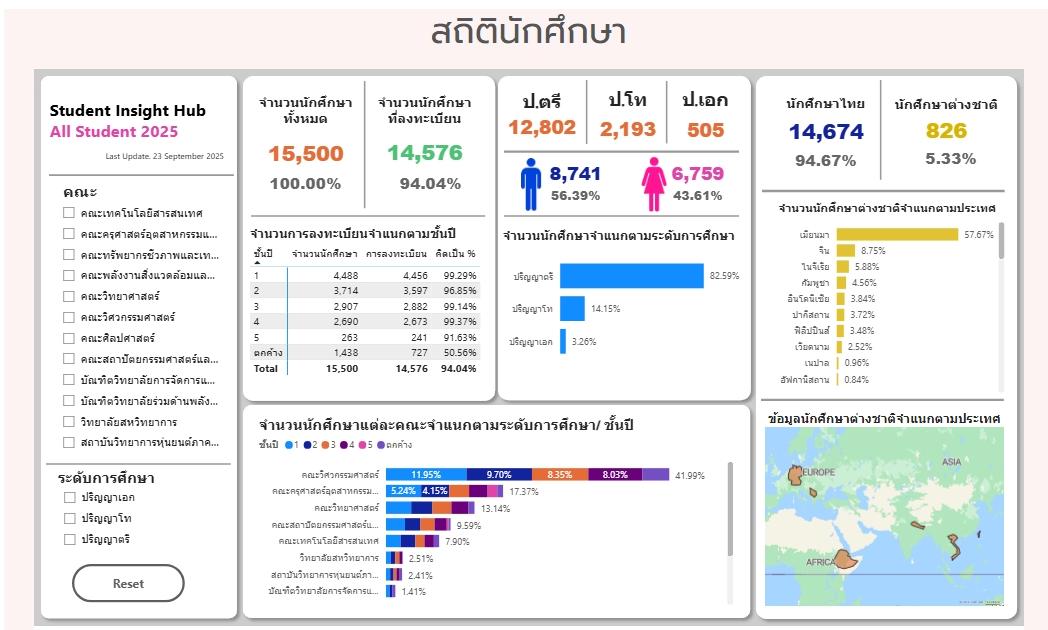
Student Insight Hub shows faculty, degree level, recorded sex and nationality as reporting dimensions. The supplied historical dashboard below is dated 23 September 2025; its key entry counts agree with the Registrar report.
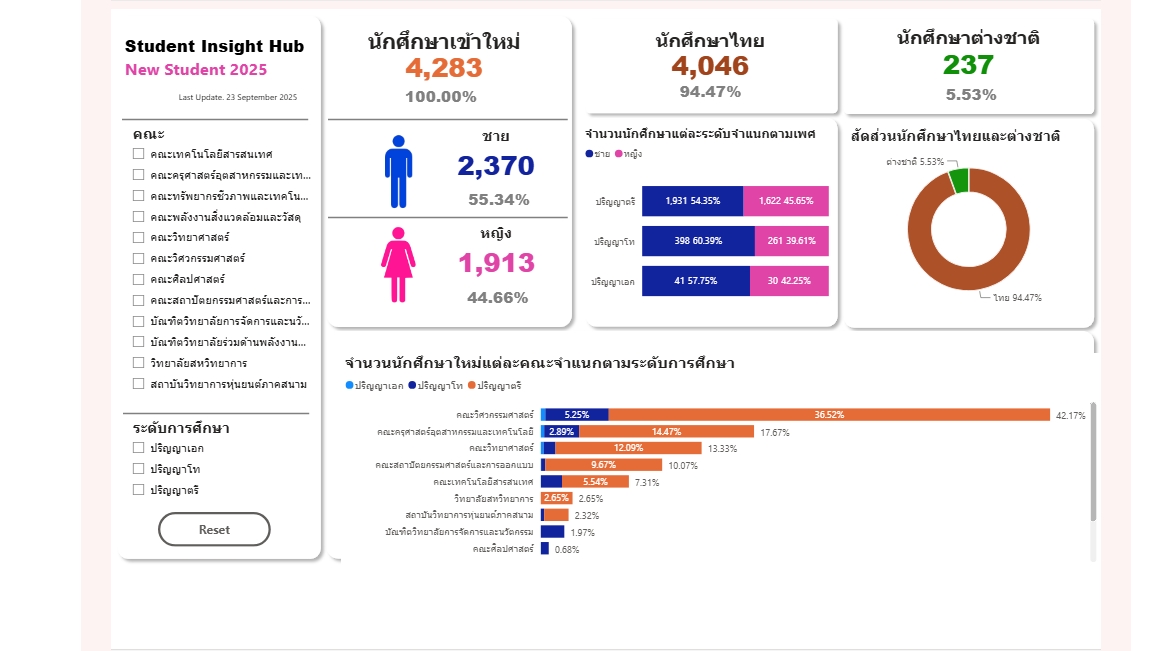
Student Insight Hub New Student 2025 reporting interface, dated 23 September 2025, showing sex, degree level, faculty and nationality dimensions.
Student Insight Hub, “New Student 2025.” Historical dashboard screenshot supplied with the evidence; snapshot 23 September 2025.
Additional reporting dimension visible in the dashboard: nationality
Published categoryNew entrantsShare
Thai students4,04694.47%
International students2375.53%
Total4,283100.00%

These nationality values are transcribed from the clearly labelled dashboard panels. They are a separate breakdown and are not counts of women.

A closer view across seven academic units

For new undergraduates in semester 1/2025, faculty-level reporting shows differences that an institution-wide percentage would conceal. The cohort comprises 1,622 women among 3,553 entrants.

Female share of new undergraduate entrants, semester 1/2025
  1. Industrial Education and Technology52.10%323 / 620 entrants
  2. Information Technology34.60%82 / 237 entrants
  3. Science67.57%350 / 518 entrants
  4. Engineering34.12%534 / 1,565 entrants
  5. Architecture and Design64.49%267 / 414 entrants
  6. Multidisciplinary Sciences43.36%49 / 113 entrants
  7. Field Robotics19.77%17 / 86 entrants

Calculated from Registrar headcounts. English unit names are translated from the source. The exact male, female and total counts are set out below.

Exact faculty headcounts and female shares
Undergraduate entrants by faculty / academic unit — 23 September 2025
Faculty / academic unitMaleFemaleTotalFemale share
Industrial Education and Technology29732362052.10%
Information Technology1558223734.60%
Science16835051867.57%
Engineering1,0315341,56534.12%
Architecture and Design14726741464.49%
Multidisciplinary Sciences644911343.36%
Field Robotics69178619.77%
Undergraduate total1,9311,6223,55345.65%
Interpretation. These are descriptive entry-composition results. They do not, by themselves, identify the causes of differences between academic units or establish women’s acceptance rates.

A second snapshot, reported in 2026

The semester 2/2568 report is dated 18 March 2026. It records 88 female entrants among 241 new entrants, a female entry share of 36.51%.

This is semester 2 of academic year 2025, with a separate intake and a different degree-level mix.

Female entry share across two separate intake cohorts
Semester 1/2025Semester 2/2025
  1. Undergraduate
    Semester 1/2025: 45.65%
    Semester 2/2025: 25.86%
  2. Master’s
    Semester 1/2025: 39.61%
    Semester 2/2025: 44.00%
  3. Doctoral
    Semester 1/2025: 42.25%
    Semester 2/2025: 21.21%
  4. All degree levels
    Semester 1/2025: 44.66%
    Semester 2/2025: 36.51%

Both series use a 0–100% scale. Shares are calculated from the headcounts in the two Registrar reports. These are different entrants, with different cohort sizes and degree-level composition.

Semester 2/2025 — new entrants by degree level; snapshot 18 March 2026
Degree levelMaleFemaleTotalFemale share
Undergraduate43155825.86%
Master’s846615044.00%
Doctoral2673321.21%
All degree levels1538824136.51%

15 + 66 + 7 = 88 female entrants; 58 + 150 + 33 = 241 total entrants. Percentages use each row’s own total.

Compare the reporting, not an assumed trend. The two intake periods differ in size and degree-level composition. Their percentages do not show the same students followed over time and do not establish whether admissions equity improved or deteriorated.

Keeping access measures distinct

Application-stage and confirmation-stage sources document the process. Published entrant tables supply the verified sex-disaggregated outcomes. Each measure needs its own population and denominator.

Female applicant share
Women applicants ÷ all applicants in the same defined admission cycle.
Women’s acceptance rate
Women receiving an offer ÷ women applicants in that same cycle.
Women’s admission-to-entry conversion
Women entering ÷ women offered admission in the same matched cycle.
Female entry share (the numerical measure reported here)
Female new entrants ÷ all new entrants in the same reporting snapshot.Measure quantified in this evidence

All percentages describing women’s representation use the final definition: female entry share. The nationality percentages use all 4,283 entrants as their denominator. The evidence presented here does not include the matched women-applicant and offer counts needed to calculate women’s acceptance rates.

Dataset alignment and calculation notes
How each source dataset is used
DatasetUse in this documentTreatment
Good University Report 2025 Annual applicant volumeKept separate from semester entry totals.
Registrar all-degree report 4,283 entrants in semester 1/2025Undergraduate, master’s and doctoral levels.
Registrar undergraduate report 3,553 undergraduate entrantsSubset of the 4,283, not an additional cohort.
Registrar second-semester report 241 entrants; snapshot in March 2026Separate intake; not relabelled as academic year 2026.
  • All entrant counts are headcounts, not full-time-equivalent values.
  • Shares are female entrants divided by total entrants within the same row, multiplied by 100 and rounded to two decimal places.
  • The male/female categories follow the published Registrar reports. No classifications are inferred from names, photographs or programme choices.
  • Only aggregate records appear. The undergraduate subset is not added to the all-degree total.
  • Annual application counts are not combined with semester entrants to infer an acceptance rate.
  • The semester snapshots are separate cohorts; semester 2/2568 is not relabelled academic year 2026.

Programme-level source detail

The two-page Registrar report lists 59 programme rows under seven academic units, including the two associate programmes grouped in that report. English translations are provided for reviewers, with the original Thai labels available in the expandable list below. Male, female and total headcounts are unchanged.

Snapshot: 23 September 2568 / 2025. The reported grand total is 1,931 male + 1,622 female = 3,553 entrants.

The source leaves the female cell blank for the KOSEN bachelor’s automation programme with one male entrant and a total of one. It is shown as “—” below, preserving the blank rather than entering a new value.

Industrial Education and Technology (11 programmes)
Industrial Education and Technology — programme entry counts (English translations)
Programme (English translation)MaleFemaleTotal
Bachelor of Science in Industrial Education — Mechanical Engineering (5 years)162036
Bachelor of Science in Industrial Education — Electrical Engineering (5 years)593493
Bachelor of Science in Industrial Education — Civil Engineering (5 years)132740
Bachelor of Science in Industrial Education — Production Engineering (5 years)201434
Bachelor of Technology — Educational Technology and Mass Communication (4 years)3881119
Bachelor of Technology — Industrial Technology, Mechanical Technology specialization (4 years)33336
Bachelor of Technology — Industrial Technology, Electrical Technology specialization (4 years)13720
Bachelor of Technology — Industrial Technology, Production Technology specialization (4 years)161430
Bachelor of Science — Applied Computer Science–Multimedia (4 years)414889
Bachelor of Technology — Industrial Technology, Civil Technology specialization (4 years)192544
Bachelor of Science — Packaging and Printing Technology (4 years)295079
Reported unit total297323620
Information Technology (3 programmes)
Information Technology — programme entry counts (English translations)
Programme (English translation)MaleFemaleTotal
Bachelor of Science — Information Technology (4 years)10134135
Bachelor of Science — Computer Science (4 years; English-language programme)382058
Bachelor of Arts — Digital Service Innovation (4 years)162844
Reported unit total15582237
Science (8 programmes)
Science — programme entry counts (English translations)
Programme (English translation)MaleFemaleTotal
Bachelor of Science — Mathematics (4 years)162036
Bachelor of Science — Chemistry (4 years)25101126
Bachelor of Science — Microbiology (4 years)177188
Bachelor of Science — Applied Computer Science (4 years)411657
Bachelor of Science — Food Science and Technology (4 years)113041
Bachelor of Science — Physics, Materials Physics and Medical Instrumentation specialization (4 years)194766
Bachelor of Science — Physics (4 years)203656
Bachelor of Science — Statistics and Data Science (4 years)192948
Reported unit total168350518
Engineering (25 programmes)
Engineering — programme entry counts (English translations)
Programme (English translation)MaleFemaleTotal
Bachelor of Engineering — Computer Engineering (4 years)682189
Bachelor of Engineering — Computer Engineering (4 years; international programme)543690
Bachelor of Engineering — Chemical Engineering (4 years; Thai study plan)395291
Bachelor of Engineering — Chemical Engineering (4 years; international study plan)182139
Bachelor of Engineering — Mechanical Engineering (4 years)10725132
Bachelor of Engineering — Electrical Engineering, Power Systems, Power Electronics and Energy specialization (4 years)431154
Bachelor of Engineering — Electrical Engineering (4 years)8417101
Bachelor of Engineering — Telecommunication and Electronics Engineering (4 years)8621107
Bachelor of Engineering — Mechatronics Engineering (4 years)36844
Bachelor of Engineering — Civil Engineering (4 years)612485
Bachelor of Engineering — Civil Engineering (4 years; international programme)542478
Bachelor of Engineering — Control Systems and Instrumentation Engineering (4 years)592887
Bachelor of Engineering — Materials Engineering (4 years)203555
Bachelor of Engineering — Environmental Engineering (4 years)253661
Bachelor of Engineering — Environmental Engineering (4 years; international programme)71320
Bachelor of Engineering — Automation Engineering (4 years; international programme)17825
Bachelor of Engineering — Industrial Engineering (4 years)444791
Bachelor of Science — Health Data Science (4 years)41721
Bachelor of Engineering — Modern Automotive and Aerospace Parts Manufacturing Engineering (4 years)281341
Bachelor of Engineering — Smart Manufacturing and Advanced Tool Engineering (4 years)362258
Bachelor of Engineering — Automotive Engineering (4 years)801292
Bachelor of Engineering — Automation Engineering (4 years; international programme; KOSEN)1—1
Bachelor of Engineering — Electronic and Infocommunication Engineering (4 years; international programme)19726
Associate Degree in Engineering — Bioprocess Engineering (associate degree / higher vocational diploma level)92433
Associate Degree — Automation Engineering (international programme; KOSEN)321244
Reported unit total1,0315341,565
Architecture and Design (9 programmes)
Architecture and Design — programme entry counts (English translations)
Programme (English translation)MaleFemaleTotal
Bachelor of Fine Arts — Communication Design (4 years; international programme)42529
Bachelor of Architecture — Architecture (5 years; international programme)243862
Bachelor of Architecture — Interior Architecture (5 years; international programme)71320
Bachelor of Technology — Medical and Science Media (4 years)24648
Bachelor of Landscape Architecture — Landscape Architecture (5 years; international programme)213
Bachelor of Science — Multiple Intelligences for Design Integration (4 years; international programme)9211
Bachelor of Science — Media Technology (4 years)6243105
Bachelor of Fine Arts — Design Innovation (4 years; international programme)123
Bachelor of Fine Arts — Media Arts (4 years)3697133
Reported unit total147267414
Multidisciplinary Sciences (2 programmes)
Multidisciplinary Sciences — programme entry counts (English translations)
Programme (English translation)MaleFemaleTotal
Bachelor of Science — Digital Design (4 years; international programme)122941
Bachelor of Engineering — Intelligent Systems Engineering (4 years; Ratchaburi study area)522072
Reported unit total6449113
Field Robotics (1 programme)
Field Robotics — programme entry counts (English translations)
Programme (English translation)MaleFemaleTotal
Bachelor of Engineering — Robotics and Automation Engineering (4 years)691786
Reported unit total691786
Original Thai programme labels

Original reporting labels are retained here for comparison with the English translations above. The degree level, duration and programme qualifiers follow the supplied report.

Industrial Education and Technology

Bachelor of Science in Industrial Education — Mechanical Engineering (5 years)
ครุศาสตร์อุตสาหกรรมบัณฑิต สาขาวิชาวิศวกรรมเครื่องกล ปริญญาตรี 5 ปี
Bachelor of Science in Industrial Education — Electrical Engineering (5 years)
ครุศาสตร์อุตสาหกรรมบัณฑิต สาขาวิชาวิศวกรรมไฟฟ้า ปริญญาตรี 5 ปี
Bachelor of Science in Industrial Education — Civil Engineering (5 years)
ครุศาสตร์อุตสาหกรรมบัณฑิต สาขาวิชาวิศวกรรมโยธา ปริญญาตรี 5 ปี
Bachelor of Science in Industrial Education — Production Engineering (5 years)
ครุศาสตร์อุตสาหกรรมบัณฑิต สาขาวิชาวิศวกรรมอุตสาหการ ปริญญาตรี 5 ปี
Bachelor of Technology — Educational Technology and Mass Communication (4 years)
เทคโนโลยีบัณฑิต สาขาวิชาเทคโนโลยีการศึกษาและสื่อสารมวลชน ปริญญาตรี 4 ปี
Bachelor of Technology — Industrial Technology, Mechanical Technology specialization (4 years)
เทคโนโลยีบัณฑิต สาขาวิชาเทคโนโลยีอุตสาหกรรม เทคโนโลยีเครื่องกล ปริญญาตรี 4 ปี
Bachelor of Technology — Industrial Technology, Electrical Technology specialization (4 years)
เทคโนโลยีบัณฑิต สาขาวิชาเทคโนโลยีอุตสาหกรรม เทคโนโลยีไฟฟ้า ปริญญาตรี 4 ปี
Bachelor of Technology — Industrial Technology, Production Technology specialization (4 years)
เทคโนโลยีบัณฑิต สาขาวิชาเทคโนโลยีอุตสาหกรรม เทคโนโลยีอุตสาหการ ปริญญาตรี 4 ปี
Bachelor of Science — Applied Computer Science–Multimedia (4 years)
วิทยาศาสตรบัณฑิต สาขาวิชาวิทยาการคอมพิวเตอร์ประยุกต์มัลติมีเดีย ปริญญาตรี 4 ปี
Bachelor of Technology — Industrial Technology, Civil Technology specialization (4 years)
หลักสูตรเทคโนโลยีบัณฑิต สาขาวิชาเทคโนโลยีอุตสาหกรรม เทคโนโลยีโยธา ปริญญาตรี 4 ปี
Bachelor of Science — Packaging and Printing Technology (4 years)
หลักสูตรวิทยาศาสตรบัณฑิต สาขาวิชาเทคโนโลยีบรรจุภัณฑ์และการพิมพ์ ปริญญาตรี 4 ปี

Information Technology

Bachelor of Science — Information Technology (4 years)
วิทยาศาสตรบัณฑิต สาขาวิชาเทคโนโลยีสารสนเทศ ปริญญาตรี 4 ปี
Bachelor of Science — Computer Science (4 years; English-language programme)
หลักสูตรวิทยาศาสตรบัณฑิต สาขาวิชาวิทยาการคอมพิวเตอร์ (หลักสูตรภาษาอังกฤษ) ปริญญาตรี 4 ปี (หลักสูตรภาษาอังกฤษ)
Bachelor of Arts — Digital Service Innovation (4 years)
หลักสูตรศิลปศาสตรบัณฑิต สาขาวิชานวัตกรรมบริการดิจิทัล ปริญญาตรี 4 ปี

Science

Bachelor of Science — Mathematics (4 years)
วิทยาศาสตรบัณฑิต สาขาวิชาคณิตศาสตร์ ปริญญาตรี 4 ปี
Bachelor of Science — Chemistry (4 years)
วิทยาศาสตรบัณฑิต สาขาวิชาเคมี ปริญญาตรี 4 ปี
Bachelor of Science — Microbiology (4 years)
วิทยาศาสตรบัณฑิต สาขาวิชาจุลชีววิทยา ปริญญาตรี 4 ปี
Bachelor of Science — Applied Computer Science (4 years)
วิทยาศาสตรบัณฑิต สาขาวิชาวิทยาการคอมพิวเตอร์ประยุกต์ ปริญญาตรี 4 ปี
Bachelor of Science — Food Science and Technology (4 years)
วิทยาศาสตรบัณฑิต สาขาวิชาวิทยาศาสตร์และเทคโนโลยีการอาหาร ปริญญาตรี 4 ปี
Bachelor of Science — Physics, Materials Physics and Medical Instrumentation specialization (4 years)
หลักสูตรวิทยาศาสตรบัณฑิต สาขาวิชาฟิสิกส์ (ฟิสิกส์วัสดุและเครื่องมือทางการแพทย์) ปริญญาตรี 4 ปี
Bachelor of Science — Physics (4 years)
หลักสูตรวิทยาศาสตรบัณฑิต สาขาวิชาฟิสิกส์ ปริญญาตรี 4 ปี
Bachelor of Science — Statistics and Data Science (4 years)
หลักสูตรวิทยาศาสตรบัณฑิต สาขาวิชาสถิติและวิทยาการข้อมูล ปริญญาตรี 4 ปี

Engineering

Bachelor of Engineering — Computer Engineering (4 years)
วิศวกรรมศาสตรบัณฑิต สาขาวิชาวิศวกรรมคอมพิวเตอร์ ปริญญาตรี 4 ปี
Bachelor of Engineering — Computer Engineering (4 years; international programme)
วิศวกรรมศาสตรบัณฑิต สาขาวิชาวิศวกรรมคอมพิวเตอร์ ปริญญาตรี 4 ปี (หลักสูตรนานาชาติ)
Bachelor of Engineering — Chemical Engineering (4 years; Thai study plan)
วิศวกรรมศาสตรบัณฑิต สาขาวิชาวิศวกรรมเคมี ปริญญาตรี 4 ปี (แผนการเรียน : ไทย)
Bachelor of Engineering — Chemical Engineering (4 years; international study plan)
วิศวกรรมศาสตรบัณฑิต สาขาวิชาวิศวกรรมเคมี ปริญญาตรี 4 ปี (แผนการเรียน : นานาชาติ)
Bachelor of Engineering — Mechanical Engineering (4 years)
วิศวกรรมศาสตรบัณฑิต สาขาวิชาวิศวกรรมเครื่องกล ปริญญาตรี 4 ปี
Bachelor of Engineering — Electrical Engineering, Power Systems, Power Electronics and Energy specialization (4 years)
วิศวกรรมศาสตรบัณฑิต สาขาวิชาวิศวกรรมไฟฟ้า (ระบบไฟฟ้า อิเล็กทรอนิกส์กำลัง และพลังงาน) ปริญญาตรี 4 ปี
Bachelor of Engineering — Electrical Engineering (4 years)
วิศวกรรมศาสตรบัณฑิต สาขาวิชาวิศวกรรมไฟฟ้า ปริญญาตรี 4 ปี
Bachelor of Engineering — Telecommunication and Electronics Engineering (4 years)
วิศวกรรมศาสตรบัณฑิต สาขาวิชาวิศวกรรมไฟฟ้าสื่อสารและอิเล็กทรอนิกส์ ปริญญาตรี 4 ปี
Bachelor of Engineering — Mechatronics Engineering (4 years)
วิศวกรรมศาสตรบัณฑิต สาขาวิชาวิศวกรรมเมคคาทรอนิกส์ ปริญญาตรี 4 ปี
Bachelor of Engineering — Civil Engineering (4 years)
วิศวกรรมศาสตรบัณฑิต สาขาวิชาวิศวกรรมโยธา ปริญญาตรี 4 ปี
Bachelor of Engineering — Civil Engineering (4 years; international programme)
วิศวกรรมศาสตรบัณฑิต สาขาวิชาวิศวกรรมโยธา ปริญญาตรี 4 ปี (หลักสูตรนานาชาติ)
Bachelor of Engineering — Control Systems and Instrumentation Engineering (4 years)
วิศวกรรมศาสตรบัณฑิต สาขาวิชาวิศวกรรมระบบควบคุมและเครื่องมือวัด ปริญญาตรี 4 ปี
Bachelor of Engineering — Materials Engineering (4 years)
วิศวกรรมศาสตรบัณฑิต สาขาวิชาวิศวกรรมวัสดุ ปริญญาตรี 4 ปี
Bachelor of Engineering — Environmental Engineering (4 years)
วิศวกรรมศาสตรบัณฑิต สาขาวิชาวิศวกรรมสิ่งแวดล้อม ปริญญาตรี 4 ปี
Bachelor of Engineering — Environmental Engineering (4 years; international programme)
วิศวกรรมศาสตรบัณฑิต สาขาวิชาวิศวกรรมสิ่งแวดล้อม ปริญญาตรี 4 ปี (หลักสูตรนานาชาติ)
Bachelor of Engineering — Automation Engineering (4 years; international programme)
วิศวกรรมศาสตรบัณฑิต สาขาวิชาวิศวกรรมอัตโนมัติ ปริญญาตรี 4 ปี (หลักสูตรนานาชาติ)
Bachelor of Engineering — Industrial Engineering (4 years)
วิศวกรรมศาสตรบัณฑิต สาขาวิชาวิศวกรรมอุตสาหการ ปริญญาตรี 4 ปี
Bachelor of Science — Health Data Science (4 years)
หลักสูตรวิทยาศาสตรบัณฑิต สาขาวิชาวิทยาศาสตร์ข้อมูลสุขภาพ ปริญญาตรี 4 ปี
Bachelor of Engineering — Modern Automotive and Aerospace Parts Manufacturing Engineering (4 years)
หลักสูตรวิศวกรรมศาสตรบัณฑิต สาขาวิชาวิศวกรรมการผลิตชิ้นส่วนยานยนต์และอากาศยานสมัยใหม่ ปริญญาตรี 4 ปี
Bachelor of Engineering — Smart Manufacturing and Advanced Tool Engineering (4 years)
หลักสูตรวิศวกรรมศาสตรบัณฑิต สาขาวิชาวิศวกรรมการผลิตอัจฉริยะและเครื่องมือขั้นสูง ปริญญาตรี 4 ปี
Bachelor of Engineering — Automotive Engineering (4 years)
หลักสูตรวิศวกรรมศาสตรบัณฑิต สาขาวิชาวิศวกรรมยานยนต์ ปริญญาตรี 4 ปี
Bachelor of Engineering — Automation Engineering (4 years; international programme; KOSEN)
หลักสูตรวิศวกรรมศาสตรบัณฑิต สาขาวิชาวิศวกรรมอัตโนมัติ (หลักสูตรนานาชาติ) ปริญญาตรี 4 ปี (หลักสูตรนานาชาติ) KOSEN
Bachelor of Engineering — Electronic and Infocommunication Engineering (4 years; international programme)
หลักสูตรวิศวกรรมศาสตรบัณฑิต สาขาวิชาวิศวกรรมอิเล็กทรอนิกส์และสารสนเทศสื่อสาร (หลักสูตรนานาชาติ) ปริญญาตรี 4 ปี (หลักสูตรนานาชาติ)
Associate Degree in Engineering — Bioprocess Engineering (associate degree / higher vocational diploma level)
หลักสูตรอนุปริญญาวิศวกรรมศาสตร์ สาขาวิชาวิศวกรรมกระบวนการชีวภาพ อนุปริญญา/ประกาศนียบัตรวิชาชีพชั้นสูง
Associate Degree — Automation Engineering (international programme; KOSEN)
หลักสูตรอนุปริญญา สาขาวิชาวิศวกรรมอัตโนมัติ (หลักสูตรนานาชาติ) KOSEN

Architecture and Design

Bachelor of Fine Arts — Communication Design (4 years; international programme)
ศิลปบัณฑิต สาขาวิชาออกแบบนิเทศศิลป์ (หลักสูตรนานาชาติ) ปริญญาตรี 4 ปี นานาชาติ
Bachelor of Architecture — Architecture (5 years; international programme)
สถาปัตยกรรมศาสตรบัณฑิต สาขาวิชาสถาปัตยกรรม(หลักสูตรนานาชาติ) ปริญญาตรี 5 ปี
Bachelor of Architecture — Interior Architecture (5 years; international programme)
สถาปัตยกรรมศาสตรบัณฑิต สาขาวิชาสถาปัตยกรรมภายใน(หลักสูตรนานาชาติ) ปริญญาตรี 5 ปี
Bachelor of Technology — Medical and Science Media (4 years)
หลักสูตรเทคโนโลยีบัณฑิต สาขาวิชามีเดียทางการแพทย์และวิทยาศาสตร์ ปริญญาตรี 4 ปี
Bachelor of Landscape Architecture — Landscape Architecture (5 years; international programme)
หลักสูตรภูมิสถาปัตยกรรมศาสตรบัณฑิต สาขาวิชาภูมิสถาปัตยกรรม (หลักสูตรนานาชาติ) ปริญญาตรี 5 ปี
Bachelor of Science — Multiple Intelligences for Design Integration (4 years; international programme)
หลักสูตรวิทยาศาสตรบัณฑิต สาขาวิชาการบูรณาการการออกแบบด้วยพหุปัญญา (หลักสูตรนานาชาติ) ปริญญาตรี 4 ปี (หลักสูตรนานาชาติ)
Bachelor of Science — Media Technology (4 years)
หลักสูตรวิทยาศาสตรบัณฑิต สาขาวิชาเทคโนโลยีมีเดีย ปริญญาตรี 4 ปี
Bachelor of Fine Arts — Design Innovation (4 years; international programme)
หลักสูตรศิลปกรรมศาสตรบัณฑิต สาขาวิชานวัตกรรมการออกแบบ (หลักสูตรนานาชาติ) ปริญญาตรี 4 ปี (หลักสูตรนานาชาติ)
Bachelor of Fine Arts — Media Arts (4 years)
หลักสูตรศิลปบัณฑิต สาขาวิชามีเดียอาตส์ ปริญญาตรี 4 ปี

Multidisciplinary Sciences

Bachelor of Science — Digital Design (4 years; international programme)
หลักสูตรวิทยาศาสตรบัณฑิต สาขาวิชาการออกแบบดิจิทัล (หลักสูตรนานาชาติ) ปริญญาตรี 4 ปี (หลักสูตรนานาชาติ)
Bachelor of Engineering — Intelligent Systems Engineering (4 years; Ratchaburi study area)
หลักสูตรวิศวกรรมศาสตรบัณฑิต สาขาวิชาวิศวกรรมระบบอัจฉริยะ ปริญญาตรี 4 ปี (พื้นที่การศึกษาราชบุรี)

Field Robotics

Bachelor of Engineering — Robotics and Automation Engineering (4 years)
หลักสูตรวิศวกรรมศาสตรบัณฑิต สาขาวิชาวิศวกรรมหุ่นยนต์และระบบอัตโนมัติ ปริญญาตรี 4 ปี

The source images are retained from the supplied attachment; only blank margins were trimmed and no data values were altered.

References (8 sources)
  1. KMUTT, Good University Report 2025

    Printed pages 13 and 15. Admissions/CRM and New ACIS are identified on page 13. The 2025 application counts are used as published on page 15, without assuming de-duplication across programmes. The official file is hosted under the university’s /2026/05/ document path.

    Open official source

  2. Registrar’s Office: new students by education level, semester 1/2568

    Snapshot: 23 September 2025. The one-page report covers all degree levels and publishes male/female entrant counts.

    Open official source

  3. Registrar’s Office: new students by education level, semester 2/2568

    One-page official report. Snapshot: 18 March 2026. The academic year remains 2025; the reporting date falls in calendar year 2026.

    Open official source

  4. Registrar’s Office: new undergraduate students, semester 1/2568

    Snapshot: 23 September 2025. Two-page faculty/programme report. Programme names, headcounts and the blank female cell are preserved in the programme appendix.

    Open official source

    Original source pages remain available for comparison: source image, page 1 · source image, page 2 · official two-page PDF.

  5. Join KMUTT: applicant/member profile form

    Public-interface observation recorded on 9 November 2026. Includes a required sex/gender field; this observation does not establish when the field was introduced.

    Open official source

  6. Join KMUTT: Round 2 Active Recruitment, School of Information Technology

    Academic year 2569 (2026). Application, selection-eligibility, confirmation and payment milestones. The supplied source records an 8 October 2026 page update.

    Open official source

  7. Registrar’s Office: Step 1 — Verify Student ID

    Explicitly labelled semester 1/2568 (2025). The instructions identify Join KMUTT as an alternative student-ID lookup route.

    Open official source

  8. Registrar’s Office: statistics and Student Insight Hub entry points

    2025 dashboard links carry the 23 September 2025 snapshot. The index also provides semester-by-semester statistical reports. The dashboard image in this article is the supplied historical screenshot.

    Open official source

Source discovery: KMUTT’s official unit directory was used to locate admissions, Registrar and institutional-reporting sites.

Original calculated chart images: faculty-share chart and two-intake comparison. Their figures are presented as editable charts and tables above.
2. A policy addressing women’s applications, acceptance/entry, and participation

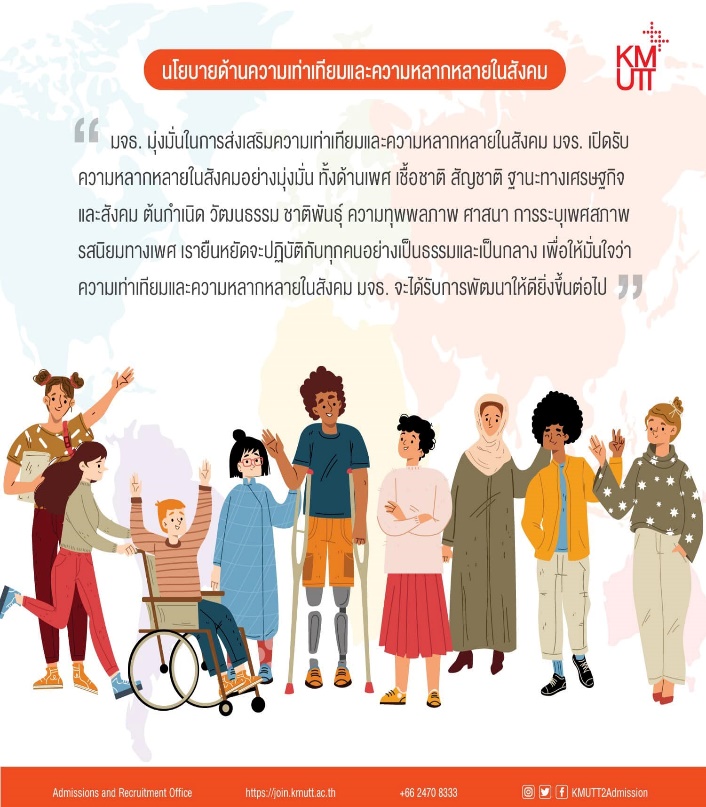
KMUTT’s published 2025 and 2026 admissions notices explicitly reject discrimination on grounds including sex, gender identity and sexual orientation in admission to its programmes and activities. This is a public equal-treatment commitment that includes women, rather than a women-only admissions scheme.

This evidence compilation connects that commitment to published application and selection procedures, entry arrangements and dated opportunities to participate in university life. It distinguishes the policy statements from examples of their practical context: admissions information, outreach, inclusion education and student support.

How the evidence addresses 5.3.2

Applications

Dated recruitment notices and published programme requirements.

Acceptance

Documented assessment, interview and eligibility stages.

Entry

Published verification and student-ID milestones, with enrolment guidance.

Participation

Gender-inclusion communication, learning activities and financial support.

Evidence status The admissions statements are the primary policy evidence. Activity photographs and financial totals are supporting evidence, not substitutes for policy wording or proof of women-only provision. Dates below identify the relevant recruitment cycle, event or reporting period; they do not imply a new policy approval date.

Policy evidence from 2025–2026

Published non-discrimination commitments

The official Join KMUTT recruitment pages embed an equal-treatment statement within the admissions instructions. The statement covers admission to programmes and activities, making it more directly relevant to this indicator than a general collection of event photographs.

“…sex, national origin, gender identity, or sexual orientation in admission to its programs and activities.”

Short extract from the 2025 undergraduate notice

Dated official recruitment records

Undergraduate direct admission, non-Thai applicants, Round 4, 1/2025

Applications: 7 April–18 May 2025

Explicit admission-related non-discrimination wording; entry verification and student-ID steps.

Undergraduate direct admission, non-Thai applicants, Round 1, 1/2026

Applications: 17 October 2025–6 January 2026

The same commitment accompanies a dated selection and entry timetable.

Petchra Pro Jom Klao master’s scholarship admission, non-Thai applicants, 1/2025

Academic year 2025

Admission-related equal-treatment wording also appears at master’s level.

Doctoral direct admission, non-Thai applicants, Round 1, 1/2026

Applications: 1 November 2025–10 March 2026

Admission-related equal-treatment wording extends the documented examples to doctoral recruitment.

Relevance to women’s access

Because sex is an expressly protected ground, the published commitment addresses women’s access within a policy applicable to all applicants. Gender identity and sexual orientation are also named. These examples document the public commitment across undergraduate and postgraduate routes; they do not establish a women’s quota or guarantee admission irrespective of programme requirements.

Scope: These four recruitment records are non-Thai recruitment routes. Domestic programme requirements are separately illustrated in the operational requirements below. The date of a recruitment cycle is not presented as the original adoption or formal review date of the university-wide policy.

Published operational requirements

Application, assessment and entry procedures

2026 international undergraduate recruitment

The 1/2026 Round 1 notice separates application, assessment and entry milestones. Its published calendar provides applicants with a common sequence of deadlines.

  1. Application submission17 October 2025–6 January 2026
  2. Data validation7–8 January 2026
  3. Faculty/school consideration9 January–3 February 2026
  4. Interview13 January–3 February 2026
  5. Eligibility announcement4 February 2026
  6. Eligibility verification4–28 February 2026
  7. Student-ID issuance / announcement1–9 March / 10–16 March 2026

Published admissions timetable. These are published scheduled stages, not a claim that every applicant completed them.

Domestic-facing example: SIT Active Recruitment 2026

The School of Information Technology publishes programme-specific academic thresholds and assessment requirements for its 2026 undergraduate Active Recruitment route. These give prospective applicants concrete information for preparing an application.

Information Technology

Minimum overall GPAX

2.75

Portfolio and interview, including presentation of relevant work.

Computer Science

Minimum overall GPAX

3.00

Programme-specific subject and assessment requirements.

Digital Service Innovation

Minimum overall GPAX

2.50

Programme-specific subject and assessment requirements.

The official SIT recruitment page provides the complete subject-grade, credit, qualification and other conditions. This table is an extract, not a replacement for the full admissions rules or a separate women’s eligibility standard.

Transition into university

The 2025 master’s and 2026 doctoral recruitment instructions also describe acceptance communication, orientation and registration. International Affairs and the Registrar’s Office are named as service contacts. These operational instructions provide the entry context alongside the equal-treatment statement.

Dated implementation examples

Access and application information in 2025

Science Open House | 10–12 October 2025

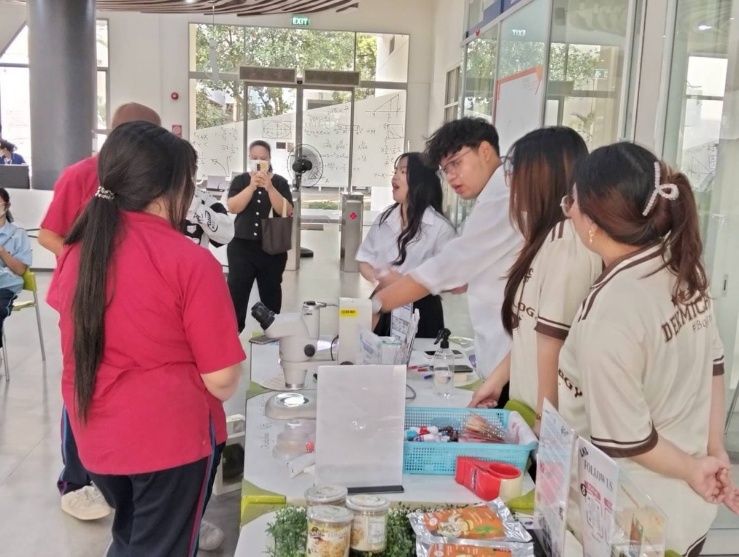
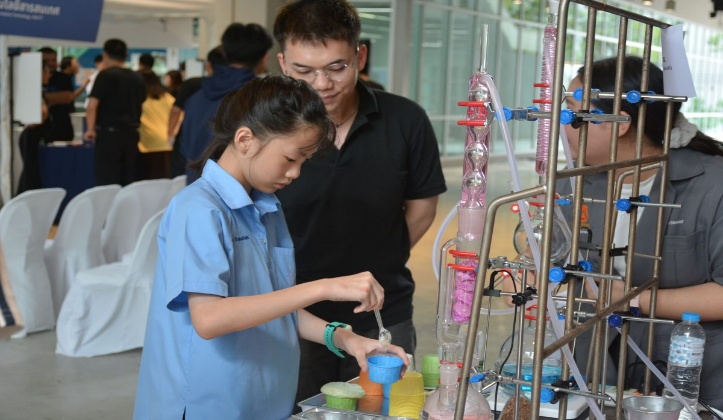
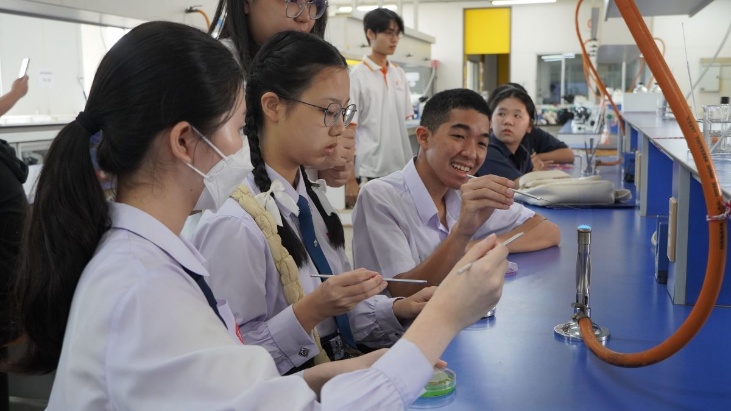
The School of Science introduced its programmes through exhibitions, practical activities and a science-project competition at the LX and N7 buildings. Information covered chemistry, mathematics, physics and microbiology, together with pre-degree opportunities. The public report identifies the event period and describes engagement with prospective learners and school visitors.

Hands-on science demonstration at a programme exploration station.Visitors examining a science demonstration with a presenter.
Programme exploration and practical science activities, 10–12 October 2025. Photographs retained from the supplied document; event details verified against the official KMUTT report .

Soft Skills Boost | 10–11 October 2025

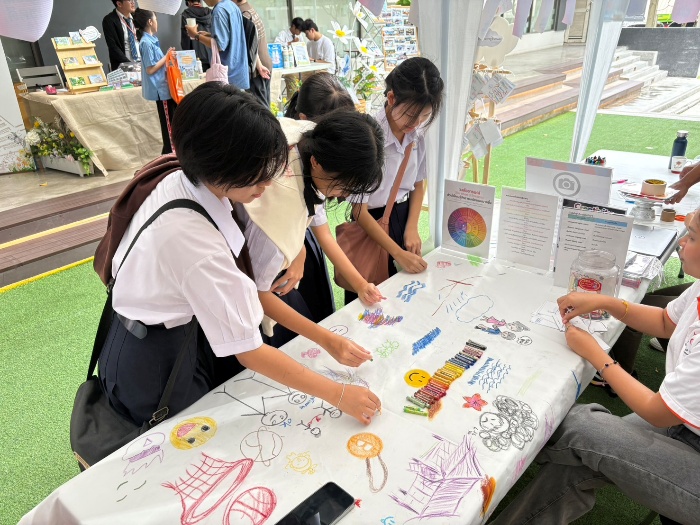
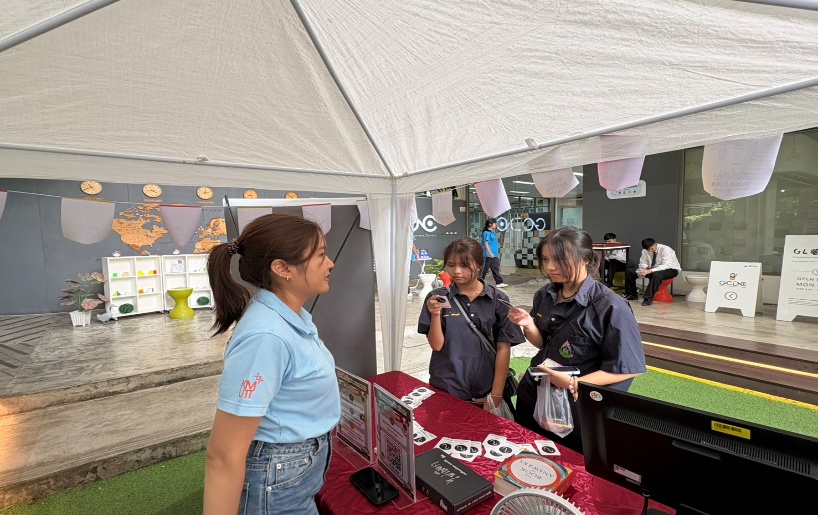
The Office of General Education and School of Liberal Arts provided three learning stations at the N15 Open House: self-awareness, communication and creativity. Reflection cards, anonymous Mentimeter responses and collaborative painting allowed visitors to explore university learning and express their ideas.

Visitors adding drawings to a collaborative painting activity.Visitors in conversation at a Soft Skills Boost activity booth.
Soft Skills Boost activities, 10–11 October 2025. Original photographs retained; date, venue and programme verified against the organising office’s account .

Indicator connection: these were general access and engagement activities. They are presented as opportunities within an inclusive admissions environment, not as women-only outreach, sex-disaggregated participation results or a replacement for the published non-discrimination commitments above.

Confirmed january 2026 activities

Prospective-student engagement in 2026

FSci Open House | 24 January 2026

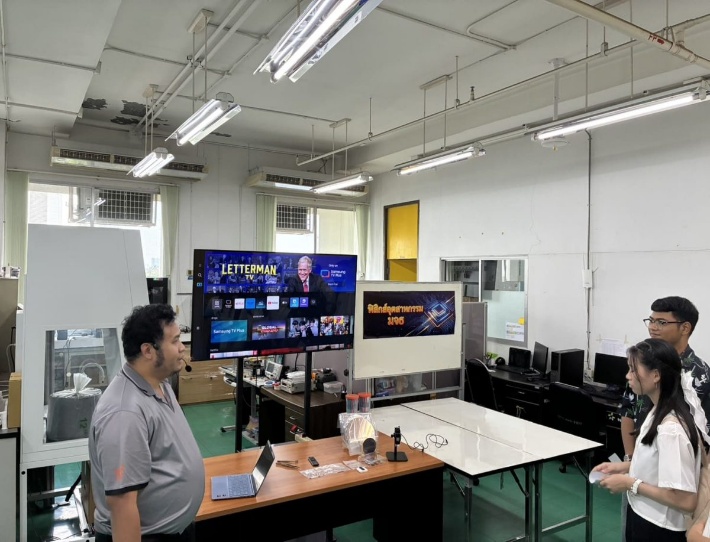
KMUTT’s School of Science held an Open House at its Learning Space to explain undergraduate, postgraduate, pre-degree and non-degree routes. Departmental booths and practical workshops helped prospective students understand academic options and experience university learning. The official report was published on 30 January 2026.

Prospective learners taking part in a science demonstration.A programme information booth with demonstrations and displays.
Programme information and demonstrations at FSci Open House, 24 January 2026. Original photographs retained; event verified through the official university report .

Wat Phutthabucha School | 20 January 2026

The School of Science’s outreach team presented programmes, entry requirements, scholarships and career pathways to Grade 11–12 learners. Physics students contributed their learning experiences. The official account records more than 147 teachers and students attending; this is the total attendance, not a female-participant count.

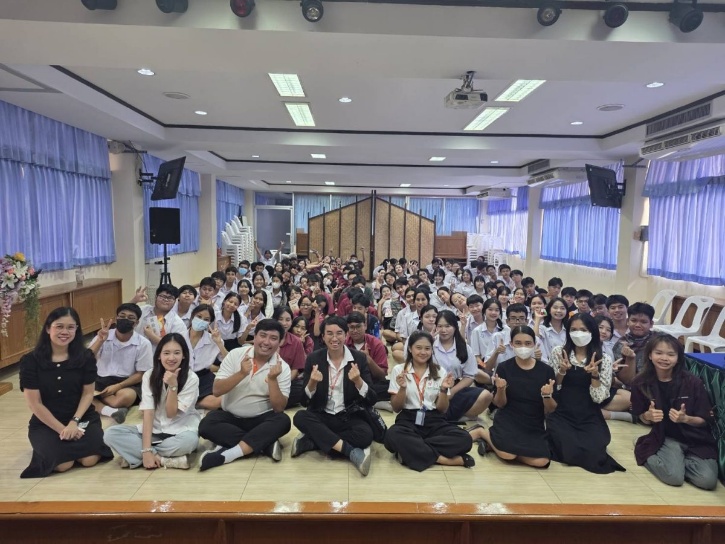
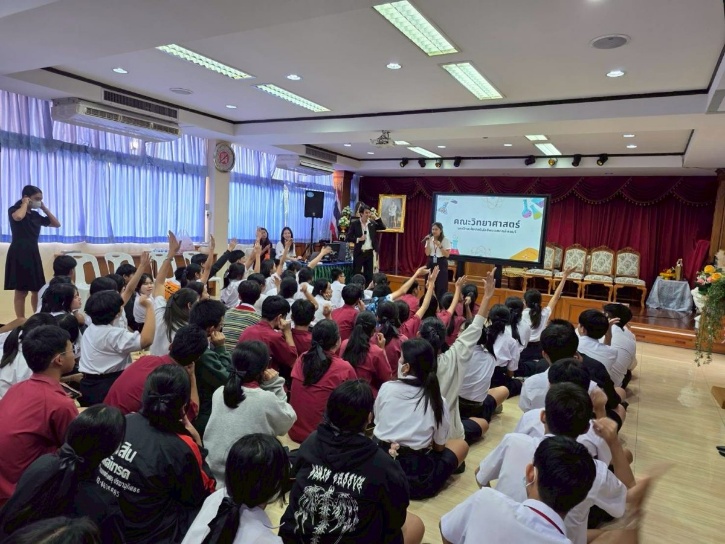
Group photograph of participants in a school guidance event.Learners raising their hands during a school guidance session.
School guidance and interaction with prospective learners, 20 January 2026. Photographs from the supplied document; programme and attendance verified against the official account .

These cases support the application-information and early-engagement components. No sex-specific selection outcome is inferred from the photographs or the total attendance.

Gender equality communication in 2025

Participation in an inclusive learning community

Pride Month learning resource | 30 May–30 June 2025

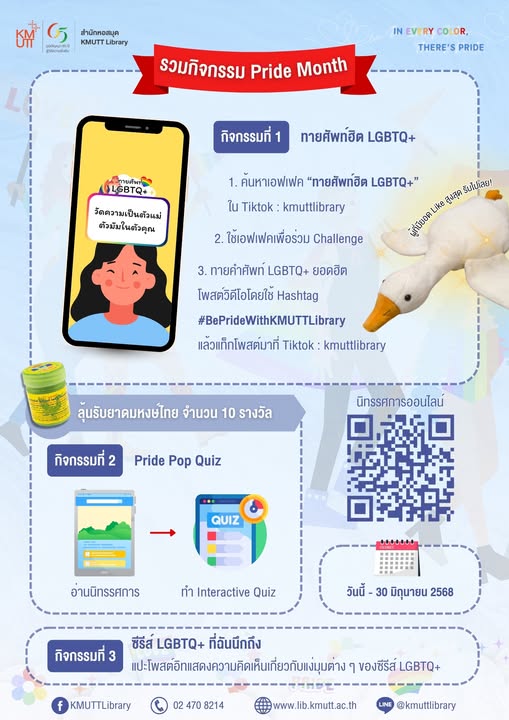
KMUTT Library’s public Pride Month resource identifies a 2025 programme at the Open Theatre, first floor of the library building (N10). Its educational material discusses sexual orientation, gender identity, gender expression and sex characteristics, alongside respect for difference and equal treatment.

SO

Sexual orientation

Sexual or romantic attraction towards other people.

GI

Gender identity

A person’s awareness of, and identification with, the gender they wish to be.

GE

Gender expression

How a person expresses gender in ways that other people can see.

SC

Sex characteristics

Biological characteristics present from birth.

Gender-diversity learning graphic from the original evidence document. The linked Library resource specifies the programme dates as 30 May–30 June 2025 . The four Thai definitions are translated into English above; the original artwork is retained through the source link.

Public institutional communication | 29 June 2025

In its dated article “Speak by Your Clothes”, KMUTT describes the university as a space in which people of different genders and identities can develop, express themselves and participate with respect for difference. The article connects this environment with gender equality and reduced inequalities. It is used here as contemporary institutional communication, not as a newly enacted dress or admissions regulation.

Connection to participation The admissions commitment covers programmes and activities; the 2025 Library programme and institutional communication document the inclusive context in which participation is encouraged. The evidence is not described as a new women-specific policy, and participation levels are not estimated from images.

Supporting evidence, 2025–2026

Financial and experiential support for participation

Financial support reported for 2025

Good University Report 2025 reports student funding across undergraduate and postgraduate study. The figures below reconcile the scholarship and bursary categories in the report and the 2025 assistance summary supplied with the original document.

University-wide student funding reported for 2025
Funding categoryAwardsValue (THB million)
Scholarships2,838133.73
Bursaries4,297179.42
Total7,135313.15

University-wide totals, not women-only awards or unique recipients. They provide support context; they do not replace the admissions policy or establish a female award rate.

Funding breakdown by study level
Study-level figures in the supplied 2025 panel, checked against the official report
Funding categoryStudy levelAwardsValue (THB million)
ScholarshipsUndergraduate2,37944.54
ScholarshipsGraduate45989.19
BursariesUndergraduate3,962160.23
BursariesGraduate33519.19

The supplied assistance panel labels the graduate scholarship figure of 459 in persons; the official report labels all four study-level counts as awards. The HTML follows the official report’s award unit, preserves this distinction, and does not assert unique recipients.

Experiential participation | 26 January 2026

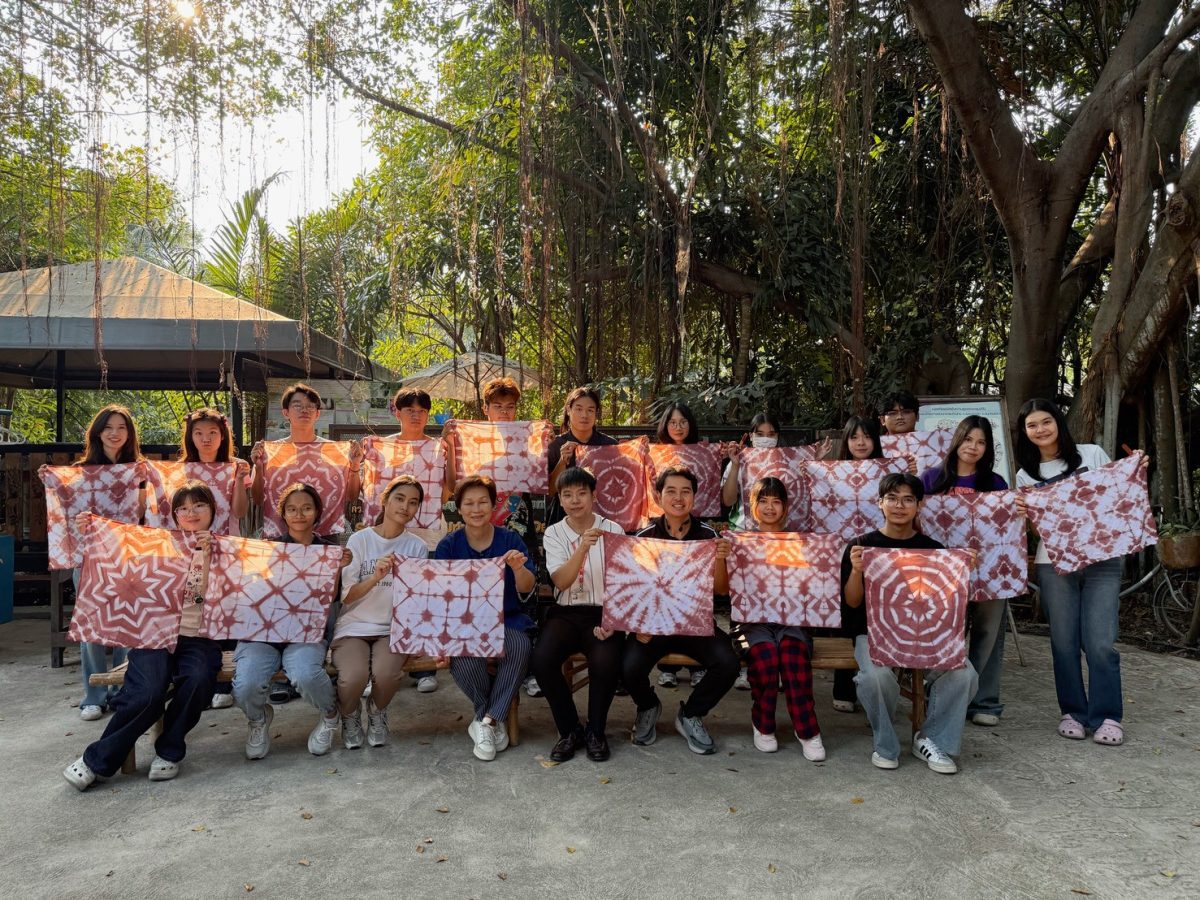
The Library’s Creative Culture for Sustainability project involved 20 students in a natural tie-dye learning activity. The official account describes practical learning and engagement with local knowledge. This is retained as a dated example of student participation, without claiming women-only eligibility or a female-participant count.

Participants displaying naturally dyed textiles after a tie-dye learning activity.
Natural tie-dye activity, 26 January 2026. Original photograph retained; event and total attendance verified through the official account .
References and source details (13 sources)

All evidence cited in the main text concerns 2025 or 2026. The supplied compilation records source-link checks on 9 November 2026. Recruitment-cycle dates and event dates are stated separately from publication dates.

Admissions and access

  • Undergraduate direct admission for non-Thai students, Round 4, 1/2025

    2025 recruitment cycle; applications 7 April–18 May 2025. Admission-related non-discrimination and entry guidance.

    Open official KMUTT source
  • Undergraduate direct admission for non-Thai students, Round 1, 1/2026

    2025–2026 recruitment cycle. Non-discrimination statement and the selection/entry timetable.

    Open official KMUTT source
  • Petchra Pro Jom Klao master’s scholarship admission, non-Thai applicants, 1/2025

    Academic year 2025. Master’s-level publication of the admission-related equal-treatment statement.

    Open official KMUTT source
  • Doctoral direct admission for non-Thai applicants, Round 1, 1/2026

    Applications 1 November 2025–10 March 2026. Doctoral-level publication of the commitment and transition guidance.

    Open official KMUTT source
  • School of Information Technology: Active Recruitment

    Undergraduate intake 2569 / 2026. Published programme thresholds and additional assessment conditions.

    Open official KMUTT source
  • Office of General Education: Soft Skills Boost at Open House

    Event 10–11 October 2025. Organiser’s confirmation of the programme, venue and three learning stations.

    Open official KMUTT source
  • School of Science: KMUTT Open House 2025

    Event 10–12 October 2025; university report 16 October 2025. Programme information, workshops and prospective-student engagement.

    Open official KMUTT source

Participation and support

  • School of Science: FSci Open House 2026

    Event 24 January 2026; university report 30 January 2026. Undergraduate/postgraduate and pre-degree/non-degree access information.

    Open official KMUTT source
  • School of Science: guidance at Wat Phutthabucha School

    Event 20 January 2026; university report 25 January 2026. Programmes, entry criteria, scholarships and total attendance exceeding 147.

    Open official KMUTT source
  • KMUTT Library: Pride Month learning resource

    Programme 30 May–30 June 2025. Dated inclusion education and gender-diversity learning graphic.

    Open official KMUTT source
  • KMUTT Voice: Speak by Your Clothes

    Published 29 June 2025. Contemporary institutional communication about inclusive participation.

    Open official KMUTT source
  • Good University Report 2025

    Reporting year 2025; file published in the university’s 2026 directory. Student scholarships and bursaries; printed page 16 (PDF page 17).

    Open official KMUTT source
  • Library: Creative Culture for Sustainability

    Event 26 January 2026; university report 30 January 2026. Dated experiential-learning activity involving 20 students.

    Open official KMUTT source

Image provenance and source handling

Supplied university document: “5.3.2 Policy for women applications.docx”, supplied by the university. Photographs and the learning/support graphics were selected from that file, with dated activities checked against the official sources above. No event photograph, approval stamp or policy signature was generated. Figure 6 is a labelled crop of the supplied 2025 summary.
This is an evidence compilation, not a newly approved university policy. It replaces the older policy image and undated general club/poster material in the revised narrative rather than relabelling them as 2025–2026 evidence.

Cropped 2025 scholarship/bursary panel from the original assistance summary . Totals checked against Good University Report 2025, p. 16 .

3. Provide women’s access schemes

KMUTT’s dated evidence documents financial support, entrepreneurship development and participation in women-focused technology opportunities. This compilation connects a documented female participant in a 2025 international entrepreneurship programme with the programme’s continuing mentoring arrangements, and presents a 2026 emergency scholarship awarded to a female engineering student.

It also adds women-focused cybersecurity participation, current scholarship application routes, and dated institutional financial-support records. The evidence distinguishes support designed specifically for women from inclusive schemes with documented female beneficiaries and from general support available to eligible students.

Evidence at a glance

Mentoring

2025 WTUN entrepreneurship programme; KMUTT profile published in February 2026.

Mixed-gender programme with a documented female KMUTT participant and continuing mentor access.

Scholarships

2026 disaster-relief award; 2025 and 2026 application notices and donor-funded awards.

Separate an identified female beneficiary from university-wide funding totals.

Other provision

Women-focused cyber participation in 2025/2026; gender-equity learning activities; a dated campus work opportunity.

Participation and development opportunities; competition prizes are not described as university scholarships.

Reading the evidence Dates identify the actual activity, application cycle or publication, as specified. All programme outcomes and dated records used here fall within 2025–2026. A source’s publication year is not substituted for an unknown original scholarship award date.

Mentoring and women’s progression

A documented pathway into entrepreneurship

Female participation in the 2025 programme

KMUTT’s profile published on 9 February 2026 identifies Ruedhaidham “Natch” Soros, an International Computer Engineering alumna, as a participant in the 2025 WTUN Accelerated Student Entrepreneurship Programme. During that programme she developed business models with a Chinese co-founder, refined her pitching and presented PATHWAY, an education venture concerned with mentorship and international learning.

Continuing mentoring, not only a one-off event

WTUN’s August 2025 report dates the second programme workshop to 30 June–4 July 2025 at Beijing University of Chemical Technology. It explains that all participants would have continuing access to advice and mentors through the Bradford-Renduchintala Enterprise Ecosystem at the University of Bradford. This independently documents the support mechanism associated with the programme.

Evidence map: participant, activity and follow-through

  1. Participant

    A named woman from KMUTT took part in the 2025 programme. The university published her account in 2026.

  2. Practical development

    Business-model development and pitching were part of her experience.

  3. Continued support

    The programme offered ongoing mentor access and business advice beyond its workshop.

  4. Institutional relationship

    KMUTT documented participation in a WTUN and University of Bradford-supported programme; mentoring delivery is attributed to the named partner ecosystem.

Figure 1. Source-based evidence map created for this revision. Compiled from the participant account and programme report.

Scope of the claim This is a mixed-gender entrepreneurship programme with a documented female KMUTT participant. It is not presented as a women-only university mentoring scheme, nor as proof of a university-wide female mentoring participation rate.

Women-focused technical opportunities

Cybersecurity participation in 2025–2026

The School of Information Technology (SIT) records participation by KMUTT students in an external competition designed to develop women’s cybersecurity talent. At the final on 31 January 2026, its ModJiw and SamoonNaKarunn teams won first and second place in the university-level category. The official report lists three members in each team.

Women Thailand Cyber Top Talent 2026KMUTT teams — final held 31 January 2026
  • ModJiwWinnerTHB 40,000
  • SamoonNaKarunnFirst runner-upTHB 30,000

External competition prize (THB). Bars start at zero; scale ends at THB 40,000.

Exact published competition prizes — university-level category, 31 January 2026
TeamResultExternal prize (THB)
ModJiwWinner40,000
SamoonNaKarunnFirst runner-up30,000

Figure 2. New chart compiled from SIT’s report published on 16 February 2026. Prize funding belongs to the external competition, not to KMUTT’s scholarship budget.

Continuity from a final held in January 2025

SIT also reported a first-runner-up result for SamoonNaKarunn at a final held on 23 January 2025. The competition retained the title “Women Thailand Cyber Top Talent 2024”, but SIT dates the activity to Cybersec Asia x Thailand International Cyber Week 2025 and published its account on 5 March 2025. The event is therefore included by its documented activity date, not by changing its official title.

Evidence classification Programme type: an external women-focused cybersecurity competition. Evidence type: KMUTT student participation and results. Financial classification: external competition prizes, separate from the institutional scholarship allocations below. Counts are reported by event; participation across years is not summed as unique beneficiaries.

Scholarship application routes

Dated routes into financial and talent support

Saet Lueang Rueang Rung: academic year 2025

The Student Financial Aid Unit’s 30 April 2025 notice provides a structured route for students in Years 2–4, with five categories of achievement and published application requirements. It is an inclusive scholarship, not an award restricted to women.

Categories
Academic achievement; leadership; creativity and innovation; arts and culture; sport.
Application window
30 April–17 June 2025.
Application materials
Application form, certified transcript, portfolio, and a one-page proposal for a project benefiting students, the university or society.
Selection and award steps
Interview list by 27 June; recipient list by 1 August, subject to the unit’s schedule. Conditions to be acknowledged by 6 August 2025.

Source: the 2025 scholarship call. Eligibility and final award conditions remain those in the complete university announcement; this table is not a replacement application notice.

SoA+D: two support routes in 2026

The School of Architecture and Design published both achievement-based support and urgent financial relief for its eligible students.

Applicants
Years 2–5; student IDs 68xxxxxxx and earlier, as specified by the school.
Support routes
Distinguished abilities: achievement, leadership, talents or community contribution. Financial relief: urgent financial hardship affecting continued study.
Dates and review
Applications: 29 May–18 June 2026. Interview: 22 June 2026. Selection by the SD Committee.
Documentation
Parents’ payroll slips or tax documents are required. Recipients from 2025 must reapply.

Source: the SoA+D 2026 notice. Both schemes are recorded as inclusive routes; the announcement is not evidence of a female-only entitlement or a gender-disaggregated award total.

A documented female scholarship beneficiary

Emergency assistance supporting continued study

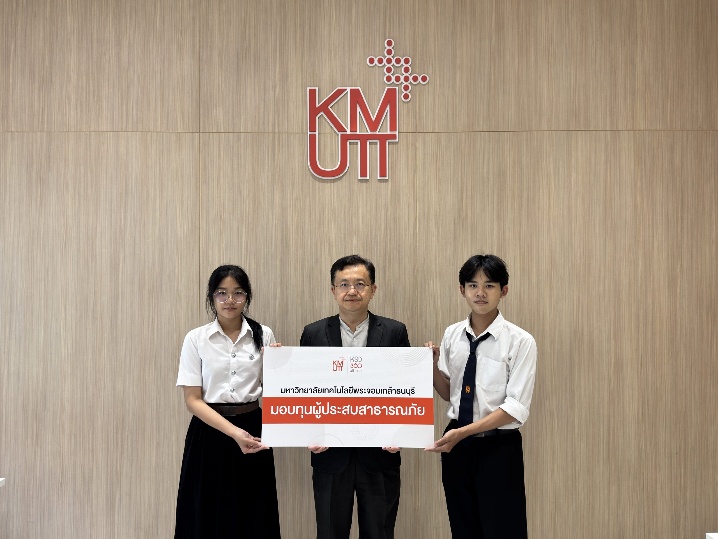
The Student Financial Aid Unit’s notice dated 15 September 2026 reports Disaster Relief Scholarship Round 1 for academic year 2026. It names a female Mechanical Engineering student affected by a fire in Kanchanaburi as one of two recipients, each awarded THB 5,000. This is direct evidence of a woman receiving financial assistance through an inclusive university scheme.

Disaster-relief assistance presentation with two students and a university representative.
Figure 3. Disaster-relief scholarship presentation. Image retained from the supplied dossier, p. 15; the 2026 case is corroborated by the disaster-relief scholarship notice.
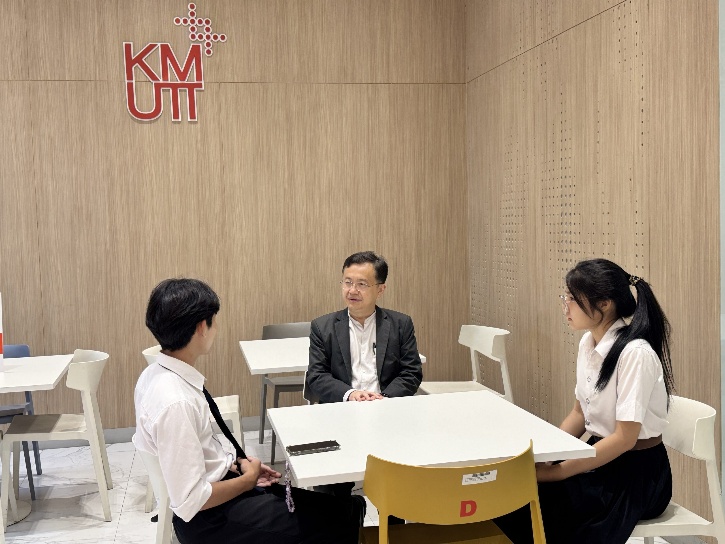
A meeting accompanying the disaster-relief assistance case.
Figure 4. Meeting accompanying the same assistance case. Original dossier, p. 15; not presented as evidence of a formal mentoring scheme.

Support mechanism documented in the notice

Form of assistance
A disaster-relief scholarship of THB 5,000 per recipient.
Access route
Affected students apply through New ACIS and submit supporting documents through the university’s FormSFA channel.
Purpose
Financial relief and encouragement following a disaster, supporting the ability to continue education.
Beneficiary interpretation
The cited case establishes an actual female recipient, not a women-only eligibility rule or a female share of all emergency awards.

Source: the disaster-relief scholarship notice; original images: the supplied evidence dossier, pp. 14–15. The publication date is not assumed to be the precise award-ceremony date.

Financial-assistance record This is an individual disbursement record under an inclusive emergency-aid scheme. Its relevance here is the documented benefit to a woman engineering student. The amount is an individual award value, not an estimate of assistance received by all women.

Supporting institutional provision

Scholarship delivery in 2025 and 2026

The following allocations provide institutional context for the financial-support system. They are not women-only funding totals, and the photographs are not used to infer the gender distribution of recipients.

Institutional scholarship allocations — separate records for 2025 and 2026
Scheme / dated recordAwardsAllocation (THB)Documented allocation
Boon Rawd • academic year 2025 Published 26 September 2025Not stated400,000THB 400,000 to KMUTT; support towards study completion without a service obligation.
Boon Rawd • academic year 2026 Published 19 September 202616400,00016 scholarships; total THB 400,000. This is a separate annual allocation, not a revision of the 2025 figure.
Boonyiem and Associates • 5 October 20265100,0005 scholarships × THB 20,000 = THB 100,000.
Poh Teck Tung Foundation • 30 September 202610 + 2300,00010 final-year awards and 2 continuing awards for five-year programmes; THB 25,000 each; THB 300,000 in total.
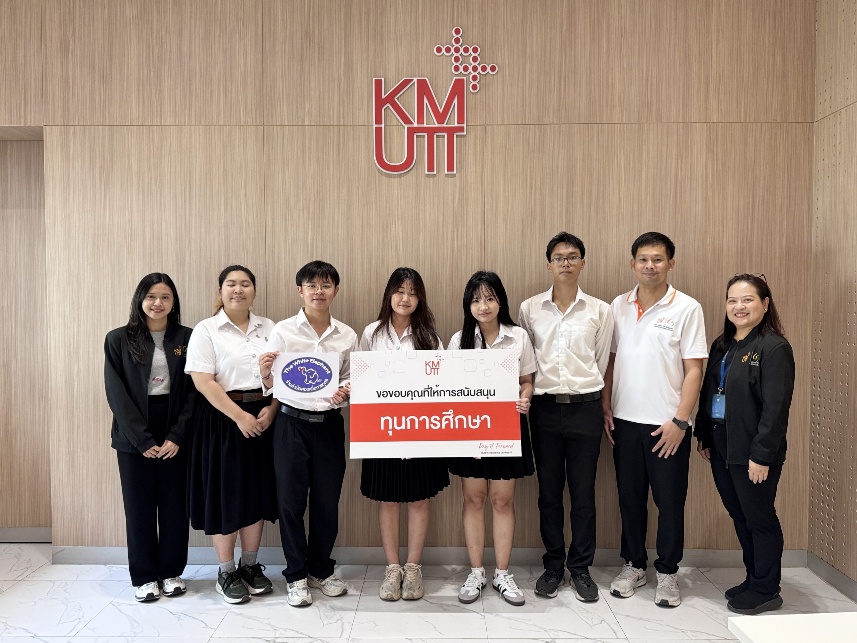
The White Elephant • academic year 2026 Published 22 September 2026525,0005 scholarships × THB 5,000 = THB 25,000.
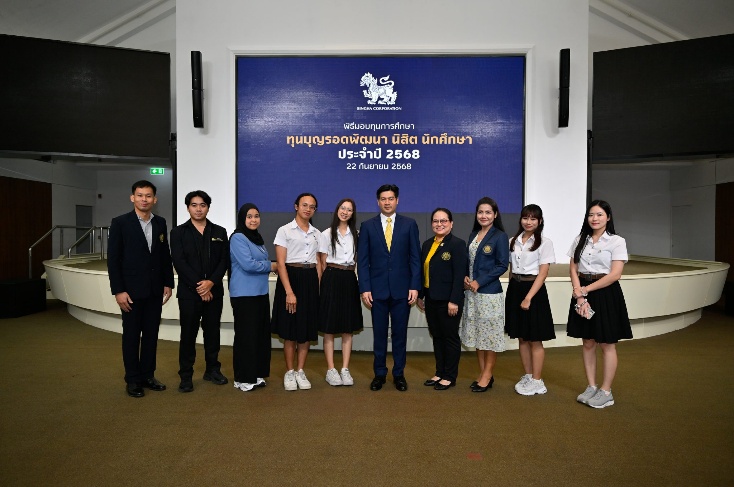
Group photograph at the 2025 Boon Rawd scholarship presentation.
Figure 5. Boon Rawd award ceremony, 2025. Supplied dossier, p. 8; date context checked against the 2025 Boon Rawd notice.
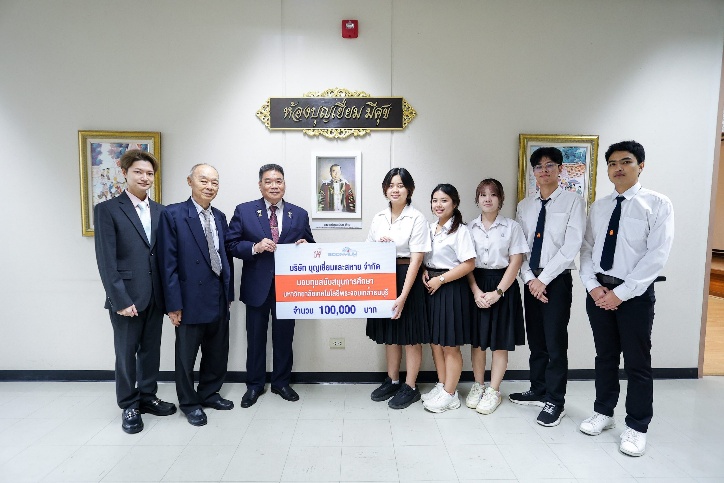
Group photograph at the 2026 Boonyiem and Associates scholarship ceremony.
Figure 6. Boonyiem and Associates ceremony, 2026. Supplied dossier, p. 10; event date corroborated by the Boonyiem and Associates report.
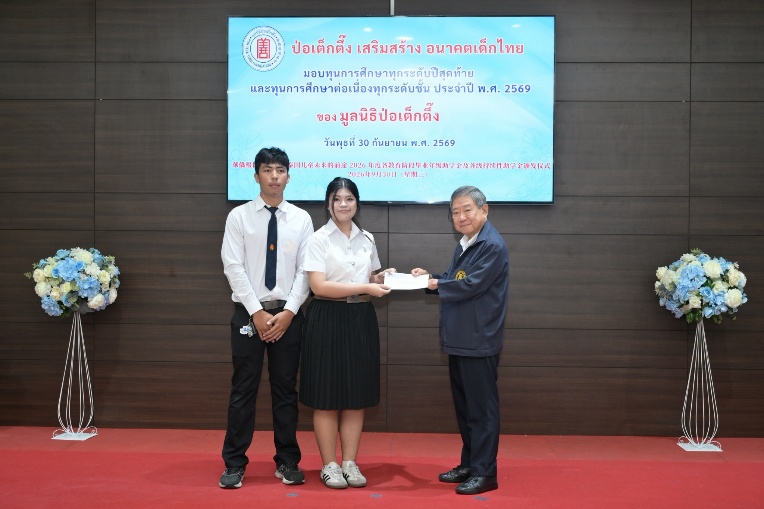
Poh Teck Tung scholarship presentation in 2026.
Figure 7. Poh Teck Tung scholarship presentation, 2026. Supplied dossier, p. 12; the Poh Teck Tung notice.
Group photograph of the White Elephant scholarship recipients and representatives in 2026.
Figure 8. The White Elephant scholarship recipients, 2026. Supplied dossier, pp. 13–14; the White Elephant notice.

Other enabling provision

Women-focused learning and campus opportunities

Gender-equity and engineering learning activities

WTUN’s dated webinar record shows KMUTT contributing to International Women in Engineering Day on 23 June 2025, with mechanical-engineering academic Dr Teeranoot Chanthasopeephan as a speaker. It also records a KMUTT-hosted workshop on gender equity in science and technology higher education on 13 March 2026, with Dr Pinet Sriyotha among its speakers. The latter record includes a replay. These are women-focused knowledge-sharing activities, rather than evidence of individual student mentoring or scholarship awards.

A dated paid-work opportunity: December 2025–January 2026

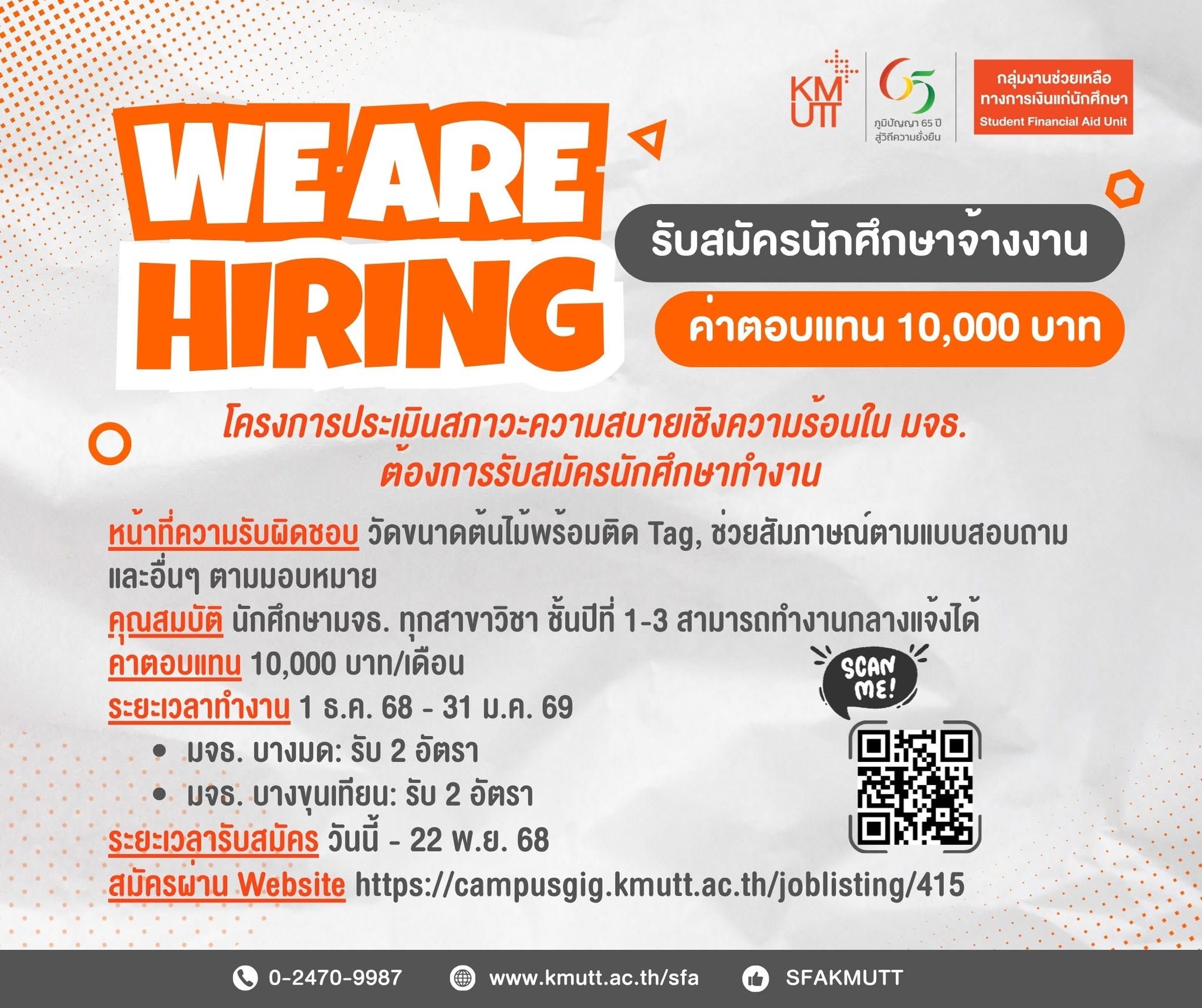
The supplied CampusGIG recruitment poster advertises a thermal-comfort assessment project for students in Years 1–3: THB 10,000 per month, 1 December 2025–31 January 2026, with two positions at Bangmod and two at Bangkhuntien. It is retained as a general income-generation opportunity, not a women-specific placement or evidence of an actual female hire. (supplied dossier, p. 19)

Historical CampusGIG thermal-comfort project recruitment poster, with dated work period, monthly remuneration and application deadline.
Figure 9. Dated university recruitment poster retained from the supplied evidence dossier, p. 19. The poster links to CampusGIG job listing 415. The application period is historical, not an invitation to apply now.
English translation of the historical CampusGIG poster

Historical notice. The poster’s stated application deadline was 22 November 2025. Its work period was 1 December 2025–31 January 2026. The following text translates the original notice; it does not announce current vacancies or confirmed hires.

Original heading
WE ARE HIRING — student employment recruitment (historical poster heading).
Project
Student employment for KMUTT’s thermal comfort assessment project.
Responsibilities
Measure trees and attach tags; assist with questionnaire-based interviews; carry out other assigned duties.
Eligibility
KMUTT students in any programme, Years 1–3, who can work outdoors.
Monthly remuneration
THB 10,000 per month.
Work period
1 December 2025–31 January 2026.
Positions by campus
Bangmod: 2 positions. Bangkhuntien: 2 positions.
Application period
From “today” as printed on the poster until 22 November 2025. The poster does not state a calendar opening date.
Historical application channel
CampusGIG job listing 415, with a QR code printed on the poster: https://campusgig.kmutt.ac.th/joblisting/415
Issuing unit and contact
Student Financial Aid Unit. Telephone: 0-2470-9987. Website: www.kmutt.ac.th/sfa. Social account: SFAKMUTT.
References and source details (13 sources)

Source details are grouped below. The supplied compilation records retrieval of web records on 9 November 2026. English descriptions below summarise the source; original Thai titles and wording remain available at the links.

Core evidence

  • KMUTT — Building Early, Leading Forward: A Young Woman Shaping Science Through Action.

    Published 9 February 2026. Used for the explicitly dated 2025 participation account.

    Open official source
  • WTUN — Newsletter, August 2025.

    Published 13 August 2025. Documents the 30 June–4 July workshop and continuing mentor access through the University of Bradford.

    Open official source
  • SIT KMUTT — Women Thailand Cyber Top Talent 2026 results.

    Published 16 February 2026; final held 31 January 2026. Source for the newly prepared competition-prize chart.

    Open official source
  • SIT KMUTT — Women Thailand Cyber Top Talent 2024: first-runner-up result.

    Published 5 March 2025. The event was held on 23 January 2025 despite the competition title retaining “2024”.

    Open official source
  • Student Financial Aid Unit — Saet Lueang Rueang Rung scholarship call, academic year 2025.

    Published 30 April 2025. Application categories, eligibility, documentation and timeline.

    Open official source
  • School of Architecture and Design — SoA+D Scholarships 2026.

    Application cycle 29 May–18 June 2026. Distinguished abilities and urgent financial-relief routes.

    Open official source
  • Student Financial Aid Unit — Disaster Relief Scholarship, Round 1/2026.

    Published 15 September 2026. Confirms the female engineering beneficiary, THB 5,000 award and application channel.

    Open official source

Financial support and visuals

  • Student Financial Aid Unit — Boon Rawd university scholarship ceremony, academic year 2025.

    Published 26 September 2025. Confirms the THB 400,000 institutional allocation.

    Open official source
  • KMUTT — Boon Rawd university scholarship ceremony, academic year 2026.

    Published 19 September 2026. Confirms 16 scholarships totalling THB 400,000.

    Open official source
  • KMUTT — Boonyiem and Associates scholarships, academic year 2026.

    Published 7 October 2026; ceremony held 5 October. Used together with the supplied dossier, pp. 9–10.

    Open official source
  • Student Financial Aid Unit — Poh Teck Tung Foundation scholarships, academic year 2026.

    Published and event dated 30 September 2026. Confirms the 10-plus-2 award structure and THB 300,000 allocation.

    Open official source
  • Student Financial Aid Unit — The White Elephant scholarship support, third consecutive year.

    Published 22 September 2026. Confirms five awards totalling THB 25,000 for academic year 2026.

    Open official source
  • WTUN — Webinars: International Women in Engineering Day 2025 and Gender Equity Workshop 2026.

    Event dates 23 June 2025 and 13 March 2026. Supports KMUTT’s speaker participation and its hosting role, respectively.

    Open official source

Supplied evidence dossier

5.3.3 Provide women’s access schemes.docx, 23 pages. Used as the original document and the source of the retained photographs, the CampusGIG poster and the KMUTT banner. Photo captions identify the original page and associated public source. Beneficiary information is drawn from the accompanying source text, not visual inference.

Poster destination (printed in the supplied evidence dossier, p. 19): CampusGIG job listing 415: Open historical CampusGIG listing 415

Figure 1 is a new source-based evidence map; Figure 2 is a new calculation-free chart of published prize amounts. Figures 3–9 are selected original illustrations, not newly generated documentary photographs. Historic or undated policy images and unrelated flood-donation stories are not used as 2025–2026 women’s access evidence.

Open the original source-based competition-prize chart

4. Encourage applications by women in subjects where they are underrepresented

KMUTT’s 2025–2026 evidence combines programme-level participation data, school-based computing guidance, engineering outreach, and public activities that increase the visibility of women in technical fields. This document brings the verified activities together with practical application information, while distinguishing women-focused communications from general recruitment opportunities.

Evidence at a glance

  1. Subject-level contextRegistrar snapshot: 23 Sep 2025

    Identify selected programmes where female entrants are fewer than male entrants.

  2. School and parent-network outreachSIT × Satriwitthaya: 20 Oct 2026

    Programme guidance, student experience sharing and practical AI learning.

  3. Engineering recruitmentEngineering Open House: 10–12 Oct 2025

    Departmental exploration linked to admission information.

  4. Women-focused visibilityWTUN: 23 Jun 2025; 18 Feb 2026

    Women engineers and a KMUTT computing alumna presented through public network resources.

  5. University collaborationGender-equity workshop: 13 Mar 2026

    KMUTT-hosted exchange with partner technology universities.

Scope: These are dated evidence records and an editorial synthesis, not a claim that all activities formed one formally named recruitment campaign. Entry statistics are not application-conversion results.

Identify underrepresentation at programme level

The Registrar’s semester 1/2025 report supports the following selected programme comparison. “Female share” is calculated as female entrants divided by total entrants; the measure is a headcount share, not an admission rate.

Selected undergraduate programmes — semester 1/2025Female share of new entrants (%) · snapshot: 23 September 2025

50% descriptive parity reference — not a THE threshold

  • Automotive Engineering13.04%12 female / 92 total
  • Electrical Engineering16.83%17 female / 101 total
  • Mechatronics Engineering18.18%8 female / 44 total
  • Mechanical Engineering18.94%25 female / 132 total
  • Robotics and Automation Engineering19.77%17 female / 86 total
  • Computer Engineering — Thai programme23.60%21 female / 89 total
  • Information Technology25.19%34 female / 135 total
  • Computer Science — English programme34.48%20 female / 58 total

Scale: 0–100%. Female entrants ÷ total entrants × 100. The line at 50% is descriptive only.

Figure 1. Author-created chart using the official 2025 Registrar counts.

Exact counts and female shares — selected programmes, 23 September 2025
ProgrammeFemaleTotalFemale share
Automotive Engineering129213.04%
Electrical Engineering1710116.83%
Mechatronics Engineering84418.18%
Mechanical Engineering2513218.94%
Robotics and Automation Engineering178619.77%
Computer Engineering — Thai programme218923.60%
Information Technology3413525.19%
Computer Science — English programme205834.48%

Interpretation: The 50% line is a descriptive parity reference, not a THE scoring threshold or a published KMUTT target. The selection does not imply that women are underrepresented in every STEM programme or that an upward trend has been demonstrated.

School-based computing outreach

SIT × Satriwitthaya School | 20 October 2026

SIT welcomed Grade 10 students and teachers from Satriwitthaya School to the LX Building, Bangmod, for a university-pathway project organised by the school’s Grade 10 parent network. The visit combined undergraduate guidance, a student panel and practical AI learning.

Programme information
SIT introduced its undergraduate study options.
Peer discussion
Students from IT, Computer Science and Digital Service Innovation shared study experiences and preparation advice in a “Find Your Future, Find Your SIT” session.
Hands-on experience
The afternoon workshop introduced AI chatbot development, led by the SIT dean.
External collaboration
The school and its parent network worked with the university to connect secondary education with higher-education choices.

For this evidence compilation, the visit provides a named school-to-computing pathway. It is reported as school-cohort outreach, rather than as a documented women-only admissions programme.

Why programme detail matters

The preceding baseline identifies IT and Computer Science separately. Participation in the same outreach visit does not make every programme presented there an underrepresented subject.

Registrar excerpt — three SIT programmes, semester 1/2025
Programme (English translation)MaleFemaleTotal
Bachelor of Science — Information Technology (4 years)10134135
Bachelor of Science — Computer Science (4 years; English-language programme)382058
Bachelor of Arts — Digital Service Innovation (4 years)162844
School of Information Technology — total as published15582237

Figure 2. English transcription of the original Registrar table excerpt: columns are male, female and total. Reproduced from the previously supplied 5.3.1 evidence attachment and checked against the official report.

Public verification

SIT’s dated school-visit report

The source records the activity and programme content. This document does not convert attendance into a number of female applications or successful admissions.

Engineering outreach and visible women engineers

Engineering Open House | 10–12 October 2025

The 2025 Engineering Open House connected departmental workshops, exhibitions and tours with study and admissions advice. Its admission area offered information on scholarships, TCAS 2026, English-language development and overseas exchange opportunities. The event also provided an early-application opportunity for international undergraduate programmes.

Departmental workshops and tours

Allow prospective learners to explore engineering subjects and ask staff and students about study choices.

Admissions guidance

Make the route from interest to programme selection and application more concrete.

International-programme early admission

The event page invited interested participants to prepare a portfolio and apply through the specified route.

This was a general engineering recruitment event, not a women-exclusive quota or selection scheme. Its role here is the accessible recruitment infrastructure around the women-focused evidence.

Open the 2025 engineering event information

International Women in Engineering Day | 23 June 2025

In the WTUN #TogetherWeEngineer webinar, KMUTT’s Associate Professor Teeranoot Chanthasopeephan from Mechanical Engineering presented research on soft robotics. Speakers also represented Mindanao State University, Southern Alberta Institute of Technology and the University of Bradford. WTUN publishes the programme and a replay.

This is direct evidence of KMUTT participation in a public, women-focused engineering resource. In this compilation it complements the mechanical-engineering and robotics context above; it is not presented as a measured recruitment outcome or as proof of a Thai national admissions campaign.

Open WTUN’s programme and webinar recordings

Collaboration and women-focused public resources

KMUTT-hosted gender-equity workshop | 13 March 2026

KMUTT hosted the online WTUN workshop on gender equity in science and technology higher education. The event was co-organised with three partner universities, offered free registration and addressed women’s underrepresentation and structural barriers in STEM. Its announcement and the WTUN replay record establish the university’s role.

  • King Mongkut’s University of Technology ThonburiThailand
  • University of Applied Sciences Upper AustriaAustria
  • University of BradfordUnited Kingdom
  • Shibaura Institute of TechnologyJapan

This is collaborative institutional learning and public engagement, not evidence that KMUTT adopted every partner’s programme.

A computing alumna in a women-in-science campaign | February 2026

WTUN’s 18 February 2026 women-and-girls-in-science newsletter featured Ruedhaidham “Natch” Soros, a KMUTT International Computer Engineering alumna, describing her engineering learning, leadership and technology entrepreneurship. The dated publication makes a KMUTT woman in computing visible to the network’s public audience. It is used here as a role-model communication, not as a claim that her graduation occurred in 2026.

Women in cybersecurity | January–February 2026

SIT publicised two Computer Science teams’ results in Women Thailand Cyber Top Talent 2026: ModJiw won and SamoonNaKarunn finished first runner-up in the higher-education category. The final was held on 31 January; SIT published the account on 16 February. The organisers were the National Cyber Security Agency and Huawei Thailand.

These examples concern women’s visibility and technical achievement. Competition prizes are not labelled university scholarships, and participation is not treated as evidence that KMUTT organised the national competition.

Connect inspiration with usable application information

Published undergraduate entry requirements | Academic year 2026

SIT’s Active Recruitment section is explicitly labelled academic year 2569 (2026). The selected requirements below give prospective applicants concrete preparation information for IT and Computer Science. They are general programme requirements, not lower or separate standards for women.

Selected academic requirements — Active Recruitment, academic year 2026
Selected requirementInformation TechnologyComputer Science — English
Minimum overall GPAX2.753.00
Minimum mathematics GPA2.753.00
Minimum mathematics credits1012
Minimum science credits520
Minimum foreign-language GPA2.753.00

For IT, the page also specifies a supporting portfolio, an interview and presentation of technology-related work. Applicants should read the full programme-specific conditions and intake announcement; this table is a selected extract, not the complete eligibility rules.

Read SIT’s full Active Recruitment 2026 requirements

Evidence relationship

SIT school and parent-network visit
A practical school-to-programme introduction in computing.
Engineering Open House
Subject exploration linked with application guidance.
WTUN women-focused resources
Visible women in engineering and computing.
KMUTT-hosted equity workshop
University-to-university exchange on participation barriers.
Published entry information
A concrete route for checking requirements and preparing an application.

The relationship above is the organising logic of this revised dossier. It does not assert a new university policy, a single coordinated campaign, a women-only quota or a quantified increase in applications.

Retained supporting example: community tutoring

Ban Koh Mai Laem School | 15–19 December 2025

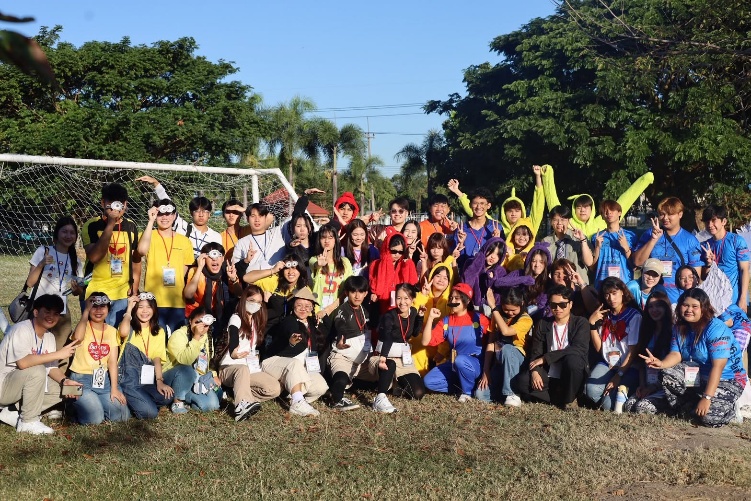
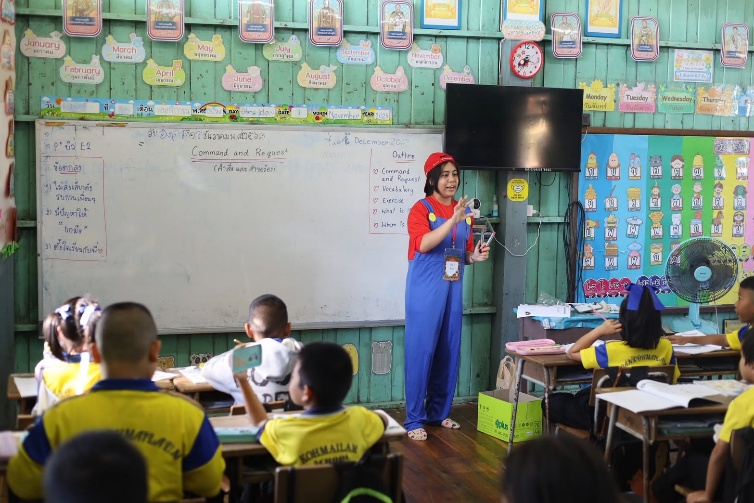
The 19th “Tutoring with Love: From Seniors to Juniors” activity brought KMUTT student volunteers to Ban Koh Mai Laem School in Ban Bueng, Chonburi. The university library’s account confirms the dates and the transfer of academic knowledge through school-based learning activities.

This example is retained as supporting community outreach and academic preparation. It is not classified as a women-only campaign or a demonstrated application outcome.

Group photograph of participants at the December 2025 school tutoring activity.
Figure 3. School and university participants in the retained 2025 tutoring example. Source photograph: original 5.3.4 attachment, page 10; event corroboration: KMUTT Library.
Tutoring taking place in a school classroom.A classroom group participating in the tutoring activity.
Figures 4–5. Classroom learning activities, retained from the same source. No gender totals or participant identities have been inferred from the photographs.
References and source details (10 sources)

References are clickable. Dates refer to the activity or data snapshot unless a publication date is separately stated. All activity and statistical evidence used in the revised narrative is from 2025–2026.

  • KMUTT Registrar — new undergraduate students by programme, semester 1/2025

    Snapshot: 23 September 2025. Two-page official report. Male, female and total entrant headcounts; programme percentages in this document are calculated from these counts.

    Open official source
  • SIT KMUTT — Satriwitthaya School visit, programme guidance and AI chatbot workshop

    Event and publication: 20 October 2026. Identifies the Grade 10 school cohort, parent-network organiser, undergraduate programme briefing, student panel and hands-on workshop.

    Open official source
  • KMUTT Engineering Open House 2025 — official event microsite

    Event: 10–12 October 2025. Documents departmental activities, engineering study guidance, TCAS 2026 information and the international-programme early-application opportunity.

    Open official source
  • World Technology Universities Network — webinar programme and recordings

    Events: 23 June 2025 and 13 March 2026. Confirms KMUTT participation in International Women in Engineering Day, the soft-robotics talk, and the KMUTT-hosted gender-equity session with replay links.

    Open official source
  • Suranaree University of Technology, Center for International Affairs — WTUN Gender Equity Workshop

    Published: 6 March 2026; event: 13 March 2026. Identifies KMUTT as host, four co-organising universities, the STEM gender-equity purpose and free public registration.

    Open official source
  • WTUN — special newsletter for International Day of Women and Girls in Science

    Published: 18 February 2026. Includes the profile of KMUTT International Computer Engineering alumna Ruedhaidham “Natch” Soros. Used as a dated public role-model communication, not as evidence that her degree or all awards occurred in 2026.

    Open official source
  • SIT KMUTT — Women Thailand Cyber Top Talent 2026 results

    Published: 16 February 2026; final: 31 January 2026. Identifies the national organisers and two winning KMUTT Computer Science teams. Competition participation and publicity are distinguished from school recruitment.

    Open official source
  • SIT KMUTT — Active Recruitment 2026 undergraduate requirements

    The retrieved section is explicitly labelled academic year 2569 (2026). Used for the IT and Computer Science minimum academic requirements and preparation information; it is not presented as women-only admission.

    Open official source
  • KMUTT Library Contributor — “Tutoring with Love: From Seniors to Juniors”, 19th edition

    Activity: 15–19 December 2025, Ban Koh Mai Laem School, Ban Bueng, Chonburi. Corroborates the school, date and academic-tutoring purpose of the retained photographic example.

    Open official source
  • User-supplied evidence documents and retained image provenance

    Current 5.3.4 original: pages 9–10 supply the December 2025 tutoring photographs. Previously supplied 5.3.1 original: pages 9–10 reproduce the Registrar report used for the cropped source excerpt. The institutional header is retained from the current 5.3.4 original. Originals are unchanged.

    Editorial treatment: replaced broad STEM assertions with programme-specific data; added dated school outreach and women-focused network resources; retained one verified community example; removed military-training and sports-award sections from the main 5.3.4 narrative. The revised document makes no ranking-score or evidence-year eligibility guarantee.

    Open the original author-created chart

    Open the original Thai Registrar excerpt

5.6 WOMEN’S PROGRESS MEASURES

1. Related information on our university as a body having a policy of non-discrimination against women.

KMUTT’s institutional framework supports non-discrimination against women through a public commitment to equal treatment, personnel-management principles, a formal Code of Ethics, and measures addressing sexual harassment. The Diversity Policy expressly includes gender among the characteristics the university respects. The 2022 Code of Ethics expressly rejects discrimination based on sex assigned at birth or gender, and is reinforced by a public 2023 announcement restating the gender-based non-discrimination standard.

This evidence brings the relevant provisions together rather than relying on a general recruitment statement alone. It distinguishes the policy instruments from a dated 2026 activity showing continued communication of the university’s ethical standards.

Evidence at a glance

  1. Diversity PolicyPublic statement; issue date not shown on cited page

    Equal treatment; gender is expressly included.

  2. Human Resources Policy2 March 2022

    Fairness, performance-based HR practices and inclusive communication.

  3. Code of Ethics and implementation notice2022; notice dated 27 April 2023

    Express non-discrimination standard and disciplinary treatment of sexual misconduct.

  4. Sexual-harassment prevention and resolution guidelines6 June 2019

    Protection and response framework covering the university community.

  5. KMUTT Ethics Day27 April 2026

    Dated communication of the 2022 ethical framework; not a new policy.

English explanations are evidence summaries, not newly issued KMUTT policies or certified legal translations. The cited Thai instruments remain authoritative.

Public commitment to equal treatment

The Registrar’s Office publishes KMUTT’s Diversity Policy in English and Thai. Gender, gender identity and sexual orientation are expressly named, alongside other forms of diversity. The statement commits the university to fair and equal treatment across its community.

Relevance to women: Women fall within this express gender-based protection. The policy is an institution-wide equality commitment, rather than a women-only benefit or a claim about the number of women admitted, employed or promoted.

KMUTT diversity-policy poster describing fair and equal treatment across gender, nationality, social background, disability, religion and other characteristics.
Figure 1. Diversity-policy communication retained from the supplied 5.6.1 attachment. Its wording is supported by the Registrar’s public policy page. The image is a policy communication, not a dated 2025–2026 activity record.

Equality and diversity policy — English reading aid

KMUTT is committed to advancing equality and diversity in society. The university welcomes diversity in gender, race, nationality, economic and social background, origin, culture, ethnicity, disability, religion, gender identity and sexual orientation. It stands for fair and impartial treatment of everyone so that equality and diversity within KMUTT continue to develop and improve.

Poster footer: Admissions and Recruitment Office · https://join.kmutt.ac.th · +66 2470 8333 · KMUTT2Admission

English reading aid for the supplied Thai policy poster; the Thai source remains authoritative.

Public source: Registrar’s Office — Diversity Policy

The cited webpage does not display a policy adoption or review year. This revision therefore does not relabel the policy as a 2025 or 2026 instrument.

Human Resources Policy: relevant provisions

The signed Human Resources Policy B.E. 2565 was announced on 2 March 2022. Its more directly relevant provisions are the fairness, competency and inclusion requirements below. Clause 4(4), quoted in the original draft, concerns proactive recruitment and external expertise; it is not used here as the sole basis for a gender non-discrimination claim.

Clause 4(1) — fairness and governance
Establishes transparency, accountability, fairness and justice in organisational management.
Clause 4(5) — compensation and welfare
Bases the compensation and welfare framework on competency and performance, giving these greater weight than seniority.
Clause 4(12) — equity, diversity and inclusion
Requires HR communication to include internal and external groups on a basis of equality and respect for diversity.
Clause 4(14) — flexible work arrangements
Supports flexibility in time and place, taking personnel health and safety into account. This is contextual support, not a separate maternity entitlement.

Original HR-policy wording and announcement

Thai original of HR Policy clause 4(12), with the English phrase Equity Diversity and Inclusion.
Figure 2. Clause 4(12), cropped from page 3 of the original signed HR policy. The provision names equity, diversity and inclusion. Original wording is unchanged.

Clause 4(12) — English reading aid

Human resources work must use communication as a tool for strategic operations so that personnel at every level benefit when they need information and feel able to act as a voice for conveying important information (Brand Ambassador) to various stakeholders. This must take account of concise and timely communication processes (Lean Communication Processes) and cover all internal and external groups (Equity Diversity and Inclusion), on the basis of equality and respect for diverse differences.

English reading aid for the supplied Thai excerpt; the original signed Thai policy remains authoritative.

Signed date of the Human Resources Policy, 2 March 2022.
Figure 3. Original announcement date and signature block: 2 March B.E. 2565 (2022). Cropped from the same policy page.

Announcement and signatory — English reading aid

Announced on 2 March B.E. 2565 (2022). Associate Professor Dr. Suvit Saetia, President of King Mongkut’s University of Technology Thonburi.

Date and title translated for international readers; consult the signed Thai policy for the original wording.

Public source: full Human Resources Policy B.E. 2565

These HR provisions complement the express sex- and gender-based non-discrimination standard described below. They are not presented as evidence of measured pay parity or the absence of discrimination cases.

Express non-discrimination and misconduct rules

Code of Ethics B.E. 2565 (2022)

The university’s formal Code of Ethics provides the underlying ethical framework. The official announcement on governance with integrity and transparency, dated 27 April 2023, restates its core standards for personnel. Core value 6 of the 2022 Code requires impartial performance of duties and rejects discriminatory treatment based on personal relationships or characteristics, including sex assigned at birth and gender. The 2023 notice restates the gender-based standard.

Core ethical value 6
An express gender-based non-discrimination standard; stronger direct evidence than a generic recruitment clause. The underlying 2022 Code also expressly names sex assigned at birth.
Serious misconduct, item 2
Sexual violation of another person is listed among serious ethical and disciplinary offences.
Serious misconduct, item 4
Improper disclosure of confidential information that harms personnel, students or service recipients is also listed.

The HR Office also publishes a Dos & Don’ts communication under the 2022 Code, highlighting human equality, respect for differences and the prohibition of sexual violation. This communicates the standard; it is not a separate policy adoption date.

Sexual-harassment prevention and resolution

The university’s legal register dates its prevention and resolution guidelines to 6 June 2019. The official sustainability page explains their community-wide scope and coverage of unwelcome sexual conduct, including verbal, written, physical and electronic behaviour and abuse of authority.

That published summary describes informal and formal handling routes, protection of complainants and related persons against retaliation, and fair treatment and privacy for accused persons. This provides a specific response framework alongside the general equality commitment.

Source distinction: the issue date is taken from the legal register ; the operational description above is attributed to KMUTT’s published summary . No 2025–2026 reissue of the 2019 guidelines is asserted.

Public communication and access to reporting

Dated implementation context: 27 April 2026

KMUTT held Ethics Day 2026 at the LX Building under the theme ‘Ethics Start with us’. The university’s report records participation by administrators, staff and students and an Ethics in Action discussion explicitly linked to the 2022 Code of Ethics. Representatives included university personnel, an alumnus, an on-campus food vendor and the student organisation.

The event provides dated evidence that the existing ethical framework continued to be communicated in 2026. It is included as general institutional implementation context, not described as women-only training or as proof of a reduction in discrimination complaints.

Public source: KMUTT Ethics Day 2026 — dated university report

Published routes for assistance and complaints

Harassment-related assistance
The published guidelines summary names supervisors, the Human Resources Management Office and designated committees as reporting or handling routes.
University complaint/contact page
A public complaints entry point is provided. The page states that complainant information is kept confidential.
University central telephone
The official contact page displays 0 2470 8000 for university contact and routing.

Public source: KMUTT complaints and contact page

Date and scope of the evidence

Policy dates and activity dates serve different purposes. The 2019, 2022 and 2023 instruments are retained with their original dates. The April 2026 record is supplementary implementation context; it does not change an older policy’s adoption date or retroactively prove an activity occurred in an earlier assessment year.

The document presents supported policy commitments and published access routes. It does not claim a new women-specific policy, a recent formal review without a dated record, a particular complaint outcome, or university-wide training coverage.

References and document record (10 sources)

Official sources checked on 9 November 2026. Link labels below open the cited source. Policy dates are distinguished from webpage availability and activity dates.

  • Registrar’s Office — Diversity Policy

    Public English/Thai equality statement. Issue/review year is not displayed on the cited page.

    Open official source
  • Human Resources Policy B.E. 2565 (2022)

    Signed 2 March 2022; clause 4(1), 4(5), 4(12) and 4(14). Policy images in this revision are retained from the supplied attachment.

    Open official source
  • KMUTT Code of Ethics B.E. 2565 (2022)

    Formal university regulation hosted by the Human Resources Management Office.

    Open official source
  • Governance with integrity and transparency — 27 April 2023

    First two pages of the ITA PDF bundle; core ethical value 6 and serious misconduct items 2 and 4. The hosting filename refers to anti-bribery measures, but the bundle begins with the broader governance announcement.

    Open official source
  • HR Dos & Don’ts under the 2022 Code of Ethics

    Public policy-communication sheet; no separate issue year is inferred from the upload location.

    Open official source
  • KMUTT Law — policy/measure register

    Lists the sexual-harassment prevention and resolution announcement dated 6 June 2019.

    Open official source
  • Sustainability @ KMUTT — SDG 10, anti-harassment section

    University-published summary of the 2019 guidelines, including scope, handling and protection measures.

    Open official source
  • KMUTT Ethics Day 2026

    University news report dated 27 April 2026; communication and discussion of the 2022 ethics framework.

    Open official source
  • KMUTT complaints and contact page

    Public complaint entry point, confidentiality statement and central telephone number.

    Open official source
  • Supplied document: 5.6.1 Policy of non-discrimination against women.docx.

    Source material: original HR-policy scans and diversity-policy poster. The original document is unchanged. This separate revision reorganises the narrative, adds externally verified official evidence, and removes blank pages and unsupported extensions of policy wording. All summaries and tables in this revision are editorial aids, not new university instruments.

2. Related information on our university as a body having a policy of non-discrimination for transgender people.

KMUTT public Diversity Policy expressly includes gender identity and sexual orientation in its commitment to equal treatment. This is the direct institutional basis for the non-discrimination statement in this evidence. The Human Resources Policy B.E. 2565 (2022) adds an equity, diversity and inclusion principle for personnel-related communication, while the university’s published sexual-harassment framework addresses unwelcome conduct across the KMUTT community.

The 2025–2026 materials below show public communication of inclusion and ethical standards. They supplement the policy evidence; they are not presented as newly adopted transgender-specific regulations or as proof that discrimination never occurs.

Evidence at a glance

  1. Explicit equality commitment

    Gender identity and sexual orientation are named in the university’s public Diversity Policy.

    Existing policy statement
  2. Personnel framework

    Clause 4(12) requires inclusive communication grounded in equality and respect for differences.

    2 March 2022
  3. Protection against sexual misconduct

    A published university summary covers all community members and describes handling and protective measures.

    2019 guidelines; public summary
  4. Dated communication

    Library Pride Month, public student voices and Ethics Day communicate inclusion and ethics.

    2025 and 2026

Policy statements, operational descriptions and dated activities are kept separate. English text is an evidence summary; it does not replace the original Thai instruments.

Express policy protection and personnel principles

The Registrar’s published Diversity Policy names gender identity and sexual orientation, rather than relying only on a generic reference to gender. Its commitment extends to the KMUTT community. Accordingly, this revision frames the indicator around equal treatment of transgender people without recasting a women-only policy as a transgender-specific instrument.

Figure 1. Existing KMUTT diversity-policy communication retained from the supplied attachment. The public Registrar statement independently supports its equality wording. This policy image is not dated as a 2025–2026 event.

Equality and diversity policy — English reading aid

KMUTT is committed to advancing equality and diversity in society. The university welcomes diversity in gender, race, nationality, economic and social background, origin, culture, ethnicity, disability, religion, gender identity and sexual orientation. It stands for fair and impartial treatment of everyone so that equality and diversity within KMUTT continue to develop and improve.

Poster footer: Admissions and Recruitment Office · https://join.kmutt.ac.th · +66 2470 8333 · KMUTT2Admission

English reading aid for the supplied Thai policy poster; the Thai source remains authoritative.

Public source: Registrar’s Diversity Policy

Personnel principles and original HR wording

The signed HR Policy retains its original announcement date, 2 March 2022. Clause 4(12) connects communication with equity, diversity and inclusion inside and outside the institution. This is supporting HR governance evidence; the direct reference to gender identity comes from the Diversity Policy.

Figure 2. Clause 4(12), cropped from the original HR-policy scan without changing the wording.

Clause 4(12) — English reading aid

Human resources work must use communication as a tool for strategic operations so that personnel at every level benefit when they need information and feel able to act as a voice for conveying important information (Brand Ambassador) to various stakeholders. This must take account of concise and timely communication processes (Lean Communication Processes) and cover all internal and external groups (Equity Diversity and Inclusion), on the basis of equality and respect for diverse differences.

English reading aid for the supplied Thai excerpt; the original signed Thai policy remains authoritative.

Sexual-misconduct safeguards and reporting access

KMUTT public summary of the 2019 sexual-harassment guidelines describes coverage of administrators, lecturers, staff, employees, students and other people working with the university. It describes unwelcome verbal, written, physical and electronic conduct and misuse of authority, without limiting coverage by gender.

Behaviour covered
Sexually offensive communication, unwanted physical contact and abuse of authority are addressed.
Handling routes
The published summary describes informal resolution and escalation to HR or disciplinary consideration.
Protection
The summary describes protection for complainants and related persons against retaliation and adverse effects on work or livelihood, alongside fairness and privacy for the accused.
Access
The summary identifies supervisors, HR and designated committees. The central university contact page supplies a public entry point.

Source distinction: this operational description is attributed to KMUTT published summary, not quoted as a certified translation of the signed guidelines. It does not create an additional promise about all complaint outcomes.

Practical meaning for this indicator

The policy evidence is the explicit equality commitment and the misconduct framework. Communication about LGBTQ+ inclusion helps make those commitments visible but does not, by itself, prove a formal policy review or a specific benefit such as gender-marker changes, uniform exemptions or healthcare coverage. No such additional entitlement is asserted here.

Dated inclusion communication in 2025–2026

Pride Month at KMUTT Library: 30 May–30 June 2025

The library’s official page records a month-long programme at the Open Theatre, first floor of the library (N10). Its educational content covers gender diversity, identity and expression, together with equality-related topics. This is dated awareness evidence, not a policy adoption date.

Figure 3. Library Pride Month activity poster retained from the attachment; the 30 May–30 June 2025 period is corroborated by the library’s official page.

Pride Month 2025 poster — readable activity information

Activity period
30 May–30 June 2025, corroborated by the official library event page.
Date printed on poster
The poster says “today”–30 June B.E. 2568 (2025). This is a historical 2025 activity record.
Venue
Open Theatre, first floor, KMUTT Library (N10).
  1. LGBTQ+ vocabulary challenge

    Participants were invited to guess popular LGBTQ+ terms using a TikTok effect.

    1. Find the effect for popular LGBTQ+ vocabulary on TikTok: kmuttlibrary.
    2. Use the effect to take part in the challenge.
    3. Post the vocabulary video with #BePrideWithKMUTTLibrary and tag TikTok: kmuttlibrary.

    The poster advertises a draw with 10 prizes; the product label and promotional fine print remain in the original poster.

  2. Pride Pop Quiz

    Read the exhibition and complete the Interactive Quiz. The poster provides a QR code for the online exhibition.

  3. LGBTQ+ series discussion

    Participants were invited to recommend LGBTQ+ series and post their views on different aspects of those series.

Poster footer: KMUTTLibrary · 02 470 8214 · www.lib.kmutt.ac.th · @kmuttlibrary

English reading aid for the legible poster text. Small promotional fine print and the original QR code are retained in the image; unclear lettering has not been guessed.

Public voices and institutional ethics

The university’s 20 June 2025 “Colorful Your Pride” feature presents student perspectives on identity and equality. It is used as a public communication record, without assigning a gender identity to anyone from appearance. On 27 April 2026, KMUTT also held Ethics Day, including discussion of how the 2022 Code of Ethics applies in practice. This is general ethical-policy communication rather than transgender-specific training.

Figure 4. Header of the 2025 “Colorful Your Pride” feature retained from the supplied document.
References and revision record (8 sources)

Official sources checked on 9 November 2026. English narrative and tables are editorial summaries, not newly issued policies or certified legal translations. Source documents remain authoritative.

  • Registrar’s Office — Diversity Policy

    Explicit gender-identity and sexual-orientation wording; no new issue date is inferred.

    Open official source
  • Human Resources Policy B.E. 2565 (2022)

    Clause 4(12); signed 2 March 2022. Original scan retained in attachment.

    Open official source
  • Sustainability @ KMUTT — SDG 10, anti-harassment section

    University-published summary of the 2019 guidelines; source of the operational summary.

    Open official source
  • KMUTT Library — Pride Month: In Every Color, There’s Pride

    Activity period: 30 May–30 June 2025; library Open Theatre, N10.

    Open official source
  • KMUTT — Colorful Your Pride

    Public student-voice feature dated 20 June 2025.

    Open official source
  • KMUTT Ethics Day 2026

    Dated 27 April 2026; general implementation context.

    Open official source
  • KMUTT contact and complaint entry point

    Public central access route; no new complaint statistics are claimed.

    Open official source
  • Supplied attachment: 5.6.2 Non-discrimination policies for transgender.docx

    Original file preserved. Retained images are identified in their captions; undated historic images are not presented as 2025–2026 implementation evidence.

    Changes made in this revision

    Corrected the women-only opening; replaced the generic recruitment quotation with the relevant inclusion provision; separated policy and awareness evidence; added verified activity dates and source links; retained and captioned relevant images; removed blank pages and unrelated or undated activity claims.

3. Related information on our university as a body having a maternity and paternity policies that support women’s participation.

KMUTT Employee Leave Rules and Procedures B.E. 2569 (2026) provide a defined maternity-leave entitlement for employees within the regulation’s scope. Clause 18 permits up to 120 days per pregnancy on full salary, including prenatal examinations and holidays within the leave period. The regulation was announced on 4 February 2026 and states an effective date of 7 December 2025.

This revision replaces the opening reference to the superseded 98-day entitlement with the current 2026 provisions. It concentrates on maternity leave for indicator 5.6.3; leave to assist a spouse after childbirth is addressed separately in the revised 5.6.9 document.

Current entitlement and policy dates

120 days

Maternity leave

Up to 120 days per pregnancy; full salary; prenatal examinations included.

Clause 18
15 additional days

Additional care in specified medical circumstances

Up to 15 additional days, with the salary provision capped at 50%; medical certification required.

Clause 19
150 working days

Extended childcare leave

Up to 150 working days without salary, following maternity leave or the specified additional care leave.

Clause 26
Counting and certification
Holidays within maternity leave count towards the entitlement; a medical certificate is required.
Clause 18
Issue / effective dates
Announced 4 February 2026; effective from 7 December 2025.
Clause 3; signed instrument
Coverage
Permanent university employees under the personnel rules; clause 44 contains the appointment-date and transition provisions.
Clauses 4 and 44

Source: 2026 regulation , read together with the original policy scans in the supplied attachment . Entitlements are not extended here to student parents or employee categories governed by separate instruments.

Maternity and postnatal-care provisions

The maternity chapter links leave to pregnancy, delivery and postnatal needs. The core entitlement is distinct from the additional medically conditioned childcare leave: the latter is not a universal extension at full pay. English explanations below are summaries of the cited Thai clauses.

Figure 1. Chapter 3, clauses 18–21, from the 2026 employee-leave regulation. Original scan retained from the attachment and checked against the HR-hosted regulation. The 120-day entitlement appears in clause 18.

Open the full signed 2026 leave regulation

How the provisions support participation

Protected time for prenatal care, childbirth and recovery allows eligible employees to remain within an established employment framework while meeting maternity-related responsibilities. Full salary applies to the core 120-day entitlement; the additional care provisions have their own conditions and payment rules. This explains the policy mechanism without claiming a measured retention or return-to-work outcome.

Clause 20 addresses medically certified absence extending beyond the periods specified in clauses 18 or 19 as sick leave. Clause 21 provides the maternity application route and the handling of overlapping leave categories.

Application, coverage and the 2025–2026 transition

Application
Submit the leave request through the supervisory chain to an authorised approver before or on the leave date. If the employee cannot sign, another person may submit it; the employee signs as soon as able. Clause 21.
Evidence
Provide the medical certification required for maternity leave and, where relevant, the child’s medical condition under the additional care provision. Clauses 18–19.
Approval
Use the authority arrangements in clause 6 and the regulation’s appended approval table. The HR form catalogue provides the public route to university forms.
Coverage
Clause 44 applies the regulation to employees appointed from 7 March 2003. Earlier appointees and employees converted from civil-service status follow the stated civil-service arrangements, with this regulation applicable where those benefits are less favourable.
Transition
Clause 45 allows employees already on maternity leave before the effective date to use the maternity entitlement under this regulation.

Open the HR forms catalogue

Original opening clauses and effective date

Figure 2. Clauses 1–3 of the 2026 regulation, including repeal of the 2019 regulation and the effective date of 7 December 2025.

Reconciling the policy versions

The HR Office publicly communicated the 2026 leave rules in its March 2026 news notice. The older English handbook still describes 98 days; this revision therefore uses the signed Thai 2026 regulation as the source for the revised entitlement rather than silently combining old and new versions.

References and revision record (6 sources)

Official sources checked on 9 November 2026. English narrative and tables are editorial summaries, not newly issued policies or certified legal translations. Source documents remain authoritative.

  • Employee Leave Rules and Procedures B.E. 2569 (2026)

    Announced 4 February 2026; effective 7 December 2025. Clauses 3–4, 6, 18–21, 26 and 44–45.

    Open official source
  • HR notice — 2026 leave rules and procedures

    March 2026 communication of the leave rules; a communication date is not the effective date.

    Open official source
  • Human Resources Office — forms catalogue

    Public access route to HR forms. The regulation, not a legacy form label, determines entitlement.

    Open official source
  • HR English handbook — Leave of absence

    Older public English description retained only to explain version reconciliation; not used for the current maternity duration.

    Open official source
  • HR regulations catalogue

    Lists employee leave instruments; separate employment categories must not be assumed to share an identical entitlement.

    Open official source
  • Supplied attachment: 5.6.3 Maternity and paternity policies.docx

    Original file preserved. Retained images are identified in their captions; undated historic images are not presented as 2025–2026 implementation evidence.

    Changes made in this revision

    Updated 98 days to the verified 120-day maternity entitlement; distinguished full-pay, conditional partial-pay and unpaid leave; added the announcement and effective dates, transitional coverage and application steps; corrected captions that previously labelled 2026 scans as 2019; separated paternity evidence; retained legible policy excerpts and removed blank pages.

4. Related information on our university as a body on prioritizing purchase of products from local, sustainable sources.

KMUTT operates a campus childcare facility under its Childcare Welfare Announcement B.E. 2559 (2016). This revised evidence identifies the facility, its published service arrangements and the access conditions that can be substantiated. The university’s sustainability webpage describes support for student mothers, but the underlying announcement restricts ordinary admission to children of university personnel. The HR employee handbook likewise describes children or grandchildren of personnel. Accordingly, this document does not present general student status as an established entitlement to a childcare place.

Verified service and access scope

Facility
KMUTT Preschool / Child Development and Welfare Center. The HR handbook locates it in front of the female students’ dormitory; location is not an eligibility rule.
Ordinary eligibility
Clause 9 of the 2016 announcement restricts the service to children of university personnel. The handbook also describes personnel’s grandchildren.
Care provided
Pre-school care, after-school care and school-holiday care are identified in the announcement. Pre-school ages are six months to three years and six months.
Cost model
University-supported, fee-charging childcare. The institution bears part of the cost, while eligible personnel contribute fees. This is not documented as free childcare.
Recent operation
An official university report records a Children’s Day activity at the center on 9 January 2026 for children of KMUTT personnel. This corroborates recent operation, not a student-admission extension.

Interpretation for this indicator: a student who also has a personnel-related connection must be assessed under the actual admission rules; no blanket eligibility for student parents is inferred. The public sustainability narrative and the controlling service rules are kept distinct.

Policy evidence: eligibility and service terms

Figure 1. Extract from the supplied 2016 childcare announcement, page 2: university subsidy, categories of care and personnel-linked eligibility (clauses 7–12). Original Thai text is authoritative.

The announcement is dated 23 May 2016 and took effect on 1 June 2016. Clause 19 provides a transitional arrangement for children of external personnel already being cared for at that time. It is not worded as a general new-admission route for university students.

Service conditions in the 2016 announcement

Hours

08:00–16:30, excluding official and public holidays; care is arranged monthly (clause 11).

Infant capacity

For children aged six months up to no more than one year, no more than four children per month (clause 10).

Payment

Advance payment before starting care and payment within the first week of subsequent months; payroll deduction or transfer is described (clauses 15–16).

Tariff changes

The announcement allows adjustment of fees with advance notice (clause 18). The historic schedule is not labelled as a newly verified 2026 tariff.

Historical fee schedule (2016)

Historical rates printed in the 2016 announcement, not newly verified 2026 fees. The age-band wording is retained as printed: the one-year boundary appears in both pre-school rows. Current rates and the applicable boundary should be confirmed with HR.

Historical 2016 fees — THB per child per month
Care category as printedTHB / child / month
Pre-school care — six months up to no more than one year2,700
Pre-school care — one year up to no more than three years and six months2,200
School-age children — after-school care500
School-age children — school-holiday care2,200

Clause 19 separately provided a transitional rate of THB 2,700 per child per month for children of external personnel already in care, aged one year up to three years and six months, until those children entered school. This is not a general new-admission route.

Open the original 2016 announcement and tariff appendix

Recent operation and practical service information

KMUTT official report of 9 January 2026 documents a National Children’s Day celebration organised by the Child Development and Welfare Center. Parents and university personnel participated in activities for children under the center’s care. This is used here as dated evidence that the institutional facility was operating during the requested evidence period. The report describes staff families rather than a verified student-parent beneficiary group.

Figure 2. Children’s Day activity at the KMUTT center, 9 January 2026. Photograph retained from the supplied companion attachment 5.6.5 and matched to the dated university report. It is not used to identify any participant’s student or employment status.
Supplied caption: Figure 2. Children’s Day activity at the KMUTT center, 9 January 2026. Photograph retained from the supplied companion attachment 5.6.5 and matched to the dated university report. It is not used to identify any participant’s student or employment status.

Access to official service information

The Office of Human Resources Management publishes the childcare announcement and a separate payment-method document in its childcare rules directory. Its English handbook provides a public explanation of the facility and personnel-related access. The office’s published telephone range is 02-470-8071–84.

Open the HR childcare rules and payment directory

Service descriptions in this file are evidence summaries, not an application approval or a new entitlement. No current vacancy, student-specific fee, or individual admission decision is asserted.

References and revision record (6 records)

The supplied compilation records official-source checks on 9 November 2026. English narrative and tables are editorial summaries, not newly issued policies or certified legal translations. Source documents remain authoritative.

  • Childcare Welfare Announcement B.E. 2559 (2016)

    Dated 23 May 2016. Clauses 7–12 were checked against the supplied policy excerpt; clause 19 and the issue/effective dates were checked in the full HR-hosted announcement. The online PDF is listed by HR.

    Open official source
  • HR employee handbook: Pre-school childcare

    Personnel-linked eligibility, ages, location, after-school and holiday care; the page does not establish general student eligibility.

    Open official source
  • KMUTT sustainability: SDG 5

    Public narrative describes student childcare. It is distinguished from, not substituted for, the underlying eligibility rule.

    Open official source
  • National Children’s Day 2026 at the childcare center

    Official report dated 9 January 2026; used only for recent operation and staff-family activity.

    Open official source
  • HR childcare rules directory

    Lists the 2016 welfare announcement and childcare payment instructions.

    Open official source
  • Supplied attachment: 5.6.4 Childcare facilities for students.docx; companion attachment 5.6.5 Childcare facilities for staff and faculty.docx (2026 activity photograph).

    Original file preserved. Retained images are identified in their captions; undated historic images are not presented as 2025–2026 implementation evidence.

    Changes made in this revision

    Corrected the procurement heading to student childcare; removed the unrelated employee-leave image; added primary-source eligibility analysis, actual service terms, the official HR handbook and a dated 2026 operational example. Replaced the unsupported general student-entitlement claim with the scope supported by the governing documents. Preserved the original policy dates and did not present historic fees or photographs as new 2026 rules.

    The unrelated 2026 employee-leave page originally placed under “Policy of Childcare facilities for students” has been removed. Employee leave is not evidence of student childcare admission.

5. Related information on our university as a body having accessible childcare facilities for students which allow recent mothers to attend university courses

KMUTT provides an institutionally supported childcare service for personnel’s families through its Child Development and Welfare Center. The Childcare Welfare Announcement B.E. 2559 (2016) establishes the university’s contribution to operating costs and personnel’s contribution through fees. The HR handbook describes access for personnel’s children or grandchildren, and an official report documents center activities for staff families on 9 January 2026. These sources support a fee-charging, university-supported childcare facility rather than a free service.

Provision for working parents

Eligible families
University personnel’s children; the public HR handbook also expressly includes grandchildren. Staff and faculty access is presented within this personnel framework, not as student-parent access.
Types of care
Pre-school, after-school and school-holiday care. The pre-school group is six months to three years and six months.
Schedule
The announcement specifies 08:00–16:30, excluding official and public holidays, with care arranged monthly.
University support
Clause 7 establishes university budget support, with personnel paying part of the costs. This is a subsidised/fee-charging model; no claim of free access is made.
Institutional administration
The HR rules directory publishes the childcare welfare announcement and payment instructions.

The purpose stated in the announcement is to enable personnel to carry out their work without concern about caring for young children. This is the direct connection between the childcare welfare arrangement and continued participation in university employment. No participation rate or causal employment outcome is invented.

Published policy and fee structure

Figure 1. Clauses 7–12 of the 2016 childcare announcement: university support, eligible families, age range and hours. Image reproduced from the supplied companion childcare attachment.

Fee schedule attached to the 2016 announcement

Historical 2016 fees — THB per child per month
Care categoryMonthly fee per child (THB)
Pre-school: six months up to no more than one year2,700
Pre-school: one year to three years and six months2,200
School-age: after-school care500
School-age: school-holiday care2,200

These are the rates printed in the announcement’s 2016 annex, not independently certified 2026 charges. Clause 18 permits later fee changes with advance notice. The age-specific rates replace the original undifferentiated “500–2,700 baht” statement.

The Thai annex includes the one-year boundary in both pre-school age bands. That wording is retained; the applicable boundary and current charges should be confirmed with HR.

Figure 4. Original fee annex to the 2016 childcare welfare announcement. The date and historical status are retained; the image is not represented as a new fee approval.

View the original historical fee-annex image

The policy also specifies advance payment before first admission, payment during the first week of subsequent months, and payment by payroll deduction or transfer. Fees are non-refundable under the stated terms; another child cannot be substituted for a paid place. The published HR catalogue separately provides payment instructions.

Documented operation during 2026

On 9 January 2026, KMUTT Child Development and Welfare Center held its National Children’s Day celebration for children of university personnel under its care. The university’s report describes parents and staff joining activities, contributing gifts and sharing refreshments. It provides a dated example of the center serving personnel’s families in the requested evidence period.

Figure 2. Families, children and personnel at the Children’s Day activity, 9 January 2026. Photograph retained from the supplied attachment and associated with the official university report.
Supplied caption: Figure 2. Families, children and personnel at the Children’s Day activity, 9 January 2026. Photograph retained from the supplied attachment and associated with the official university report.
Figure 3. Children participating in the center’s 2026 celebration. Retained source photograph; no identities, family relationships or participant totals are inferred from appearance.
Supplied caption: Figure 3. Children participating in the center’s 2026 celebration. Retained source photograph; no identities, family relationships or participant totals are inferred from appearance.

Service administration and supporting evidence

Public information for eligible personnel

The HR employee handbook locates the pre-school service at the KMUTT Preschool Building in front of the female students’ dormitory. Personnel can consult the Office of Human Resources Management’s public childcare directory for the welfare announcement and payment documents. Its published telephone range is 02-470-8071–84.

Evidence boundaries

The 2016 instrument substantiates eligibility, cost sharing and service terms. The 2026 report substantiates recent center activity. Neither is used to claim a current vacancy, a guaranteed childcare place, an unchanged 2026 tariff, or a quantified effect on women’s retention. This distinction preserves the documented benefit without adding unsupported operational assurances.

References and revision record (5 records)

Official sources checked on 9 November 2026. English narrative and tables are editorial summaries, not newly issued policies or certified legal translations. Source documents remain authoritative.

  • Childcare Welfare Announcement B.E. 2559 (2016)

    Announced 23 May 2016; effective 1 June 2016. Service terms and fee annex were read from the supplied policy images.

    Open official source
  • HR employee handbook: Pre-school childcare

    Personnel’s children/grandchildren, ages, location and after-school/school-holiday care.

    Open official source
  • Children’s Day 2026 at the KMUTT childcare center

    Official university report dated 9 January 2026; corroborates activity for personnel’s families.

    Open official source
  • HR childcare rules and payment directory

    Public list of childcare welfare and payment documents.

    Open official source
  • Supplied attachment: 5.6.5 Childcare facilities for staff and faculty.docx; 5.6.4 Childcare facilities for students.docx (readable 2016 policy scans).

    Original file preserved. Retained images are identified in their captions; undated historic images are not presented as 2025–2026 implementation evidence.

    Changes made in this revision

    Corrected the opening indicator description from students to staff and faculty. Added the official HR eligibility explanation, clause-specific service terms, an editable fee table with the true policy year, and the university-supported/paid distinction. Retained two relevant photographs of the 2026 Children’s Day event; removed duplicated or undated historic photo material and personal-name details unnecessary to the indicator.

6. Related information on our university as a body having women’s mentoring schemes, in which at least 10% of female students participate.

KMUTT publicly documented mentoring provision includes participation in the 2025 WTUN Accelerated Student Entrepreneurship Programme (ASEP), for which the university has published an individual female participant’s account. The programme’s organiser separately confirms continuing access to mentors. A further KMUTT activity in February–March 2026 explicitly included individual academic mentoring for scholarship students. This revision presents those dated mentoring mechanisms and distinguishes them from counselling, healthcare and general outreach. It does not turn programme-wide attendance or a single participant’s story into a university-wide female-student participation rate.

Evidence map

WTUN ASEP 2025: KMUTT participant account

What it establishes
An explicitly identified woman from KMUTT took part in an entrepreneurship development programme.
Scope retained
The 2026 profile describes her as an alumna; it is not used as a current-enrolment register.

WTUN programme and follow-through

What it establishes
A structured sequence of workshops, development support and continuing mentor access.
Scope retained
An inclusive international programme, not described as women-only.

Academic mentoring, 28 February–1 March 2026

What it establishes
A KMUTT scholarship-development activity explicitly included individual mentoring and development feedback.
Scope retained
The reported attendance is not a female-student count.

University SDG webpage

What it establishes
An institutional narrative associates counselling with women’s mentoring and reports participation above 10%.
Scope retained
The underlying sex-disaggregated participation register is not published in the cited narrative; that percentage is not reproduced here as verified data.

Evidence statement: dated mentoring opportunities and a documented female participant are supported. A dedicated women’s scheme with verified participation by at least 10% of all female students is not established by these public cases alone. This distinction is retained rather than replacing it with an estimated figure.

A documented female participant and continuing mentor access

KMUTT profile published on 9 February 2026 identifies Ruedhaidham “Natch” Soros, an International Computer Engineering alumna, as a participant in WTUN ASEP during 2025. It describes business-model development with a co-founder, pitching practice and presentation of the PATHWAY education venture. The publication is used for the participant’s own documented connection to the programme, not to infer the experience of other women.

WTUN ASEP: dated programme and mentoring evidence

  1. Event

    Bradford workshop

  2. Event

    Beijing workshop

  3. Publication

    Continuing mentor access reported by WTUN

  4. Publication

    KMUTT publishes the 2025 participation account

Events and publications appear in chronological order. Equal-width entries indicate sequence, not elapsed duration.

Figure 1. Editorial timeline compiled from the official programme announcement, August 2025 follow-up and KMUTT profile. Event dates and publication dates are intentionally separated. This is a source-based illustration, not a documentary photograph.

View the original timeline illustration

Why this is mentoring evidence

WTUN names KMUTT among the participating universities. Its programme structure pairs intensive workshops with support to test and develop a business plan. The second workshop ran from 30 June to 4 July 2025 in Beijing. In its August report, WTUN explicitly states that participants would continue to have access to advice and mentors through the Bradford-Renduchintala Enterprise Ecosystem at the University of Bradford. This follow-through is the evidence of an ongoing support mechanism, distinct from attendance at a one-off public talk.

The network-wide totals reported by WTUN cover several universities. They are not counted as KMUTT female participants. Nor is the participant’s later role as a mentor to school learners counted as additional KMUTT students receiving mentoring.

Additional institutional mentoring in 2026

Individual academic mentoring for scholarship students

The Faculty of Industrial Education and Technology’s report of 7 March 2026 describes an activity held on 28 February–1 March 2026 under a scholarship-support project bearing the programme-year label 2568 (2025). The activity combined manuscript development, publication preparation, practical workshops and individual mentoring with feedback on development plans. It involved mentors, responsible staff and scholarship students at undergraduate and graduate levels. The report refers to a group of 20, without a usable female-student breakdown.

Academic focus

Research writing, manuscript structure and preparation for academic publication.

Delivery

Practical work, individual mentoring and development-plan feedback.

Connection to students

Scholarship students participate alongside mentors and project personnel.

Treatment in this document

Evidence of an actual institutional mentoring activity; not relabelled as a women-only programme or as 20 female mentees.

Participation measurement used in this revision

A university-wide participation percentage would require distinct female student mentees in the reporting period divided by the corresponding total female-student population, with a consistent year and population definition. Repeat appointments must not be counted as additional people. Neither a healthcare consultation total nor a count of students mentoring external schoolchildren supplies that numerator.

For that reason, no “at least 10%” achievement is calculated from the case studies in this file. The university’s published statement is identified separately in the evidence map. The revised narrative describes demonstrated provision without asserting an unsupported coverage result.

References and revision record (6 records)

The supplied compilation records official-source checks on 9 November 2026. English narrative and tables are editorial summaries, not newly issued policies or certified legal translations. Source documents remain authoritative.

  • KMUTT: Building Early, Leading Forward — A Young Woman Shaping Science Through Action

    Published 9 February 2026; explicitly describes participation during 2025.

    Open official source
  • WTUN: Inaugural Accelerated Student Entrepreneurship Programme 2025

    Published 7 February 2025; programme design, workshop dates and participating institutions.

    Open official source
  • WTUN Newsletter: August 2025

    Published 13 August 2025; second workshop and continuing access to Bradford’s mentor team.

    Open official source
  • KMUTT: Academic-development and individual-mentoring activity

    Published 7 March 2026; activity held 28 February–1 March 2026. The 20-person report is not gender-disaggregated.

    Open official source
  • KMUTT sustainability: SDG 5, women’s progress measures

    Institutional counselling/mentoring and above-10% statement retained only as an attributed claim, not an independently reconstructed rate.

    Open official source
  • Supplied attachment: 5.6.6 Women mentoring schemes.docx.

    Original file preserved. Retained images are identified in their captions; undated historic images are not presented as 2025–2026 implementation evidence.

    Changes made in this revision

    Replaced unrelated healthcare, food-safety, staff-development and internship material with dated mentoring evidence. Added the participant–programme–continuing-support connection, a new source-based timeline, a 2026 individual-mentoring example and explicit counting boundaries. Distinguished an inclusive mentoring opportunity with a documented woman participant from a women-only scheme and from proof of the 10% institutional threshold.

    Material removed from the original

    Food-safety inspections, staff nutrition activities, HPV testing, general staff lectures and routine internship administration have been removed from the core case. JAIDEE ONLINE and the Motivation Clinic are not renamed as verified mentoring schemes solely because they offer counselling. These exclusions keep the evidence focused on development-oriented mentoring relationships.

7. Related information on our university as a body having measurement/tracking of women’s likelihood of graduating compared to men’s, and schemes in place to close any gap.

KMUTT publishes sex-disaggregated student statistics through its Registrar’s Office and Student Insight Hub, maintains academic and graduation-request services, and documents support mechanisms intended to help students complete their studies. This evidence edition brings together the 2025 student snapshot, the academic-year 2025 approval report supplied with the original document, and dated examples of academic and financial support reported in 2026.

The measures below are labelled by their actual denominator. Student composition, approved-graduate counts and graduation-registration services are not presented as women’s cohort completion rates. No university-wide female-versus-male graduation-rate comparison or measured reduction in that gap is asserted from these sources.

Evidence assembled for this indicator

Sex-disaggregated population

Student Insight Hub: 6,759 women and 8,741 men; 15,500 students across all degree levels.

Period
23 September 2025

Graduation administration

New ACIS, Pre-Grad and the Registrar’s graduation services provide the public routes for academic records and completion requests.

Period
Services checked in 2026

Approval and study-duration monitoring

The attached Registrar table records 2,733 undergraduate approvals, classified as early, on time or beyond the normal programme duration.

Period
Academic year 2025; source snapshot dated 28 August 2026

Academic support and early intervention

A published 2026 case documents coordinated advising, a six-week early-warning mechanism and peer support.

Period
Reported 26 October 2026

Financial continuity for a woman student

The financial-aid office reports THB 5,000 emergency assistance to a female Mechanical Engineering student.

Period
15 September 2026

Sources: Registrar portal , service pages , EMPM account , financial-aid announcement , academic calendar and supplied figures . General support is distinguished from a women-only scheme.

A correctly defined female-student baseline

The supplied Student Insight Hub screenshot is dated 23 September 2025 and reports all degree levels together. It provides a sex-disaggregated population baseline; it does not identify a graduating entry cohort. The Registrar publishes the relevant statistical portals and downloadable reports.

All students

15,500

University-wide student population in this snapshot.

Women

6,759

43.61% of all students (6,759 / 15,500).

Men

8,741

56.39% of all students (8,741 / 15,500).

Student composition — all degree levels, 23 September 2025
Women 43.61%Men 56.39%
Undergraduate students
12,802
Undergraduate population only; not the university total.
Master’s / doctoral students
2,193 / 505
The three degree-level totals sum to 15,500.
Registered students
14,576
Registration status at the snapshot date; not a longitudinal retention or graduation rate.
Original Student Insight Hub snapshot (23 September 2025)

The headline totals are provided as native text above. The complete source dashboard is retained because its small cross-tab and map labels cannot all be transcribed confidently. No unreadable detail is guessed.
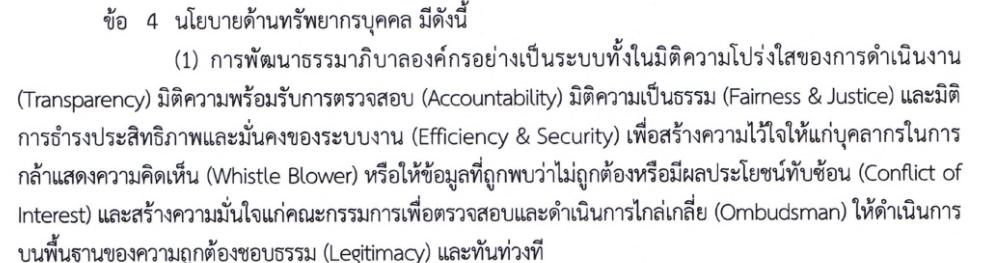
Figure 1. Student Insight Hub, All Student 2025, updated 23 September 2025. Retained from the supplied attachment. The revised text distinguishes the university total from its undergraduate subset.

For a genuine gender comparison, women and men must be followed from defined entry cohorts to a common completion cut-off, with comparable programme durations. A female share of enrolment or of graduates is a different statistic. This document does not infer cohort outcomes from a single population snapshot.

What the graduation report actually measures

The supplied Registrar report for academic year 2568 (2025) classifies approved undergraduate completions by study duration. Its total row is reproduced below as a count table, not a sex-disaggregated completion-rate calculation.

Approved undergraduate completions — academic year 2568 (2025)

Before the normal programme duration

53

Approvals classified by the Registrar as early.

Within the normal programme duration

2,463

Approvals classified as on time.

Beyond the normal programme duration

217

Approvals classified as taking longer.

Total shown2,733

53 + 2,463 + 217; no sex breakdown is provided in this table.

Source report excerpt and dates (page 3 of 3)
Header approval window
5 November 2025–7 October 2026
Footer: data as of
28 August 2026
Source office / page
Registrar’s Office — 3 of 3

On narrow screens, scroll the source table horizontally to compare all count columns.

Approved undergraduate completions by programme duration — academic year 2568 (2025)
Faculty / department / programmeBefore normal durationWithin normal durationBeyond normal durationUndergraduate total
Institute of Field RoboticsInstitute subtotal363975
Bachelor of Engineering in Robotics and Automation Engineering (4-year programme)Programme detail within the institute subtotal363975
Total approved undergraduate completions, academic year 2568 (2025)Report grand total532,4632172,733

English transcription of the clear supplied excerpt. The institute subtotal and its programme row refer to the same 75 approvals; they must not be added together. The original Thai source remains authoritative.
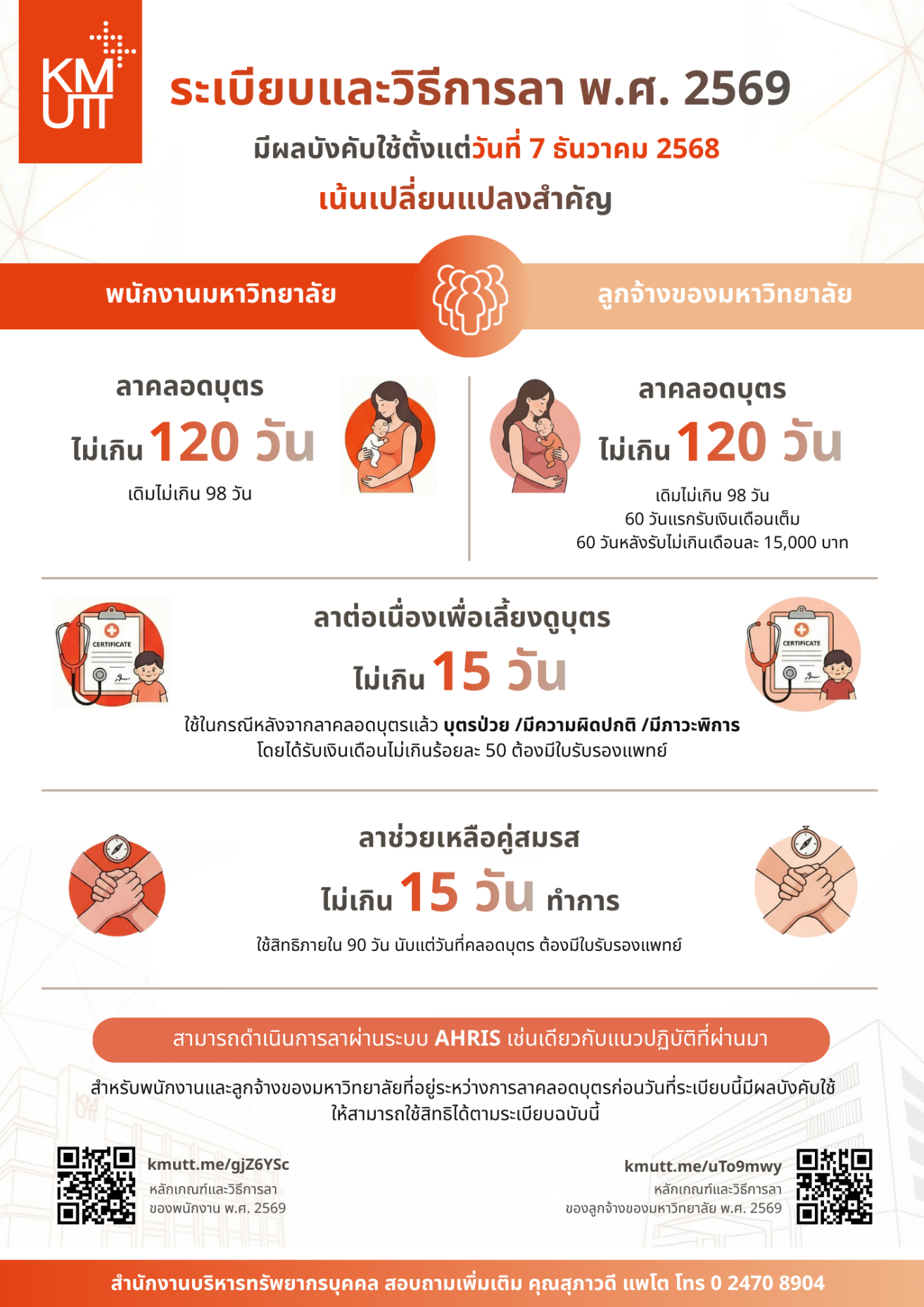
Figure 2. Total row and source dates from the Registrar’s academic-year 2568 undergraduate approval report, supplied in the original attachment (report page 3 of 3). The header and footer are retained rather than silently redated.

View the original report excerpt

Date handling: the report header gives an approval window of 5 November 2025–7 October 2026, while the footer states “data as of 28 August 2026”. The figures are therefore described here as the supplied snapshot, not certified as a final full-window census. The public statistics catalogue lists academic-year 2568 graduate-approval reporting.

Academic completion is distinct from ceremony registration

The Registrar’s public services link academic records, the Pre-Grad request system and graduation procedures. The 2026 academic calendar includes a graduation-request period for students who have completed curriculum requirements. MOD LINK’s documented 2025 role includes graduate registration; its presence alone does not demonstrate a female-versus-male cohort analytics function.

Academic and approval records
Evidence of the administrative completion process.
Study-duration classifications
Evidence that completion timing is recorded.
MOD LINK registration
Evidence of a service channel; not a statistical outcome.
2025 ceremony photographs
Removed from the central evidence because a ceremony does not measure women’s likelihood of completing a degree.

Dated support that helps students continue to completion

Coordinated advising and early warning: a 2026 reported case

KMUTT account of the EMPM Forum, published on 26 October 2026, describes a coordinated support model for eight Myanmar undergraduate and graduate scholarship students. It reports that all eight completed their studies. This is a programme-specific outcome for that group, not a university-wide result and not a female-only completion rate.

Preparation before arrival

A single focal point, flexible document handling and prepared advisors, laboratories and peer support.

Three-party coordination

International Affairs, faculty advisors, and student-development and wellbeing units work together.

Six-week early warning

Academic difficulties are identified early in the first semester, before the midterm period.

Supported autonomy

Close initial support develops into peer-mentoring and student-leadership opportunities.

The account provides a concrete institutional example of early intervention and progression support. It does not publish sex-disaggregated results or show that these mechanisms were triggered by a measured gender graduation gap.

Emergency assistance with a documented woman beneficiary

On 15 September 2026, KMUTT Student Financial Aid Unit reported disaster-assistance awards of THB 5,000 per student. One recipient was a female Mechanical Engineering student affected by a house fire in Kanchanaburi. The announcement directs affected students to apply through New ACIS and submit supporting documents through the unit’s form route.

This is direct evidence of financial support reaching a woman student during a disruption to her circumstances. The announcement does not report her subsequent graduation, so the award is described as continuity support rather than proof of a completed degree or a closed gender gap.

Evidence statement for publication

KMUTT published information establishes a sex-disaggregated student-data base, a documented graduation-administration process and specific academic and financial support mechanisms. The 2025–2026 evidence presented here supports those statements without converting unrelated counts into a gender-specific probability of graduating.

References and revision record (7 records)

Official sources checked on 9 November 2026. English narrative and tables are editorial summaries, not newly issued policies or certified legal translations. Source documents remain authoritative.

  • Registrar’s Office — Statistics catalogue

    Public route to student statistics, Student Insight Hub and graduate-approval reports. Numeric snapshots reproduced here are retained from the supplied attachment.

    Open official source
  • Registrar’s Office — Graduated students

    Official links to academic records, Pre-Grad and graduation services.

    Open official source
  • Registrar’s Office — graduate registration

    2025 registration through MOD LINK is distinguished from academic completion and cohort tracking.

    Open official source
  • KMUTT — EMPM Forum 2026 student-success account

    Published 26 October 2026. Eight programme participants completed; no sex-specific outcome is stated.

    Open official source
  • Student Financial Aid Unit — disaster assistance

    Published 15 September 2026. THB 5,000 per recipient; includes a woman student in Mechanical Engineering.

    Open official source
  • Registrar — academic calendar, 2026

    2026 graduation-request guidance and the Pre-Grad service route; dates should follow the live official calendar.

    Open official source
  • Supplied attachment: 5.6.7 Track women graduation rate.docx

    Original file preserved. Retained images are identified in their captions; undated historic images are not presented as 2025–2026 implementation evidence.

    Changes made in this revision

    Corrected 12,802 from a university total to an undergraduate subtotal; rebuilt the gender baseline and study-duration counts as editable tables; retained source dates, including the report’s different header and snapshot dates; replaced ceremony-led narrative with actual completion administration and 2026 support cases; removed unsupported gender-completion and gap-closure claims; added clickable official references and two source figures.

8. Related information on our university as a body having a policy that protects those reporting discrimination from educational or employment disadvantage.

KMUTT published framework combines a complaint-management procedure that covers discriminatory service and inappropriate conduct, confidential handling of complainant information, and specific anti-retaliation measures described in the university’s sexual-harassment guidelines. The Human Resources Policy B.E. 2565 (2022) also supports confidence in reporting wrongdoing and impartial handling through an ombudsman mechanism.

The university communicated its complaint channels on 23 April 2025 and continues to list complaint-handling guidance in its 2026 public-disclosure portal. This revision identifies each protection separately and keeps the scope of the underlying instrument explicit.

Policy and implementation evidence

Complaint-management manual

Covers complaints across university missions, including discrimination; explains confidential data handling and responsibility for routing cases.

Date / scope
Procedure; refers to the 2023 integrity framework.

Sexual-harassment guidelines

The university’s published summary describes protection of complainants and related persons from retaliation and adverse career or livelihood effects.

Date / scope
Policy dated 6 June 2019; harassment context.

Human Resources Policy

Clause 4(1) promotes trust in speaking up about wrongdoing and confidence in legitimate, timely investigation or mediation.

Date / scope
2 March 2022; personnel governance.

Complaint-channel announcement

Public information explaining where to report misconduct or submit complaints.

Date / scope
23 April 2025.

Complaint portal and ITA disclosure

Access instructions, confidentiality conditions and links to the relevant procedure.

Date / scope
Public routes checked in 2026.

Confidentiality is not treated here as a synonym for a universal non-retaliation guarantee. The broader complaint procedure and the more specific harassment-related protection are complementary evidence, not interchangeable policy clauses.

Protection and fair treatment: the documented scope

Protection within the sexual-harassment framework

KMUTT published explanation of its 2019 guidelines covers the university community, including students, academic staff, employees and people working with the university. It states that complainants and related persons are protected against retaliatory bullying and actions adversely affecting career or livelihood. It also provides fair treatment, privacy and an opportunity for the accused to respond.

This is a specific protection relevant to gender-related misconduct. It is not rewritten as an unconditional guarantee about grades, scholarships, recruitment or promotion for every possible discrimination complaint. The issue date is verified in the legal register; the protection wording here is attributed to the university’s public summary.

A personnel policy that supports speaking up

Clause 4(1) of the 2022 Human Resources Policy connects transparency, accountability and fairness with employees’ confidence to express concerns or provide information about wrongdoing and conflicts of interest. It also refers to an ombudsman mechanism for legitimate and timely investigation or mediation. These provisions support reporting culture without, by themselves, defining every form of protection from retaliation.

Figure 1. Human Resources Policy B.E. 2565 (2022), clause 4(1). Excerpt of the policy scan supplied in the companion 5.6.2 attachment, checked against the HR-hosted policy. This is supporting reporting-governance evidence, not a replacement for the specific harassment-protection provision.

Clause 4(1) — English reading aid

Develop systematic organisational good governance across transparency, accountability, fairness and justice, and the efficiency and security of work systems, to build personnel’s trust and confidence to express opinions as whistleblowers or provide information about wrongdoing or conflicts of interest. It also supports the committee carrying out investigation and mediation (Ombudsman) on a basis of legitimacy and timeliness.

English reading aid for the supplied Thai clause, checked against the cached HR-hosted policy. The original Thai policy remains authoritative. This clause supports reporting governance; it does not replace a specific anti-retaliation provision.

How the evidence relates to indicator 5.6.8

  • Enable reporting
  • Limit information disclosure
  • Address retaliation within the applicable policy

The revised evidence separates three functions: enabling a person to report, limiting disclosure of their information, and addressing retaliation within an applicable policy. This prevents the original general fairness statement from being presented as though it contained protections that its quoted text did not actually specify.

Complaint handling and confidential information

The complaint-management manual expressly includes discriminatory service and inappropriate conduct, including sexual harassment and violations of personal rights. It assigns student cases to Student Affairs, personnel cases to Human Resources, and legal or disciplinary processes to the Legal Office after screening by the Office of the President.

Confidentiality

Names and addresses are not disclosed. Information is masked when transferred in the system; paper transfers are marked confidential, sealed and signed for.

Intake and screening

The responsible office receives the complaint, records it and screens the information before routing.

Responsible unit

Student Affairs, Human Resources, the Legal Office or another relevant unit handles the case according to its subject.

Follow-up

Progress and corrective actions are followed up, with reporting and feedback to the complainant.

Time standard

Routine resolution is targeted within three working days; complex fact-finding cases are excepted.

Source: complaint-management manual, scope, definitions, responsibilities and procedure sections; supplied attachment also reproduces the reporting and confidentiality process.

Current public access routes

Students and personnel
The current Hermes landing page directs university members to MOD LINK.
Members of the public / external users
The landing page states that its external-user system is being improved and offers telephone, email or a sealed letter instead.
Telephone / email
02-470-8000; contact@kmutt.ac.th.
Sealed letter
Address to the President of KMUTT, 126 Pracha Uthit Road, Bang Mod, Thung Khru, Bangkok.
Confidentiality condition
The portal states that complainant information is kept confidential. It requests accurate identifying and contact details for follow-up.

Source: current Hermes landing page. These instructions avoid implying that an external web form is functioning when the published landing page directs users to alternatives. No complaint was submitted during this review.

Public communication in 2025–2026

The university’s announcement of 23 April 2025 publishes a complaint-channel poster and links to the central reporting service. The supplied copy of that poster is retained below. The current access information above takes account of the portal’s subsequently displayed instructions.

Figure 2. KMUTT complaint-channel poster, published with the 23 April 2025 announcement. Image retained from the original attachment. It shows the website, sealed-letter, email, telephone and MOD LINK routes.

English reading aid — published 2025 poster

KMUTT complaint-reporting channels. If you find indications of corruption or inappropriate acts, or wish to make suggestions to improve the university, report the information through the university website or the other channels shown.

Website
www.kmutt.ac.th, menu “Receive complaints”, or hermes.kmutt.ac.th/complain.
Sealed letter
Address to the President of KMUTT, 126 Pracha Uthit Road, Bang Mod, Thung Khru, Bangkok 10140.
Email
contact@kmutt.ac.th
Telephone
The published poster lists 0-2470-8000 or 0-2470-8035.
MOD LINK
For KMUTT students and personnel only, using the menu “Report problems within KMUTT”. Separate student and personnel QR codes remain in the original poster.
After receipt
The university will process the submitted information according to its complaint-handling procedure.

The poster was published with the announcement of 23 April 2025. Current access instructions are set out above: the Hermes landing page lists 02-470-8000, email or a sealed letter for external users while its external-user system is being improved. The poster’s additional number is retained as historical poster content, not asserted as a newly verified portal contact. The original Thai poster remains authoritative.

The 2026 public-disclosure page lists complaint-handling guidance under O16 and reporting channels under O17; it also lists fiscal-year 2025 complaint statistics under O18. These links demonstrate public disclosure of the system, not proof that no discrimination occurred or that every case was resolved in a particular way.

References and revision record (8 records)

Official sources checked on 9 November 2026. English narrative and tables are editorial summaries, not newly issued policies or certified legal translations. Source documents remain authoritative.

  • Manual for complaint handling and reporting corruption / misconduct

    Scope, confidentiality definition, assigned responsibilities and workflow. The manual refers to the 2023 integrity framework; no new 2026 policy issue date is invented.

    Open official source
  • KMUTT Sustainability — published summary of the 2019 sexual-harassment guidelines

    Section 11, especially scope and protection measures. This is the university’s explanatory publication, distinguished from the signed policy instrument.

    Open official source
  • KMUTT legal register — policy and measures catalogue

    Lists the sexual-harassment prevention and resolution guidelines with an issue date of 6 June 2019.

    Open official source
  • Human Resources Policy B.E. 2565 (2022)

    Clause 4(1), reporting confidence and ombudsman mechanism. Announced 2 March 2022.

    Open official source
  • KMUTT complaint-channel announcement

    Published 23 April 2025; source for the reproduced reporting-channel poster.

    Open official source
  • Central complaint and feedback portal

    Current entry instructions and confidentiality conditions. Alternative external-user routes are stated on the landing page.

    Open official source
  • ITA public-disclosure catalogue

    2026 disclosure list: O16 complaint guidance, O17 reporting channels and O18 fiscal-year 2025 complaint statistics.

    Open official source
  • Supplied attachment: 5.6.8 Policies protecting those reporting discrimination.docx

    Original file preserved. Retained images are identified in their captions; undated historic images are not presented as 2025–2026 implementation evidence.

    Changes made in this revision

    Replaced a general fairness-only opening with directly sourced procedural safeguards; added the manual’s masking/sealed-transfer requirements, case-routing responsibilities and specific harassment-related anti-retaliation protection; checked the 2025 poster against current portal instructions; added the 2026 disclosure trail; removed unrelated stakeholder-participation and general governance pages; retained two relevant figures. Companion supplied attachment used for Figure 1: 5.6.2 Non-discrimination policies for transgender.docx.

9. A policy paternity that supports women’s participation by ensuring that fathers can participate in childcare duties

KMUTT provides a formal leave category for eligible university employees to assist a spouse who has given birth. Chapter 4, clause 22 of the Employee Leave Rules and Procedures B.E. 2569 (2026) allows up to 15 consecutive working days of leave. This provision gives eligible fathers a defined opportunity to share care responsibilities following childbirth and support their spouse during recovery.

The 2026 instrument was announced on 4 February 2026, takes effect from 7 December 2025 and repeals the 2019 employee-leave regulation. This revised evidence uses the current Thai wording “spouse” rather than retaining the wife-only wording in the older English description.

Current entitlement and application conditions

Purpose
Leave to assist a spouse who has given birth.
Chapter 4 / clause 22

Duration

Up to 15
consecutive working days

Up to 15 consecutive working days for an occasion of childbirth.

Clause 22

Timing

90
days after childbirth

Submit the request before or on the leave date, within 90 days after childbirth.

Clause 22
Supporting documents
Attach a medical certificate of childbirth and the child’s birth certificate.
Clause 22
Approval
Submit through the supervisory chain to an authorised approver; take leave after approval.
Clauses 6, 12 and 22
Employee scope
Permanent university employees as defined by the personnel rules, subject to the appointment-date arrangements in clause 44.
Clauses 4 and 44

This document addresses the spouse-support leave mechanism under indicator 5.6.9. Maternity leave is covered separately in revised evidence 5.6.3. No uptake, return-to-work or workforce-retention percentage is inferred from the existence of this policy.

Direct policy evidence and scope

Figure 1. Chapter 4 and clause 22 of the 2026 employee-leave regulation. Legible excerpt from the supplied companion attachment 5.6.3, checked against the HR-hosted regulation. The original Thai text specifies 15 working days, the 90-day window and supporting documents.

Chapter 4, clause 22 — English reading aid

An employee who wishes to take leave to assist a spouse who has given birth must submit the leave request through the supervisory chain to the authorised approver before or on the leave date, within 90 days after childbirth. For each occasion, up to 15 consecutive working days may be taken. Attach a medical certificate of childbirth issued by a physician practising modern medicine and the child’s birth certificate. Absence may begin only after approval.

Reading aid for the complete clear Thai excerpt, checked against page 4 of the HR-hosted regulation. The original Thai instrument remains authoritative. Clause 22 does not itself state a salary-payment rate.

The protected activity is assistance to a spouse after childbirth, not general childcare-centre access or ordinary annual leave. The narrative therefore links the policy to shared care responsibilities without treating another family welfare service as a substitute. The signed Thai clause is the primary authority for duration and procedure.

Payment wording
Clause 22 does not itself specify a salary-payment rate. This evidence does not add a paid-leave claim from the separate maternity provision.
Coverage and transition
Clause 44 applies the regulation to employees appointed from 7 March 2003. Earlier appointees and employees converted from civil-service status follow the stated government arrangements, with this regulation applying where those benefits are less favourable.
Authority and administration
Clause 6 refers to the appended approval-authority table; clause 12 requires approval before absence. The employee’s leave is processed through the university’s established administrative route.

The 2026 instrument and its effective date

Figure 2. Clauses 1–3 identify the 2026 instrument, repeal the 2019 instrument and state the effective date of 7 December 2025. The announcement year and effective date are recorded separately.

Clauses 1–3 — English reading aid

Clause 1 — instrument
The regulation is called the KMUTT Employee Leave Rules and Procedures B.E. 2569 (2026).
Clause 2 — repeal
The Employee Leave Rules and Procedures B.E. 2562 (2019) are repealed.
Clause 3 — effective date
The regulation takes effect from 7 December B.E. 2568 (2025).

English reading aid for the complete supplied Thai excerpt. The printed announcement date of 4 February 2026 is recorded separately from the effective date. The original Thai regulation remains authoritative.

HR communication and leave administration

The HR Office published a 2026 leave-rules notice in March 2026. Its accompanying information sheet explains the 15-working-day spouse-support category, the 90-day window and use of the AHRIS leave system. The public HR forms catalogue provides a further access route to university forms.

Figure 3. HR communication on the 2026 leave rules, retained from the supplied 5.6.9 attachment. It distinguishes university employment categories and includes the spouse-support leave information and AHRIS submission route. The signed regulation remains authoritative.

HR information sheet — spouse-support category

The sheet is headed Leave Rules and Procedures B.E. 2569 (2026), effective from 7 December 2025. It presents university employees and another university employment category side by side.

Spouse-support duration
Up to 15 working days.
Use window and certificate
Use within 90 days after childbirth; a medical certificate is required by the information sheet.
Submission system
Leave can be processed through AHRIS, following the existing administrative practice.

The signed employee regulation and its eligibility/transition provisions govern this article. Clause 22 additionally specifies the child’s birth certificate and approval before absence. Separate employment-category rules are not assumed identical, and the maternity payment figures elsewhere in this sheet are not spouse-support salary terms.

Separate maternity information in the original HR sheet
University employees — maternity
Up to 120 days, previously up to 98 days. This column does not print a maternity-payment figure.
Other university employment category — maternity
Up to 120 days, previously up to 98 days. The sheet states full salary for the first 60 days and no more than THB 15,000 per month for the following 60 days.
Conditional post-maternity care
Up to 15 days after maternity leave where the child is ill, has an abnormal condition or has a disability; salary is capped at 50% and a medical certificate is required. This is a separate maternity-related category, not the 15-working-day spouse-support leave.
Transitional maternity note
The sheet states that employees in the categories shown who were already on maternity leave before the regulation took effect may use the rights under the new rules. This note is not converted into an additional spouse-support entitlement.
Contact and original QR codes
The HR contact telephone printed on the sheet is 0 2470 8904. The original named contact and separate category-specific policy QR codes remain in the source poster; unclear small link characters are not guessed.

These entries preserve the other clear information in the original communication. Maternity leave is treated separately in criterion 5.6.3; no maternity salary rate is applied to clause 22.

Older English forms and handbook labels are not used to narrow the 2026 instrument’s “spouse” wording. Nor are the separate maternity provisions in this poster automatically attributed to paternity leave.

References and revision record (7 records)

Official sources checked on 9 November 2026. English narrative and tables are editorial summaries, not newly issued policies or certified legal translations. Source documents remain authoritative.

  • Employee Leave Rules and Procedures B.E. 2569 (2026)

    Announced 4 February 2026; effective 7 December 2025. Relevant clauses: 2–4, 6, 12, 22 and 44.

    Open official source
  • HR notice — 2026 leave rules and procedures

    March 2026 public communication. The notice and its information sheet are implementation communications, not a different policy issue date.

    Open official source
  • Human Resources Office — forms catalogue

    Official public catalogue of HR forms. The 2026 information sheet also identifies AHRIS as the leave-processing route.

    Open official source
  • HR English handbook — Leave of absence

    Legacy English description used only for version comparison; the signed 2026 Thai instrument takes precedence in this revision.

    Open official source
  • Human Resources Office — regulations catalogue

    Public index of personnel instruments. Separate employment-category rules are not assumed to have identical entitlements.

    Open official source
  • Supplied attachment: 5.6.9 Paternity policy.docx

    Original file preserved. Retained images are identified in their captions; undated historic images are not presented as 2025–2026 implementation evidence.

    Changes made in the supplied revision

    Replaced the mixed maternity/paternity introduction with a focused spouse-support leave explanation; updated the controlling instrument to 2026; retained the 15-consecutive-working-day entitlement and its actual application conditions; distinguished issue and effective dates; corrected the “wife” translation to the current “spouse” wording; added scope, documentary requirements and the AHRIS communication; removed unrelated medical-welfare and annual-leave material and blank pages.

  • Supplied companion attachment: 5.6.3 Maternity and paternity policies.docx. Chapter 4 scan used for Figure 1; original companion file preserved.

Gender equality at KMUTT

Student data, documented achievements and employee rights.

Women at KMUTT

Snapshot: 23 September 2025

New entrants

44.66%women
Women
1,913
Total
4,283

Semester 1/2025 · all degree levels

All students

43.61%women
Women
6,759
Total
15,500

2025 student snapshot · all degree levels

These are different populations. Entry share is not an acceptance rate; student share is not a graduation rate.

Support with visible examples

Cybersecurity

1st & 2nd places

ModJiw and SamoonNaKarunn took the top two university-level places at Women Thailand Cyber Top Talent 2026. External prizes: THB 40,000 and THB 30,000 respectively.

Final: 31 January 2026

Financial support

THB 5,000

Emergency assistance to an identified female Mechanical Engineering student affected by a house fire. One documented beneficiary of an inclusive scheme, not a university-wide funding total.

Award report: 15 September 2026

Mentoring

Beyond workshops

A named female KMUTT alumna joined WTUN ASEP 2025; the partner programme documented continuing mentor access. KMUTT also held individual academic mentoring for scholarship students in 2026.

2025 programme · 28 February–1 March 2026 activity

Computing outreach
20 October 2026

SIT welcomed Satriwitthaya School learners for programme guidance, student experience sharing and an AI chatbot workshop, connecting prospective students with technical study pathways.

Family support with clear terms

Maternity leave

120days per pregnancy

Up to 120 days on full salary for employees within the regulation’s scope. Includes prenatal examinations and holidays within the leave period. Separate extended childcare leave permits up to 150 working days without salary, following maternity or the specified additional care leave.

Spouse-support leave

15consecutive working days

Up to 15 per occasion. Apply before or on the leave date, within 90 days after childbirth; attach a medical certificate of childbirth and the child’s birth certificate. Approval is required before absence. Clause 22 does not itself state a salary rate.

2026 employee-leave regulation: announced 4 February 2026; effective 7 December 2025. Employee eligibility and the appointment-date arrangements in clause 44 apply; separate employment categories are not assumed identical. English explanations are reading aids; the original Thai instrument remains authoritative.

Personnel-family childcare

08:00–16:30

University-supported, fee-charging care, excluding official and public holidays. Ordinary admission is for personnel’s children; the HR handbook also includes grandchildren. Pre-school ages: 6 months–3 years 6 months. General student-parent eligibility is not established.

Rights and continued participation

Equal treatment

The public Diversity Policy explicitly includes gender, gender identity and sexual orientation. The 2022 Code of Ethics reinforces non-discrimination, supporting women and transgender people.

Safe reporting

Complaint procedures provide confidential handling. The sexual-harassment framework describes protection from retaliation for complainants and related persons within that specific context.

Study continuity

Registrar data and academic services support monitoring. A 2026 institutional case documents coordinated advising, a six-week early-warning mechanism and peer support.

These examples show documented provision and participation. They do not establish university-wide mentoring coverage, leave uptake or a female-versus-male cohort completion rate.

Sources and reporting notes

Compiled from the thirteen supplied SDG 5 evidence articles. Student snapshots are from 2025; activity examples span 2025–2026. Policy issue and effective dates remain separate. The complete criterion articles retain the detailed evidence and qualifications.

Policies for gender equality

Equal treatment, fair work and family support at KMUTT.

English descriptions are reading aids; the original instruments govern. Issue dates and eligibility remain specific to each policy.

Equality and protection

  • Diversity and inclusion

    Registrar’s Office · undated policy statement

    Equal treatment expressly includes gender, gender identity and sexual orientation.

    Read policy details

    The Diversity Policy recognises gender, race, national origin, socio-economic background, urban and rural geographic origin, culture, ethnicity, disability, religion, gender identity and sexual orientation. It commits to treating everyone equally so that diversity is maintained and developed.

    The published policy statement does not display an adoption or review date.

    Open official policy
  • Equal treatment

    University Governance · undated web statement

    Ensures equal treatment and services, prohibiting discrimination based on gender and other factors.

    Read policy details

    Good management and governance includes equity: receiving equal treatment and services without discrimination based on gender, race, religion, physical or health condition, personal status, social standing, education, or other factors.

    Related SDGs: 5, 10, 16.

    Open governance principles
  • Ethical conduct

    Code of Ethics · 2022; reinforcing notice · 2023

    Core ethical value 6 requires impartial duties and rejects discrimination, including on sex assigned at birth and gender.

    Read policy details

    The 2022 Code of Ethics states the non-discrimination standard, expressly naming both sex assigned at birth and gender. The governance-with-integrity-and-transparency notice dated 27 April 2023 restates the gender-based standard; the two instruments are kept distinct.

    The 2023 notice also identifies sexual misconduct and sexual harassment among the serious misconduct matters. The original instruments set the applicable scope and procedures.

    Read the 27 April 2023 notice (Thai PDF)

    Open official policy
  • Preventing harassment

    Prevention and resolution guidelines · 6 June 2019

    A published institutional framework addresses sexual violation and sexual harassment.

    Read policy details

    The KMUTT Law policy register lists the announcement on guidelines to prevent and resolve sexual violation or sexual harassment, B.E. 2562 (2019), dated 6 June 2019.

    The register is the official access route to the announcement. Its 2019 issue date is retained; this listing is not labelled as a new 2026 policy.

    Open official policy register

Fair work and teaching

  • Fair HR governance

    Human Resources Policy · 2 March 2022 · clause 4(1)

    Develops systematic governance with a core focus on fairness and justice for all personnel.

    Read policy details

    1. Systematic Governance: Develop organizational governance focusing on Transparency, Accountability, Fairness & Justice, and Efficiency & Security. This aims to build trust, encouraging personnel to act as Whistleblowers regarding misconduct or Conflicts of Interest, and ensuring the Ombudsman committee can mediate issues with legitimacy and timeliness.

    Related SDGs: 5, 8, 16.

    Open HR policy (Thai PDF)
  • Inclusive communication

    Human Resources Policy · 2 March 2022 · clause 4(12)

    Promotes a communication strategy that is inclusive, embracing equity, diversity, and inclusion.

    Read policy details

    12. Strategic Communication: Use communication as a strategic tool. Ensure a lean communication process that is timely and inclusive (Equity, Diversity, and Inclusion), empowering staff to become brand ambassadors.

    The clause covers personnel at every level, meaningful internal and external communication, the role of brand ambassadors, lean communication processes, equality and respect for differences.

    Related SDGs: 5, 10, 17.

    Open HR policy (Thai PDF)
  • Fair compensation

    Human Resources Policy · 2 March 2022 · clause 4(5)

    Compensation and welfare place greater weight on competency and performance than seniority.

    Read policy details

    Clause 4(5) provides a competency- and performance-based approach to compensation and welfare, with greater weight on those factors than seniority, to retain capable personnel and attract capable applicants.

    This is a personnel-management principle. It is not presented as a measured gender-pay-parity result.

    Open HR policy (Thai PDF)
  • Equitable teaching

    KMUTT PSF · guidelines approved in 2016

    Requires instructors to treat all students equitably as a core and foundational teaching competency.

    Read policy details

    Building the teaching competencies of faculty members must align with the KMUTT Professional Standards Framework for Teaching and Supporting Learning (KMUTT PSF). 1. Assessment Criteria The following criteria are used for developing academic personnel (instructor positions) according to the KMUTT PSF: (1) Newly appointed instructors must demonstrate foundational teaching competencies, including treating students equitably, designing lessons that support student learning, assessing learning outcomes, and managing the classroom. These competencies will be part of the initial probation review (the first 6-month assessment).

    Related SDGs: 4, 5, 10.

    Open official teaching guidelines

Family leave and childcare

  • Family leave

    Employee Leave Rules · 2026 · effective 7 December 2025

    Eligible employees have defined maternity, childcare and spouse-support leave provisions.

    Read policy details

    The 2026 regulation covers permanent university employees within its definitions, with appointment-date and transition provisions in clauses 44–45. Separate employee categories must not be assumed to have identical rights.

    Clause 18 permits up to 120 days of maternity leave per pregnancy on full salary, including prenatal examinations and holidays in the leave period. Medical certification and the request/approval requirements apply.

    Clause 19 provides up to 15 additional continuous days to care for a child with the specified illness, abnormal health condition or disability, with medical certification and a salary cap of 50%. Clause 26 permits up to 150 working days without salary following maternity leave or the specified additional care leave.

    Clause 22 permits up to 15 consecutive working days to assist a spouse who has given birth. Submit through the supervisory chain before or on the leave date within 90 days after childbirth, with the childbirth medical certificate and child’s birth certificate; approval is required before absence. This clause does not itself specify a salary-payment rate.

    The instrument was announced on 4 February 2026 and states an effective date of 7 December 2025. The Thai regulation governs eligibility, payment and administration.

    Open employee leave rules (Thai PDF)
  • Childcare welfare

    Childcare announcement · 2016 · personnel-linked service

    A regulated, fee-charging childcare service supports personnel families under stated admission conditions.

    Read policy details

    The announcement was issued on 23 May 2016 and took effect on 1 June 2016. The HR service description concerns eligible children or grandchildren of personnel and specifies admission conditions and fees.

    The subsidy and childcare service are not a universal entitlement to free care or general student-parent admission. The announcement’s 2016 fees are not relabelled as current 2026 rates.

    Read the HR childcare service information

    Open childcare announcement (Thai PDF)
References and original documents

Reviewed 9 November 2026. Policy issue dates above are distinct from this link-review date.