1. Related information on our university as a body on measuring the amount of food waste generated from food served within the university.
The 2025 KMUTT institutional record identifies 127,768 kg of food waste and 56,997 kg of garden waste, together forming 184,765 kg of organic waste. Food waste includes preparation residues and uneaten food from campus catering. Keeping these streams separate identifies food waste without counting all leaves and branches as food waste.
Food waste measured separately from garden waste
Food waste
127,768 kg
Preparation residues and uneaten food.
Garden waste
56,997 kg
Leaves, branches and other garden material.
Combined organic waste
184,765 kg
Food waste plus garden waste in 2025.
Two components of the recorded organic waste total · 2025
Food waste
127,768 kg
Garden waste
56,997 kg
The supplied account cites the published KMUTT organic-waste programme as reporting the same 184,765 kg organic total and 36,000 kg food-waste digestion input for 2025. The digestion input is a portion of food waste generated, rather than the total food-waste figure. It also cites the municipal composition as identifying organic waste as a separate campus category.
Food waste sent to treatment remains within food waste generated. The 36,000 kg digestion input below is not added to the 127,768 kg food-waste total.
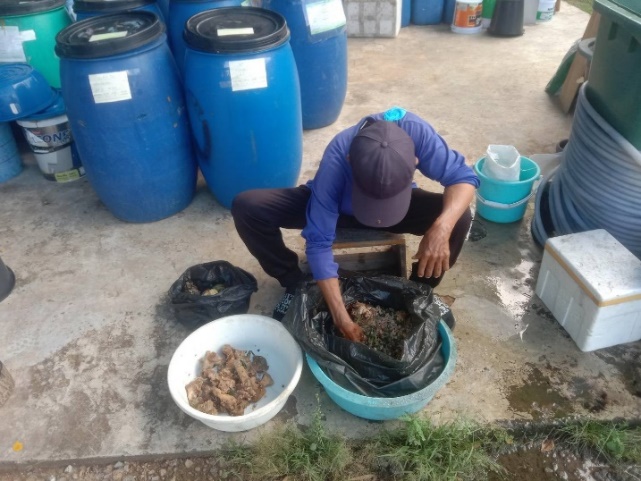
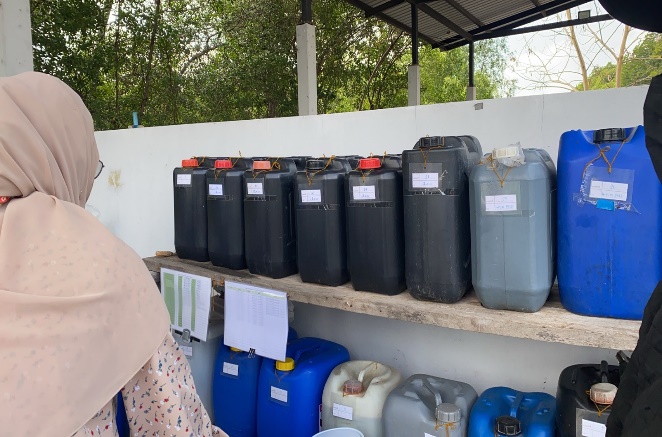
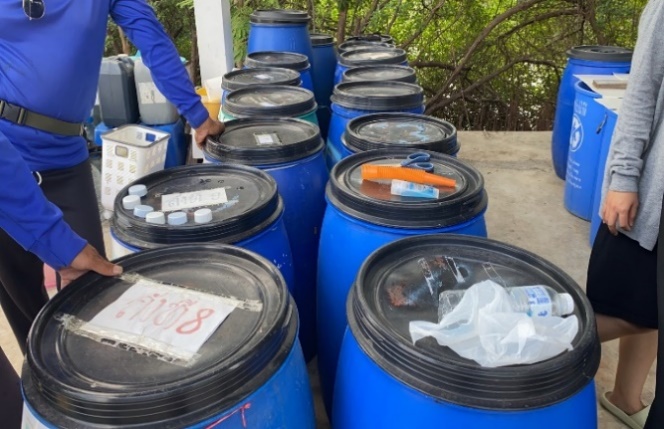
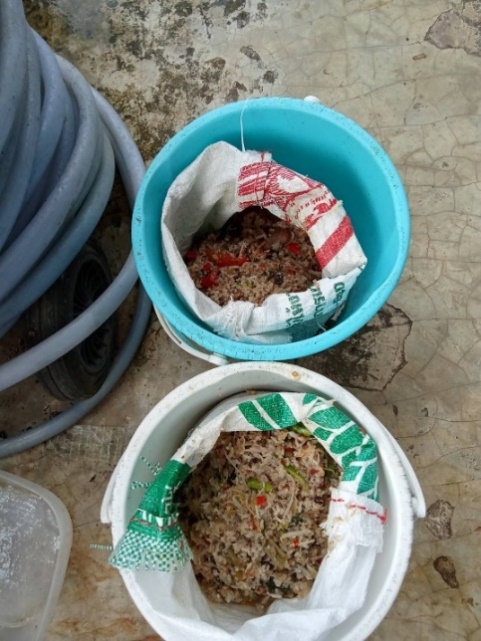
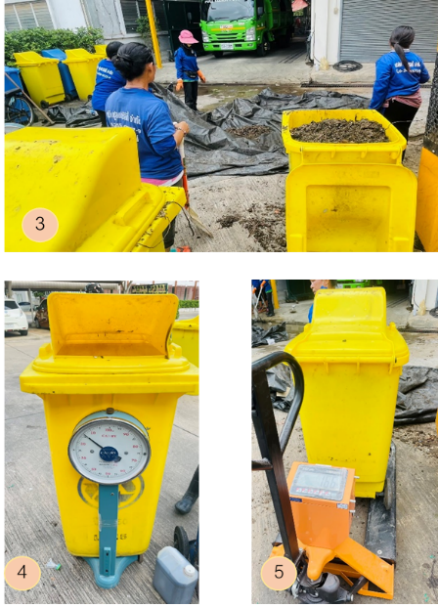
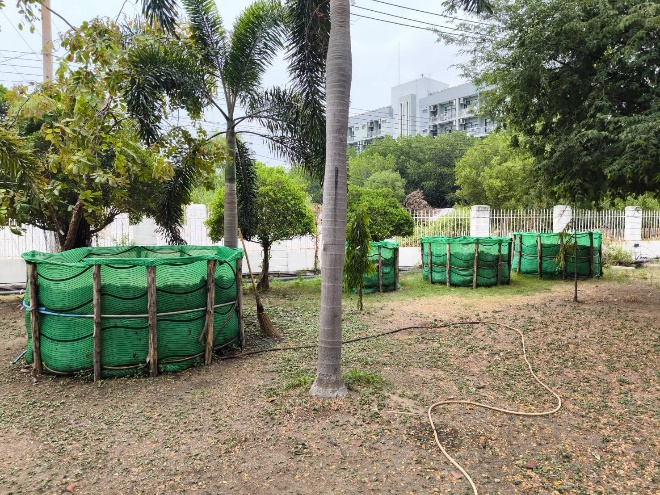
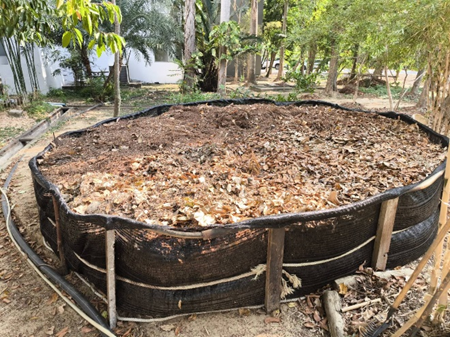
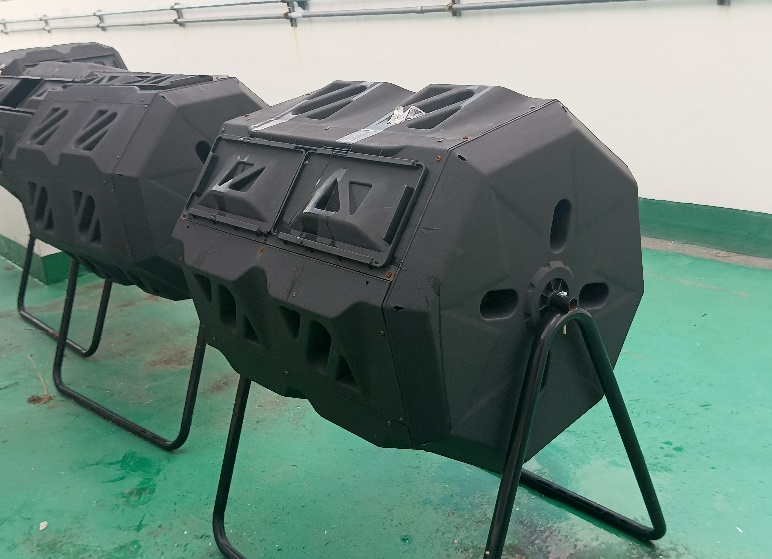
Food-waste handling and treatment containers in the supplied institutional record. Photograph dates are not specified.
From recorded waste to treatment routes
The cafeteria account describes raw meat, vegetable peelings, bones, shells and plate leftovers, producing approximately 80–150 kg of food waste per day. KMUTT established organic-waste utilisation using material from campus food centres and canteens. Approximately 100 kg of food waste per day produces around 10 m³ of biogas per day, used for cooking and boiling water at the canteen. Soil conditioner or fertiliser is also produced. The account reports that these activities reduce around 6.12% of total municipal solid waste and support waste-to-energy use and the campus organic farm.
Anaerobic digestion
36,000 kg
Food waste used to produce biogas.
Garden composting
3,168 kg
Leaves and branches composted on campus.
Government-agency disposal
145,597 kg
Remaining food and garden waste; on-campus treatment space was insufficient.
The source reports 21.20% of organic waste managed and treated in 2025. The routing quantities reconcile: 36,000 + 3,168 + 145,597 = 184,765 kg. The programme describes biogas and fertiliser production within 24 hours; the separate leaf-compost method below uses a 2–3 month period.
Outputs reported for the treatment programme
Biogas
3,600 m³/year
Reported annual gas production.
Organic fertiliser
12,264 kg/year
Reported by-product of biogas production.
Liquid fertiliser
18,000 litres/year
Reported output from the waste disposal centre.
The institutional account reports avoided emissions of 794,048.7 kg CO₂-e per year and annual savings of more than USD 2,785.69, based on waste-management, LPG-gas and fertiliser costs.
The narrative places organic waste at 31.40% of all solid waste. The supplied municipal composition graphic prints 31.39%; both source values are retained in the context section without silently changing either.
Biogas research presented in July 2025
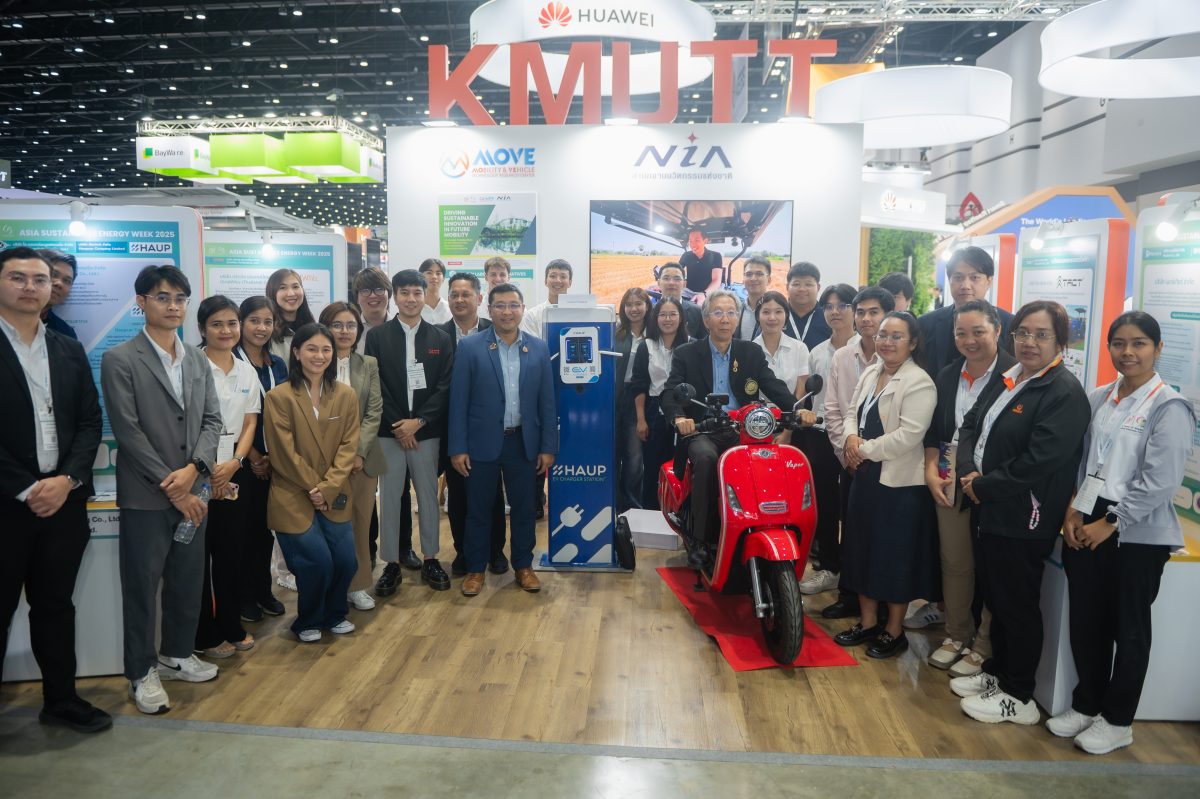
At Asia Sustainable Energy Week on 2–4 July 2025, the EESH Center presented research on developing biogas production from food waste. KMUTT event record identifies the work as a food waste utilisation initiative, alongside community engagement on climate change. This dated activity corroborates continuing technical work on the treatment route described in the institutional waste record. It does not substitute for the annual measurement totals.
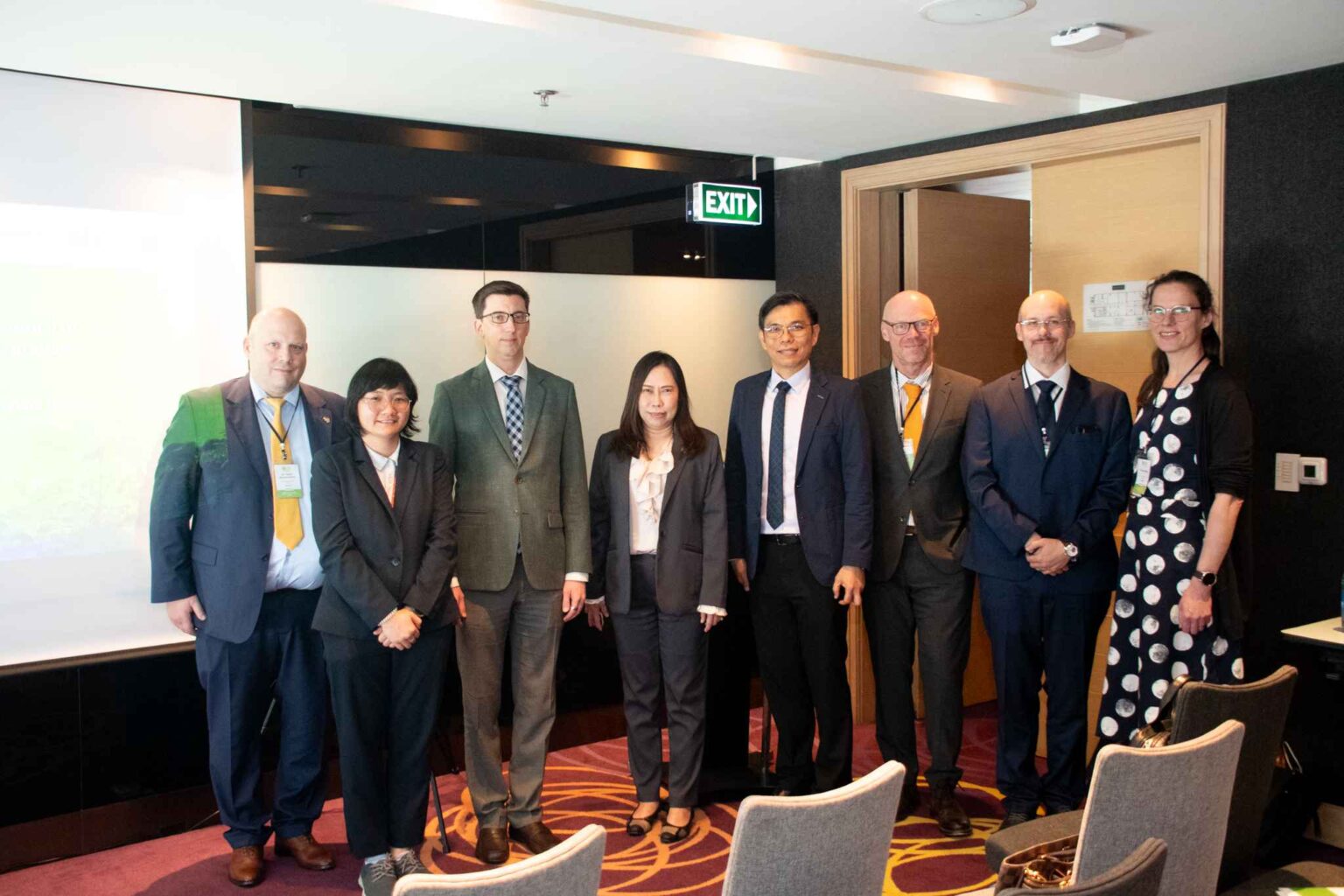
EESH research presentation at Asia Sustainable Energy Week, 2–4 July 2025. Source: KMUTT.
Community-market scraps used as animal feed
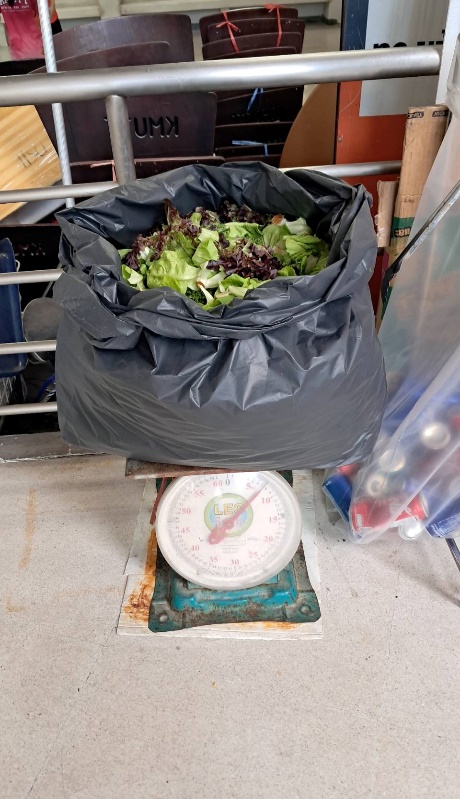
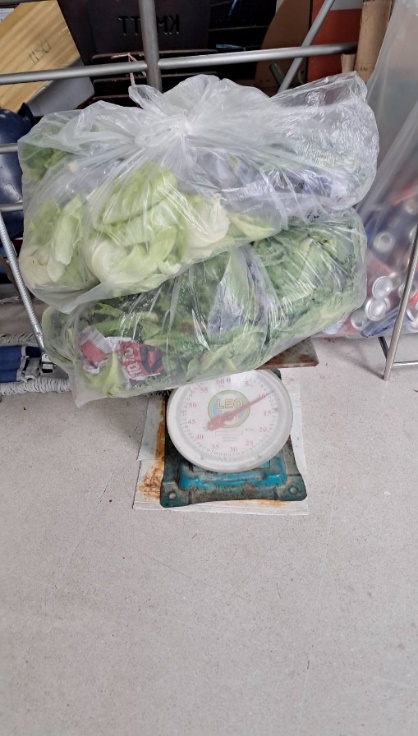
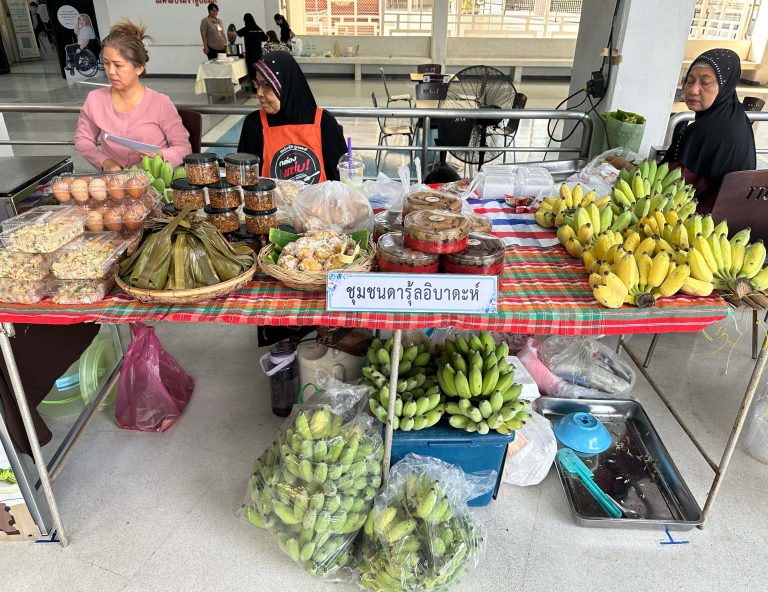
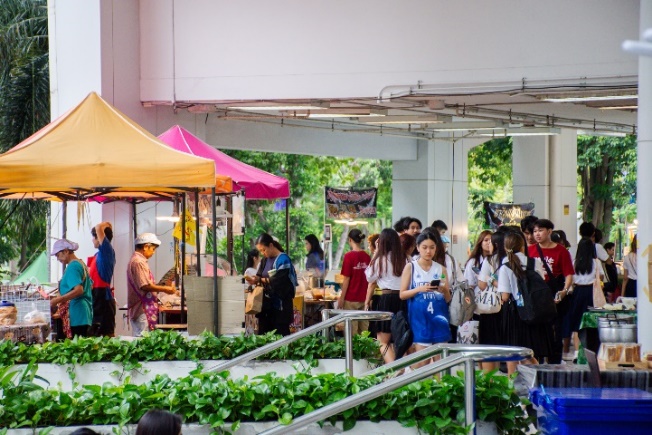
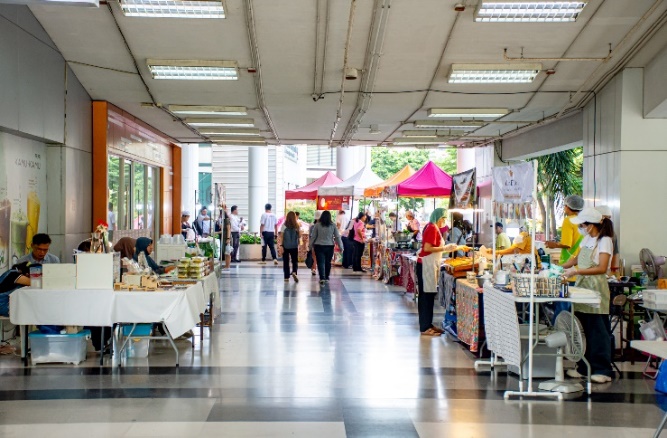
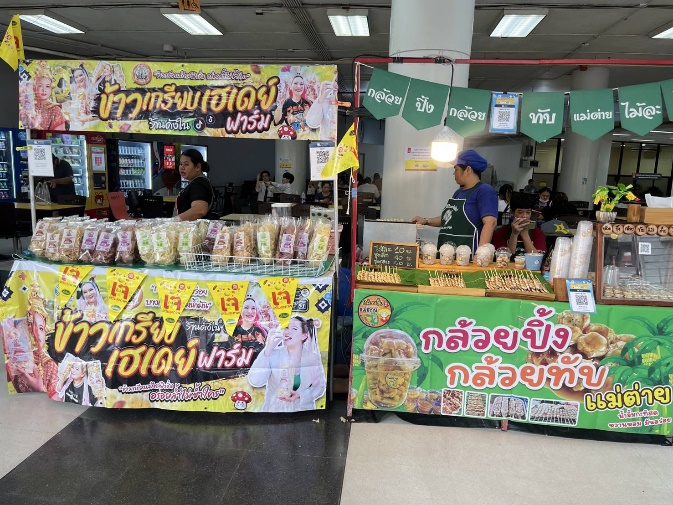
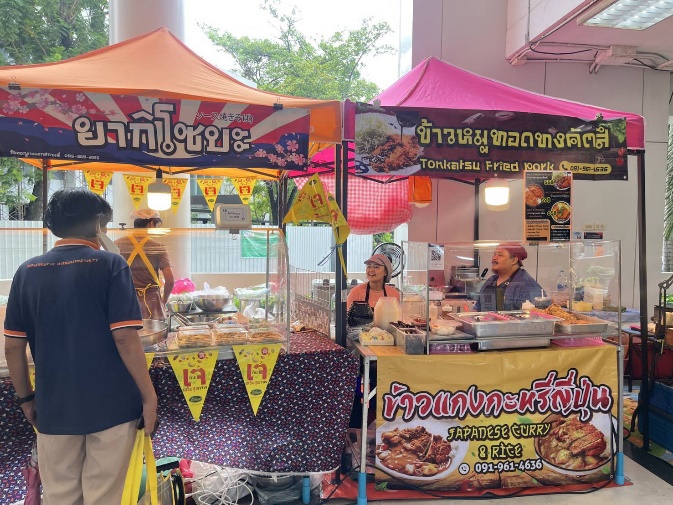
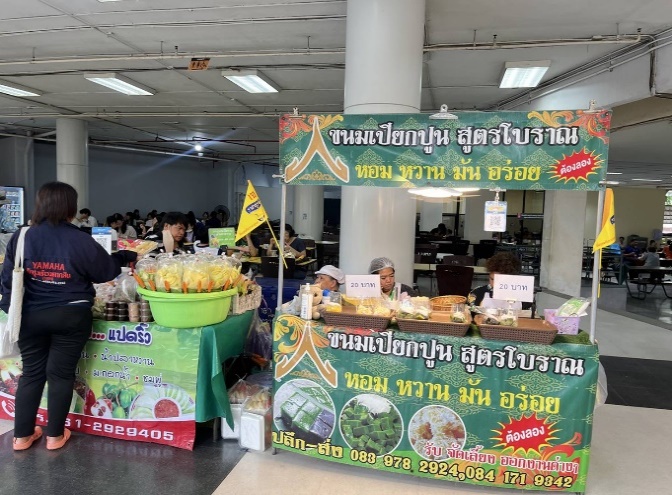
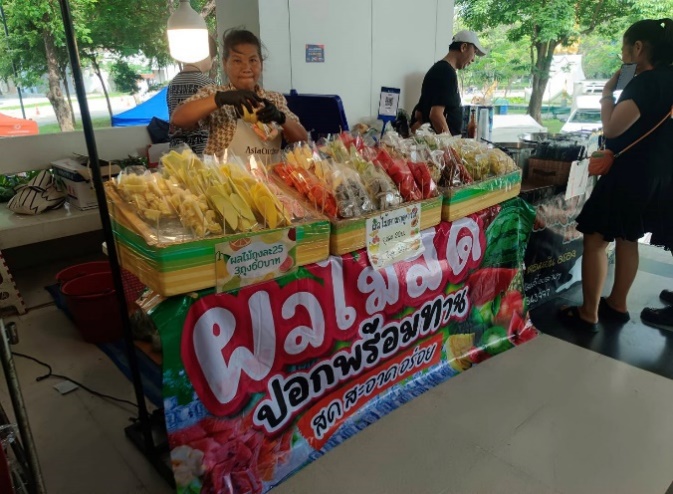
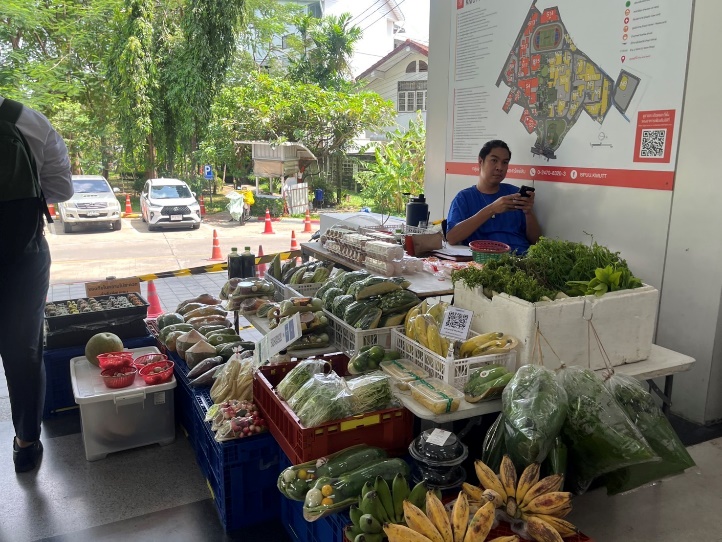
KMUTT has opened the area around the parking building on the 1st floor for a community market, which is open to vendors from the surrounding community three times a week. Within the market there are shops selling food, various items, and fresh vegetable and fruit shops, resulting in approximately 4-8 kilograms of vegetable scraps left over from trimming per day.
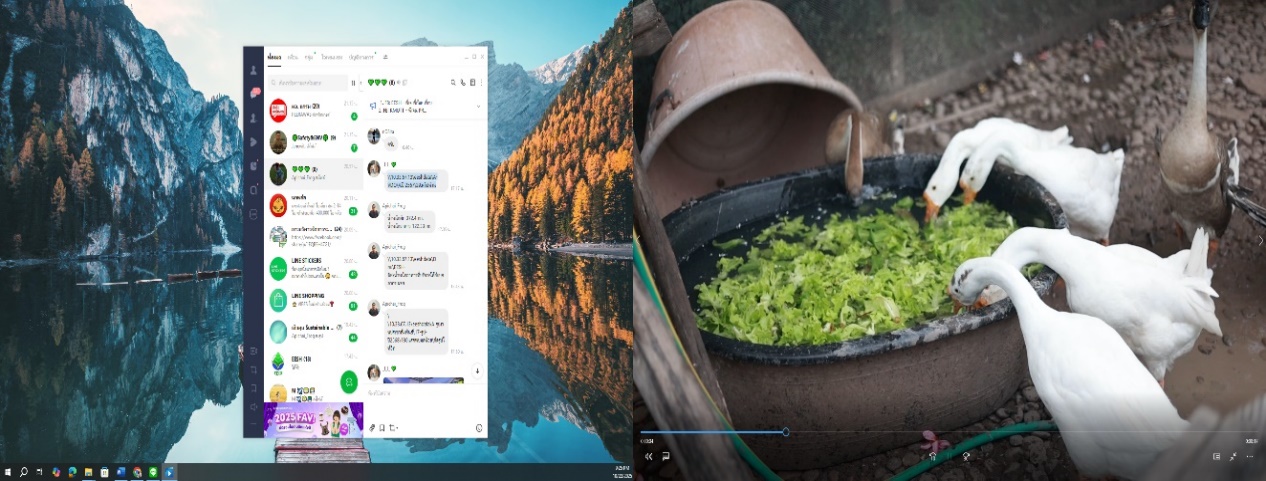
To reduce the amount of food waste that needs to be disposed of and to promote the efficient use of resources the university has therefore initiated a method to utilize these vegetable scraps by using them as food for the geese that the university raises within the university's own grounds. In 2025, the amount of vegetable scraps fed to geese was 454.6 kilograms.
The 454.6 kg figure is the separately reported 2025 animal-feed activity. Its overlap with the annual waste record is not specified, so it is not added to or subtracted from the food-waste total.
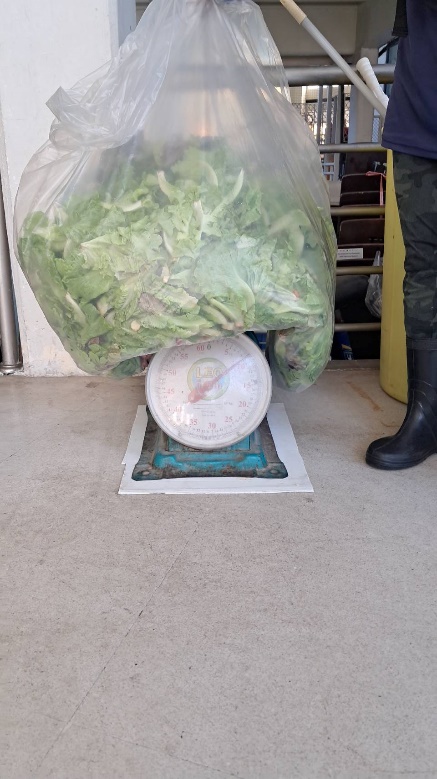
Vegetable scraps weighed in the supplied market record. The photographs document handling; individual scale readings are not interpreted.
122.33 kg of surplus food shared for human consumption
Food waste diverted to biogas or compost remains part of food waste generated. The supplied record separately describes 122.33 kg of surplus food shared for human consumption during 2025. That food redistribution quantity is retained as a prevention activity and is not added to food waste generated. No revised total or per-capita ratio is derived by combining these different measures.
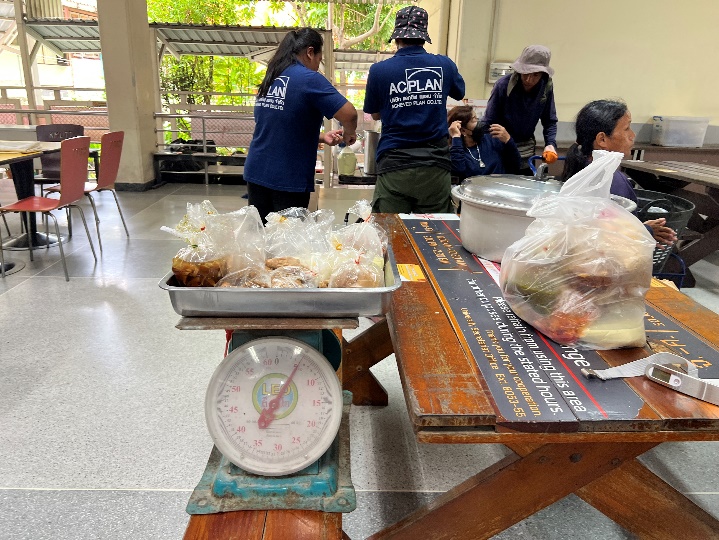
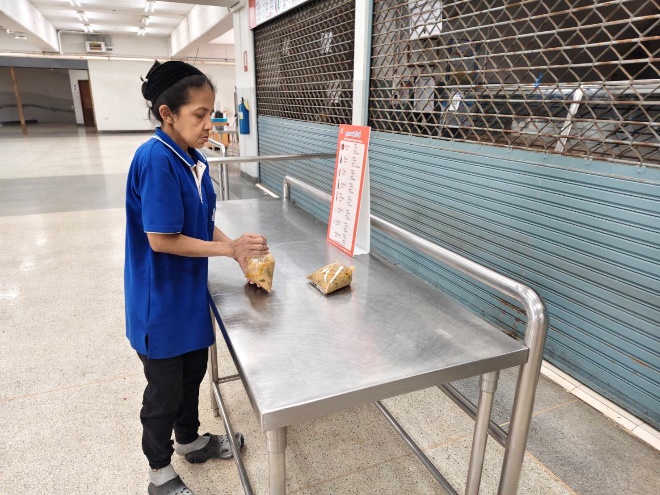
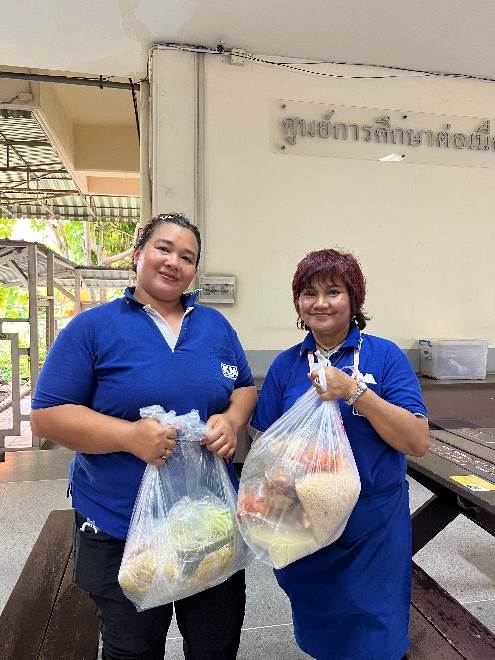
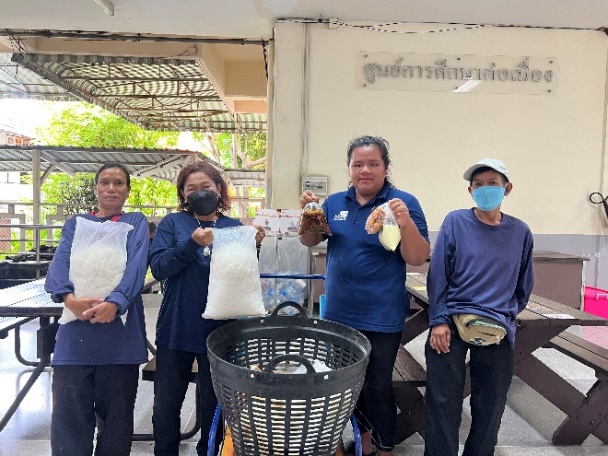
Surplus food left over from sales at KMUTT community markets and cafeterias, which occurs after the time of distribution to students and staff, is managed systematically and conscientiously. The shop owners pack leftover food in appropriate containers and place them in front of the shop after closing the shop each day. To provide an opportunity for students, housewives, gardeners and personnel who may have income limitations to come and eat free of charge. This approach, which emerged from a collaborative effort between relevant parties within the university, has been discussed with community markets and vendors to find ways to manage surplus food that is still of high quality and safe to consume. As a result of these discussions and exchanges of ideas, many entrepreneurs expressed their willingness to participate in supporting this approach It is believed that sharing excess food not only reduces food waste but also helps alleviate the burden on those who may be facing financial hardship. This is in line with the university's sustainable development guidelines and fosters a sharing society within the university community.
Surplus-food packing, weighing and collection in the institutional record. The account reports 122.33 kg shared during 2025.
Supporting photographs, compost methods and campus context
Leaf composting and campus cultivation
Food-waste containers in the supplied treatment record; no photograph date is specified.
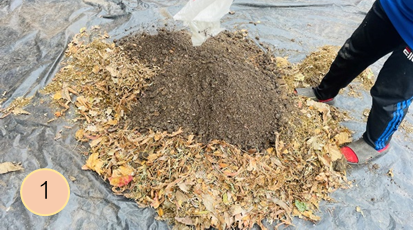
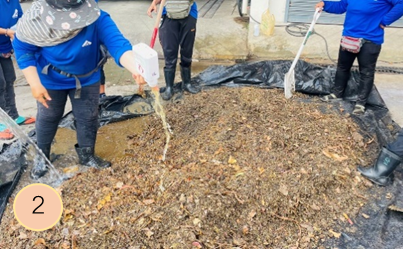
Original dry-leaf compost preparation illustrations, steps 1 and 2.
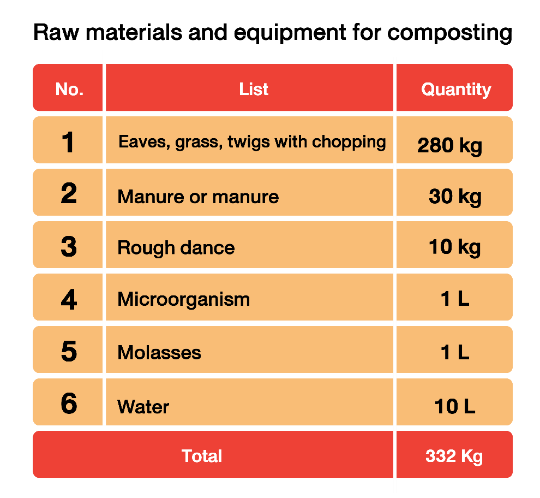
Original compost-preparation sequence, including the numbered container, weighing and shredding illustrations. Repeated identical source copies are shown once.Original compost-mixture illustration. It is a batch recipe, not an annual waste total. Its ambiguous English ingredient labels and mixed kilogram/litre quantities are retained without reinterpretation.
Vegetable gardens
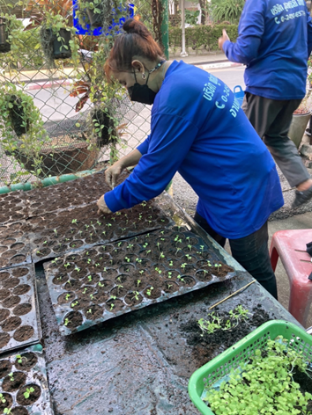
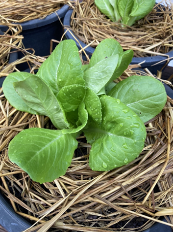
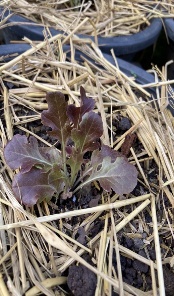
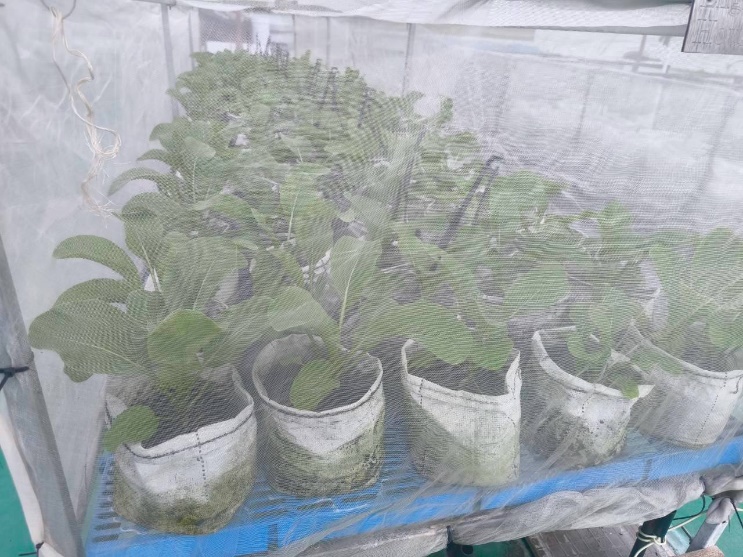
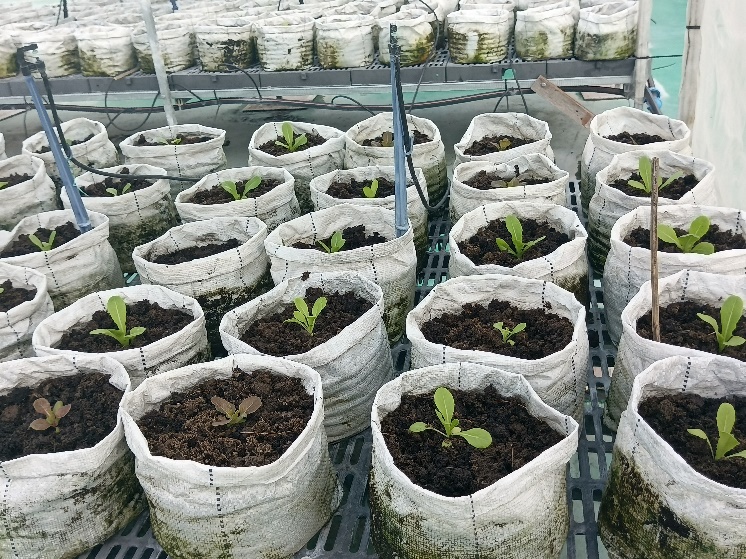
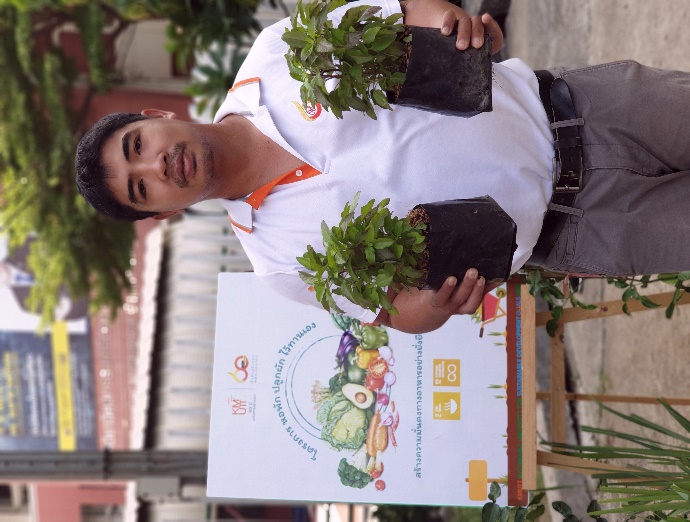
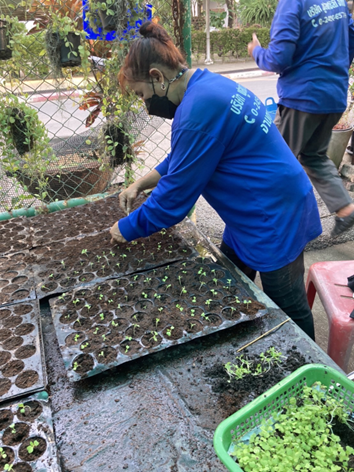
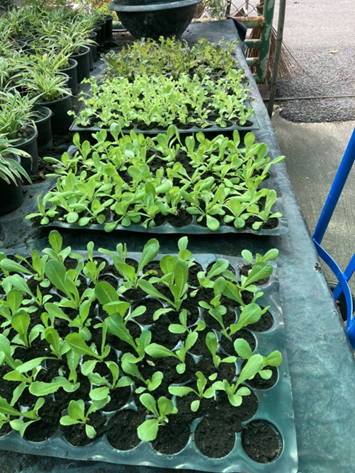
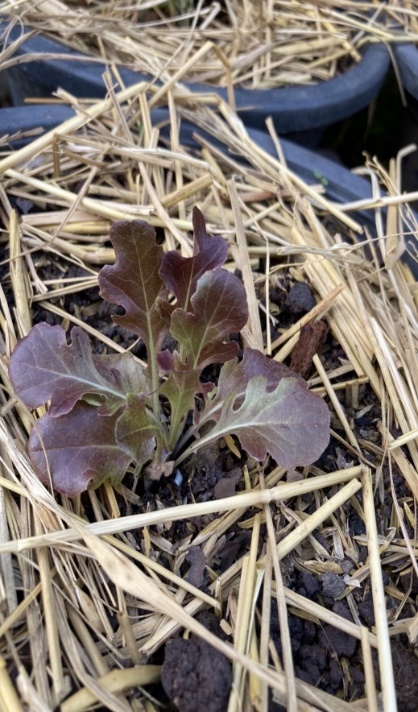
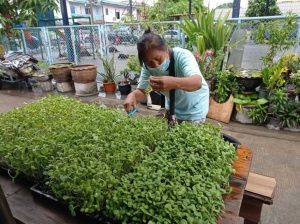
Seedling cultivation in the institutional record. Photograph dates are not specified.
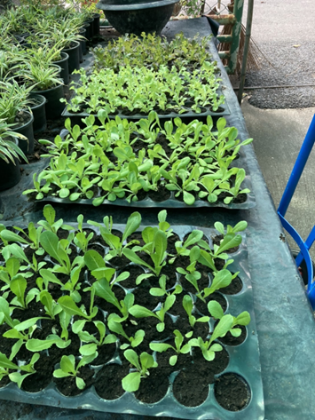
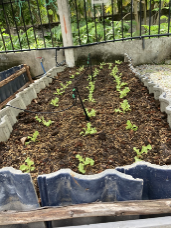
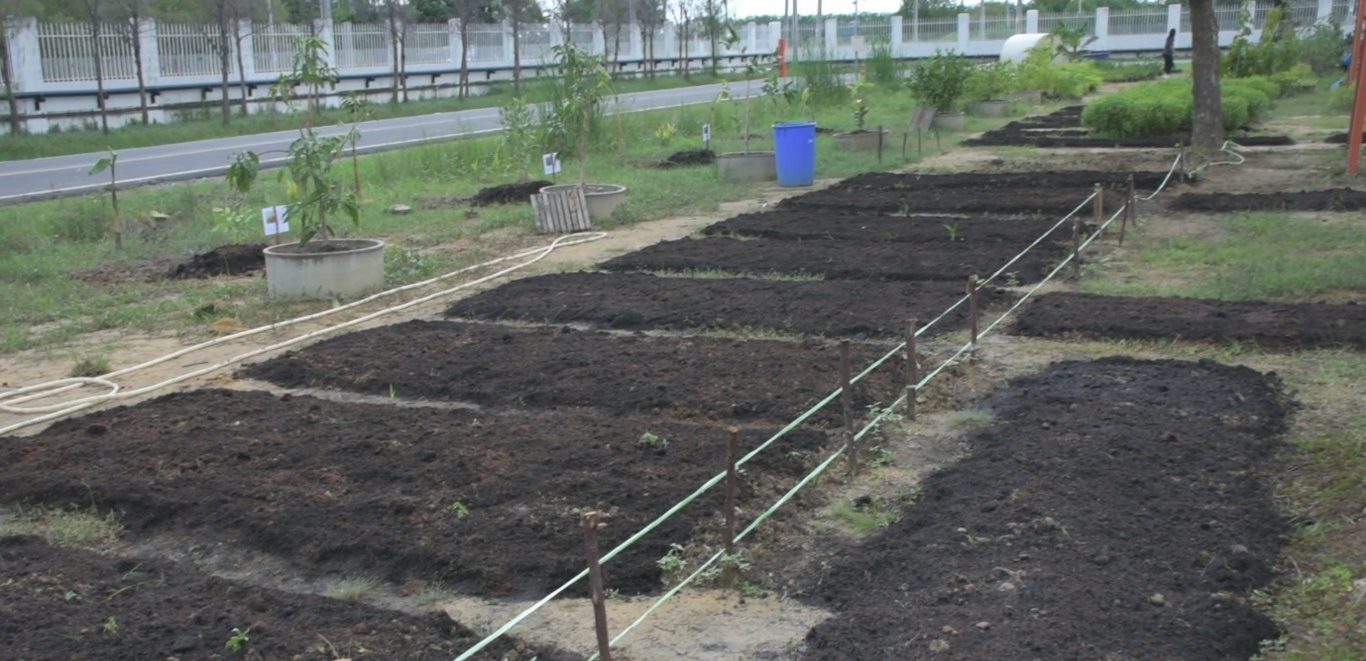
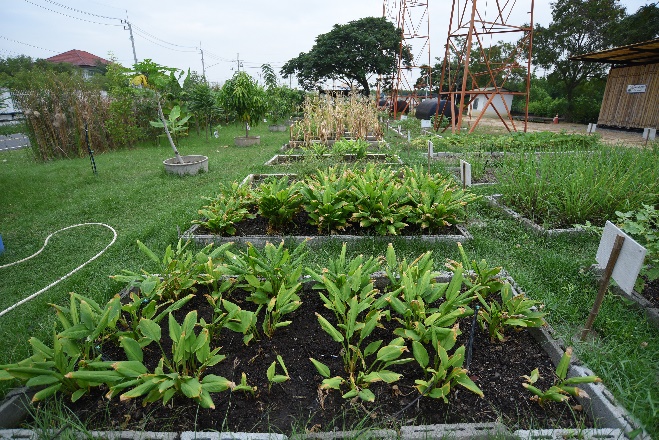
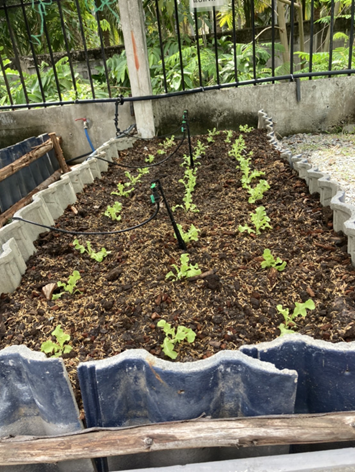
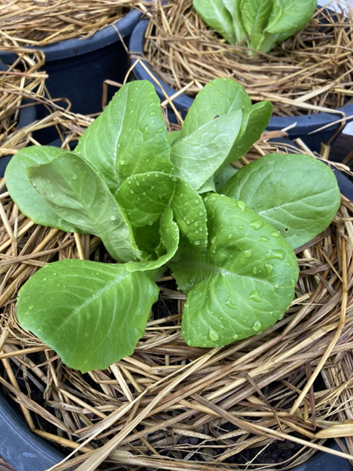
Vegetable plants and growing beds in the institutional record.
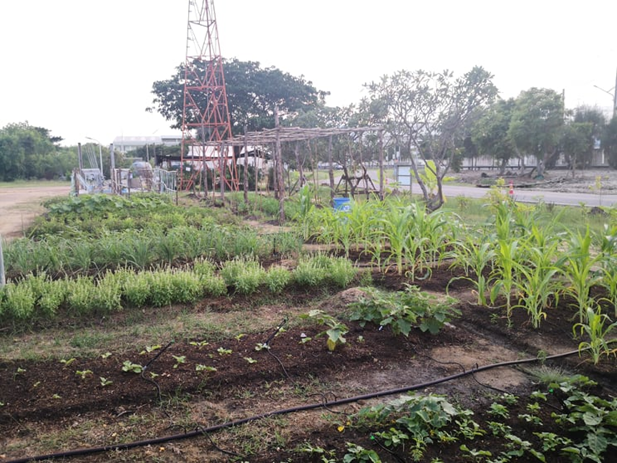
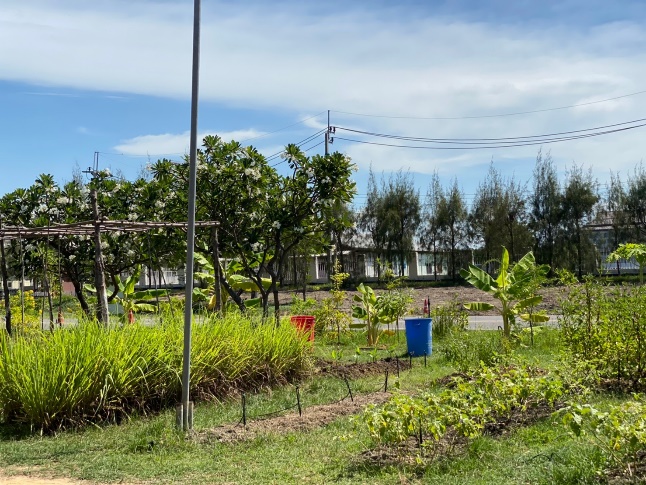
Campus vegetable-growing area shown in the original institutional record.
Leaf-and-branch compost: one part manure to four parts plant material
Use one part animal manure, four parts leaves and twigs, and plain water. If fermented water is available, it may be mixed into the water used for sprinkling.
Equipment: a 1 × 3 metre net, 4–5 posts, a hammer and wire.
Tie the net into a circle, position the posts around it and secure the net to the main posts. The source describes a cement ring, plastic-net enclosure or screen enclosure.
For the first layer, spread 4 kg of leaves and twigs, level the layer, then add and level 1 kg of animal manure. Repeat for approximately 6–8 layers.
Water thoroughly, then water every 2–3 days. Leave for 2–3 months to obtain compost for nourishing plants.
Leaf-compost enclosures in the supplied institutional record.
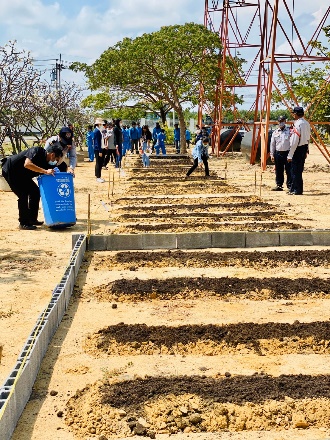
Growing beds associated with the institutional compost and cultivation account.
Additional market and food-sharing photographs
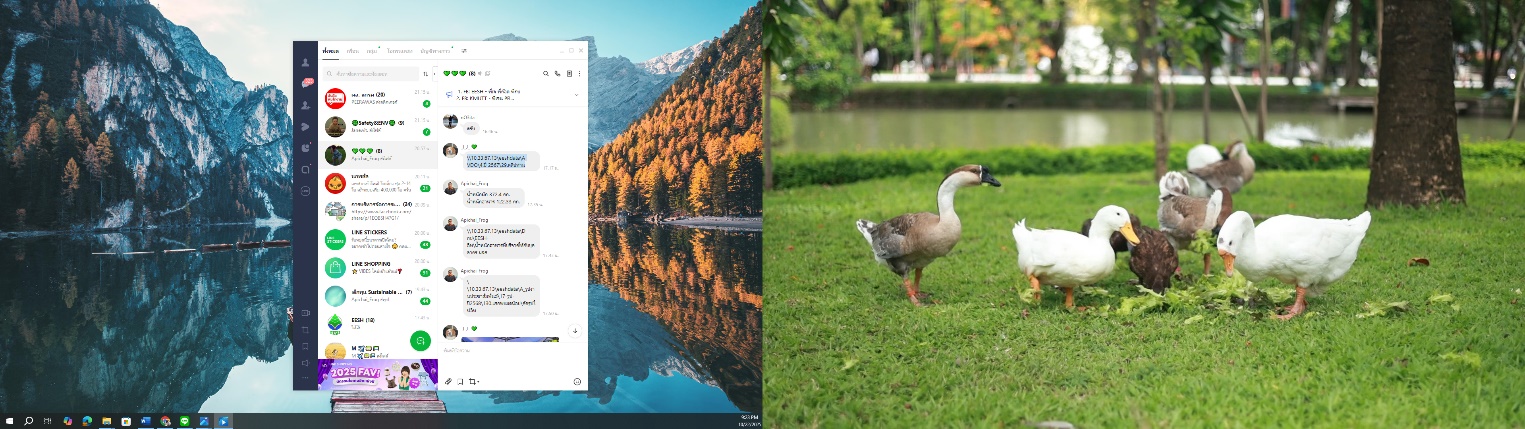
Original composite geese-feeding illustrations retained whole. No message text or individual digital records are transcribed.
Food-sharing photographs in the supplied institutional record.
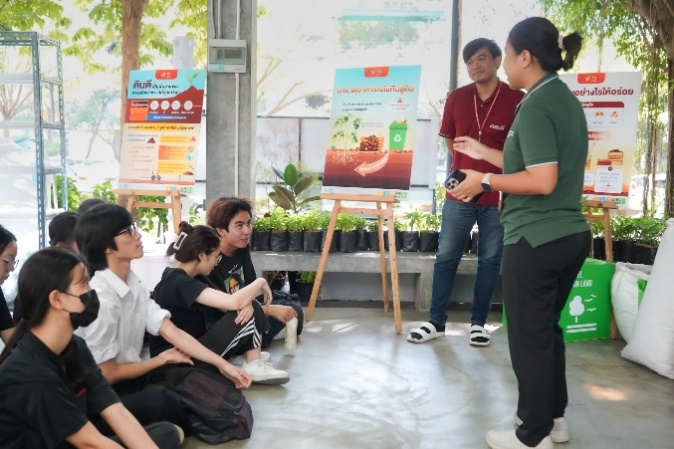
Soil-Crafting Workshop
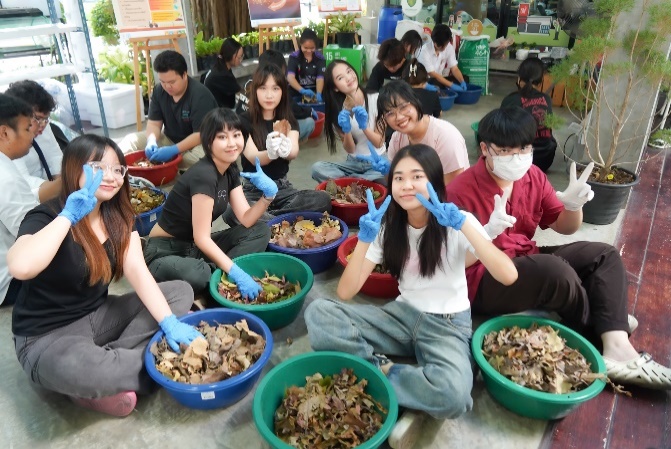
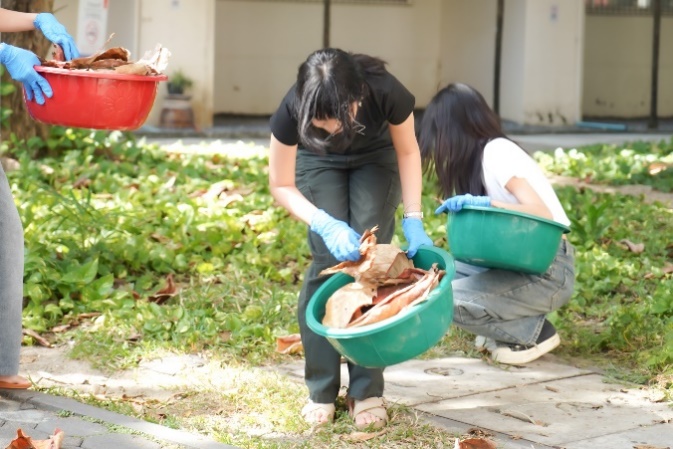
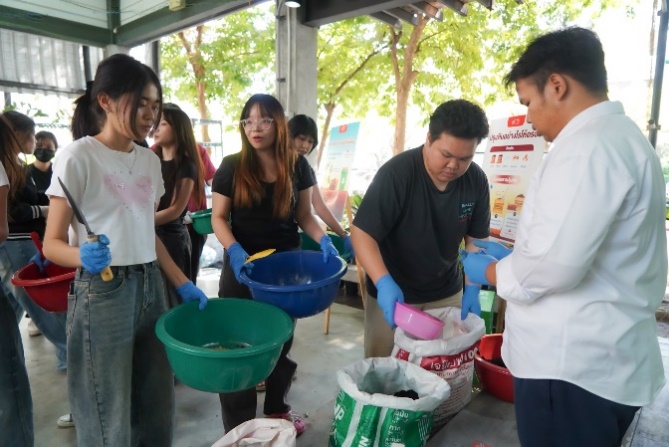
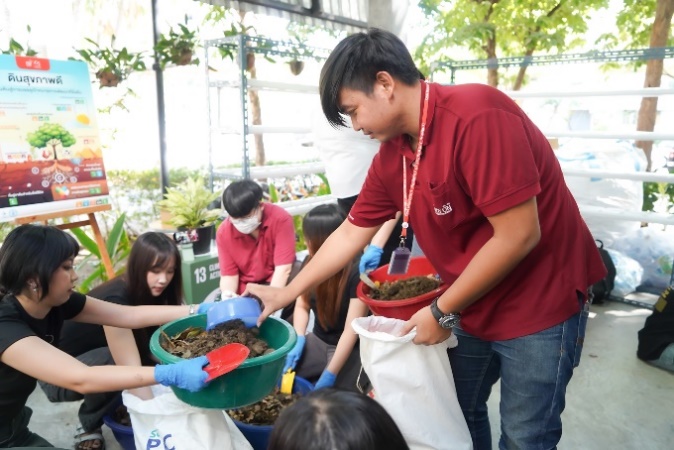
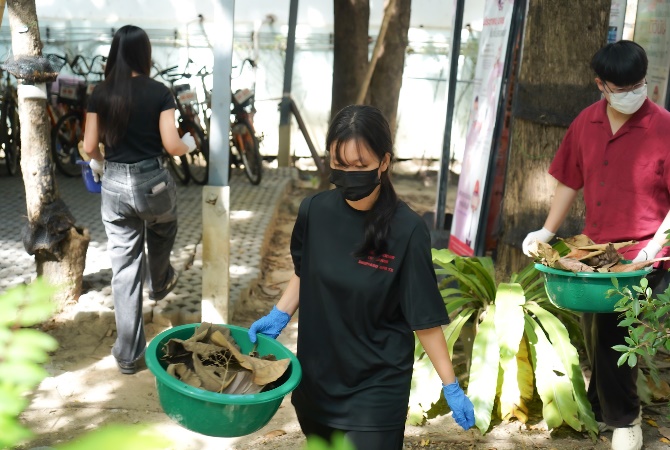
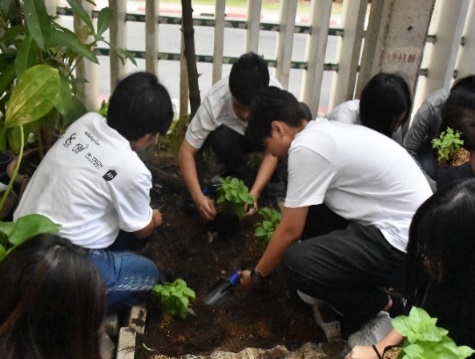
The Soil-Crafting Workshop emphasizes experiential learning through the utilization of abundant fallen leaves across the King Mongkut’s University of Technology Thonburi (KMUTT) campus as raw material for organic compost production. The procedure is straightforward and widely accessible: leaves are layered with food scraps to balance carbon and nitrogen sources, water is added to maintain adequate moisture, and the pile is regularly turned to ensure proper aeration. Over time, microbial activity facilitates the decomposition of organic matter, resulting in nutrient-rich compost that enhances soil fertility and structure
Practical learning in the original Soil-Crafting Workshop record.
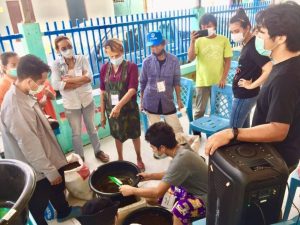
Workshop participants handle organic material and prepare compost.
Original workshop photographs; dates are not specified.
Municipal waste context: separate from food-waste measurement
KMUTT has developed its municipal solid-waste management system since 2002 around waste segregation, collection and utilisation. Campus streams include organic, recycled, non-recycled, toxic and workshop waste. Exhibitions and training occur five times per year. The original narrative describes a municipal-waste comparison of 35.84 kg per capita-year in early 2006 and 32.44 kg per person-year in 2025, reporting a possible 9.48% reduction. Its supplied chart instead labels 2025 as 32.45 kg per capita-year; the narrative also includes the words “Garden waste”, leaving that phrase’s category scope unclear.
This is a municipal-waste comparison, not a food-waste-per-capita result. The original 32.44 narrative value, 32.45 chart value and reported 9.48% are retained without selecting a new denominator or deriving a revised food-waste rate.
2025 municipal composition · 588,580 kg total
Waste stream
Quantity (kg)
Printed share
Non-recycled waste
262,799
44.65%
Recycled / reused waste
112,370
19.09%
Organic waste
184,765
31.39%
Toxic waste
2,835
0.48%
Non-recycled workshop waste
25,811
4.39%
Municipal rate, 2006–2025
Original chart values · kilograms per capita-year. Bars share a zero origin and a 40 kg axis maximum.
2006
35.84
2007
30.41
2008
27.99
2009
28.49
2010
26.74
2011
27.43
2012
26.45
2013
27.64
2014
27.33
2015
27.44
2016
28.70
2017
29.63
2018
28.55
2019
23.59
2020
19.34
2021
9.73
2022
23.17
2023
32.89
2024
35.43
2025
32.45
Campus population snapshots
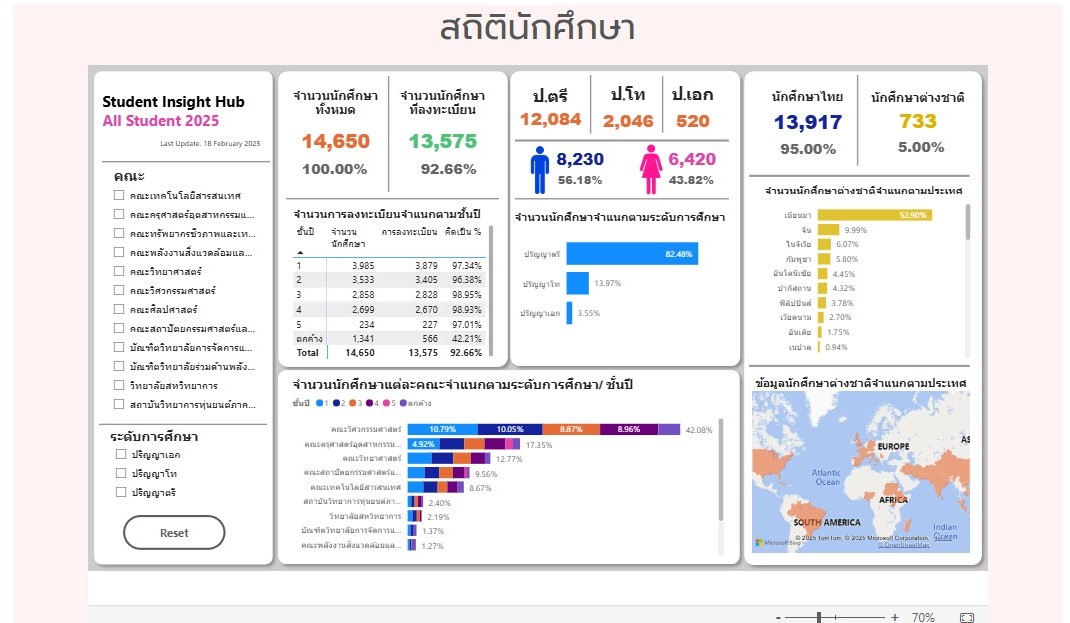
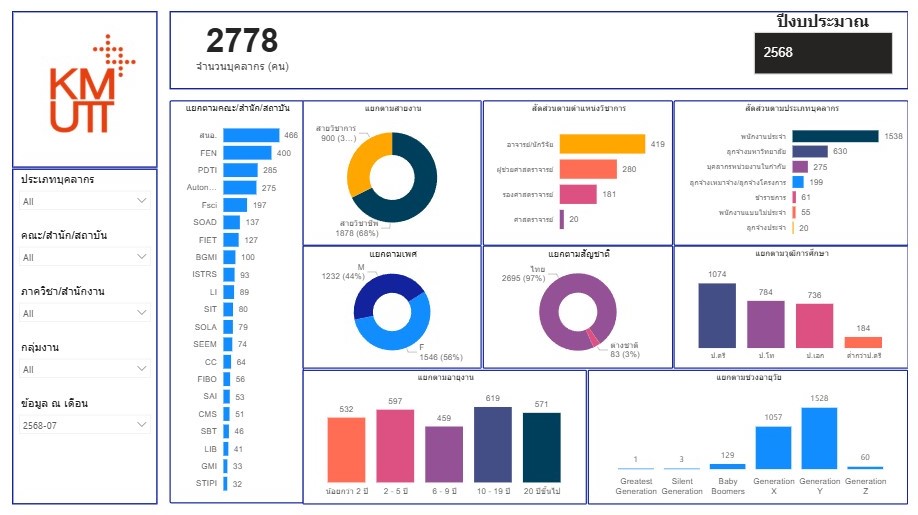
The student dashboard is labelled “All Student 2025”, last updated 18 February 2025. The personnel dashboard is fiscal year 2568 (2025), with its month filter set to 2568-07 (July 2025). These are distinct snapshots, not an automatically compatible denominator for food-waste rates.
Students · 18 February 2025
Visible headline field
Count
All students
14,650
Registered students
13,575
Undergraduate / master’s / doctoral
12,084 / 2,046 / 520
Male / female
8,230 / 6,420
Thai / international
13,917 / 733
Personnel · July 2025
Visible headline field
Count
All personnel
2,778
Academic / non-academic
900 / 1,878
Male / female
1,232 / 1,546
Thai / international
2,695 / 83
Original student dashboard, last updated 18 February 2025. Clearly readable headline counts are transcribed above; detailed filtered charts and the map remain in the original.Original personnel dashboard: fiscal year 2568 (2025), month filter 2568-07. No food-waste-per-capita ratio is derived from this snapshot.
Sources and evidence links
Supplied KMUTT institutional evidence: Campus food waste tracking, including 2025 food and garden waste records, treatment figures and surplus food sharing.
1. Related information on our university as a body on having a programmer in place on student food insecurity/hunger.
KMUTT combines continuing living-cost assistance, emergency hardship support and access to food. The dated evidence distinguishes a 2025 scholarship policy and food-sharing record from support notices issued in 2026.
Continuing support for disadvantaged undergraduates
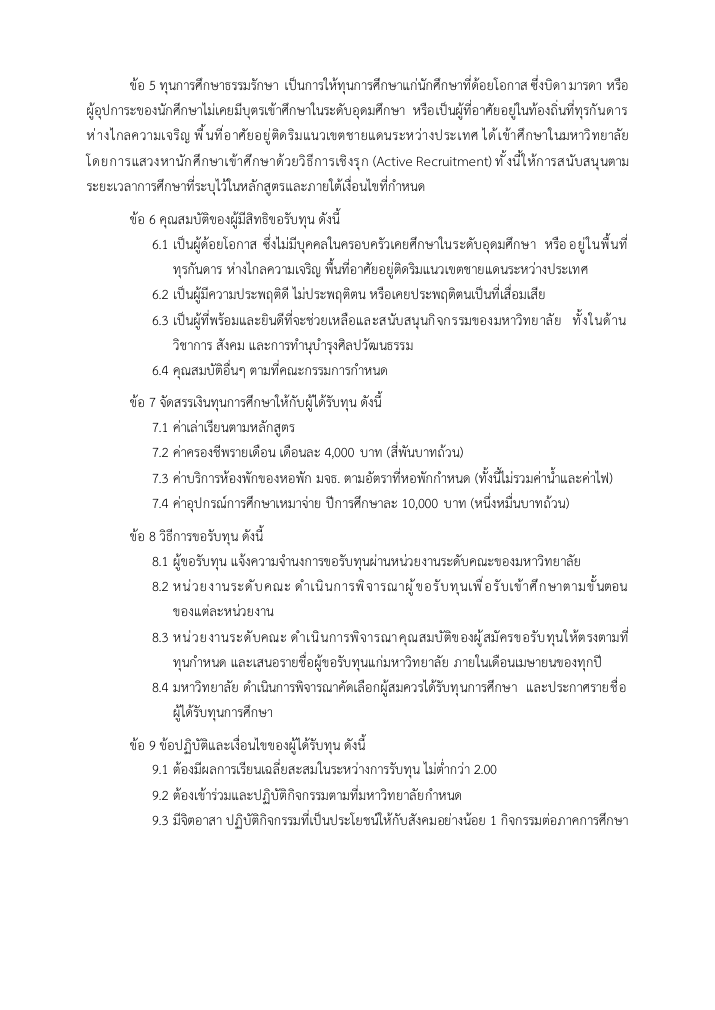
The Thammaraksa scholarship policy dated 18 February 2025 establishes continuing assistance for selected disadvantaged undergraduates. Support covers the prescribed programme duration, subject to policy conditions including a cumulative GPA of at least 2.00. Faculties recruit and screen eligible candidates, nominate them to the university and support selection. This coordinated financial pathway supports day-to-day needs, including the ability to purchase food.
Living expenses
THB 4,000/month
A general living allowance, not a separately earmarked meal voucher.
Educational materials
THB 10,000/academic year
A lump-sum allocation for educational materials.
Tuition
Curriculum tuition
Tuition support under the prescribed programme.
Accommodation
KMUTT dormitory room charges
At the dormitory’s prescribed rate; water and electricity are excluded.
How students enter and continue on the pathway
Faculty screening
Candidates apply through their faculty, which screens eligibility and nominates candidates to the university.
University selection
The university considers candidates and announces the selected scholarship recipients.
Continuing conditions
Recipients maintain a cumulative GPA of at least 2.00, participate in required activities and undertake at least one socially beneficial volunteer activity per semester.
A year-round route for sudden hardship in 2026
Award amount
THB 5,000–10,000
Per award for an eligible undergraduate.
Award frequency
Up to twice
Per academic year, subject to selection.
Application period
Throughout the academic year
An adviser endorsement and hardship documents are required.
The emergency scholarship announcement signed on 13 February 2026 provides THB 5,000–10,000 per award, up to twice per academic year, for eligible undergraduates facing specified sudden household hardship or serious illness. Applications are accepted throughout the academic year, with an adviser endorsement and supporting hardship documents. The Student Financial Aid Unit arranges interviews and committee consideration. This offers a needs-based response when a sudden loss of household income threatens a student’s ability to meet essential expenses. The announcement carries B.E. 2568 in its title but bears a 2026 signature date.
The title retains B.E. 2568, while the supplied evidence identifies the signature as 13 February 2026. This notice is presented as 2026 support, rather than relabelled as an implemented 2025 measure. Award limits describe the scheme, not the number of students actually funded.
Food made available without charge
The supplied campus food waste record documents a 2025 surplus food sharing arrangement with campus market and cafeteria vendors. Safe remaining food is made available without charge after sales to students and campus workers facing financial constraints. The institutional record reports 122.33 kg of surplus food shared in 2025. This is a food redistribution measure, distinct from the scholarship allowances above; it is not a count of individual students experiencing food insecurity.
122.33 kg shared in 2025
Surplus food redistributed for human consumption. This is a food quantity, not a count of individual students experiencing food insecurity.
Growing food on campus
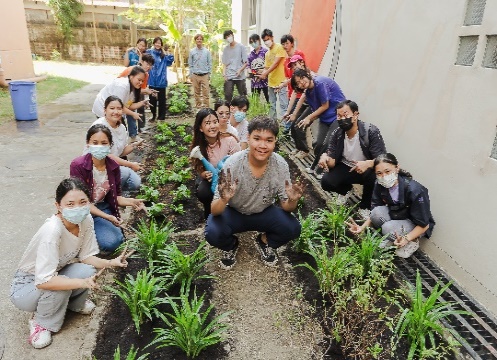
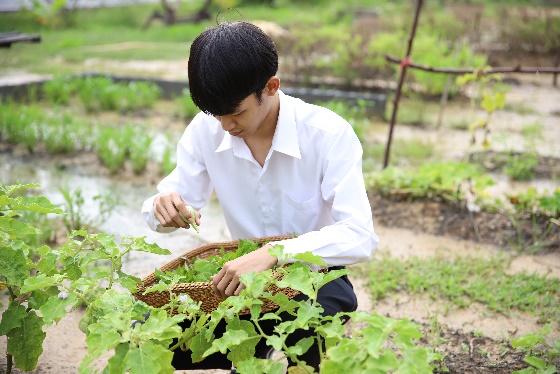
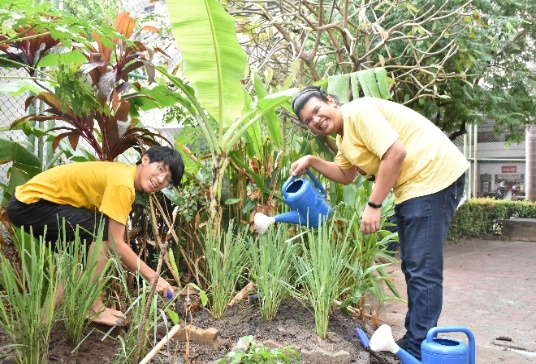
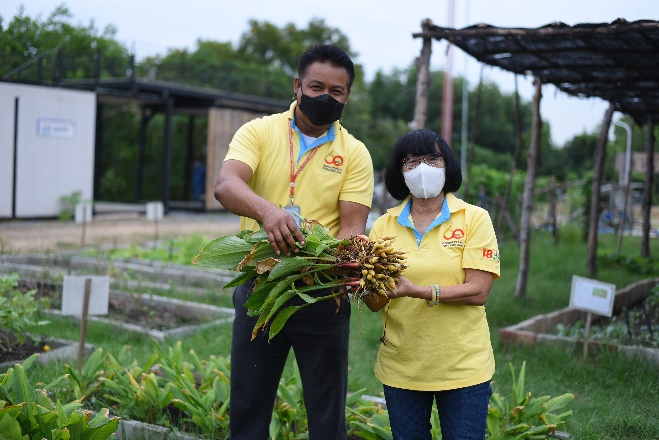
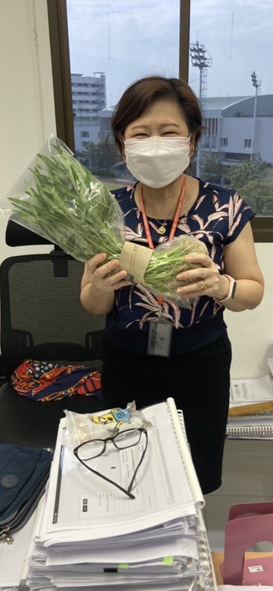
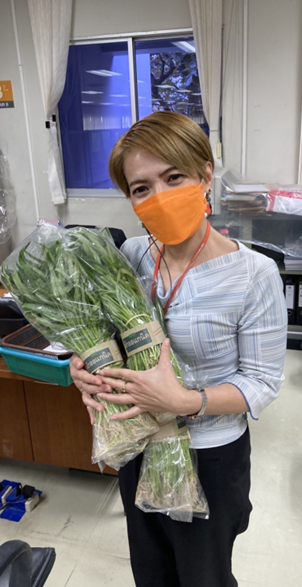
The institutional account describes a food-security project for students, personnel and surrounding communities, linked to well-being and practical skills. Students and personnel take part under the philosophy of sufficiency economy. One area is used for organic vegetable gardening around student dormitories so that students or staff can eat the produce. A second organic-growing area produces vegetables for trade with university personnel and the surrounding community. Leaves and branches from the campus are composted to fertilise the vegetable gardens.
Student and community participation in the original campus-growing record. Photograph dates are not specified.
Bring a container: no-cost beverage access
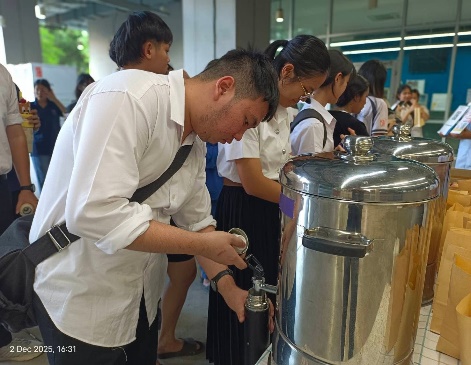
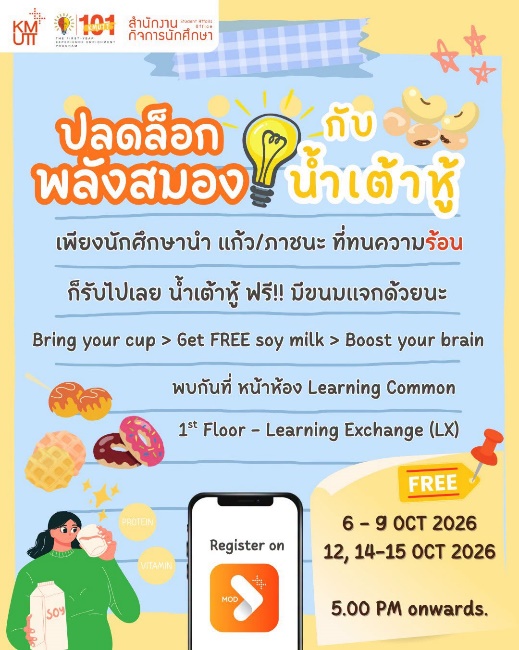
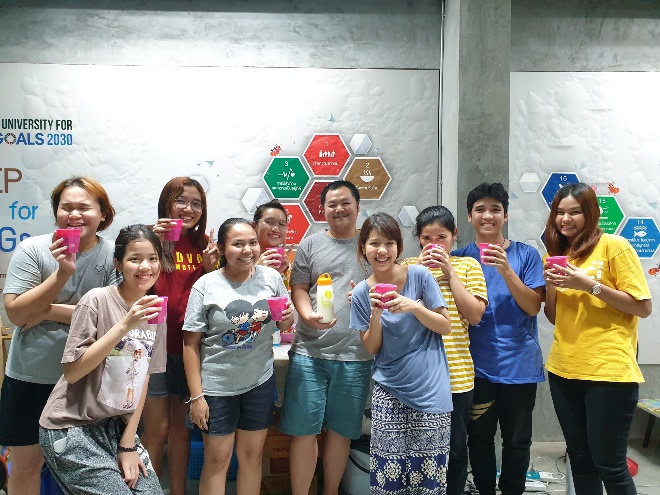
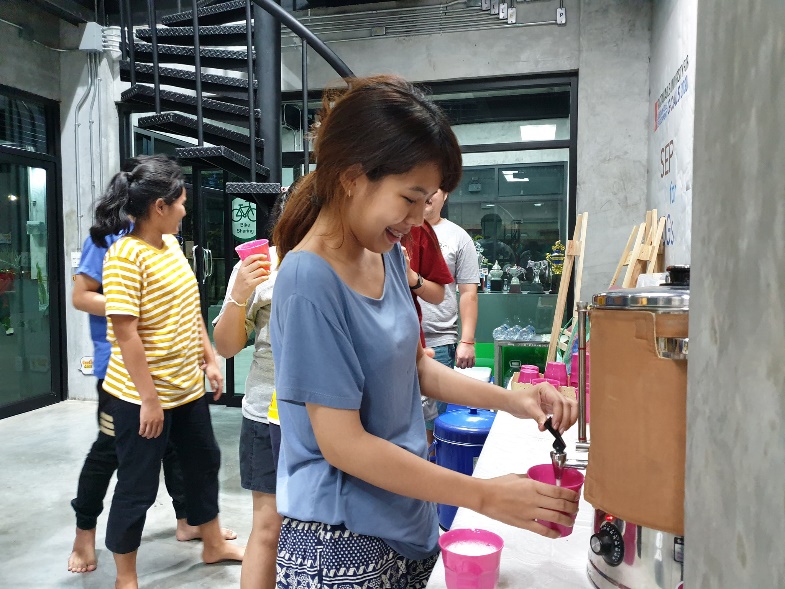
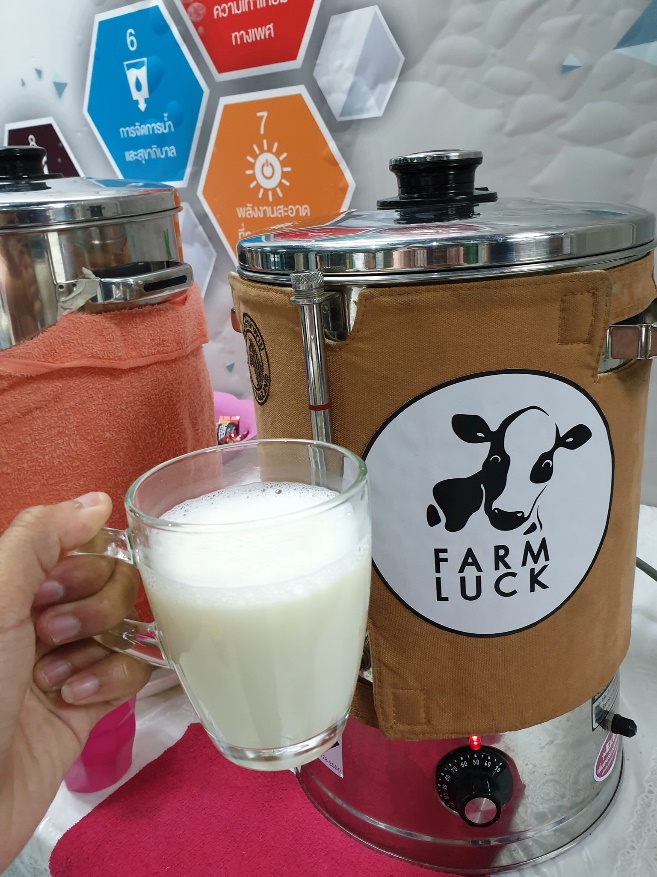
KMUTT has distributed soy milk to staff and students who bring their own cups on the 1st floor of the Learning Commons (LX) building.
KMUTT has a free soft drink service point for students who bring their own containers. This is held twice a month throughout the academic year.
Soy-milk distribution photographs from the institutional support record. They are distinct from the dated October 2026 notices.
The narrative describes the soft-drink point as twice monthly. The original posters below advertise weekly arrangements; they are preserved as separate notices, without treating the frequencies as identical.
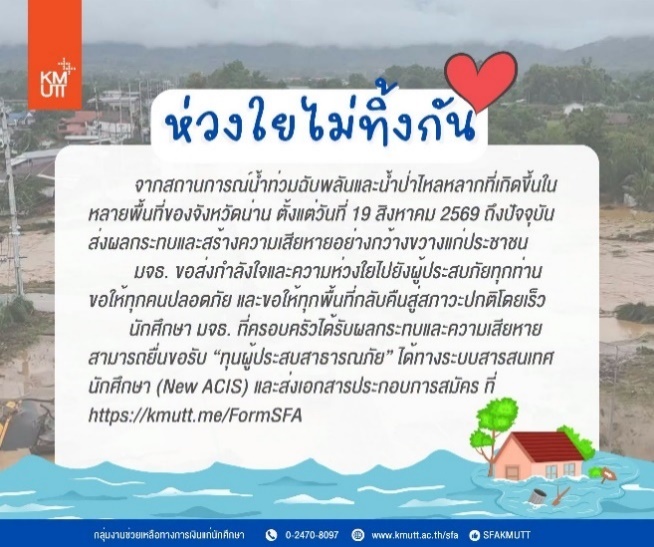
Financial support when floods affect students’ families
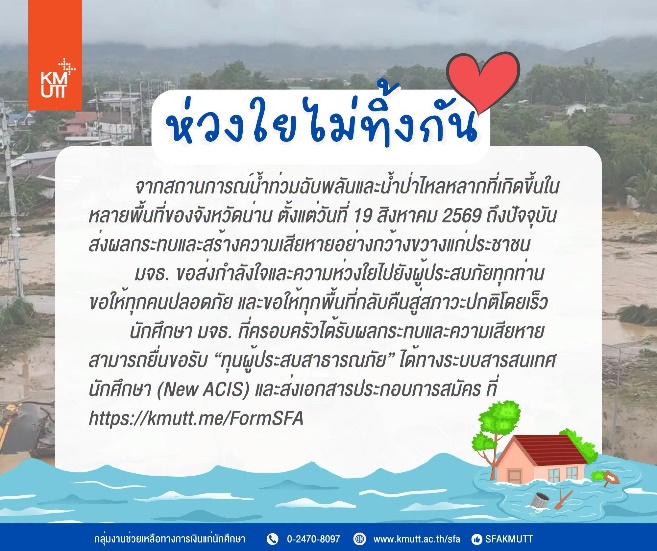
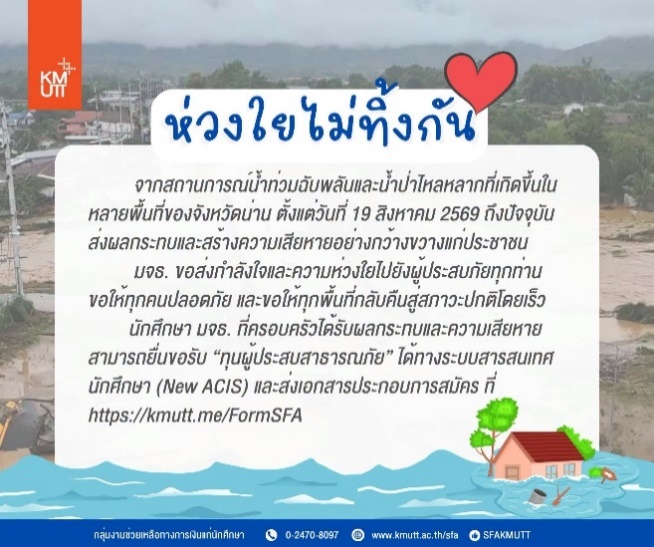
In light of the recent flash floods, river overflows, and coastal surges affecting many areas and families, King Mongkut’s University of Technology Thonburi (KMUTT) extends its heartfelt concern and encouragement to all those impacted. We sincerely wish for everyone’s safety and for the situation to return to normal as swiftly as possible.
For KMUTT students whose families reside in flood-affected areas and have suffered damage, the university has established a special “Flood Relief Scholarship” to help alleviate hardship. Eligible students may apply through the Student Information System and submit the required supporting documents.
Original Flood Relief Scholarship notices. The first refers to flooding in Nan beginning 19 August 2569 (2026); it directs affected students to New ACIS and the supporting-document form. The second notice gives the same support route without an explicit date.
Khun Ta Garden: cultivation, meals and learning
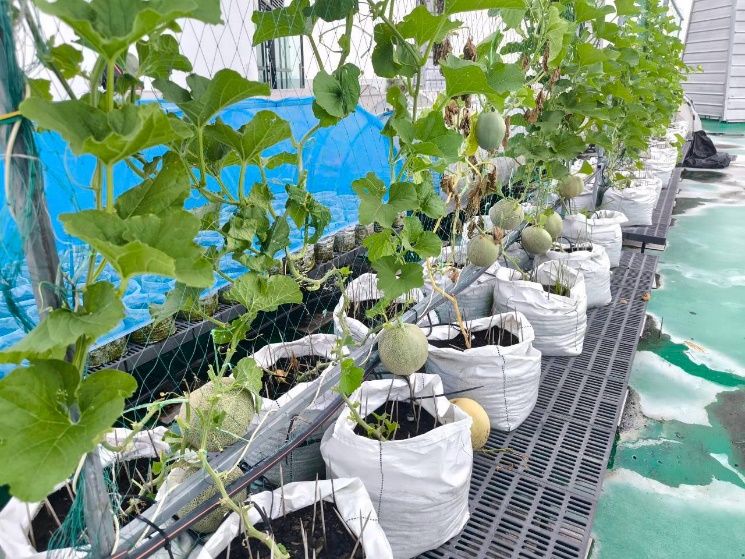
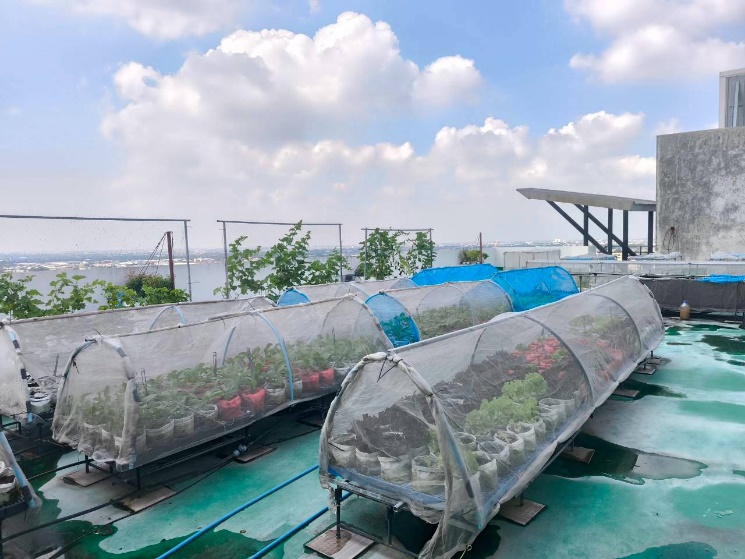
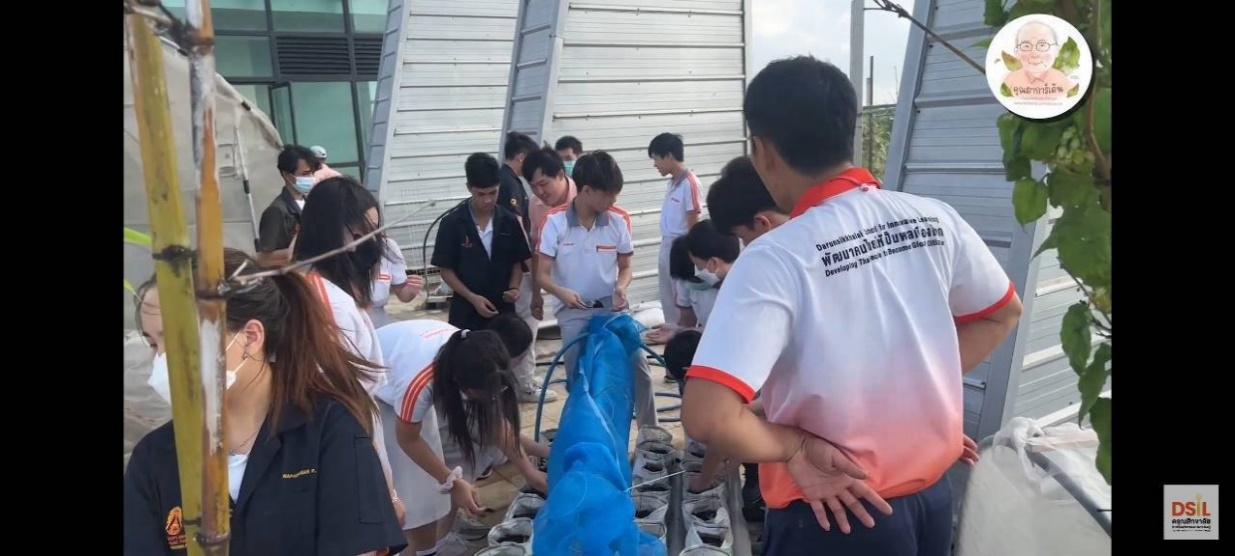
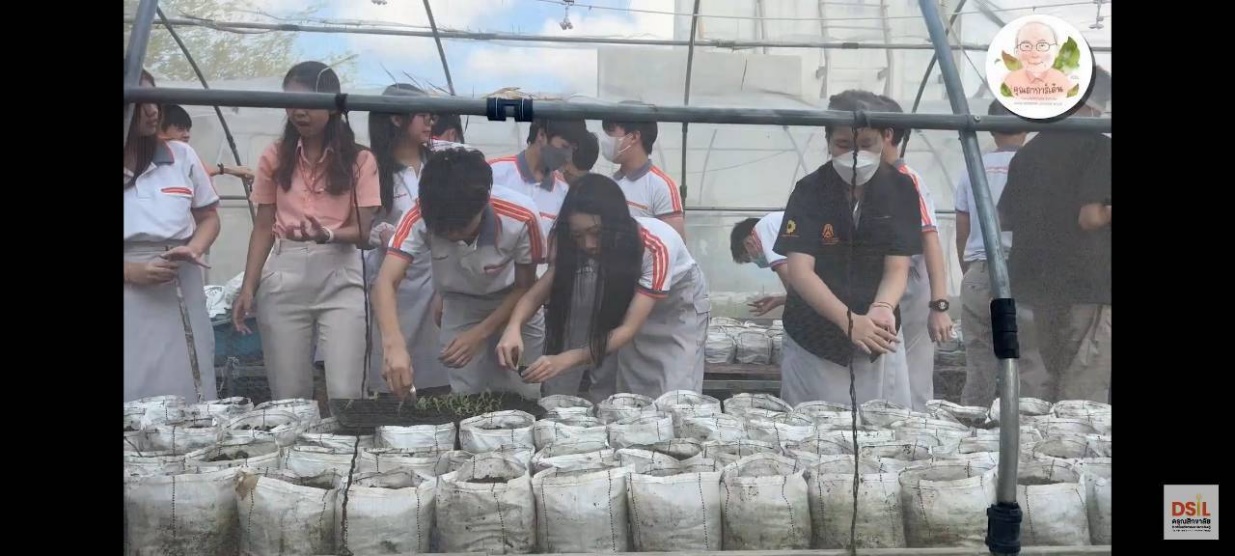
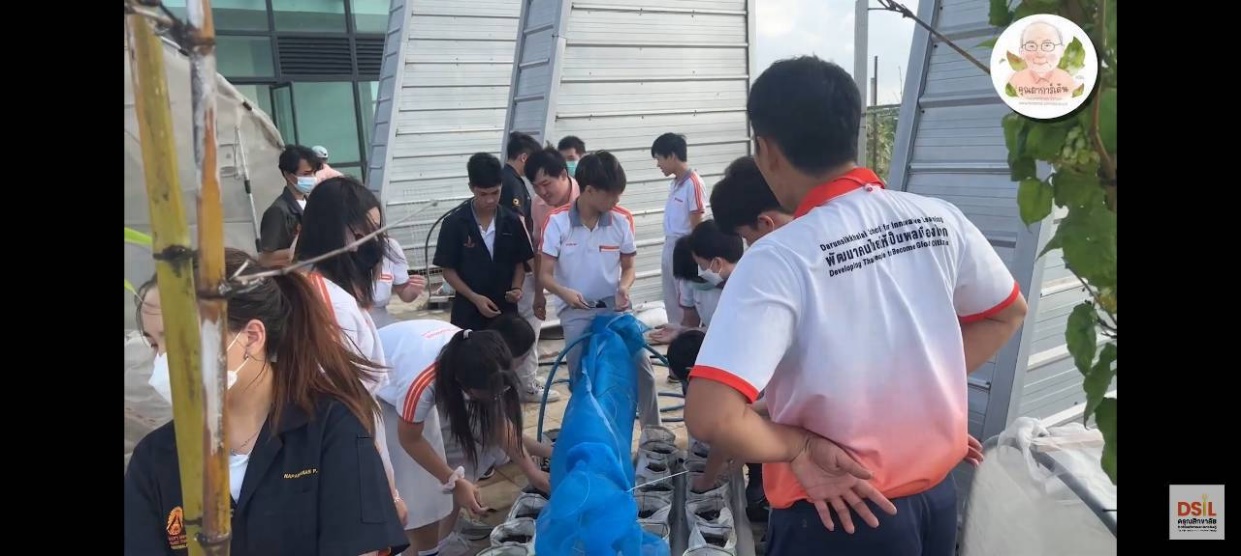
Khun Ta Garden (Grandpa Garden), the rooftop vegetable garden of Darunsikkhalai School for Innovative Learning, was established during the COVID-19 pandemic in 2020 by President Khun Paron Israsena Na Ayudhya. The account describes his aim for Thai children to develop critical thinking, practical skills and global citizenship through agriculture. Applying the King’s sufficiency-economy philosophy, the rooftop plot aims to provide sustainable, safe and wholesome food for students, teachers and staff.
Rooftop cultivation at Darunsikkhalai School for Innovative Learning in the original institutional record.
Crops include salad greens, sweet basil, holy basil, sweet potatoes, melons, cucumbers and water spinach, alongside catfish raising. The harvest is used to prepare meals. Vegetable-preparation scraps and leftover food amounting to 5 kg per day are repurposed into compost and organic liquid fertiliser for soil enrichment.
Teachers and students cultivate and care for crops, conduct experiments, and study soil preparation and seed germination. A Smart Farm system regulates irrigation, temperature and humidity to support growing conditions.
This is the school’s rooftop-learning and food-production context. The 2020 founding date and 5 kg/day reuse statement are retained as described; neither is converted into a new university-wide annual result or a count of hungry university students.
Original notices and additional photographs
Scholarship policy and campus-vendor documents
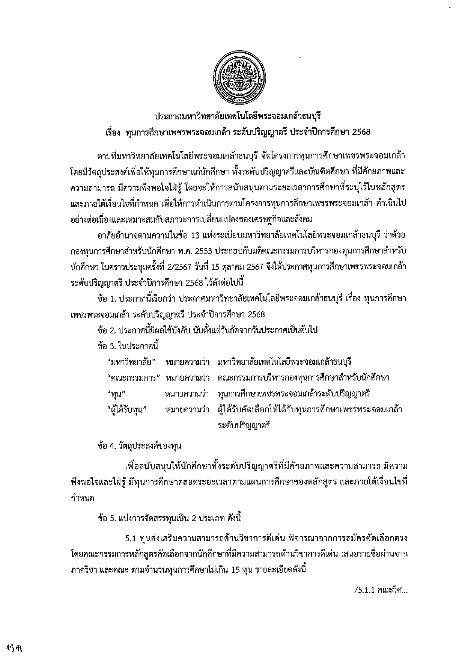
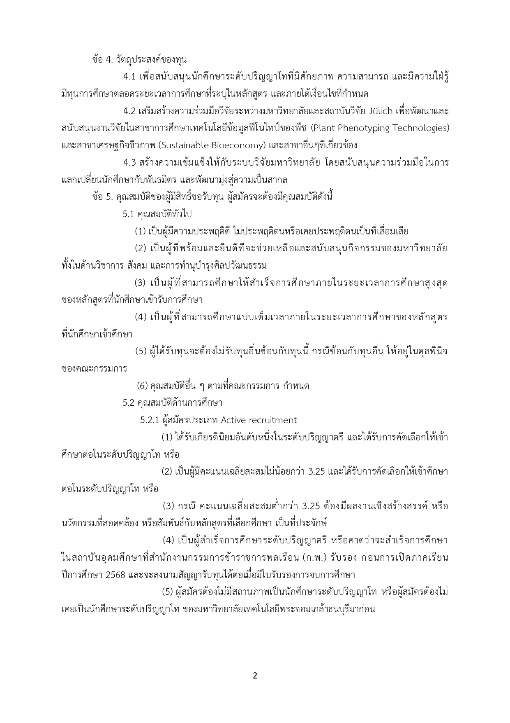
Official Thammaraksa policy, page 2: eligibility, four support categories, faculty nomination and continuing conditions. The 18 February 2025 date is in the full policy linked under Sources.Original campus food-vendor announcement, B.E. 2566 (2023), concerning expiry of existing food-vendor leases at the second food centre (Building 7). It is not relabelled as a new 2025 eligibility or healthy-food policy.Original screenshot of a campus-vendor document retained whole. Its small body text is not reconstructed or used to infer new policy clauses.
Campus food vendors and local ingredients
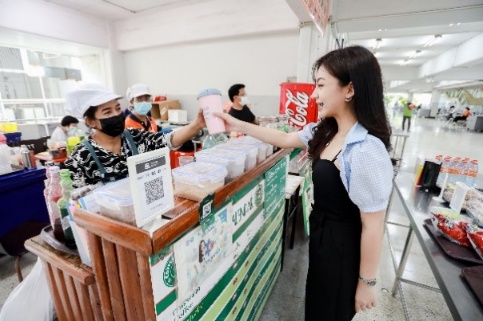
King Mongkut's University of Technology Thonburi arranged a selection of restaurants and shops serving within the university with criteria such as healthy food, vegetarian food, and environmentally friendly packaging. Both restaurants and beverages on campus were also enforced to use raw materials that can be found locally.
Food vendors shown in the original institutional support record.
Campus markets and food-service areas in the institutional record.
Additional campus-growing photographs
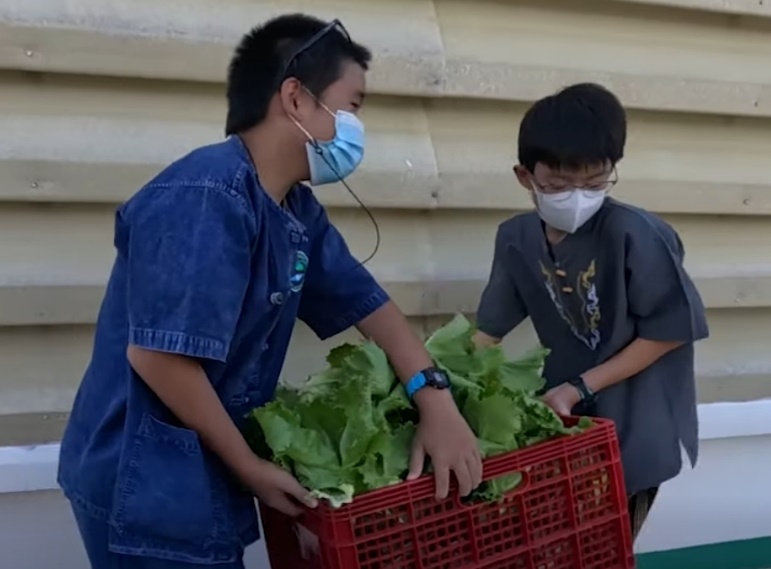
Students participate in cultivation and harvesting in the original record.
Original cultivation and garden-product photographs. No numerical claims are inferred from the background display.
Original garden products and supporting materials from the institutional record.
Original beverage notices and their advertised schedules
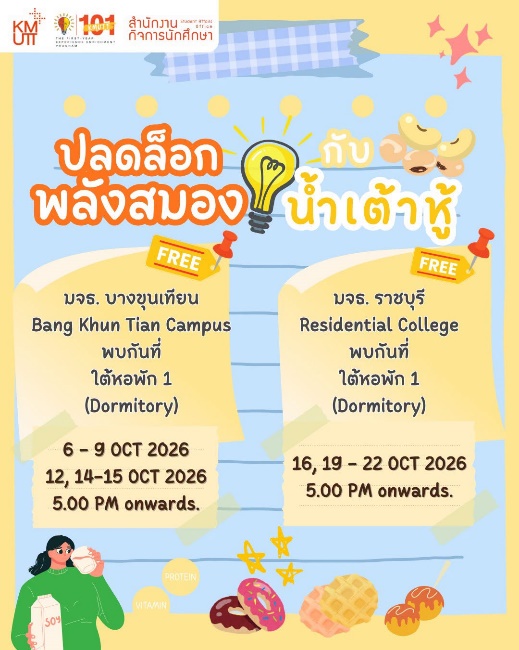
Original October 2026 soy-milk notices, retained whole in their original colours. Bring a cup or heat-resistant container. They advertise the campus-specific dates listed below.
Advertised location
2026 dates
Time
Bang Khun Tian · beneath Dormitory 1
6–9 and 12, 14–15 October 2026
From 17:00
Ratchaburi Residential College · beneath Dormitory 1
16 and 19–22 October 2026
From 17:00
Bang Mod · Learning Commons, LX floor 1
6–9 and 12, 14–15 October 2026
From 17:00
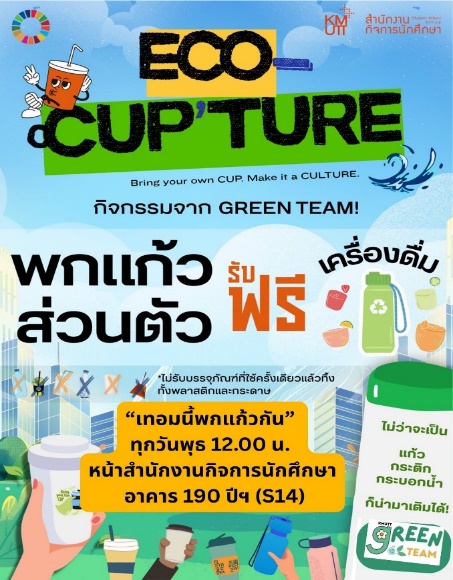
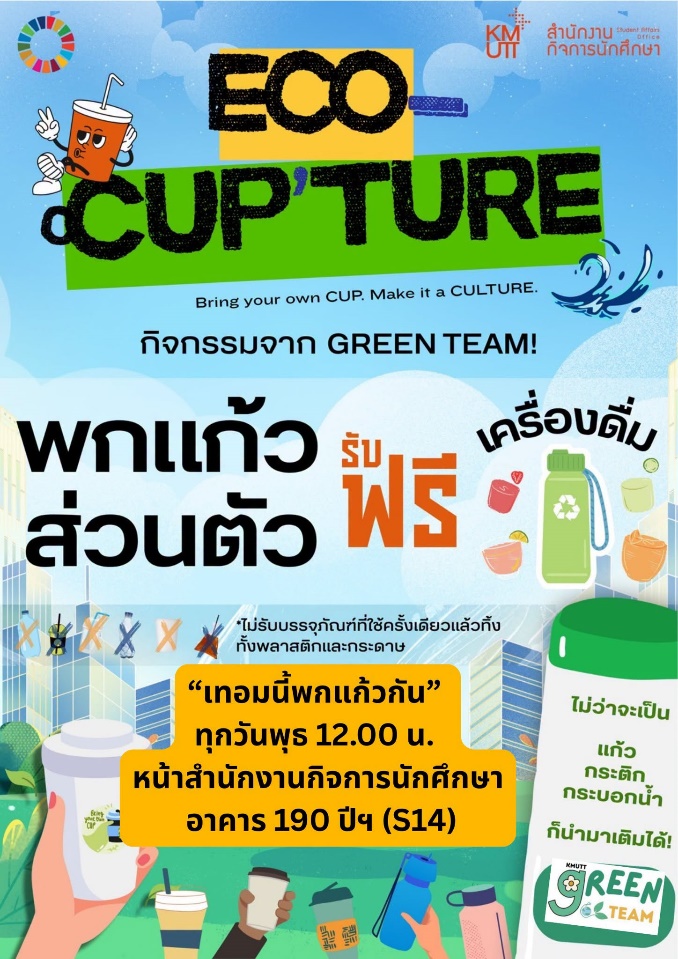
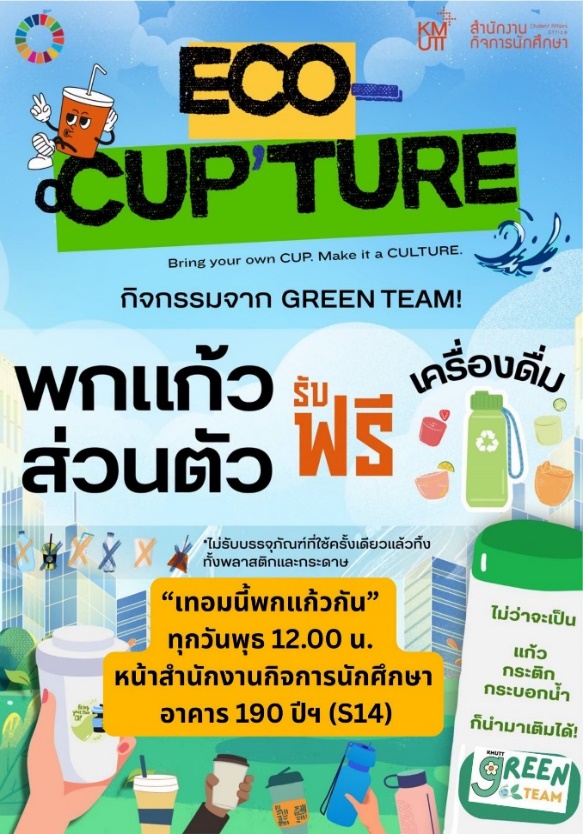
Original Eco Cup’ture notices retained whole. The left poster advertises every Wednesday at 12:00 outside Student Affairs, 190-Year Building (S14). The right poster advertises Monday, Tuesday, Thursday and Friday distribution. No year is printed on these two notices.
Further school-garden and meal-preparation evidence
Original wide school-garden learning illustrations retained with their original framing and logos.
Crops and growing containers in the original school rooftop-garden record.
Harvested vegetables and composting equipment shown in the original school record.
Original school teaching and learning illustrations, retained whole.
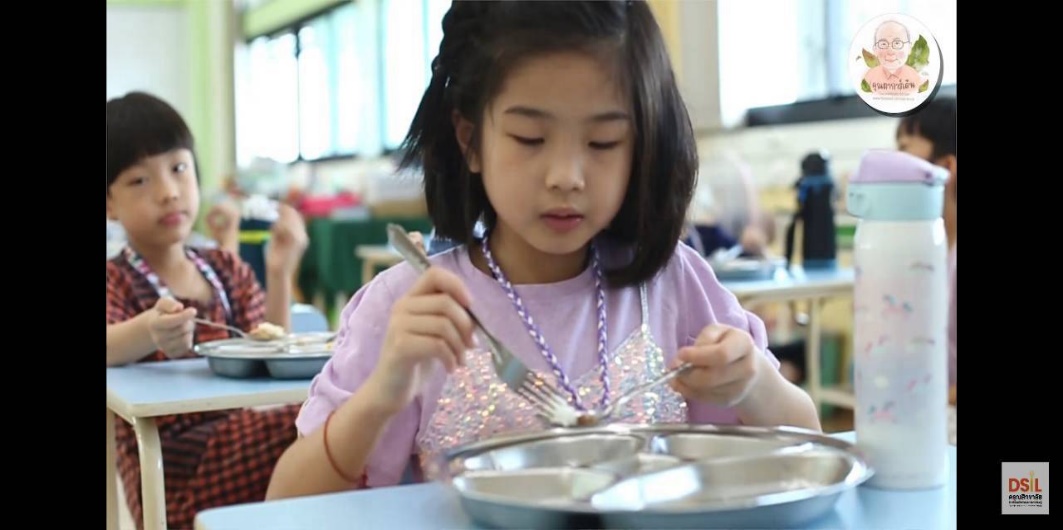
Original school meal consumption and preparation illustrations, retained whole.
2. Related information on our university as a body on providing interventions to target hunger among students and staff.
The supplied evidence documents free surplus-food sharing, examination-period food and drink provision, and campus beverage access. Paid meal options and financial assistance are presented separately, with their original dates, amounts and eligibility conditions.
122.33 kg of surplus food shared in 2025
KMUTT supplied campus waste record documents an arrangement with community market and cafeteria vendors to share safe remaining food without charge after sales. Students and campus workers with limited incomes can collect the food placed in appropriate containers at the participating shops. The institutional record reports 122.33 kg of surplus food shared in 2025. This provides a direct food access measure alongside the scholarships and living cost assistance described in the original evidence. The weight is a food quantity and is not converted into a count of meals or unique recipients.
Surplus-food sharing photograph supplied with the 2025 campus waste record. No separate capture date is assigned.
Food and refreshments during examinations
The original evidence describes food and drink provision for students studying during examinations, including instant noodles, bread and milk. It also contains October 2026 soy milk campaign posters identifying service points at LX and student residential facilities, with participants asked to bring reusable cups. The original photographs and posters are reproduced below. These direct provision examples are distinct from the THB 30 paid meal option at S14 and from general scholarship totals.
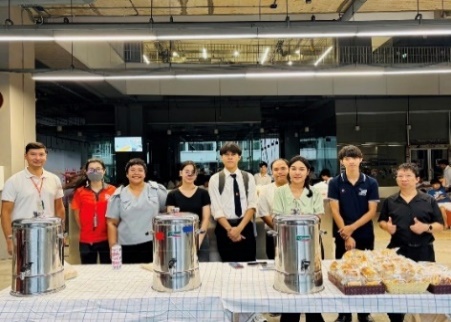
The institutional account describes a lunch programme for students in need, supported by donors who provide lunch funds. During examinations, KMUTT opens buildings so that students can read and prepare for exams. Donor-supported snacks and refreshments include instant noodles, bread, hot milk and other drinks, available to students while they study.
Students studying with refreshments in the institutional record. The photographs do not specify an examination year.
Bring a reusable container for beverage access
KMUTT has distributed soy milk to staff and students who bring their own cups on the 1st floor of the Learning Commons (LX) building.
KMUTT has a free soft drink service point for students who bring their own containers. This is held twice a month throughout the academic year.
Original soy-milk distribution photographs. They are not relabelled as the October 2026 campaign dates.
The narrative describes soft-drink provision twice per month. Separate original notices advertise weekly arrangements; both are retained without assuming that their schedules are identical.
Affordable paid options at S14
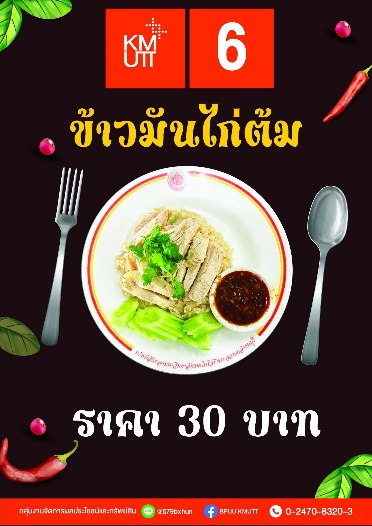
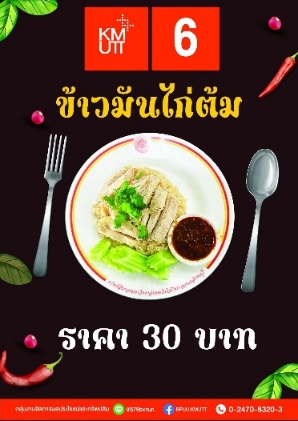
The supplied account describes the “30 Baht Special Menu” at the cafeteria in King Mongkut Memorial Building (S14), intended to ease living expenses for students, staff and visitors in the Bangmod community.
Shop 6
Boiled chicken rice
THB 30
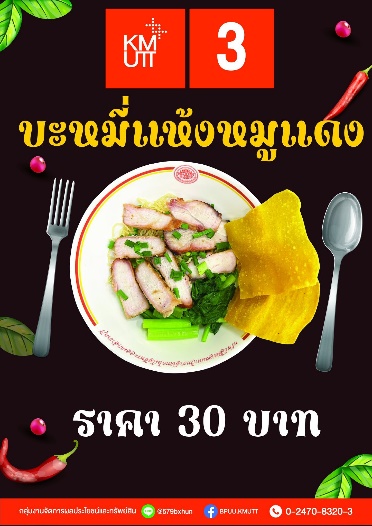
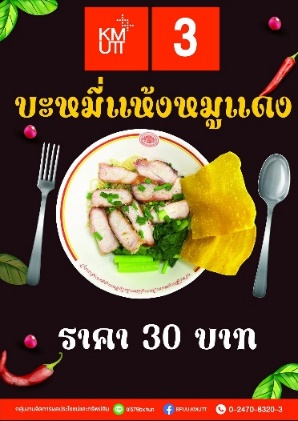
Shop 3
Wonton and barbecued pork noodles
THB 30
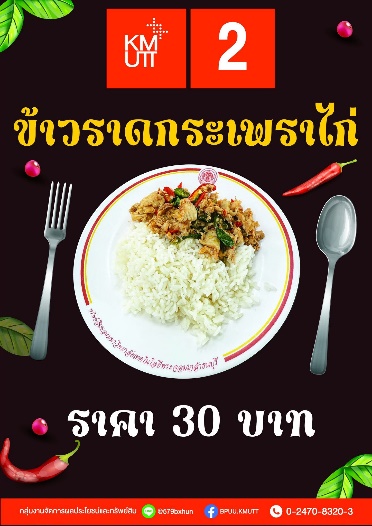
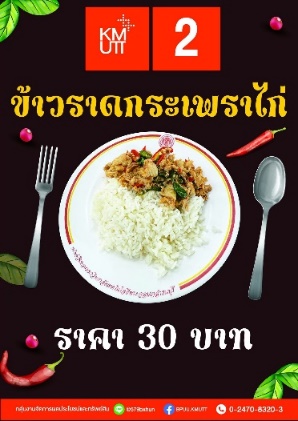
Shop 2
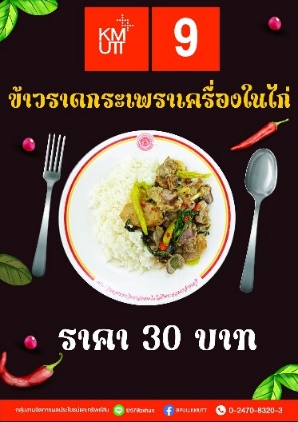
Rice with stir-fried basil chicken
THB 30
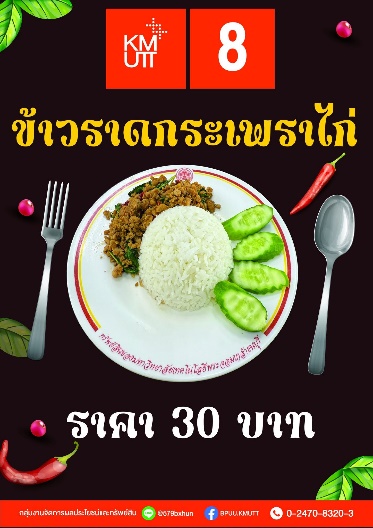
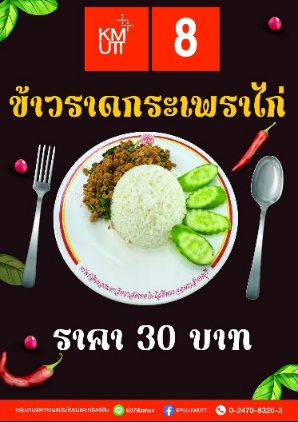
Shop 8
Rice with stir-fried basil chicken
THB 30
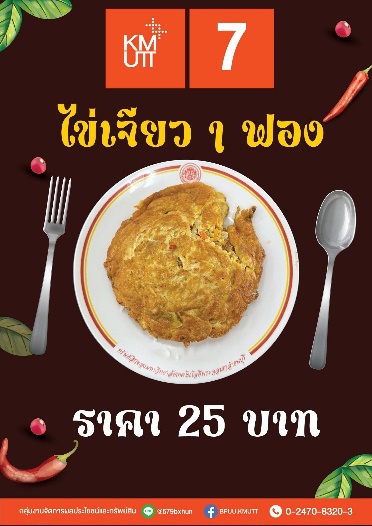
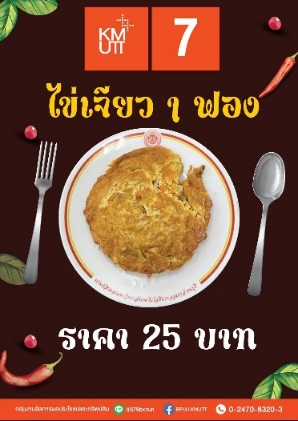
Shop 7
One-egg omelette
THB 25
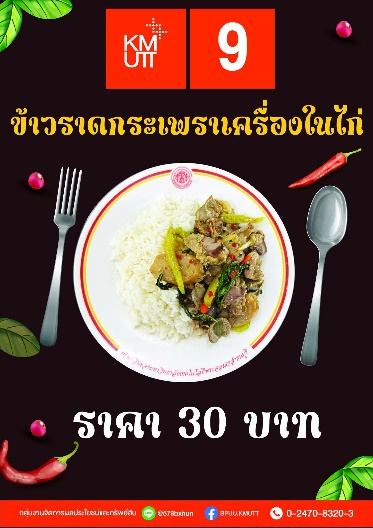
Shop 9
Rice with stir-fried basil chicken offal
THB 30
These are paid menu notices, distinct from free food provision. Five supplied posters display THB 30; the one-egg omelette poster displays THB 25. The shop numbers and prices are transcribed as printed, without treating them as dates or quantities of meals. No service year is printed.
Financial assistance for sudden hardship · 2026
Award amount
THB 5,000–10,000
Per award for an eligible undergraduate.
Frequency
Up to twice
Per academic year, subject to selection.
Application period
Throughout the academic year
Adviser endorsement and hardship evidence are required.
The Ajarn Paiboon Hungsapruek Fund announcement signed on 13 February 2026 accepts applications throughout the academic year from eligible undergraduates facing specified sudden household hardship or serious illness. It offers THB 5,000–10,000 per award, up to twice per academic year. Applicants provide an adviser endorsement and documents demonstrating hardship, followed by an interview and committee consideration through the Student Financial Aid Unit. This financial support can help eligible students meet essential living expenses; it is recorded separately from food distribution.
The supplied evidence dates the signature to 13 February 2026. The announcement title carries B.E. 2568. These award limits are not food-distribution totals or a count of recipients.
Original scholarships, notices and related support evidence
Broader financial-support context
KMUTT supports undergraduate and graduate educational opportunities through general and specific scholarships. The institutional account explains that financial difficulties can hinder education and that support aims to develop talented, capable and ethical graduates. Its four categories are listed below.
Scholarships to develop students' potential
Scholarships to create opportunities and create good, moral people.
Student Welfare Fund
Scholarships for international students
Student support funds
University allocations for students in financial distress whose lack of educational funding affects their studies.
Support for students with disabilities
Support under the Committee for the Promotion of Education for Persons with Disabilities regulations on higher education for persons with disabilities, 2009, to widen educational opportunities and promote equality.
“Raksa Dhamma” project
The original account describes access to university for students from non-formal and informal education, Phrapariyattidhamma School (General Education Department), alternative education equivalent to Mathayom 6, and vocational-certificate programmes in fields specified by the relevant programme.
Disaster-related assistance
Support when students’ families experience fires, floods or storms. The original description excludes incidents affecting life or the body, referring to the student accident-insurance conditions.
COVID-19 tuition assistance
Assistance for hardship caused by COVID-19, including impacts on parents’ income and students’ loss of part-time income.
Company and philanthropic grants
Grants from companies, shops and charitable individuals for students who lack funds and have good academic results and conduct, allocated according to donors’ objectives, either annually or continuously until programme completion.
University educational loans
Loans for KMUTT students’ study expenses during their programme. The university loan must be repaid within three years after student status ends.
Original scholarship allocation record · period not stated
This table combines several financial-support categories, including repayable government loans and non-repayable grants. Its reporting year is not stated in the supplied table. The reported scholarship counts are not treated as unique recipients, meals served or a 2025 hunger-intervention outcome. Blank original cells remain blank.
Scholarship or funding category
Enrolled students (persons)
Reported scholarships (persons)
Amount (THB million)
Undergraduate level
11,640
4,760
141.80
University income-funded scholarships (Education Fund)
1264
7.63
Educational Support Scholarship
1
0.07
Thammaraksa Scholarship
13
1.70
Student Subsidy Scholarship
2
0.05
Siriwiriya Scholarship
6
0.76
10% tuition-fee assistance
0
0.00
Disaster Relief Scholarship
9
0.03
Other emergency assistance for students affected by COVID-19
1,233
5.02
External funding
3,496
134.17
Government student loans
2,546
103.56
External non-repayable grants
260
7.79
Faculty funds and external sources
690
22.82
Graduate level
2,086
412
17.18
University income-funded scholarships (Education Fund)
48
0.20
10% tuition-fee assistance
0
0.00
Other emergency assistance for students affected by COVID-19
48
0.20
External funding
364
16.98
External/faculty-allocated scholarships
364
16.98
Grand total
13,726
5,172
158.98
Petch Phra Chom Klao · undergraduate
King Mongkut’s University of Technology Thonburi (KMUTT) hereby announces the provision of the Petch Phra Chom Klao Scholarship for undergraduate students in the Academic Year 2568 (2025/2026). This scholarship program is established to recognize outstanding academic achievement and to support students in pursuing excellence in education, innovation, and leadership.
Original undergraduate Petch Phra Chom Klao announcement, academic year 2568 (2025/2026), pages 1 and 2.
Rukkaphitthayaphat · graduate
King Mongkut’s University of Technology Thonburi (KMUTT) hereby announces the provision of the Rukkaphitthayaphat Scholarship for master’s degree students in the Academic Year 2568 (2025/2026). This scholarship program is established to support graduate-level education and foster academic excellence, innovation, and professional development among KMUTT students.
Original Rukkaphitthayaphat graduate-scholarship announcement, academic year 2568 (2025/2026), pages 1 and 2.
Doctoral scholarship account and supplied pages
King Mongkut’s University of Technology Thonburi (KMUTT) hereby announces the provision of the Petch Phra Chom Klao Scholarship for doctoral students in the Academic Year 2568 (2025/2026). This scholarship program is established to honor academic excellence and to support advanced research, innovation, and leadership development among KMUTT doctoral candidates.
Original pages supplied beside the doctoral scholarship narrative. Their heading identifies Rukkaphitthayaphat graduate scholarships, academic year 2568 (2025/2026).
The doctoral narrative names Petch Phra Chom Klao, while these supplied pages are headed Rukkaphitthayaphat. Both are retained without assuming that the names identify the same notice.
Ajarn Paiboon emergency-fund background
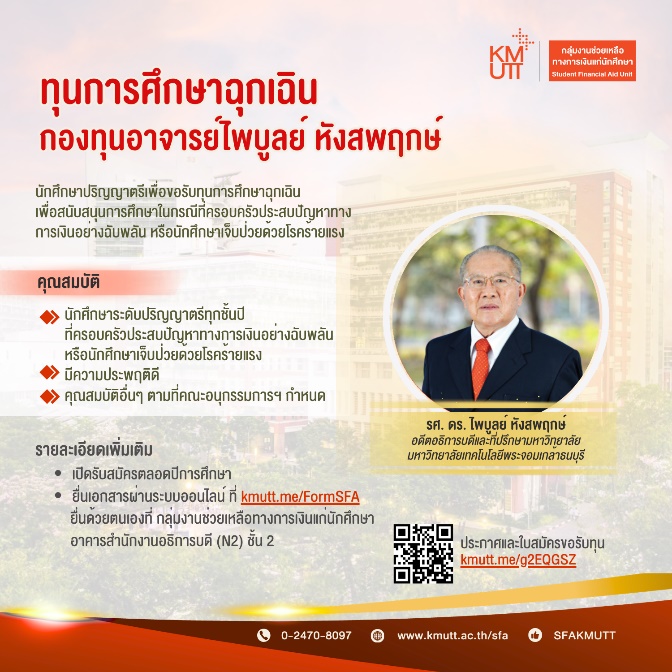
In honor of the vision and dedication of Assoc. Prof. Dr. Paiboon Hangsapruek, former President and Advisor of King Mongkut’s University of Technology Thonburi (KMUTT), who placed great importance on advancing education and supporting students, the university has established the Ajarn Paiboon Hangsapruek Fund. This emergency scholarship is intended to assist students facing sudden crises or financial difficulties, ensuring that such obstacles do not hinder their education. The fund reflects KMUTT commitment to enabling students to continue their studies and graduate as capable, high-quality professionals.
Original emergency-scholarship poster for the Ajarn Paiboon Fund. Its eligibility and application information are retained whole.
Disaster Relief Scholarship · Round 1/2026
To alleviate hardship and safeguard student welfare, King Mongkut’s University of Technology Thonburi (KMUTT), through the Office of Student Financial Aid, has awarded the “Disaster Relief Scholarship, Round 1, Academic Year 2569 (2026)”.
The scholarships, valued at 5,000 Baht each, were graciously presented by Prof. Dr. Chaowalit Limmaniwitjit, in recognition of the university’s commitment to supporting students affected by crises. This initiative aims to provide immediate assistance and encouragement, ensuring that students can continue their studies with resilience and hope.
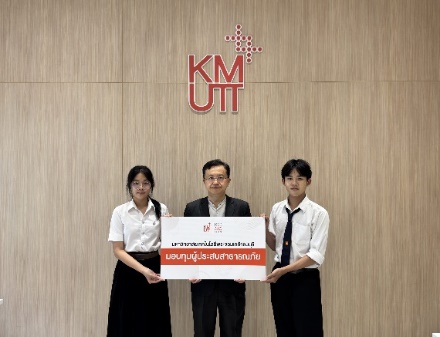
Original disaster-relief presentation photographs supplied with the Round 1/2026 account.
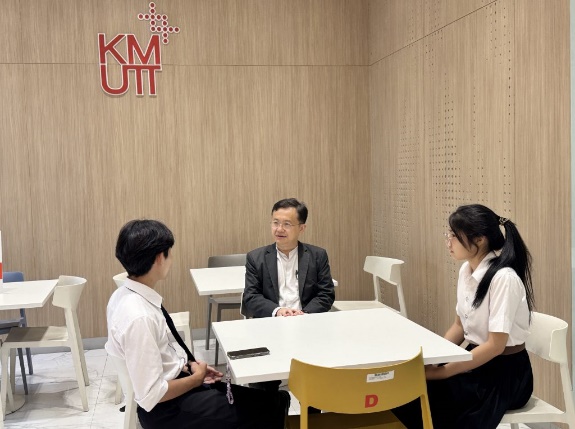
Additional original disaster-relief photographs; THB 5,000 per scholarship is not multiplied into an invented recipient total.
Additional lunch-support and examination-period evidence
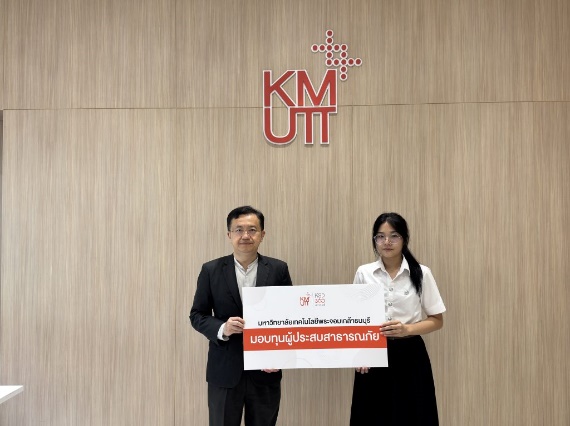
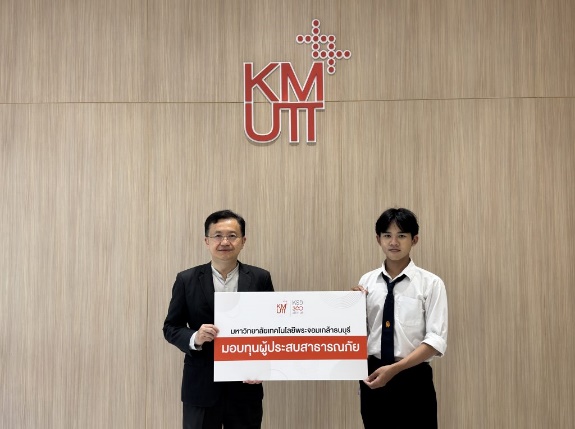
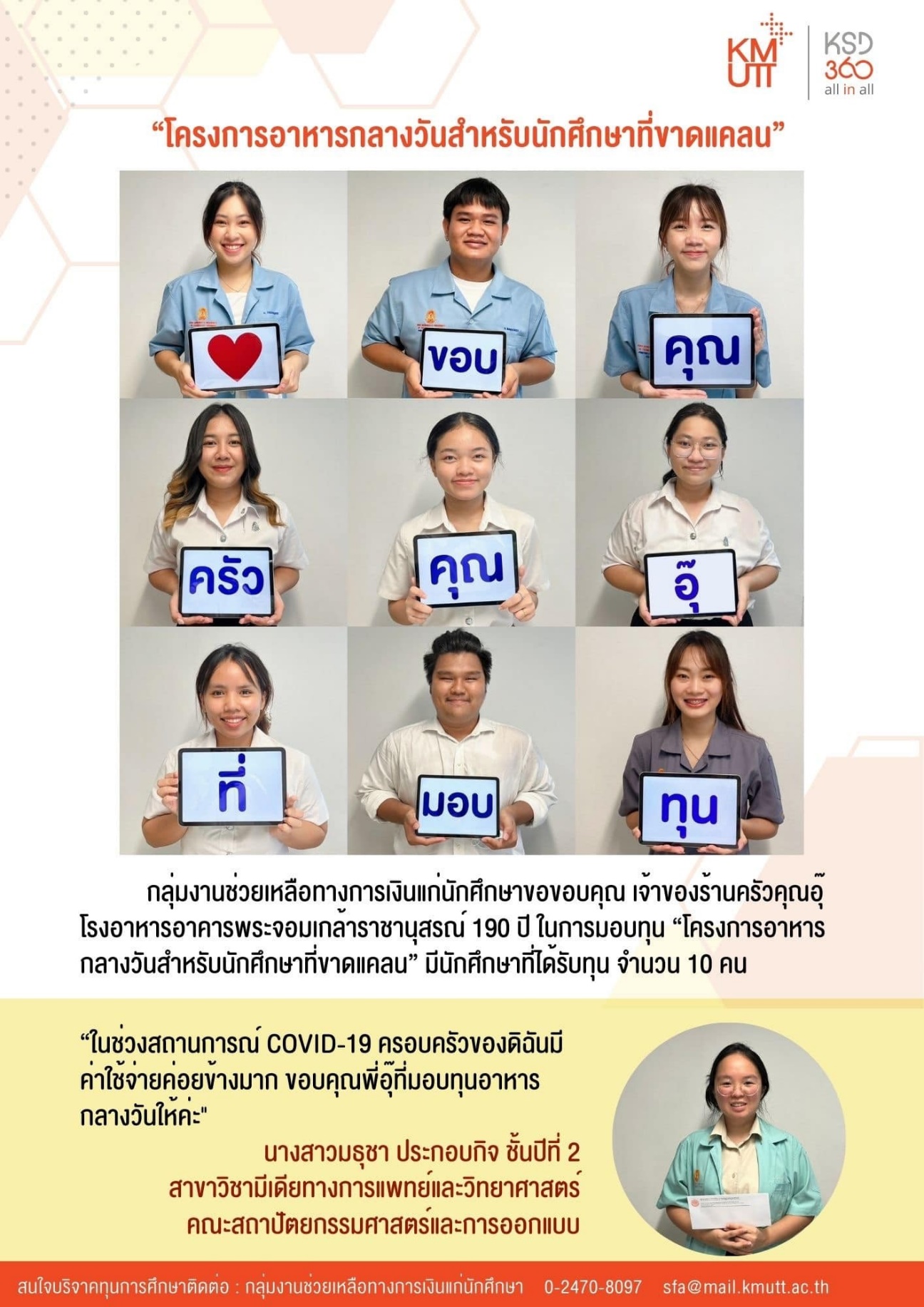
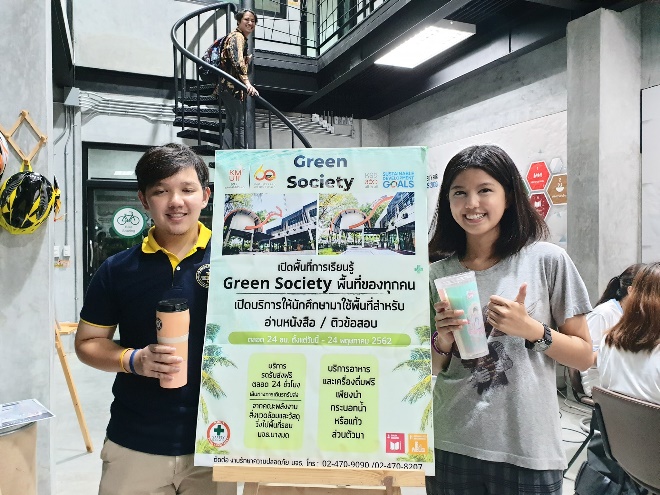
Original donor-supported lunch-project poster. It explicitly refers to COVID-19 and 10 students; that historical statement is not relabelled as a new 2025 or 2026 beneficiary count.Original Green Society examination-support photograph and notice. Small background text is not reconstructed.
Original study-period drink photographs.
Original milk-distribution photograph in the examination-support record.
Support beyond KMUTT · KMITL, 2 October 2026
On October 2, 2026, faculty members and students from the KMUTT Volunteer Ants Team visited King Mongkut’s Institute of Technology Ladkrabang (KMITL) to deliver encouragement and support to those affected by the recent flooding.
The team brought food, beverages, and essential supplies generously donated by members of the KMUTT community and the public, to help ease immediate hardship. The items were formally received by Assoc. Prof. Dr. Khomsan Maleesee, President of KMITL, and Asst. Prof. Thitipan Tritrakan, Vice President for Student Affairs and Alumni Relations.
KMUTT Volunteer Ants sincerely thank all donors for their kindness and generosity. Your goodwill is a vital force in alleviating suffering and strengthening the spirit of unity, helping us overcome this crisis together.
Original KMUTT Volunteer Ants flood-support artwork, retained whole.
Donated food and supplies in the original KMITL flood-support account.
Handling donated supplies in the original external flood-support account.
This is support delivered to KMITL in 2026, not a count of food distributed to KMUTT students in 2025.
Flood-relief applications for affected students
In light of the recent flash floods, river overflows, and coastal surges affecting many areas and families, King Mongkut’s University of Technology Thonburi (KMUTT) extends its heartfelt concern and encouragement to all those impacted. We sincerely wish for everyone’s safety and for the situation to return to normal as swiftly as possible.
For KMUTT students whose families reside in flood-affected areas and have suffered damage, the university has established a special “Flood Relief Scholarship” to help alleviate hardship. Eligible students may apply through the Student Information System and submit the required supporting documents.
Original flood-relief notices. The first refers to Nan flooding from 19 August 2569 (2026); the second is undated. Preserve the Student Information System and supporting-document route.
Original beverage campaign notices
Original October 2026 soy-milk notices: bring a cup or heat-resistant container. Dates and campus locations are transcribed below.
Advertised location
2026 dates
Time
Bang Khun Tian · beneath Dormitory 1
6–9 and 12, 14–15 October 2026
From 17:00
Ratchaburi Residential College · beneath Dormitory 1
16 and 19–22 October 2026
From 17:00
Bang Mod · Learning Commons, LX floor 1
6–9 and 12, 14–15 October 2026
From 17:00
Original undated Eco Cup’ture notices. The left advertises Wednesdays at 12:00, Student Affairs, 190-Year Building (S14); the right advertises Monday, Tuesday, Thursday and Friday. These weekly notices remain separate from the twice-monthly narrative.
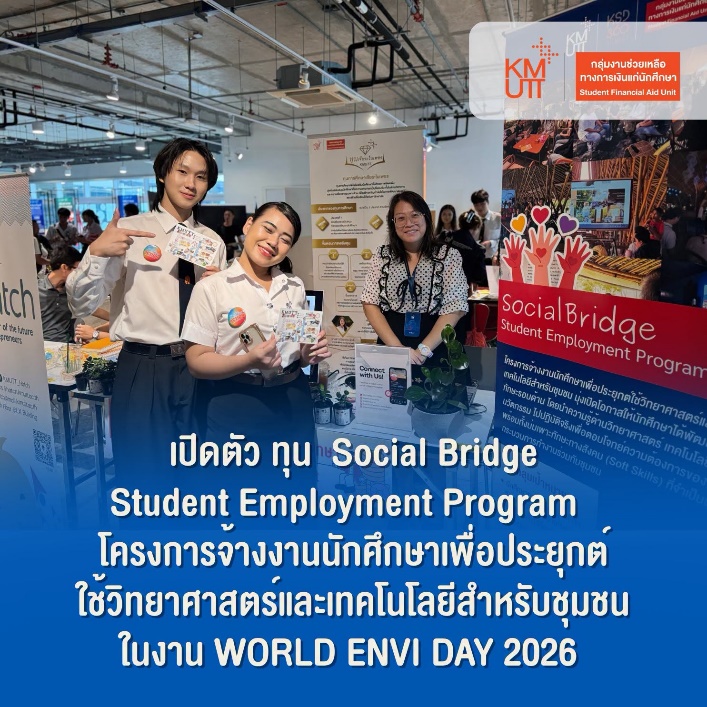
Social Bridge student employment · 5 June 2026
On Friday, June 5, 2026, the Office of Student Financial Aid at King Mongkut’s University of Technology Thonburi (KMUTT) participated in the exhibition and activities of WORLD ENVI DAY 2026 at the LX Building, 3rd Floor. A highlight of the event was the official launch of the Social Bridge: Student Employment Program, designed to engage students in applying science and technology for the benefit of local communities. The program attracted significant interest from students and various organizations.
This initiative emphasizes holistic skill development beyond the classroom by enabling students to apply scientific knowledge, technology, and innovation in real-world contexts to address community challenges. At the same time, it cultivates essential soft skills through collaborative work with communities, while providing students with supplementary income under a structured employment system.
Original Social Bridge launch illustration at WORLD ENVI DAY 2026. Supplementary student income and skills are distinct from direct food distribution.
Original paid-menu posters
Original shop 6, 3 and 2 menu posters. Each displays THB 30; they are paid options.
Original shop 8, 7 and 9 posters. The middle poster specifies one-egg omelette at THB 25; the others show THB 30.
Scholarship support for border-conflict hardship
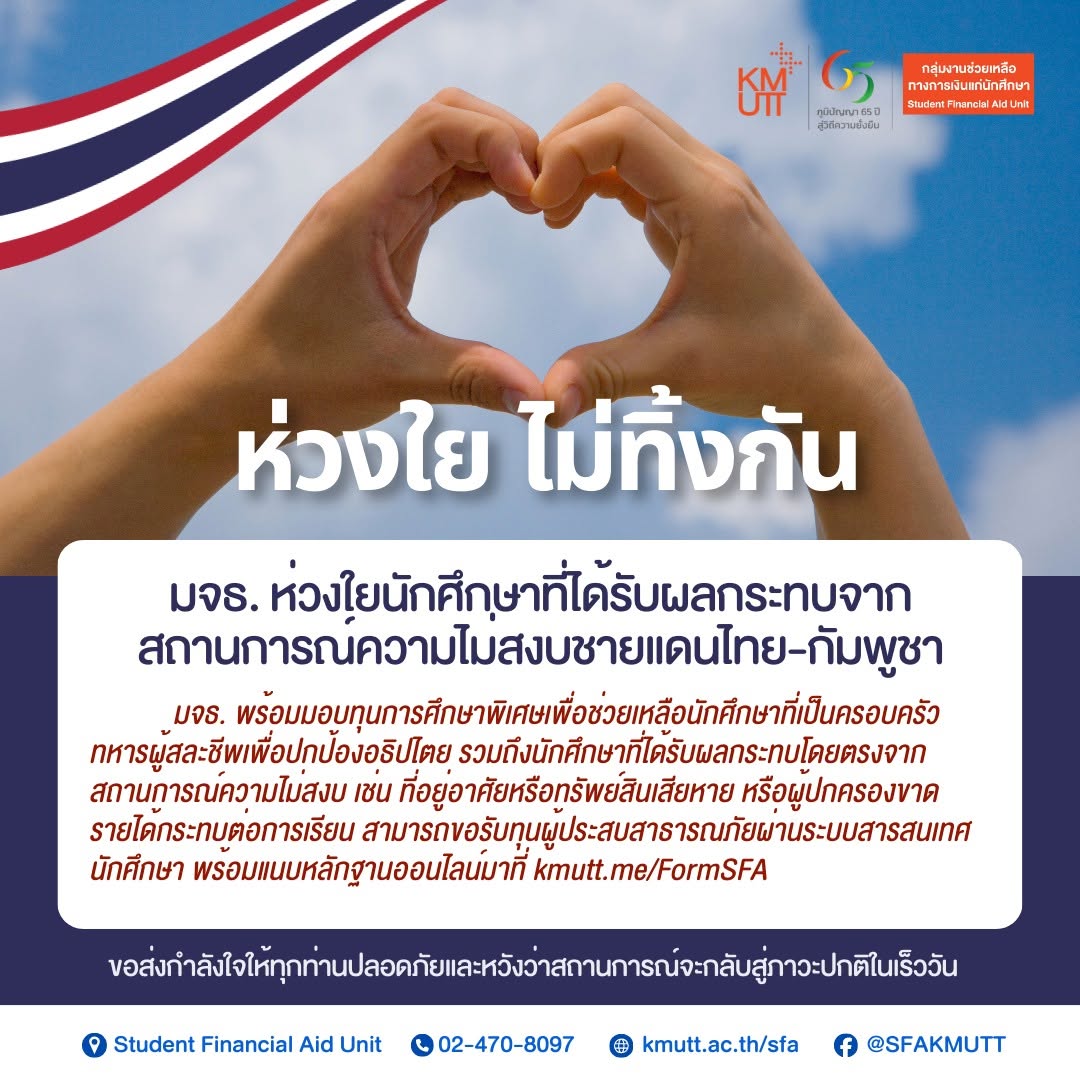
King Mongkut’s University of Technology Thonburi (KMUTT) expresses its deep concern for students impacted by the ongoing unrest along the Thai–Cambodian border. To provide assistance, the university has established a special scholarship program for:
Students from military families who have lost loved ones in the defense of national sovereignty.
Students whose families have been directly affected, such as through damage to housing or property.
Students whose parents have lost income, resulting in financial hardship that affects their education.
Original Thai–Cambodian border-conflict support notice. No date or number of recipients is inferred.
Khun Ta Garden · school food and learning context
Khun Ta Garden was established during the COVID-19 pandemic in 2020 by the President, Khun Paron Israsena Na Ayudhya, who envisioned Thai children learning to think critically, gaining practical skills, and growing into global citizens with agriculture serving as a tool to help shape and refine the students. Applying the principles of the "Sufficiency Economy" a philosophy championed by the King we have utilized the rooftop space to establish a small-scale agricultural plot, with the goal of creating a sustainable source of safe, wholesome food for our students, teachers, and staff. at Khun Ta Garden, a variety of crops are grown including salad greens, sweet basil, holy basil, sweet potatoes, melons, cucumbers, and water spinach alongside the raising of catfish. The produce harvested is then used for preparing meals. Vegetable scraps from food preparation and leftover food waste amounting to 5 kilograms per day are repurposed to create compost and organic liquid fertilizer for soil enrichment. Teachers and students work together to cultivate crops, provide care, conduct experiments, and study soil preparation and seed germination. Furthermore, agricultural technology has been integrated through a "Smart Farm" system, which regulates irrigation, temperature, and humidity to ensure optimal growing conditions.
The garden’s founding in 2020 and 5 kg/day reuse statement concern the school’s food-and-learning account. They are not extrapolated into a university-wide 2025 annual result or counted as hunger-intervention recipients.
Original rooftop cultivation at Darunsikkhalai School for Innovative Learning.
Original wide school-garden learning illustrations, retained with their framing and logos.
Crops and growing containers in the original school record.
Harvested vegetables and composting equipment in the original school record.
Original teaching and group-learning illustrations, retained whole.
Original school meal consumption and preparation illustrations, retained whole.
Sources and evidence links
Supplied KMUTT evidence for 2.2.1 Campus food waste tracking: 2025 surplus food sharing account and photographs.
Supplied KMUTT evidence for 2.3.2: examination-period food provision, October 2026 soy milk posters, campus food options and original student-support records.
— Other Cash Assistance for Students Affected by COVID-19
1,233
5.02
External Funding Sources
3,496
134.17
— Government Scholarships
2,546
103.56
— Private Sector Scholarships
260
7.79
— Faculty Funds & External Donors
690
22.82
Graduate Level
2,086
412
17.18
Internal Income Fund (Education Fund)
48
0.20
— Tuition Fee Reduction 10%
0
0.00
— Other Cash Assistance for Students Affected by COVID-19
48
0.20
External Sources / Faculty Allocation
364
16.98
Grand Total
13,726
5,172
158.98
3. Related information on our university as a body on providing sustainable food choices for all on campus, including vegetarian and vegan food.
The supplied evidence describes vegetarian food, healthy menu choices, seasonal produce and local sourcing at campus dining points, together with reusable-container incentives and flexible portions intended to reduce waste. The original opening paragraph explicitly refers to the 2021 service position; that date remains unchanged. The dated 2025–2026 activities below add evidence of continued work on the environmental and nutritional quality of campus food provision.
Food choices, local ingredients and portions
KMUTT began promoting healthy food and a safe university food system in 2010, with rules for selecting restaurants. The original 2021 service account describes healthy and vegetarian choices made from local and domestic ingredients in all four KMUTT canteens. It also describes pork-free options for Muslim students and personnel, and portions in sizes S, M, L and XL so that consumers can choose amounts suited to their needs and reduce food waste.
The supplied account describes campus food-distribution points offering vegetarian, healthy and other food choices for students and personnel, suited to different diets. Ingredients include seasonal plants, vegetables and fruits, purchased from local farmers.
Dietary options
Vegetarian and healthy selections are described in the institutional record; the original canteen-wide statement refers to 2021.
Seasonal and local ingredients
Seasonal plants, vegetables and fruit, with ingredients purchased from local farmers.
Portion choice
S, M, L and XL in the original account; intended to match consumer needs and reduce waste.
Container reuse
Discounts for bringing personal food containers, according to participating-stall conditions.
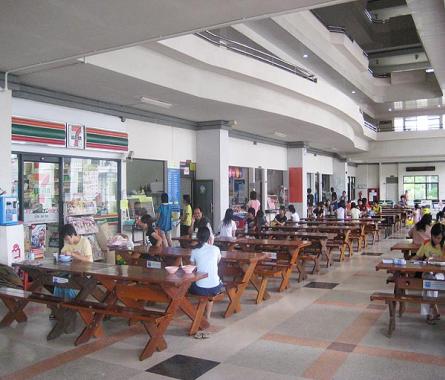
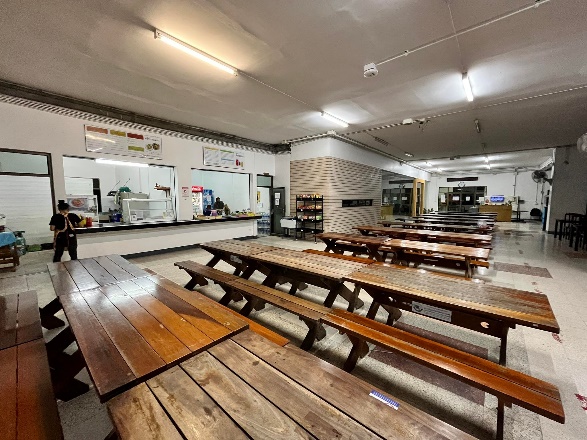
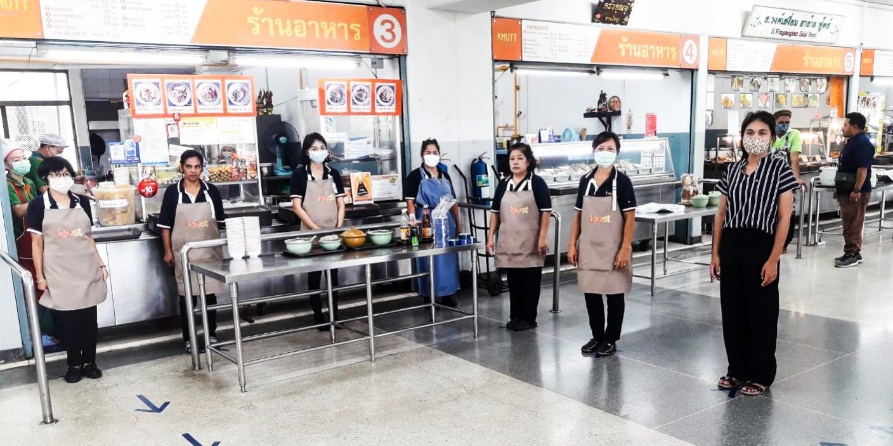
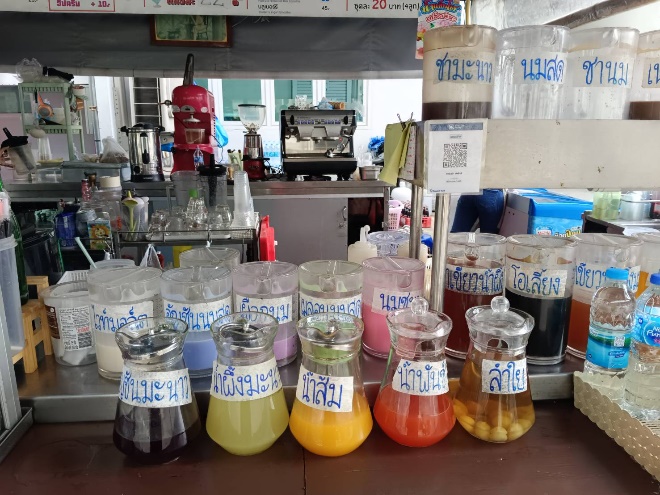
Original campus food-service and dining photographs. They are illustrative; no new capture date or universal vegan status is assigned.
Vegetarian-focused menu examples in the record
Salads
Vegetarian grilled-tofu salad
Vegetable salad rolls
THB 59
Main dishes
King oyster mushroom fried rice
Vegetarian creamy tom yum noodles
Spaghetti with pumpkin and spinach
Vegetarian pasta with grilled vegetables
Stir-fried water spinach
THB 39
Soups
White-bean soup
Shiitake-mushroom wonton soup
Vegetable soup
THB 59
Drinks
Thai herbal drink
Roselle drink
Pandan drink
Lemongrass drink
Mixed fruit smoothie
Pineapple smoothie
Carrot smoothie
Orange smoothie
THB 19
Prices are those printed on the supplied undated menu, per listed item in its category. “Vegetarian” is not treated as a guarantee that every dish is vegan; ingredients and availability at every outlet are not established by these examples.
Food-vendor training · 21 February 2026
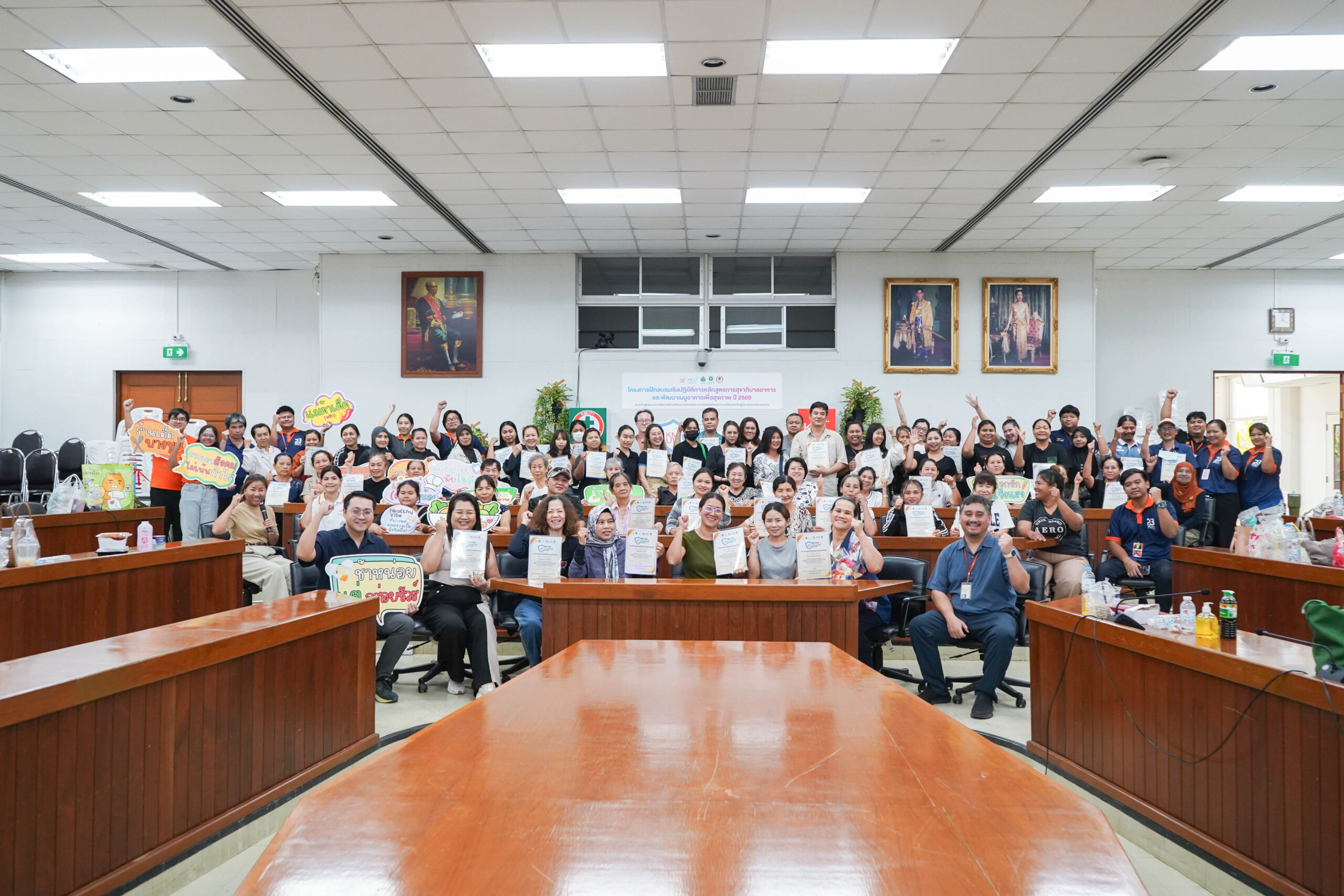
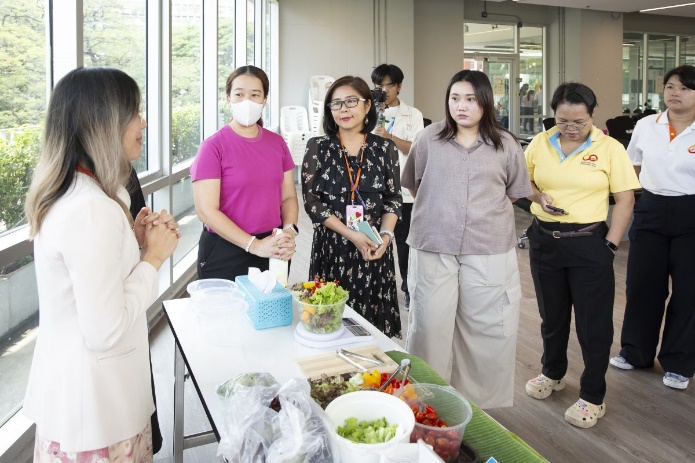
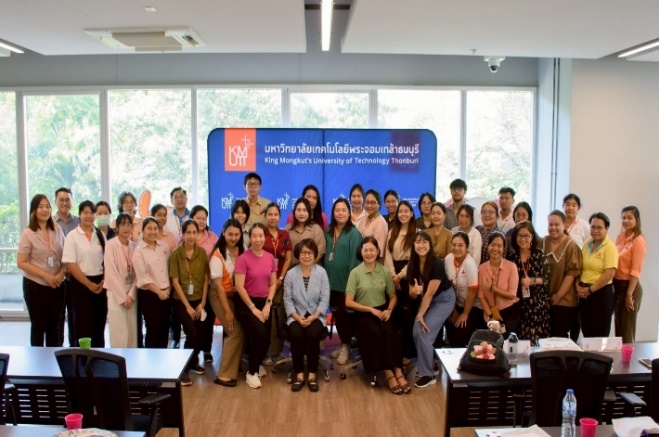
On 21 February 2026, the EESH Center and Health Care Unit organised food sanitation, healthy menu development and sustainable operations training for food vendors at Classroom Building 2, Bangmod. Department of Health specialists addressed food handling standards, personal hygiene and healthy canteen menus. The afternoon sessions used demonstrations and practical learning on energy efficiency, food waste management and hygiene. These operational measures complement the food choices described in the original record by addressing how campus catering is prepared and managed.
Food handling and menu quality
Department of Health specialists addressed food-handling standards, personal hygiene and healthy canteen menus.
Sustainable catering operations
Demonstrations and practical learning addressed energy efficiency, food-waste management and hygiene.
Food-vendor sanitation and sustainability training, Classroom Building 2, KMUTT Bangmod, 21 February 2026. Supplied source: KMUTT EESH.
Learning to choose balanced food · 2025
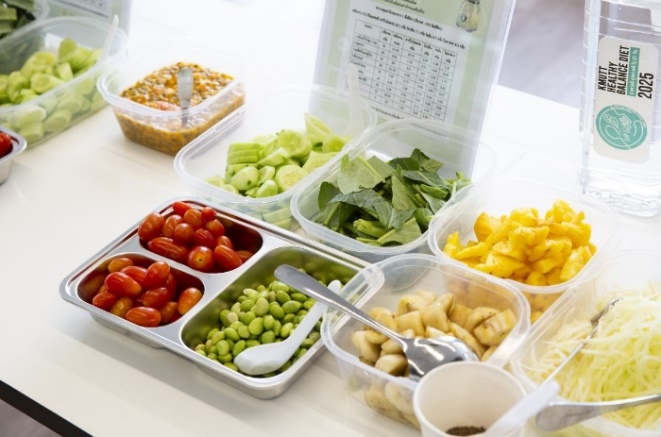
The Health Care Unit launched “KMUTT Healthy Balance Diet 2025: Eat Well, Stay Healthy in 21 Days” on 6 May 2025 at the Self-Learning Room, LX Building. The activity attracted 46 staff members from university departments who signed up to participate. It supports informed food choices; the participant count is not a count of vegetarian or vegan meals sold.
Programme launch
6 May 2025
Self-Learning Room, LX Building.
Participants
46 staff
University staff who signed up; not a meal-sales or student count.
Challenge period
21 days
“Eat Well, Stay Healthy in 21 Days”.
The goal of this initiative is to promote knowledge and understanding of proper nutritional practices, encouraging staff to adopt balanced eating behaviors as role models for healthy living. The program featured expert speakers from the Balanced Diet for Health Project of the Thai Health Promotion Foundation (ThaiHealth), who delivered insightful talks on topics such as “The Secret Code of the Healthy Plate and Food Exchange Groups (Cut Sugar, Fat, Salt, and Boost Fruit & Vegetable Intake)” and “Reading Nutrition Labels for Smarter Eating.”
Participants also engaged in various skill-building activities, including workshops on reducing salt and sugar intake, making “5 Food Groups in 1 Glass” drinks, vegetable weighing games, practicing plate portioning based on the 2:1:1 principle, and quiz competitions with prizes. The activity aligns with Sustainable Development Goal (SDG) 3, focusing on good health and well-being. The “KMUTT Healthy Balance Diet 2025” challenge is one of KMUTT key initiatives, reflecting the university’s commitment to comprehensive staff wellness and the promotion of a sustainable culture of good health.’
Practical food-selection and plate-portioning activities in the Healthy Balance Diet 2025 record.
Plant-based beverage access and container reuse
The supplied institutional food support evidence includes October 2026 posters advertising free soy milk for participants bringing their own cups, with locations at LX and student residential facilities. This is a plant based beverage option combined with container reuse. The posters establish the advertised offering and conditions, rather than comprehensive vegan menu availability at every campus outlet.
Original October 2026 soy-milk notices cited from the supplied 2.3.1 record. Bring a cup or heat-resistant container. These are advertised offerings, not evidence of vegan menus at every outlet.
Bring a food container: participating-stall incentives
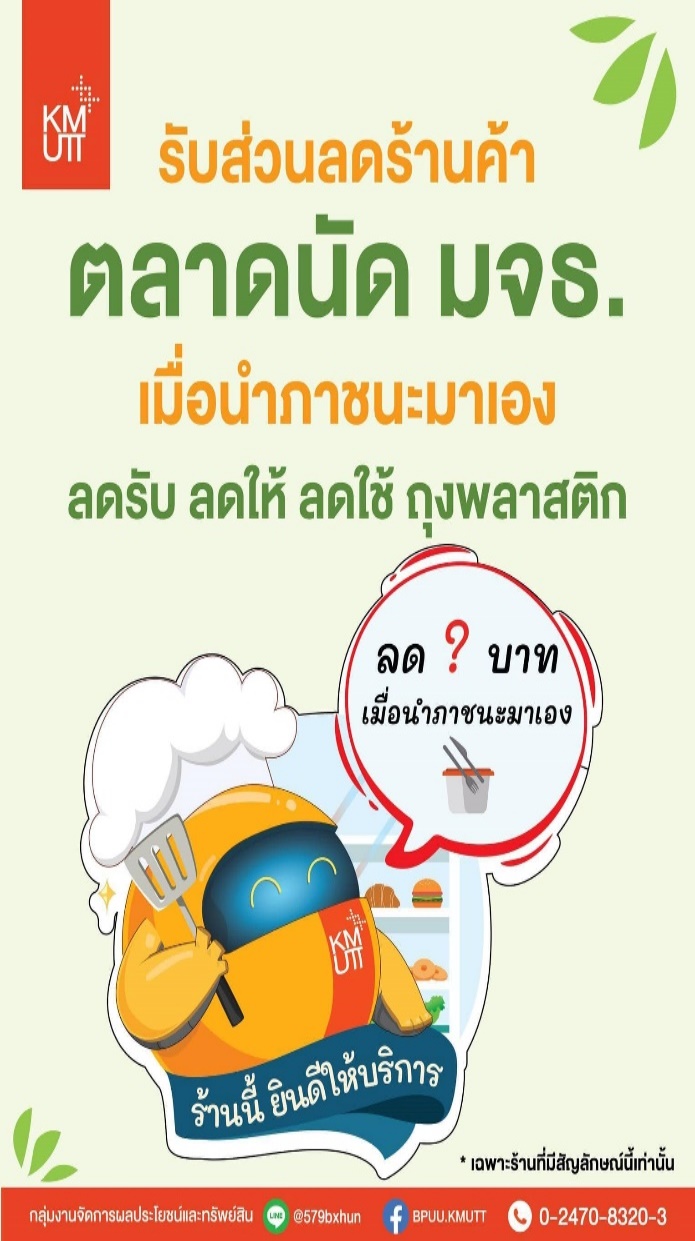
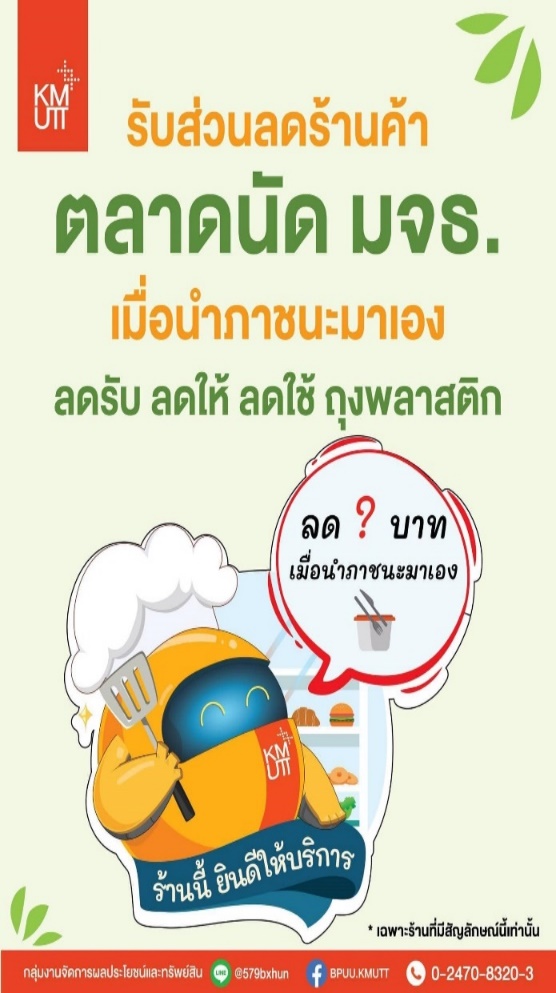
KMUTT has a campaign to encourage people to bring their own food containers to receive discounts on food and to reduce plastic use.
The original market poster limits the offer to stalls displaying the sign. It prints a question mark in the discount-amount field, so no fixed baht reduction is asserted.
Personal food containers in the original campus reuse campaign photographs.
Additional menus, locations and original campaign evidence
Mixed-menu examples, separate from vegetarian listings
Salads
Japanese salad
Caesar salad
Tuna salad
Tender chicken salad
THB 59
Main dishes
Stir-fried mixed vegetables
Stir-fried bean sprouts with tofu
Stir-fried pumpkin
Stir-fried sponge gourd with egg
THB 39
Soups
Onion soup
Mild soup with tofu and minced pork
Braised pork soup
Sour curry with snakehead fish and mixed vegetables
Pork-rib soup with ginger
THB 59
Drinks
Thai herbal drink
Roselle drink
Pandan drink
Lemongrass drink
Mixed fruit smoothie
Pineapple smoothie
Carrot smoothie
Orange smoothie
THB 19
This menu explicitly includes tuna, chicken, pork, fish and egg dishes. It is retained as mixed-menu context and is not presented as a vegan menu.
Original mixed-dish photographs from the institutional record.
Additional dining and market photographs
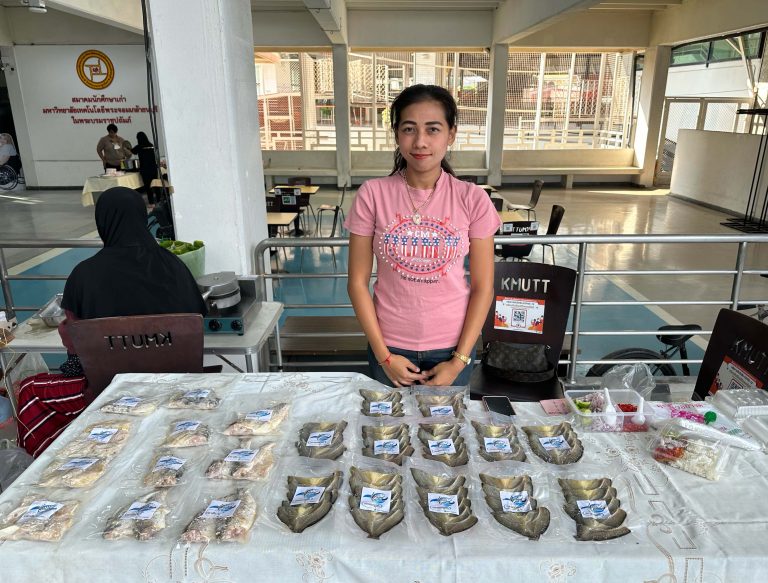
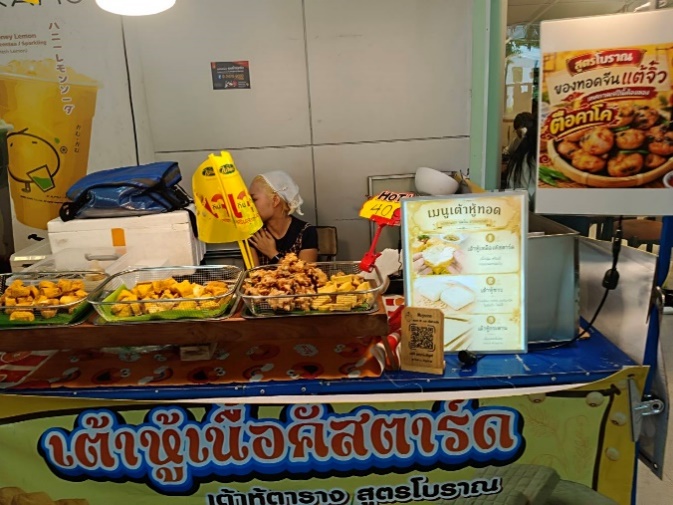
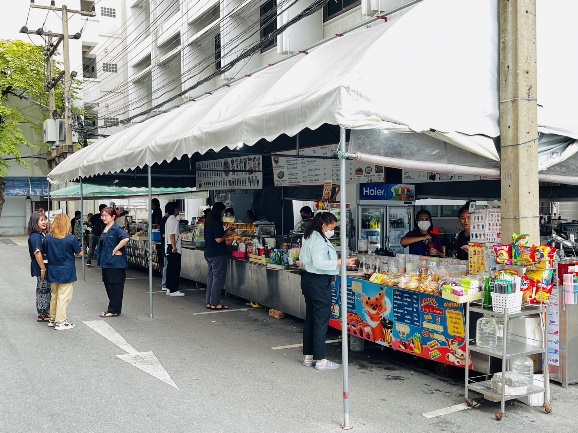
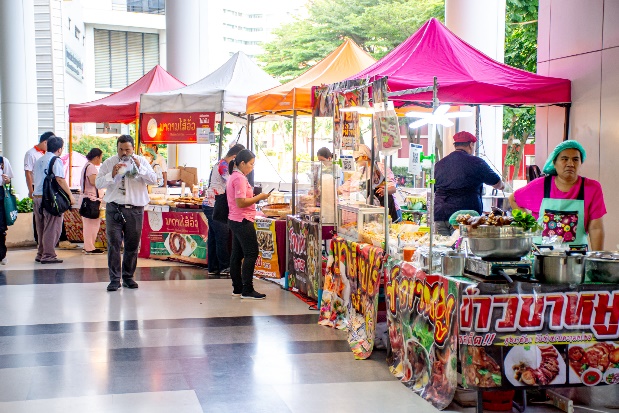
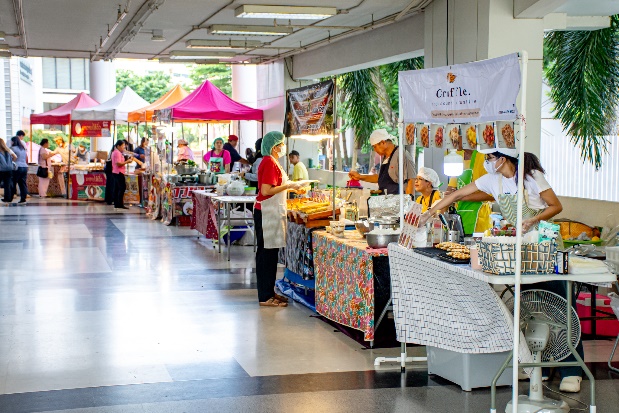
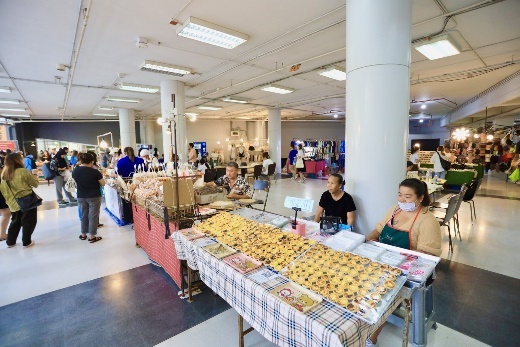
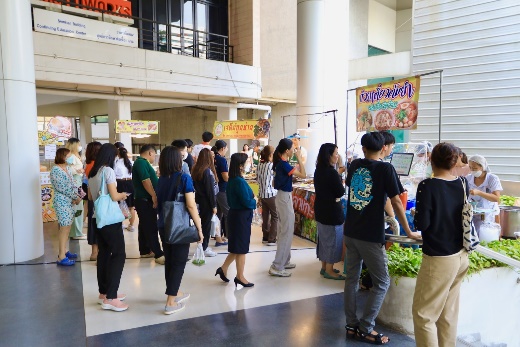
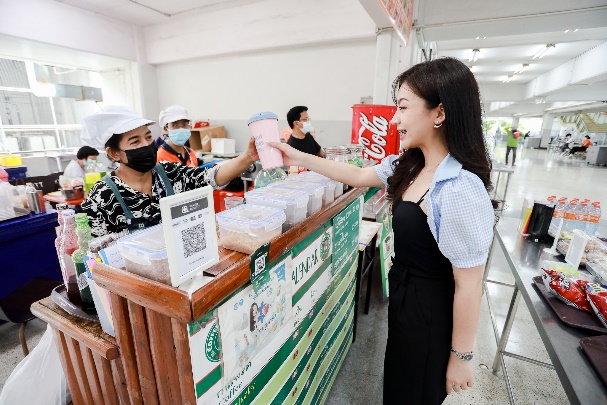
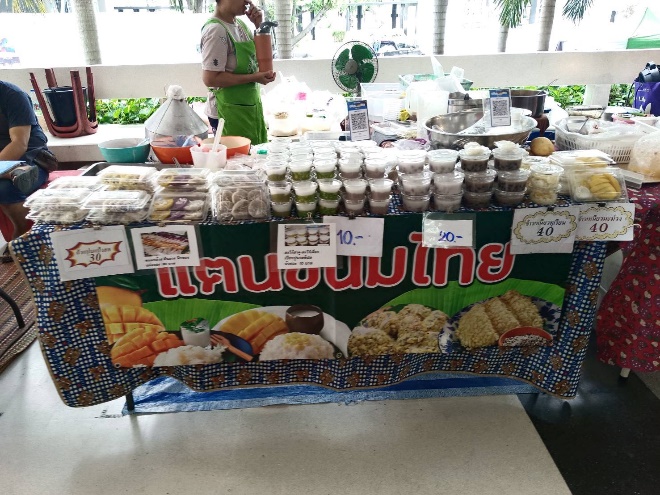
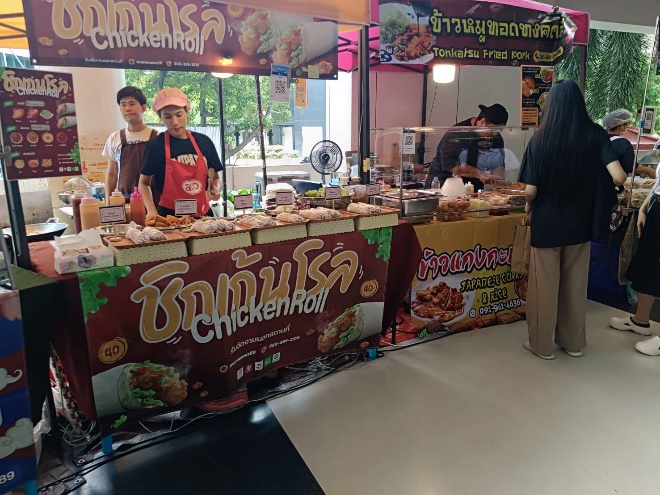
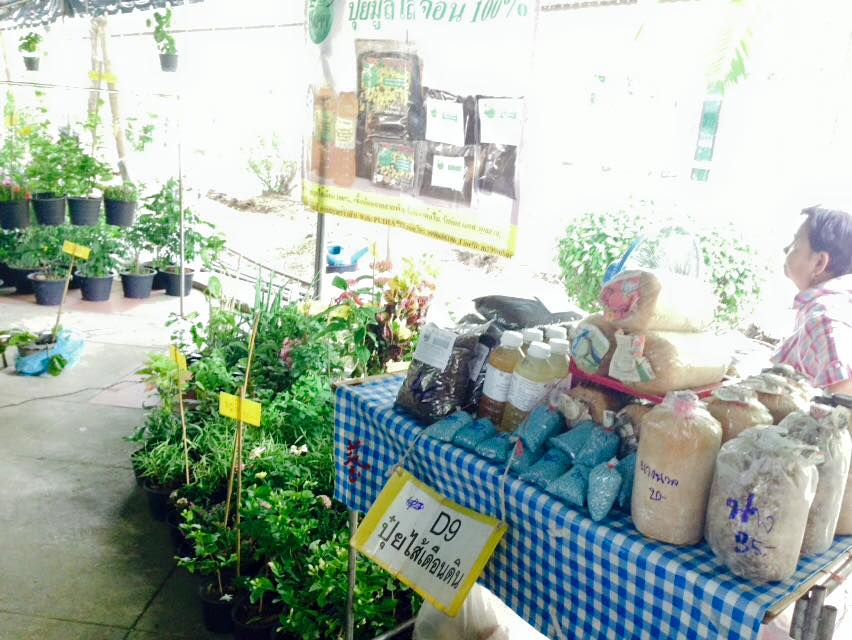
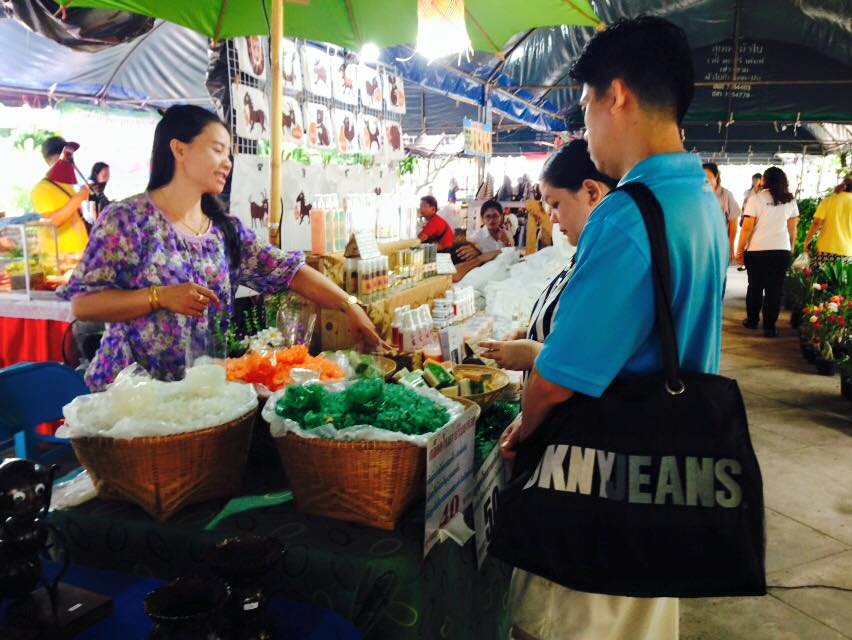
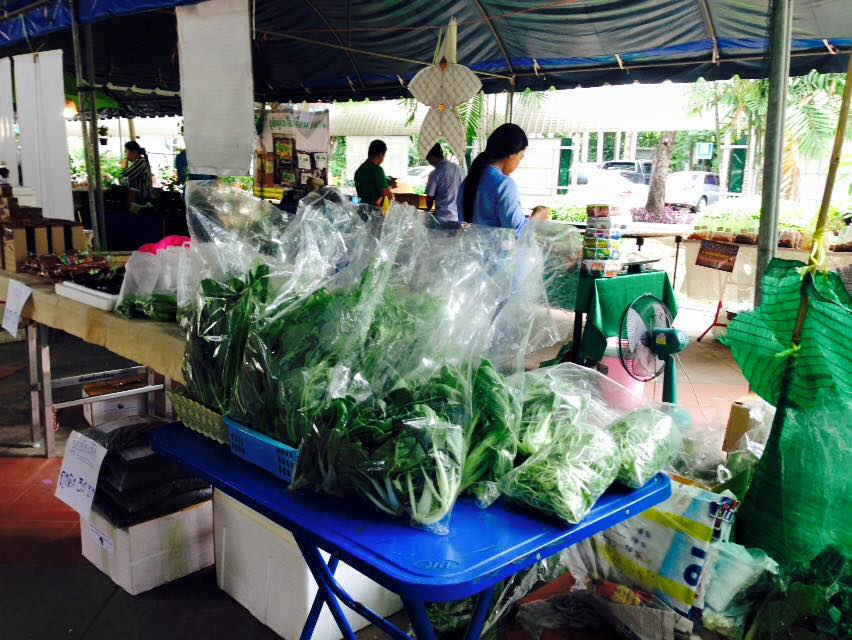
Original campus-market food stalls.
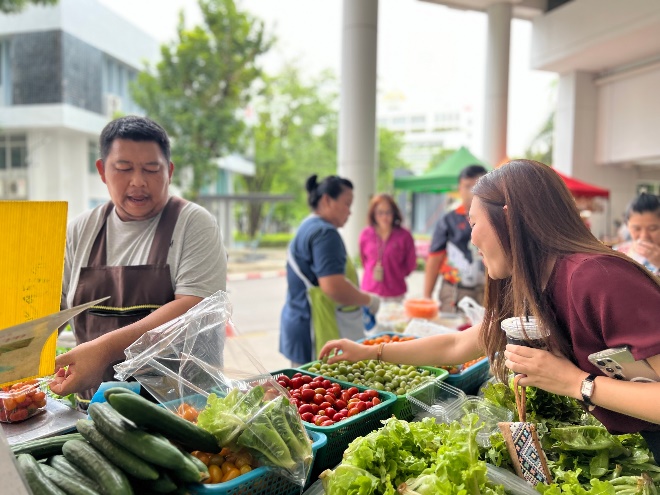
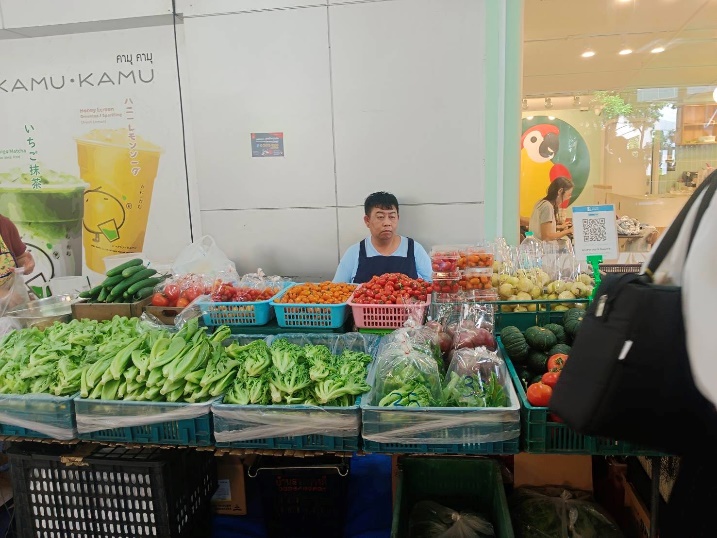
Original food and fresh-produce vendors.
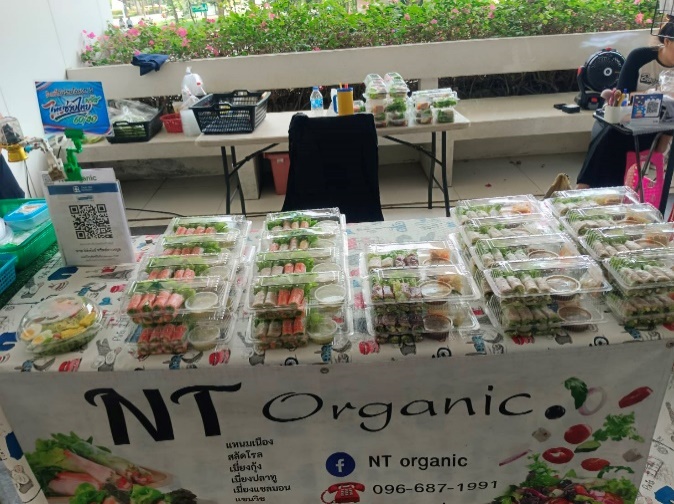
Original organic-produce and prepared-food stalls. Photograph dates are not specified.
Food-service points described in the original record
CB1 courtyard
The original record identifies a food kiosk in the CB1 courtyard.
Dormitory dining
The source labels female- and male-dormitory dining facilities.
190th Anniversary Building
The source identifies a canteen at the 190th Anniversary Building.
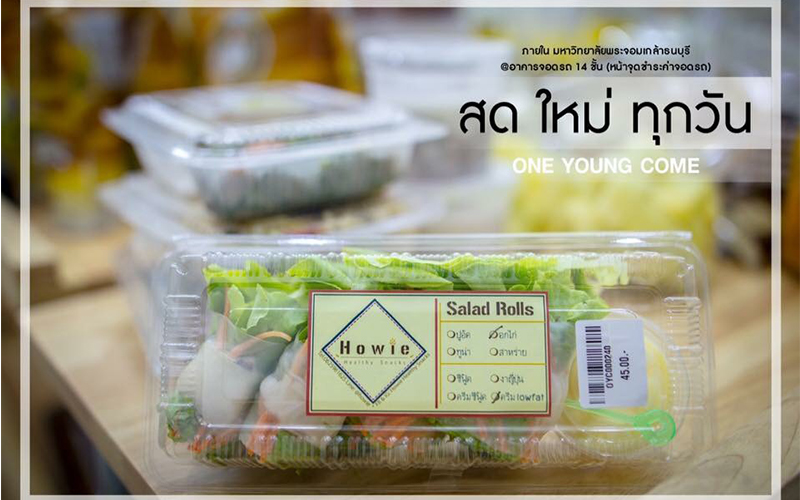
“One Young Come”
The restaurant name is retained as supplied. The account places it on the ground floor of the 14-storey parking building and describes an option for health-conscious consumers and vegetarians.
Original produce-purchasing and outdoor-kiosk photographs. The photographs are not used to identify every named restaurant.
Original dining-facility photographs associated with the source’s dormitory labels.
Original canteen photograph associated with the 190th Anniversary Building caption.
Market access and late-hour food provision
The supplied record describes a travelling campus market on Wednesdays and Thursdays, offering food and other supplies on the ground floor of the 14-storey parking building.
Original market stalls shown in the institutional record.
Additional original campus-market photographs.
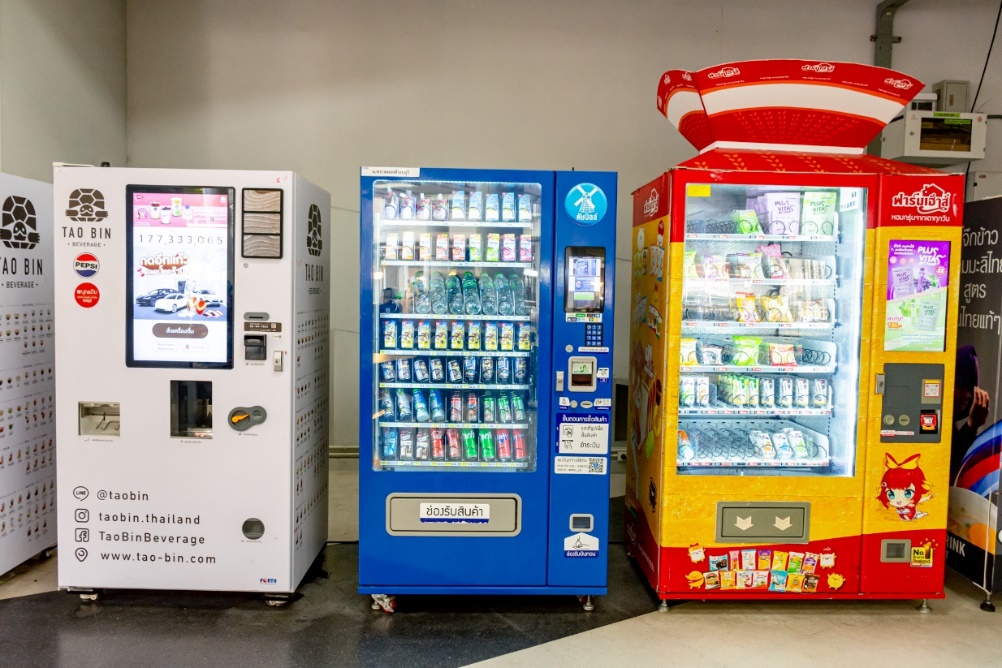
The source reports drinking-water dispensers and 16 automated food-service units available 24 hours a day across the university for students and staff, including those working late or studying for examinations.
Original photograph of automated food and beverage vending machines. The supplied count of 16 and 24-hour service statement are not a new site inventory or evidence that every machine stocks vegetarian or vegan food.
Additional Healthy Balance Diet photographs
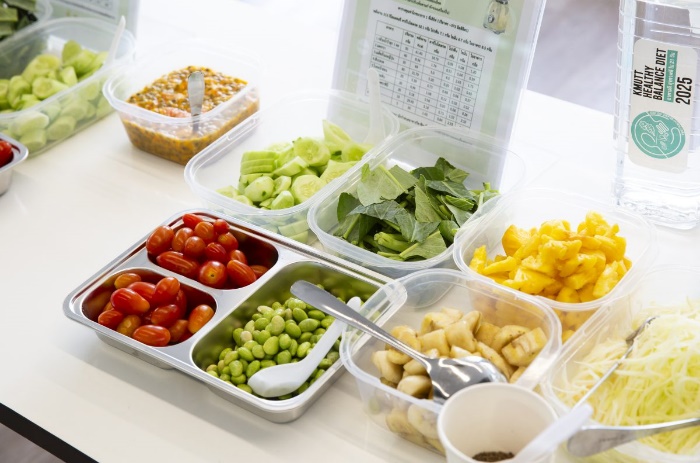
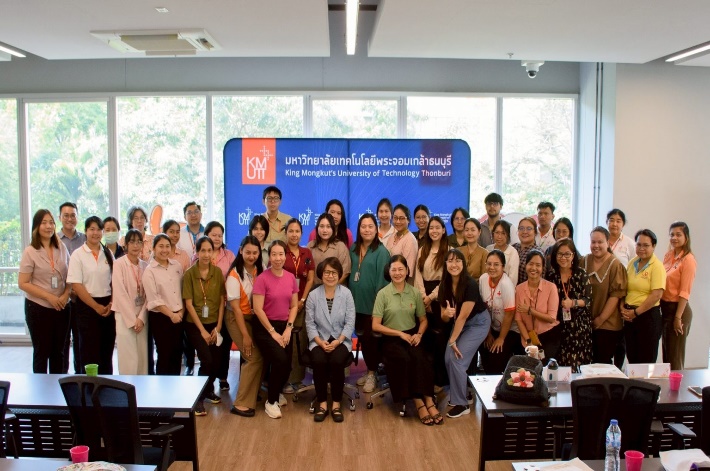
Original programme food display and group photograph. The source’s 46-person count concerns staff registrations, not a visual count from this photograph.
Original container-reuse campaign materials
Original market discount poster: bring a personal container; participating stalls display this sign. The printed discount amount is “?” rather than a numerical baht value.Original personal-cup use photograph in the campus campaign.
Sources and evidence links
Supplied institutional evidence for 2.3.3: campus food choices, local produce, portions and reusable-container incentives.
Supplied institutional evidence for 2.3.1 and 2.3.2: October 2026 soy milk campaign posters.
4. Related information on our university as a body on providing healthy and affordable food choices for all on campus.
The institutional evidence identifies a THB 30 special meal programme at the King Mongkut Memorial Building cafeteria, S14, for students, staff and other campus users. The supplied menu posters display individual dishes and prices, providing specific examples of affordable on-campus provision. The posters and original food service descriptions are retained below. Their supplied dates are not changed, and the advertised prices are not extended to every outlet or every menu item.
Posted meal prices at King Mongkut Memorial Building · S14
The supplied account describes the “30 Baht Special Menu” at the King Mongkut Memorial Building cafeteria (S14), intended to ease living expenses for students, staff and visitors in the Bangmod community.
Shop 6
Boiled chicken rice
THB 30
Shop 3
Wonton and barbecued pork noodles
THB 30
Shop 2
Rice with stir-fried basil chicken
THB 30
Shop 8
Rice with stir-fried basil chicken
THB 30
Shop 7
One-egg omelette
THB 25
Shop 9
Rice with stir-fried basil chicken offal
THB 30
Five supplied posters show THB 30, while the one-egg omelette poster shows THB 25. These are paid menu examples, not prices guaranteed for every menu or outlet. No service year is printed on the posters.
Healthy-choice labelling and menu selection
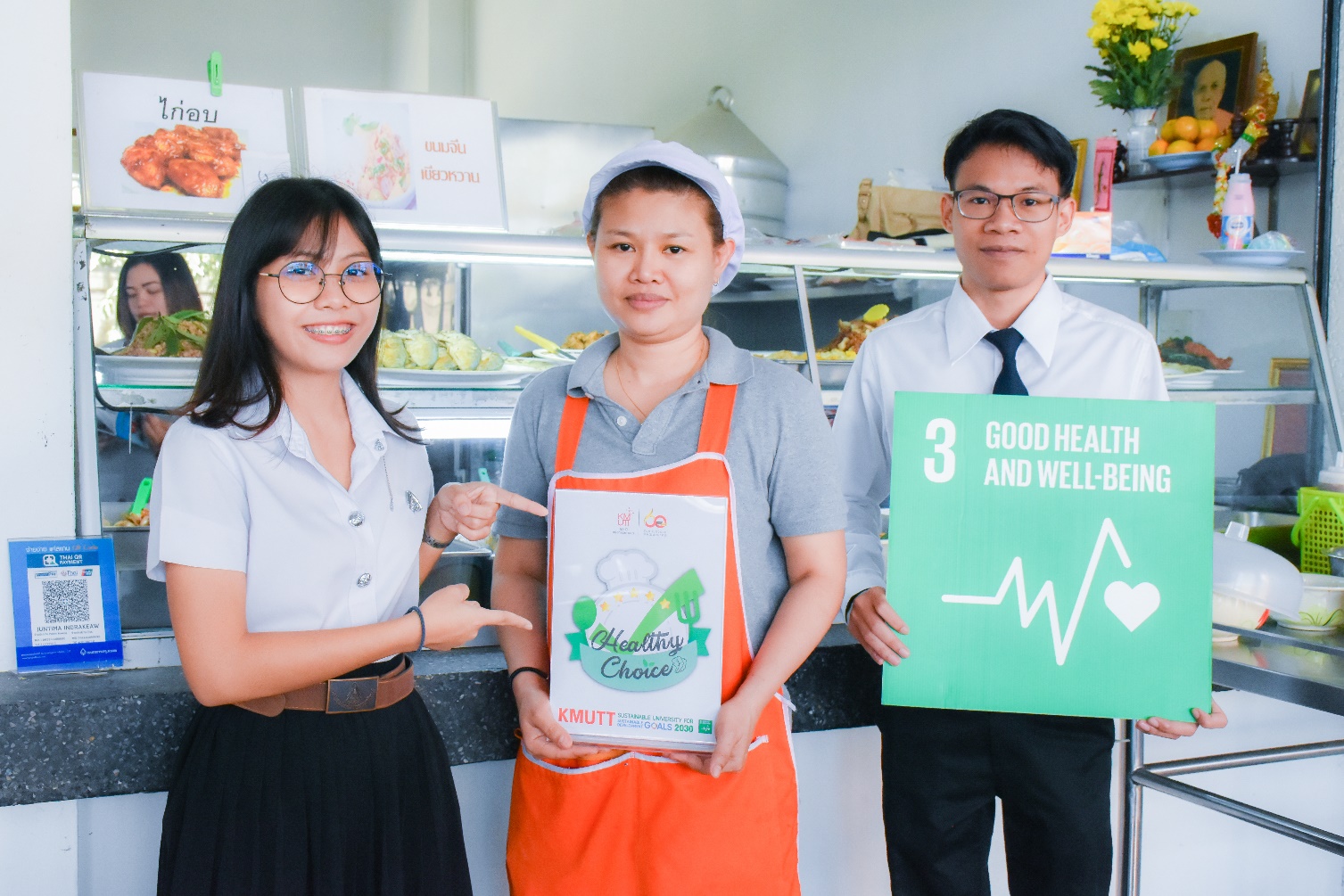
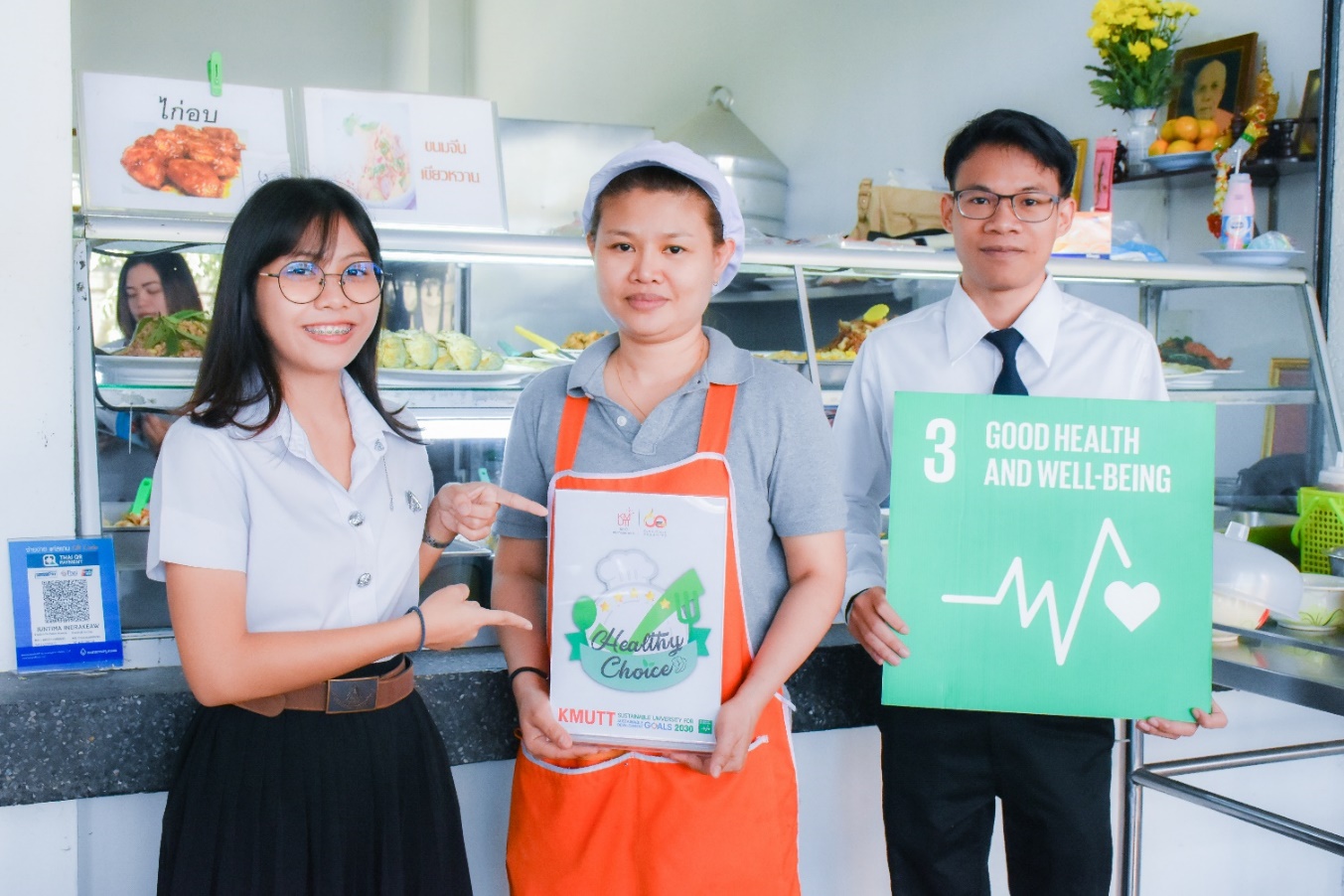
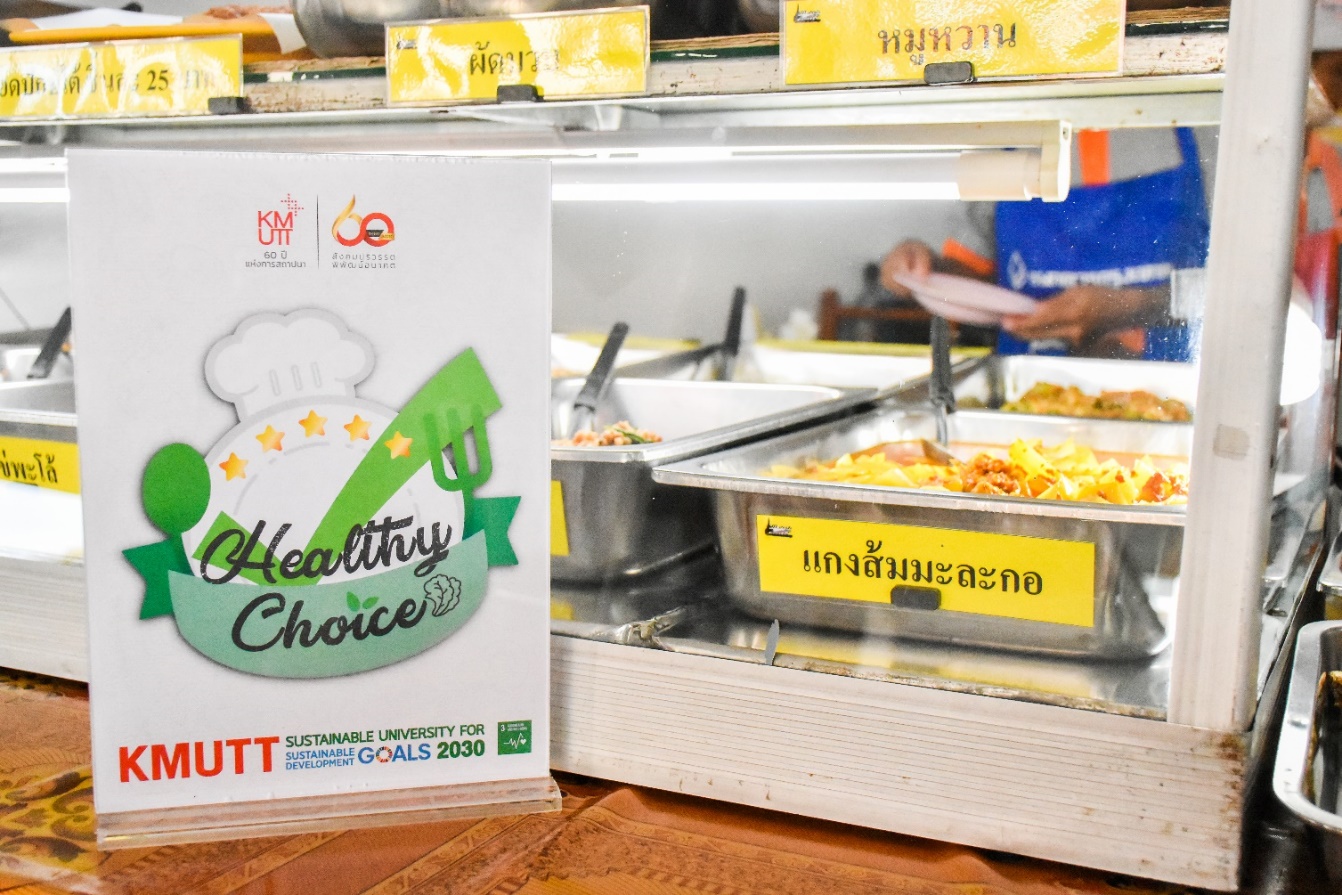
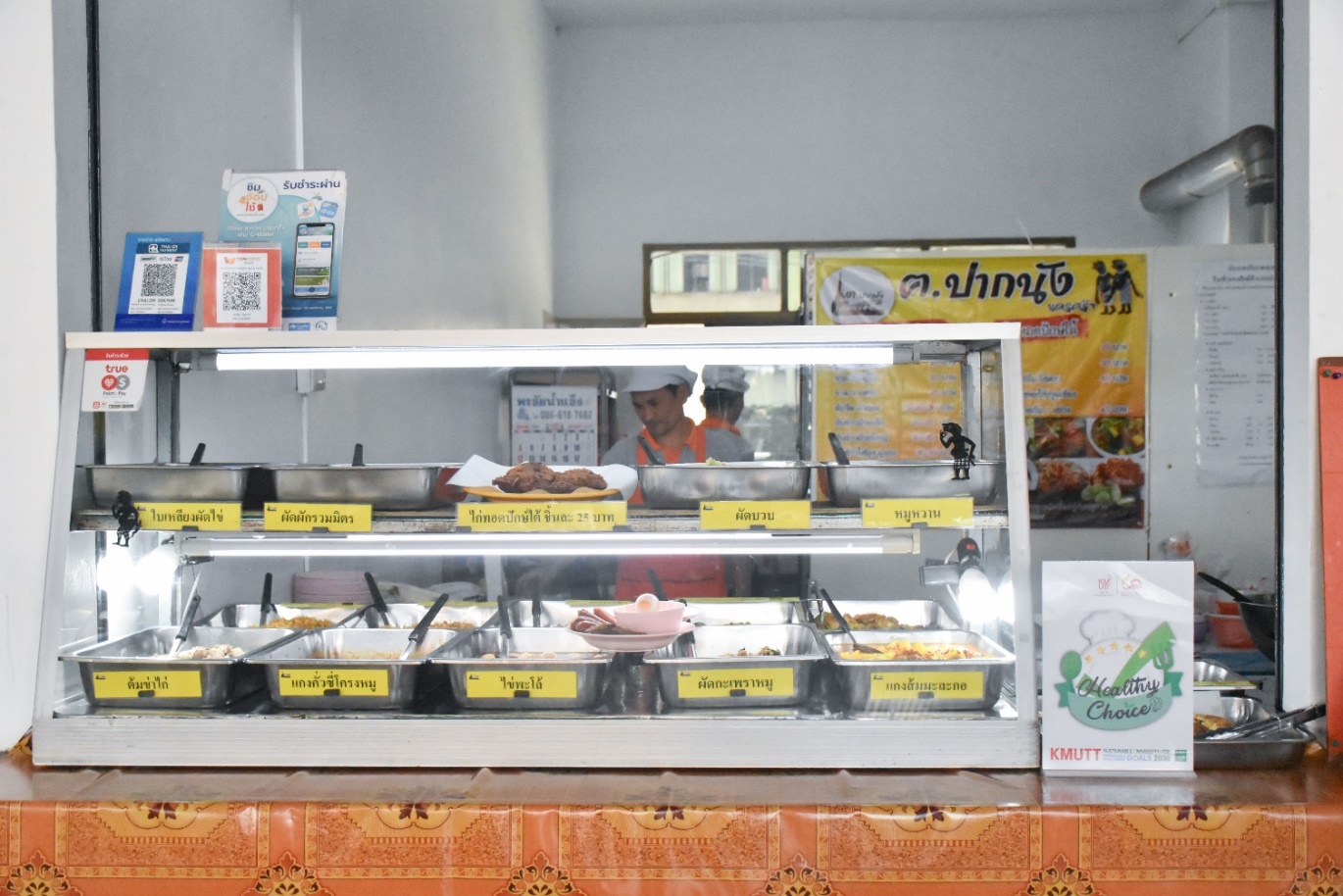
The original institutional account states that KMUTT selected alternative healthy menus from restaurants and used labels to identify them for students and personnel, describing availability in every KMUTT store.
This retains the source’s institutional coverage statement. The supplied examples do not independently establish a common nutritional standard for every low-priced dish or a current outlet-by-outlet audit.
Original Healthy Choices labelling and food-service photographs. Their capture dates are not specified.
Community vendors and accessible food options
The supplied record describes community shops where local vendors sell a variety of drinks and healthy food to students and staff at inexpensive prices.
Original community food and fresh-produce vendor photographs. They illustrate the supplied account without assigning a single price to all products.
Food safety and healthy menu development · 2026
On 21 February 2026, KMUTT EESH Center and Health Care Unit delivered food sanitation and healthy menu development training at Classroom Building 2, Bangmod. Department of Health speakers covered food establishment standards, food handler hygiene and healthy canteen initiatives. Participants completed knowledge assessments for food handler certification. Practical afternoon sessions addressed energy use, hygiene and food waste. This dated activity supports the quality and safety of campus meal provision alongside the affordability measures in the supplied record.
Standards and assessment
Food establishment standards, food-handler hygiene and healthy canteen initiatives; participants completed knowledge assessments for food-handler certification.
Practical operations
Afternoon learning addressed energy use, hygiene and food-waste management.
Food vendors attending food sanitation and healthy menu development training, Classroom Building 2, Bangmod, 21 February 2026. Source supplied: KMUTT EESH.
Knowledge assessments are recorded as completed. No pass rate or number of certified vendors is inferred from the photograph.
Nutrition knowledge to assess food choices · 2025
The Health Care Unit launched “KMUTT Healthy Balance Diet 2025: Eat Well, Stay Healthy in 21 Days” on 6 May 2025 in the Self-Learning Room, LX Building. The activity attracted 46 staff members from university departments who signed up to participate. It supports informed food choices and is separate from a claim that every low-priced meal meets a particular nutritional standard.
Launch
6 May 2025
Self-Learning Room, LX Building.
Participants
46 staff
Staff who signed up; not a count of meals sold.
Challenge period
21 days
“Eat Well, Stay Healthy in 21 Days”.
The goal of this initiative is to promote knowledge and understanding of proper nutritional practices, encouraging staff to adopt balanced eating behaviors as role models for healthy living. The program featured expert speakers from the Balanced Diet for Health Project of the Thai Health Promotion Foundation (ThaiHealth), who delivered insightful talks on topics such as “The Secret Code of the Healthy Plate and Food Exchange Groups (Cut Sugar, Fat, Salt, and Boost Fruit & Vegetable Intake)” and “Reading Nutrition Labels for Smarter Eating.”
Participants also engaged in various skill-building activities, including workshops on reducing salt and sugar intake, making “5 Food Groups in 1 Glass” drinks, vegetable weighing games, practicing plate portioning based on the 2:1:1 principle, and quiz competitions with prizes. The activity aligns with Sustainable Development Goal (SDG) 3, focusing on good health and well-being. The “KMUTT Healthy Balance Diet 2025” challenge is one of KMUTT key initiatives, reflecting the university’s commitment to comprehensive staff wellness and the promotion of a sustainable culture of good health.’
Original Healthy Balance Diet practical-learning photographs. The 46-person figure concerns staff participation, not the number of nutritionally certified menu items.
Bring a container: incentives at participating stalls
KMUTT has a campaign to encourage people to bring their own food containers to receive discounts on food and to reduce plastic use.
The supplied discount poster applies to stalls displaying its sign. The discount-amount field is “?” rather than a fixed baht figure, so no exact saving is invented.
Personal food containers in the original campus campaign photographs.
No-cost drinks with a personal container
KMUTT has a free soft drink service point for students who bring their own containers. This is held twice a month throughout the academic year.
The original narrative says twice per month. The supplied posters advertise weekly schedules: Wednesdays at 12:00 outside Student Affairs, 190-Year Building (S14), and a separate Monday, Tuesday, Thursday and Friday arrangement. These are retained as distinct notices without equating their frequencies.
Original Eco Cup’ture notices, retained whole with their advertised conditions. No year is printed.
Additional menus, photographs and original campaign evidence
Other menu examples in the institutional record
These menus have their own posted category prices. They are separate from the S14 special-menu posters; their prices are not replaced by the THB 30 programme price. No service year is printed.
Mixed menu
Salads
Japanese salad
Caesar salad
Tuna salad
Tender chicken salad
THB 59
Main dishes
Stir-fried mixed vegetables
Stir-fried bean sprouts with tofu
Stir-fried pumpkin
Stir-fried sponge gourd with egg
THB 39
Soups
Onion soup
Mild soup with tofu and minced pork
Braised pork soup
Sour curry with snakehead fish and mixed vegetables
Pork-rib soup with ginger
THB 59
Drinks
Thai herbal drink
Roselle drink
Pandan drink
Lemongrass drink
Mixed fruit smoothie
Pineapple smoothie
Carrot smoothie
Orange smoothie
THB 19
Vegetarian-focused menu
Salads
Vegetarian grilled-tofu salad
Vegetable salad rolls
THB 59
Main dishes
King oyster mushroom fried rice
Vegetarian creamy tom yum noodles
Spaghetti with pumpkin and spinach
Vegetarian pasta with grilled vegetables
Stir-fried water spinach
THB 39
Soups
White-bean soup
Shiitake-mushroom wonton soup
Vegetable soup
THB 59
Drinks
Thai herbal drink
Roselle drink
Pandan drink
Lemongrass drink
Mixed fruit smoothie
Pineapple smoothie
Carrot smoothie
Orange smoothie
THB 19
The mixed menu includes tuna, chicken, pork, fish and egg. Vegetarian-labelled examples are not automatically classified as vegan.
Additional labelled food-service examples
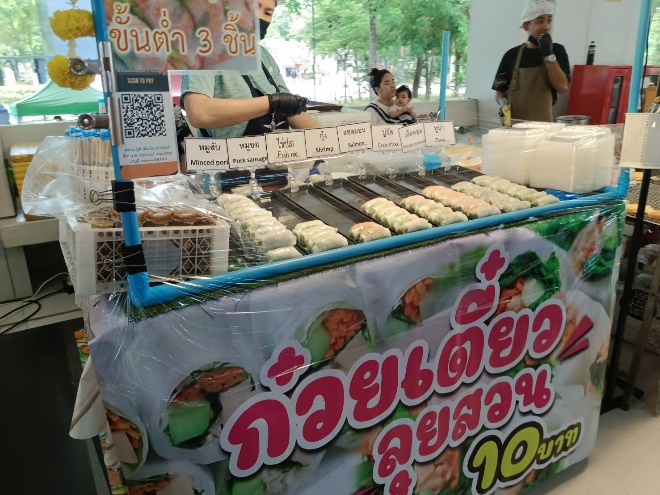
Original counter photograph displaying the Healthy Choices mark.Original packaged salad-roll photograph, retaining its printed branding and framing. No ingredient or nutritional certification is inferred.
Additional community-market photographs
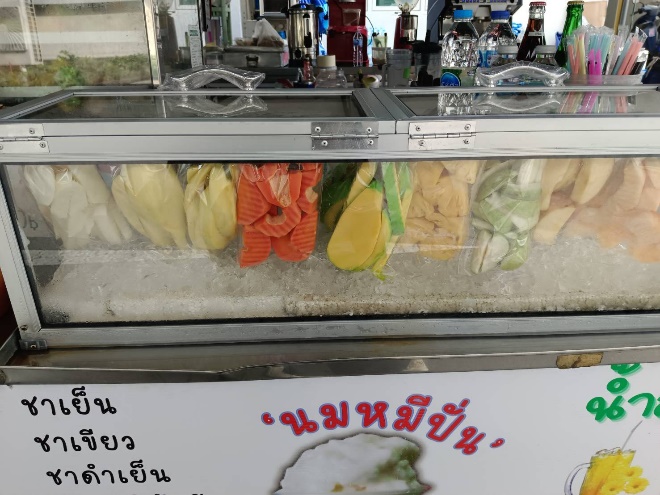
Original fresh-fruit and drink stalls in the campus community-market record.
Original prepared-food stalls. The illustrations do not establish one nutritional profile for every item.
Original container-reuse materials
Original market discount poster: personal containers are encouraged at stalls displaying this sign. The baht amount is left as “?”.Original personal-cup use photograph in the institutional campaign.
Additional programme food and group photographs
Original Healthy Balance Diet food-display and group photographs.
Original S14 menu posters
Original shop 6, 3 and 2 posters, each displaying THB 30.
Original shop 8, 7 and 9 posters. The middle poster is one-egg omelette at THB 25; the others display THB 30.
Sources and evidence links
Supplied KMUTT evidence for 2.3.4: healthy food options, campus community market, reusable-container incentives and S14 special meal posters.
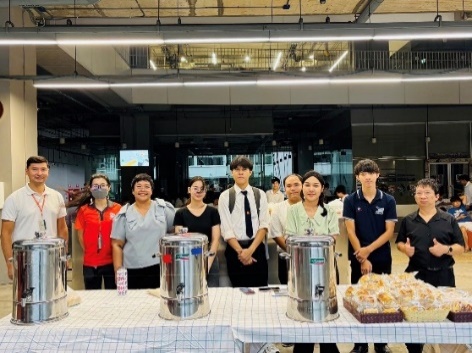
KMUTT institutional food sharing arrangement explicitly includes housekeepers, gardeners and other personnel with limited incomes, alongside students. Participating campus market and cafeteria vendors pack safe remaining food in appropriate containers and make it available without charge after sales. The supplied 2025 campus food waste record reports 122.33 kg of surplus food shared through this arrangement. That quantity covers the combined programme; it is not assigned entirely to staff or converted into an unsupported staff beneficiary count. The staff access arrangements and original photographs in this document are retained below.
Food sharing that reaches campus workers
Safe surplus
Campus market and cafeteria vendors pack remaining food in appropriate containers.
No-cost access
Food is made available after daily sales to students and workers with limited incomes.
Shared programme
122.33 kg was shared in 2025 across the combined programme, not solely with staff.
Surplus food remaining after sales at KMUTT community markets and cafeterias is managed systematically and responsibly. Shop owners pack the remaining food in appropriate containers and place it in front of their shops after closing each day, making it available free of charge to students, housekeepers, gardeners and other personnel who may have limited incomes. The arrangement was developed collaboratively within the university through discussions with community markets and vendors about sharing food that remains of good quality and safe to consume. Many vendors expressed their willingness to participate. The university regards this sharing as a way to reduce food waste and ease financial hardship, consistent with its sustainable development approach and a sharing society within the campus community.
Original photographs of campus workers accessing shared food. These illustrate the institutional arrangement; no staff-only recipient count is inferred.
Kitchen gardens and access to fresh produce
The original record describes campus kitchen gardens and distribution of produce to university personnel, as well as food and beverage sharing. Its stated harvest of more than 200 kg is retained with the original account and is not assigned a new annual reporting date. Student flood scholarships remain in the original evidence as student assistance; they are not counted as staff hunger interventions.
KMUTT describes a food-security project for students, personnel and communities to support well-being and access to good food. Personnel and students help operate the project and gain practical skills and experience, following the philosophy of sufficiency economy. Land is allocated to the activities: one part provides organic vegetable gardens in student dormitory areas for students or staff to eat, while a second part grows organic vegetables for sale to university personnel and the community. Leaves and branches from the university are composted to fertilise the vegetable gardens.
Dormitory gardens
Vegetables for students or staff to eat.
Produce for sale
Vegetables for university personnel and the community; campus leaves and branches are composted for cultivation.
Original campus kitchen-garden and vegetable-harvest photographs. The supplied account does not give a new annual reporting date.
The listed crops include water spinach, lettuce, “fairy mushroom” and Chinese leafy greens (listed as “Guangdong” in the original English account).
Reported kitchen-garden yield
More than 200 kg
Produce is distributed to university personnel. The source does not specify an annual reporting period for this harvest figure.
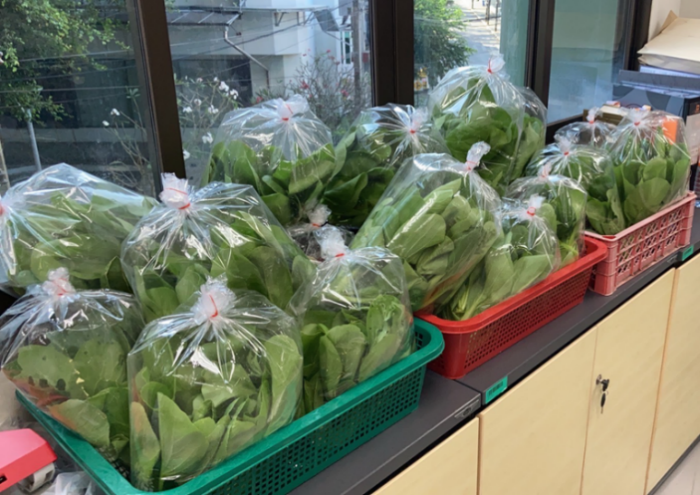
Original harvested vegetables prepared for distribution to university personnel.
Staff nutrition knowledge · May 2025
The Health Care Unit launched KMUTT Healthy Balance Diet 2025 on 6 May 2025 at LX, with 46 staff participants. ThaiHealth-supported experts addressed balanced eating, nutrition labels, food exchange groups and reducing sugar, fat and salt. Participants practised meal portioning and increasing fruit and vegetable intake. This activity supports staff nutrition knowledge alongside practical food access. Its participation figure measures nutrition programme attendance and is not a count of staff identified as food insecure.
Launch
6 May 2025
Health Care Unit, LX Building.
Participation
46 staff
Nutrition programme participation; not a count of staff identified as food insecure.
Shared drinks and personal-cup access
KMUTT has distributed soy milk to staff and students who bring their own cups on the 1st floor of the Learning Commons (LX) building.
The institutional narrative includes staff and students. The supplied October 2026 posters specifically advertise student access with a heat-resistant personal cup; they do not establish a new staff beneficiary total.
Bang Khun Thian Campus
6–9, 12, 14–15 October 2026
From 5:00 pm; dormitory ground floor.
Ratchaburi Residential College
16, 19–22 October 2026
From 5:00 pm; dormitory ground floor.
Bangmod · Learning Exchange (LX)
6–9, 12, 14–15 October 2026
From 5:00 pm; first-floor Learning Common; MOD registration shown.
Original October 2026 soy-milk invitations, kept whole with locations, dates, cup conditions and registration information.
KMUTT has a free soft drink service point for students who bring their own containers. This is held twice a month throughout the academic year.
The source narrative says twice a month throughout the academic year. Separate undated ECO Cup’ture posters advertise Wednesday at 12:00 outside Student Affairs, 190-Year Building (S14), and a Monday/Tuesday/Thursday/Friday arrangement. These schedules are kept distinct.
Original free-drink notices. The Wednesday notice accepts a personal cup and excludes single-use plastic cups and paper cups; it permits a water bottle or food container instead of a cup. The other notice offers ice on Monday, Tuesday, Thursday and Friday and sweet drinks on Wednesday. No year is printed.
Additional garden photographs and original support notices
Garden spaces, materials and participation
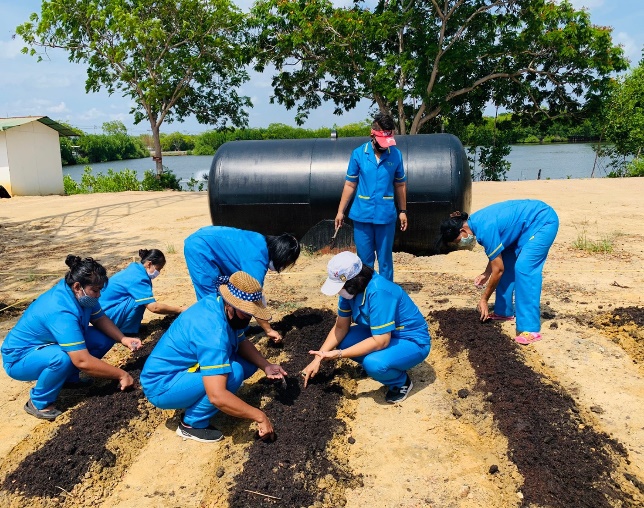
Planting and reused growing containers in the original campus garden record.
Original plant-care material and project information photographs. They are retained as photographs, not converted into a guessed recipe.
Original garden and campus setting photographs.
Original project participant and garden-bed photographs. The sideways source photograph is displayed upright without changing its file.
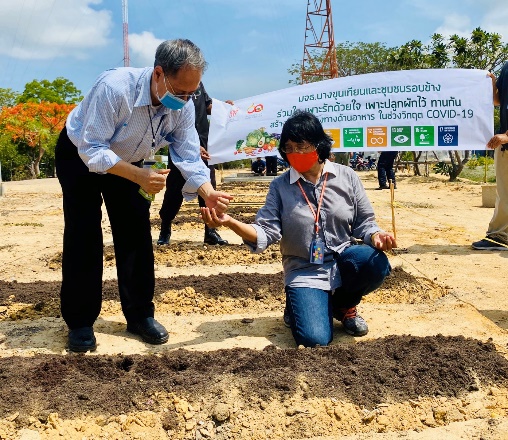
Original planting activities in the institutional record. The banner shown in the photographs refers to the COVID-19 period; it is not relabelled as a new 2025 event.
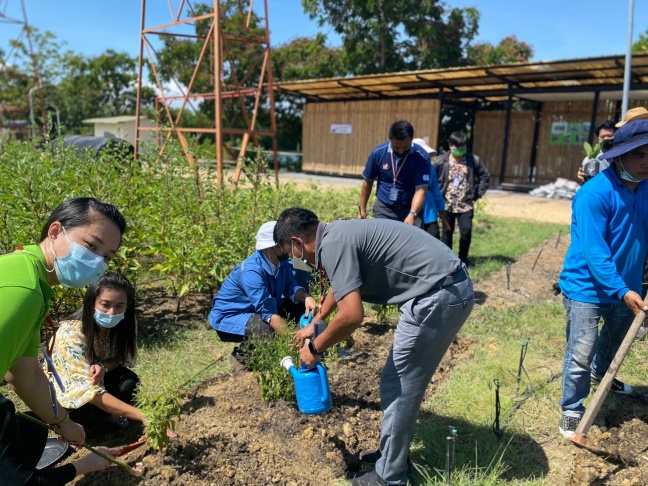
Original watering and garden participation photographs.
Growing vegetables and mushrooms
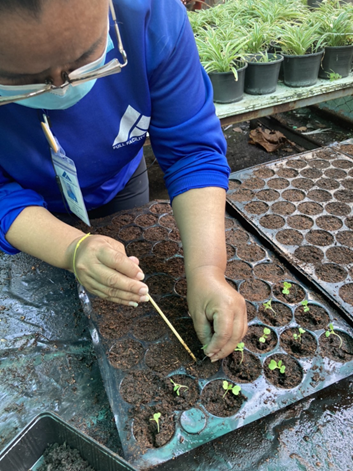
Original seedling preparation photographs.
Original seed trays and planted growing beds.
Original leafy vegetables in container gardens.
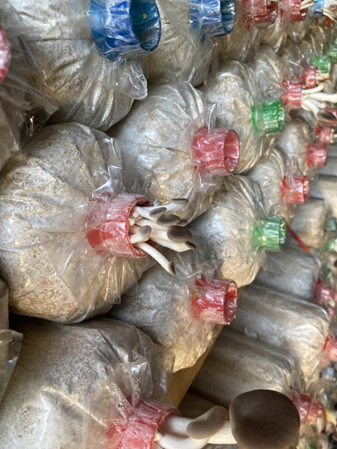
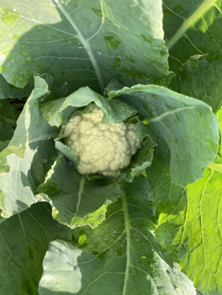
Original mushroom-growing bags and cauliflower photographs.
Original harvested mushroom photographs, retaining their separate source images.
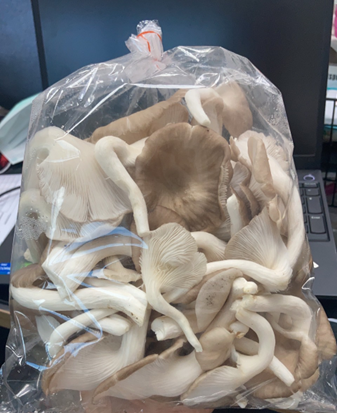
Original packaged-mushroom photograph, retained in its full wide framing.
Original produce distribution to personnel
Original produce packaging and distribution to university personnel.
Original personnel receiving packaged vegetables. No number of unique recipients is calculated from photographs.
Additional food-sharing photographs
Original shared-food access and weighing photographs. The weighing image is illustrative; the reported annual quantity comes from the supplied record, not a scale reading inferred from this photograph.
Original beverage-distribution photographs
Original beverage-distribution photographs retained as institutional context. The right-hand photograph bears a 2 December 2025 timestamp, distinct from the October 2026 invitations.
Student flood assistance · separate context
These notices concern students and are retained from the supplied record. They are not counted as interventions addressing staff hunger.
In light of the recent flash floods, river overflows, and coastal surges affecting many areas and families, King Mongkut’s University of Technology Thonburi (KMUTT) extends its heartfelt concern and encouragement to all those impacted. We sincerely wish for everyone’s safety and for the situation to return to normal as swiftly as possible.
For KMUTT students whose families reside in flood-affected areas and have suffered damage, the university has established a special “Flood Relief Scholarship” to help alleviate hardship. Eligible students may apply through the Student Information System and submit the required supporting documents.
Original student flood-assistance notices, kept whole. The first refers to Nan Province and 19 August 2026; the second does not specify an event date. Applications use the student information system with supporting documents.
Sources and evidence links
Supplied KMUTT institutional evidence for 2.3.5: kitchen gardens, distribution to personnel, surplus food sharing and original illustrations.
Supplied KMUTT institutional evidence for 2.2.1 Campus food waste tracking: 2025 surplus food sharing quantity and photographs.
1. Related information on our university as a body providing access on food security and sustainable agriculture knowledge/skills/technology to local farmers and food producers.
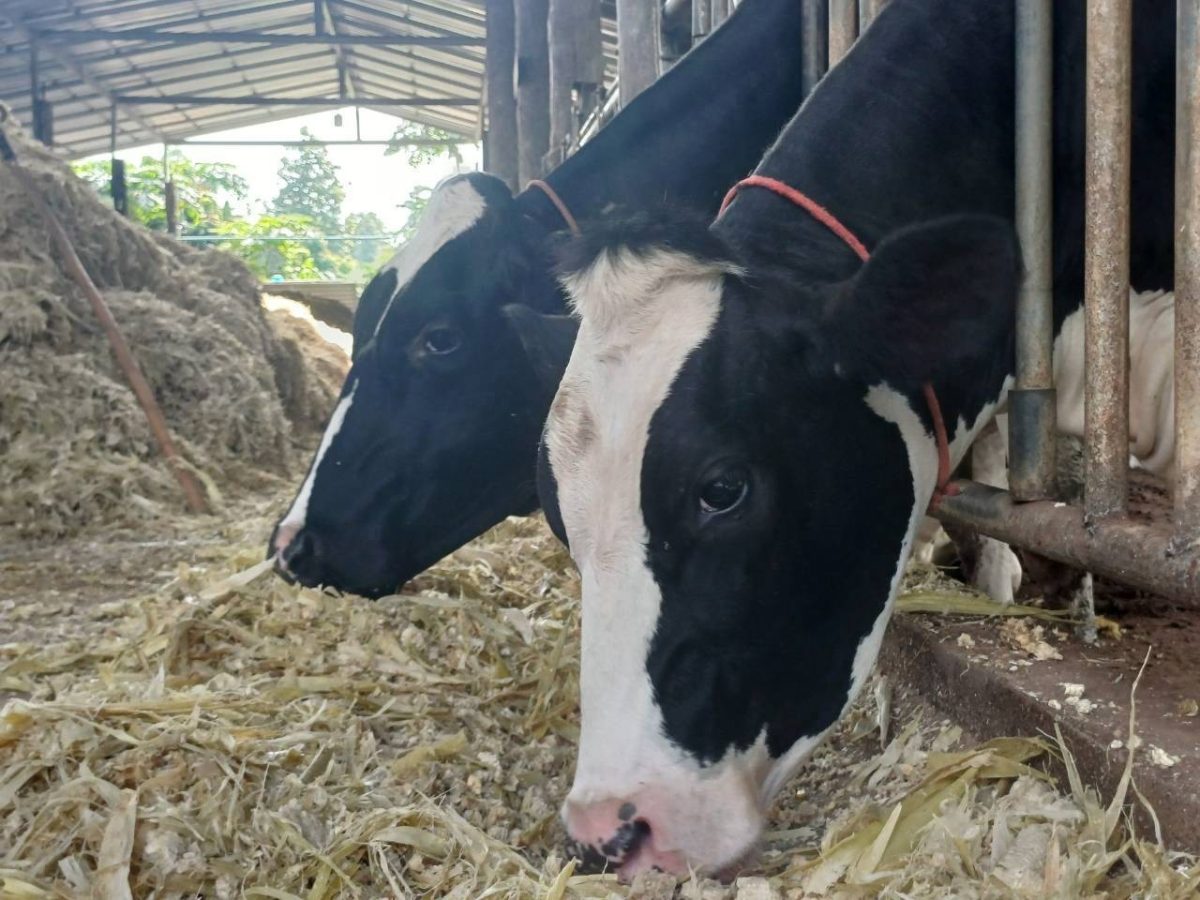
KMUTT connects farmers with expertise in feeding, reproduction, housing and farm data through its Dairy School collaboration. At Samran Farm in Phetchaburi, adjusting feed with locally available ingredients increased milk production from 510 to 700 kg per day between February and July 2025, while milking cows decreased from 54 to 52. This is a reported farm case, rather than a nationwide outcome.
Applied dairy knowledge: a farm-level result
Daily milk production · Samran Farm
February 2025
510 kg/day
July 2025
700 kg/day
Common scale: 0–700 kg/day. Farm case in Phetchaburi; feed adjusted using locally available ingredients.
Same farm and period
February 2025
July 2025
Milking cows
54
52
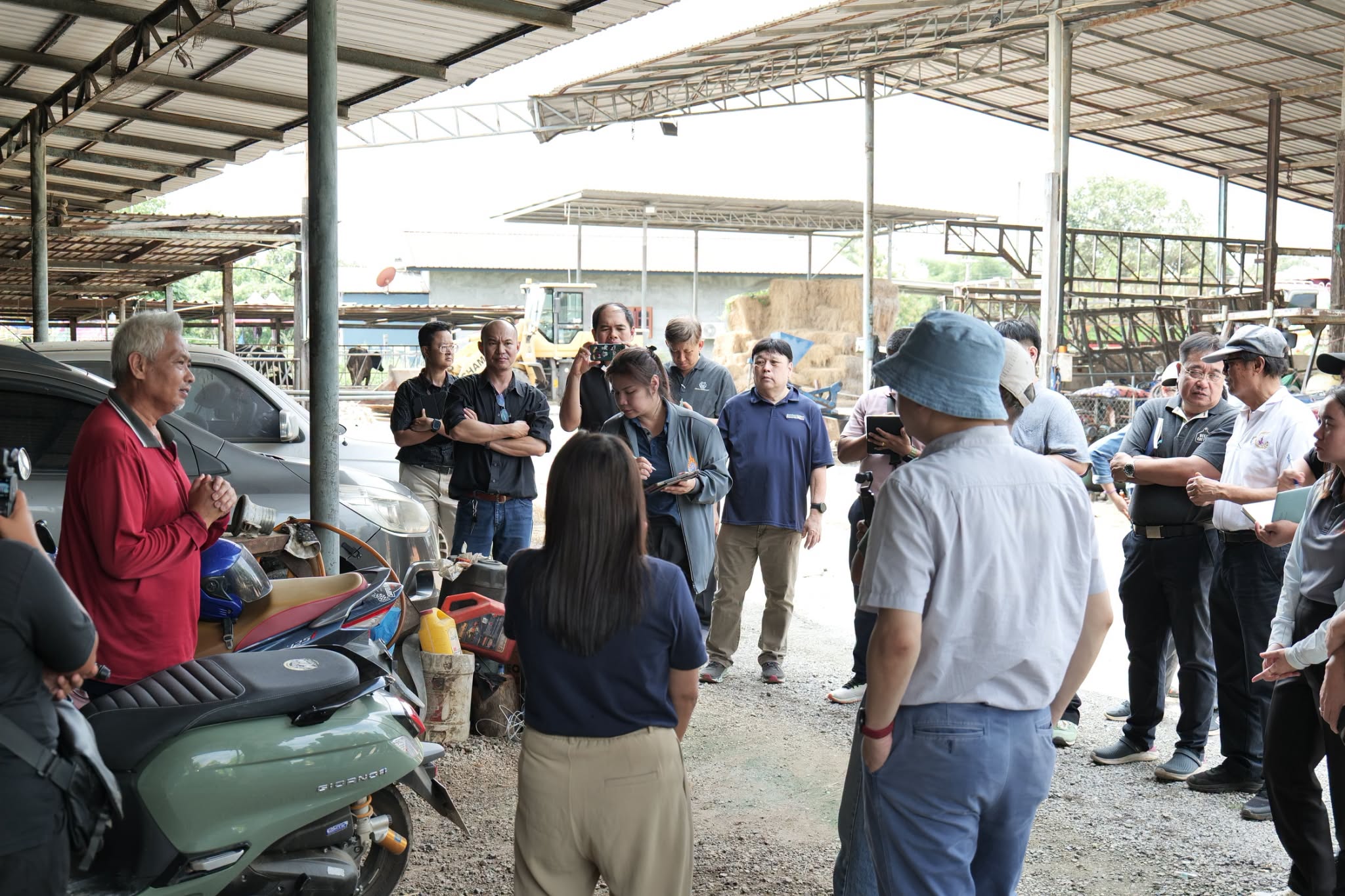
In late August 2026, KMUTT and University of Wisconsin–Madison experts visited dairy farms in Sukhothai, Chiang Mai and Sakon Nakhon to assess local problems and adapt advice to actual farming conditions. KMUTT also developed a data pipeline and dashboard to make milk production, quality, health and reproduction information useful for farm decisions. These activities provide locally relevant knowledge and technology supporting food production and farmer livelihoods.
The two periods describe one reported farm. They are not national production totals or a result attributed to every participating farm.
Dairy project illustration accompanying the KMUTT report published on 19 October 2026. A separate photograph capture date is not asserted.
From farm advice to lifelong learning
The project progress report presented on 5 March 2026 describes technology transfer undertaken between June 2024 and December 2025, including feeding, reproduction, housing and a milk-based pregnancy test. This mixed-period report complements the separately dated 2025 farm result above. It also records development of lifelong learning and Dairy School models linking researchers, extension officers and farmers.
The complete institutional account below includes solar-powered irrigation, agricultural processing, the April 2025 Agri-PV seminar and site visit, May 2025 dairy farm collaboration, and October 2026 Dairy School activities. Earlier or undated examples retain their supplied periods. Access charges are not specified in the cited dairy reports, so no free-access claim is assigned to these additions.
Solar technology for local farming
Rang Bua, Chom Bueng District, Ratchaburi. These original examples retain their supplied periods; the account does not establish a new common event date.
Solar-powered electric fences
In Rang Bua Subdistrict, Chom Bueng District, Ratchaburi, farmers use battery-powered electric wire fences to keep livestock within grazing areas beyond the reach of power transmission lines. Previously, the vehicle batteries had to be taken home for charging about once every 2–3 days. The joint RSC/SorPor working group applied solar power to charge batteries for electric fences and other electrical devices. The supplied account reports average annual energy savings of THB 2,500 per household, alongside environmentally friendly clean-energy use. It records 119 farmers completing training, a collaboration network of seven KMUTT lecturers/personnel, and a solar-power learning centre for agriculture, study visits and expansion of clean-energy technology under the New Theory agriculture approach.
Solar-powered drip irrigation
Rang Bua Subdistrict has sandy-loam soils that retain little water, and farming outside irrigated areas relies mainly on rainfall, with water shortages each year. The joint RSC/SorPor working group introduced solar-powered drip irrigation and an automatic watering system controlled by smartphone. The supplied account reports more efficient water use, reduced pumping-fuel costs of THB 12,000 per household, less environmental impact, and reductions in working time and agricultural labour. Farmers can cultivate and generate income throughout the year; cultivation after paddy farming in the dry season is reported to increase average annual income by THB 5,000 per household. Reported outputs are 27 farmers completing training, a collaboration network of seven KMUTT lecturers/personnel and three KMUTT students, and three agricultural solar-power learning centres for study visits and technology expansion.
Farmers completing training
119
Solar-powered fence activity; separate programme population.
Farmers completing training
27
Solar-powered irrigation activity; not added to the fence count.
Irrigation learning centres
3
Sites for study visits and expansion of the technology.
Original solar-technology demonstration and learning photographs accompanying the fence and irrigation account.
Food processing: knowledge, safety and equipment
The original account describes food-safety knowledge and improved production for the Ban Kha radish-processing community enterprise in Ratchaburi, in the western radish-growing area that also includes Phetchaburi. The enterprise had 30 members and accounted for 66.4% of the radish-growing area in Ban Kha. Traditional pickled-radish preparation kneaded the roots with salt and preservatives, dried them for three days, then added flavouring. Random testing found preservative levels above food standards. The research team provided knowledge on microorganism testing, preservative and bleaching-agent tests, and hygienic processing. Producers adopted measuring scales for more accurate quantities, reduced preservatives to reported safe levels and improved packaging for storage. The account also records transfer of radish-processing machinery to ease workloads and labour shortages and address bacterial spoilage, reporting a 25% increase in profit and a doubling of daily production while retaining the original taste.
King Mongkut’s University of Technology Thonburi (KMUTT) has developed an innovative radish processing technology that reduces labor, time, and production costs, thereby enhancing income opportunities for the Ban Kha community-based radish enterprise.
The detailed Ban Kha machinery report linked in this evidence was published on 16 March 2023. Earlier results are retained with that context, rather than relabelled as a new 2025 intervention.
Assistant Professor Dr. Mai Noipitak, a researcher at King Mongkut’s University of Technology Thonburi (KMUTT), Ratchaburi Campus, stated that the initiative to develop processing equipment for the Ban Kha community enterprise specializing in radish transformation originated from the group's inability to meet growing customer demand and their aspiration to enhance production standards. In response, the village headman and the president of the Ban Kha Subdistrict Administrative Organization sought technical consultation and support from KMUTT Ratchaburi.
The initial prototype presented for improvement was a rusted steel radish slicer. After one year of research and development, the KMUTT Ratchaburi research team successfully designed and fabricated a radish processing machine comprising two main components: a slicing unit and a water-extraction unit. The slicing machine integrates an electronic circuit system and is powered by two electric motors connected through a gear reduction mechanism to lower rotational speed. A key feature of the slicer is its array of over 100 stainless-steel blades arranged in parallel, enabling the radish to be cut into uniform strips of desired dimensions.
The total investment for the project was approximately 100,000 Thai Baht, supported by funding from the Office of Science and Industrial Park (OSIP), the Division for Promotion and Coordination of Scientific, Research and Innovation Benefits (DPC-SRI), and the Office of the Permanent Secretary, Ministry of Higher Education, Science, Research and Innovation (MHESI). This initiative was part of the Area-Based Innovation for Community program, which aims to promote the application of innovation to enhance local societal and community development.
Original radish slicing equipment and manual preparation photographs. The equipment is shown whole alongside the community production context.
Agri-PV: producing food and energy together
Seminar
24 April 2025
KX Building, Bangkok: Agri-PV design concepts and crop/animal selection.
Research visit
25 April 2025
KMUTT Bangkhuntien: prototypes, energy research facilities and business-development opportunities.
King Mongkut’s University of Technology Thonburi (KMUTT), in collaboration with the National Science and Technology Development Agency (NSTDA) and both domestic and international partners—including Forschungszentrum Jülich, Germany; Rajamangala University of Technology Lanna (RMUTL); the National Research Council of Thailand (NRCT); HUB Net Zero; the Ministry of Higher Education, Science, Research and Innovation (MHESI); the Program Management Unit for Human Resources & Institutional Development, Research and Innovation (PMU-B); and other allied organizations—organized a practical seminar on “Agri-PV System Design Concepts: Selecting Crops/Animals for Energy and Food Production” on 24 April 2025 at the KX Building, Bangkok. On 25 April 2025, participants visited KMUTT Bangkhuntien to observe Agri-PV prototype systems, energy research facilities, and business development opportunities.
The seminar emphasized the integration of photovoltaic (solar cell) technology with agriculture to maximize land and resource efficiency. Key topics included solar cell design and performance evaluation for agriculture, aquaculture under solar panels, livestock farming under limited energy conditions, the potential of Agri-PV for combined food and energy production, research on animal feed from energy crops, and emerging trends in food/feed ingredients from Agri-PV systems.
Participants also toured KMUTT Agri-PV prototype facilities and research demonstrations, such as algae cultivation, CO₂ recycling for precision agriculture, smart EMS technology for solar-battery systems, microbial fermentation, algae-based product development, and biomass valorization (lignin and biochar). The seminar highlighted academic collaboration, applied research, and technology transfer aimed at modernizing agricultural practices, promoting sustainable food and energy production, and supporting long-term development of farming communities.
Original Agri-PV seminar group and learning photographs from the 24–25 April 2025 programme, retained in their full wide framing.
Vocational partners and dairy-farm learning · 2025
On 19 May 2025, the Faculty of Industrial Education and Technology, KMUTT, organized a project to discuss academic collaboration in vocational education in agriculture and dairy farm management with Ratchaburi College of Agriculture and Technology, held at the college.
The meeting was led by Assoc. Prof. Dr. Sakrin Phumiratana, Advisor to KMUTT; Prof. Dr. Morakot Tanticharoen, Senior Advisor to the President of KMUTT; Asst. Prof. Dr. Rungroj Piyapanuwat, Assistant to the President for Research and Industry, KMUTT Ratchaburi; Assoc. Prof. Dr. Thanet Thanittheeraphan, Dean of the Faculty of Industrial Education and Technology; Dr. Sompop Panyasomphorn, Associate Dean for Off-Campus and Ratchaburi Educational Innovation; Dr. Supachai Phuengsangwan, Lecturer in Electrical Education; Ms. Sawinee Wuttisakulwong, Research Assistant, KMUTT Ratchaburi; and Ms. Jaranja Saengthong.
The KMUTT delegation met with executives and faculty members of Ratchaburi College of Agriculture and Technology and conducted site visits to two dairy farm enterprises: Chatupoom Chimpalee Farm and Surasak Dairy Farm. The discussions and visits fostered academic collaboration, joint research, and innovation development, particularly in applying technology to modernize dairy farm management standards in Thailand. The initiative also aims to cultivate skilled personnel in agriculture, thereby strengthening both academic and industry capacity for sustainable development.
Original farm and college collaboration photographs accompanying the 19 May 2025 activity.
IoT knowledge for older aquaculture farmers
KMUTT students are transforming the challenges of an aging society into opportunities through IoT innovation. Their project focuses on reducing burdens and extending the working capacity of elderly Thai aquaculture farmers. By applying smart technologies to monitor and manage aquaculture systems, the innovation not only enhances efficiency and safety but also empowers senior farmers to remain active contributors to the industry, fostering sustainability and resilience in local communities.
The “Teletubbies” student team from the School of Integrated Field of Robotics (FIBO), KMUTT, developed an intelligent IoT system to support elderly aquaculture farmers. The innovation integrates water quality sensors, automated feeding, and aeration systems with the AI Farm platform, enabling real-time monitoring and precise pond management. It reduces physical burdens, lowers feed and electricity costs, and incorporates a voice-command system to enhance usability for senior farmers. Beyond extending the working capacity of aging farmers, the project introduces an accessible business model adaptable to both small and large-scale farms. The innovation earned the Royal Trophy Award and Popular Vote at the JUMP Thailand Hackathon 2025, serving as a clear example of how technology can address the challenges of an aging society, improve the quality of life for small-scale farmers, and strengthen the sustainability of Thailand’s aquaculture industry.
Original farmer consultation and field technology-use photographs. These show the supplied project context, not new measured savings or beneficiary totals.
Original IoT system and AI Farm interface illustration. It is a system demonstration, not a dated dataset; its interface values are not transcribed as farm outcomes.
Dairy School field learning · October 2026
King Mongkut’s University of Technology Thonburi, Ratchaburi Campus (KMUTT RC) has strengthened its collaboration with a network of academics from leading institutions across Thailand by organizing a field study and workshop to advance the “Dairy School” initiative. The activities were held from 14–16 October 2026 at Nongpho Ratchaburi Dairy Cooperative Ltd. (Under the Royal Patronage) and KMUTT Ratchaburi Campus.
The program was led by Associate Professor Dr. Sakarin Bhumirat, University Advisor, and Professor Dr. Chaowalit Limmaneevichitr, Vice President for Student and Lifelong Learner Development, KMUTT. They were joined by a network of experts in animal science and animal nutrition from seven institutions: Khon Kaen University, Chiang Mai University, Kasetsart University (Kamphaeng Saen Campus), Muban Chombueng Rajabhat University, Rajamangala University of Technology Isan, Rajamangala University of Technology Tawan-ok, and Ratchaburi College of Agriculture and Technology.
Over the three-day program, the working team conducted on-site visits to dairy farms operated by local farmers to assess current conditions and gain first-hand insights into the challenges they face, with particular emphasis on feed and nutrition management. On the final day, participants gathered at KMUTT Ratchaburi Campus for a brainstorming workshop to integrate scientific knowledge, technology, and innovation from multiple disciplines. The discussion focused on developing practical solutions to strengthen the capabilities of Thai dairy farmers and promote the long-term sustainability and competitiveness of Thailand’s dairy industry.
Original farm observations and farmer discussions from the 14–16 October 2026 Dairy School activity.
Stingless-bee learning with local expertise
On 22 September 2026, the research team from the Lifelong Learning Development Research Unit at King Mongkut’s University of Technology Thonburi, Ratchaburi Campus (KMUTT RC) visited Ban Nam Phu School in Mueang District, Ratchaburi Province, to promote community-based learning through an educational activity on stingless bee farming under the “Stingless Bee School” project. The activity was conducted in collaboration with Mr. Parintr Nuchphan, a respected local wisdom expert, who shared his knowledge and experience with students from Grades 7–9 (Mathayom 1–3).
A key role of KMUTT Ratchaburi Campus in this initiative is the design and promotion of holistic learning, integrating knowledge from science, environmental studies, and local wisdom into a meaningful learning experience. The project team organized hands-on activities that allowed students to learn from real-world experiences, including the ecological importance of stingless bees, as well as proper farming and management practices.
The program aims to equip students with practical knowledge that can be applied to the conservation and sustainable use of local natural resources. Furthermore, it serves as a foundation for developing vocational skills and creating future income-generating opportunities for young people in the community.
KMUTT Ratchaburi’s commitment to building this learning foundation marks an important step toward expanding the impact of the project through the “New Livelihood Creation Initiative”, in collaboration with local community partners and stakeholders. This effort is expected to contribute to sustainable community development while empowering youth with essential skills and entrepreneurial potential.
KMUTT RC remains committed to serving as a key mechanism in supporting lifelong learning and enhancing the capacity of young people within local communities, enabling them to become active contributors to sustainable social and economic development.
Original teaching and participant photographs accompanying the 22 September 2026 Ban Nam Phu School activity.
Marketing knowledge for local coffee producers
The Project on Enhancing Marketing Skills for Local Coffee Farmers in Doi Mae Salong, Chiang Rai Province has been honored with the Outstanding Project Award in Sustainable Economy Innovation, in recognition of its contribution to promoting sustainable economic development through capacity building, market access enhancement, and value creation for local coffee-growing communities.
This achievement reflects the project's success in empowering local farmers with practical marketing knowledge and skills, enabling them to improve product competitiveness, strengthen community enterprises, and create sustainable livelihoods while preserving the unique identity of Doi Mae Salong coffee.
Original award artwork for the Doi Mae Salong coffee-farmer marketing project. The artwork is labelled Enactus Thailand 2026; this is not assigned to 2025.
Learning alongside communities
KMUTT undertakes research and applies its results to build a knowledge-based society and support sustainable development, academic benefits and stronger communities and local economies. University–community and society projects use an integrated area-based approach around its study areas, including Thung Khru, Rat Burana, Bang Khun Thian and Ratchaburi, the western region and other areas nationwide. The supplied institutional overview frames its operations as fiscal year 2025; the individual earlier or later examples below retain their own dates.
King Mongkut’s University of Technology Thonburi (KMUTT) is committed to fostering social engagement by encouraging staff and students to learn alongside communities while co-creating innovations that improve local livelihoods and well-being. Through long-term community partnerships, KMUTT promotes collaborative learning processes and supports researchers who work closely with community members to identify local needs and develop sustainable solutions.
As part of its community engagement initiatives, KMUTT has established “Learning Villages” where knowledge, innovation, and local resources are integrated to strengthen community capacity and sustainable development. Relevant activities include the development of environmentally controlled greenhouse systems to improve agricultural productivity, the application of clean energy technologies in remote areas, and the use of digital technologies to expand access to knowledge and learning resources. These initiatives support local food production systems by enhancing farming efficiency, reducing resource constraints, and promoting environmentally sustainable agricultural practices.
In addition, KMUTT integrates STEM education with community-based resources to support vocational development and create income-generating opportunities for local residents, youth, and future farmers. Through training activities, knowledge exchange programs, and technology transfer, the university helps communities strengthen their agricultural capabilities, improve food security, and build sustainable livelihoods.
Original community learning and agricultural control-system photographs. Undated illustrations are not assigned a new activity year.
Supporting photographs and wider institutional project accounts
Bangmod community knowledge and enterprise
Under the One Tambon One University (U2T) project, the Faculty of Arts worked with STECO, Thung Khru District Office and Public Health Service Centre 54 Tas-Iam on an economic and environmental rehabilitation project connected to Bangmod Canal tourism. Activities included training in environmentally friendly fermentation tanks and delivery of 312 tanks to the community; waste-management education through 12 episodes on FM 95.25, with the programme title given in the source as “Keep it up and tell it. Talk it up”; and online entrepreneur-development training in basic entrepreneurship, online marketing, communication and product presentation. A network group for entrepreneur competency development was formed after training. Outputs included Bangmod Highlights community tours, Cycling Routes @Bangmod, guides to eating and travelling around Bangmod, and books supporting tourism and local wisdom, including “Here…Bangmod” and “Turn the Rice Field into an Orange Orchard”. Information was also published on the Bangmod website.
Original Bangmod route guide and local-knowledge publication. These are documentary artwork, retained whole rather than reconstructed from small text.
Original Bangmod website and digital-publication screenshots, kept whole.
Inclusive skills training and local products
"Training Project – Apprenticeship for Disabled Persons To prepare for work in the workplace, Class 8" by the joint working group of RSC/SorPor. NESDB and NESDB. Funds are supported by 4 public and private enterprises, with people with disabilities participating. Project 55 lecturers, students, KMUTT personnel and 59 guest speakers organize training courses 1) Office staff 2) Media production course digital publications and 3 local handicraft product development courses
Training on content design and use of activities for learning (Activities Base Learning), an online learning format and using the Moodle system (E-Learning) for the third course, was conducted in collaboration with Ban Nangoy-Phon Community Enterprise Learning Center. Pla Lo, Sakon Nakhon Province Create 2 product brands, namely "Do" and "Yay Di", generating about 3.4 million baht in revenue.
At the end of the project, 8 people with disabilities get jobs in the workplace, 2 freelancers, and 10 people continue their education/vocational training. during tracking
Original community skills and product-development photographs.
Original digital-design and online-learning screenshots, kept whole.
Community food processing in Non-Din Daeng
KMUTT, Buriram College of Agriculture and Technology and BIOTEC, NSTDA established the Non-Din Daeng Community Enterprise Incubator Unit in Buriram to strengthen farmers’ product-processing capabilities. Products included germinated brown rice, concentrated and ready-to-drink passion-fruit juice, frozen passion-fruit products, concentrated and ready-to-drink roselle juice, and tamarind tea. The supplied account reports jobs, occupations and income across five villages: 30 villagers generated more than THB 1.6 million in income and more than THB 280,000 in profit. It also describes further production development and links with surrounding communities, tourism accommodation, and plant genetic cultivation and conservation as part of sustainable area development. The source does not specify an annual reporting period for these totals.
Original community-enterprise drink products, retained whole with their packaging and branding.
Phulae pineapple: zero-waste research background
With a sweet taste The perfect crispness makes “Phulae Pineapple” a GI product of Chiang Rai Province that has orders from China both in the form of fresh fruit. Fruits are peeled or trimmed before being exported every year consecutively. Until now, there is more than 50,000 rai of this type of pineapple planted in Chiang Rai Province, with a production of more than one hundred thousand tons per year.
However, the production of Phulae pineapple has a lot of leftover material, which has the potential to be transformed into a high-value product. The process of producing pineapple in various steps Carbon emissions due to foreign import regulations must be taken into account. Including consumers who give importance to Therefore, research is being done to create additional value from the remaining materials in the production process and to obtain figures on the greenhouse gas emissions of Phulae pineapple products by means of collecting data and using photographs. By air It is important to make the Phulae pineapple of Chiang Rai Province Maintain competitiveness in the Chinese market as well as in other countries. Continuously.
This is the origin of the project of using innovation to increase the value of waste materials and evaluating the carbon footprint in the production and processing chain of Phulae pineapple in Chiang Rai Province.
With the support of the National Research Council of Thailand by Assoc. Prof. Dr. Anak Khanthachawana, Lecturer in the Faculty of Engineering. King Mongkut’s University of Technology Thonburi (KMUTT), as the project leader, said that under this 1-year project (starting operations in April 2023) it consists of 2 sub-research areas: (1) carbon footprint data analysis The process of planting and processing Phulae pineapple throughout the production chain includes designing mathematical processes and algorithms together with using images from unmanned aerial vehicles for analyzing carbon footprint throughout the process of growing Phulae pineapple. and (2) guidelines for adding value and/or creating innovation from the use of leftover materials in the Phulae pineapple processing process according to the Zero waste approach, with the main goal being to raise awareness among farmers or entrepreneurs about the impacts. to the environment that affects the industry as a whole This will lead to a change in the production and management model that is beneficial to both the environment and the Phulae pineapple market both in Thailand and abroad.
The account identifies a one-year project beginning in April 2023. The linked report was published in April 2024. Planted area above 50,000 rai and output above 100,000 tonnes per year describe the stated regional context, not hectares or KMUTT project outcomes.
Original pineapple preparation and processing photographs.
Original prepared pineapple and field-study photographs.
Original project team and product photograph, retained whole.
Additional solar-technology learning photograph
Original community learning photograph accompanying the solar-energy account.
Additional radish production and training photographs
Original processing and technology-transfer group photographs.
Original radish-growing fields and crops.
Original community enterprise product photograph.
Additional aquaculture team and pond photographs
Original student team and aquaculture pond photographs, retained whole.
Additional Agri-PV research demonstrations
Original demonstration and product-development photographs accompanying the Agri-PV seminar.
Original product discussion and research demonstration photographs.
Additional dairy collaboration photographs
Original college and farm collaboration photographs accompanying the 19 May 2025 activity.
Original Dairy School group photograph accompanying the October 2026 activity.
Original October 2026 Dairy School farm-learning photographs.
Additional stingless-bee programme photograph
Original programme group photograph accompanying the September 2026 activity.
Institutional learning model and original examples
Original institutional community-and-society infographic. Its pictorial explanation is retained whole without guessing small text or reconstructing an unsupported dataset.
Original community agriculture and learning-setting photographs.
2. Related information on our university as a body providing events for local farmers and food producers to connect and transfer knowledge.
KMUTT Ratchaburi organised a three-day Dairy School field programme at Nongpho Ratchaburi Dairy Cooperative and KMUTT Ratchaburi. Specialists in animal science and nutrition from seven partner institutions joined the university team. Visits to cooperative members’ farms enabled researchers to hear farmers’ problems directly, particularly feed management issues. On the final day, the network met at the university to consolidate observations and develop interdisciplinary responses. The programme connected local dairy producers, the cooperative and academic expertise through practical farm visits and a follow-up workshop.
Dairy School: producers and experts in the field
When
14–16 October 2026
Three-day field programme with farm visits and a follow-up workshop.
Where
Nongpho and KMUTT
Nongpho Ratchaburi Dairy Cooperative and KMUTT Ratchaburi.
Who
7 partner institutions
Animal-science and nutrition specialists with the university team; not seven farmer attendees.
Farm exchange
Visits to cooperative members’ farms let specialists hear local producers’ problems directly, particularly feed management.
Follow-up workshop
On the final day, the network consolidated field observations at the university and developed interdisciplinary responses.
Original Dairy School event photograph for the 14–16 October 2026 farm visits and workshop. No attendance total is calculated from the photograph.
Cassava producers, processors and research exchange
KMUTT and BIOTEC/NSTDA co-hosted the Global Cassava Sustainability Forum 2025, opening on 16 June 2025 at Pullman Bangkok King Power. The three-day programme connected industry representatives, researchers and policymakers across the cassava value chain. More than 40 speakers contributed to knowledge exchange on cultivation, plant disease, environmentally responsible starch processing, waste management and higher-value products. Food innovation exhibits and a programme of factory and research visits linked research with producer and processor needs. This is an industry-wide exchange platform; no unverified count of local farmer attendees or free registration claim is added.
Opening
16 June 2025
Pullman Bangkok King Power.
Programme
3 days
Industry representatives, researchers and policymakers across the value chain.
Knowledge contributors
More than 40 speakers
International speakers; not a verified count of local farmers attending.
Original Global Cassava Sustainability Forum illustration published by NSTDA on 17 June 2025.
Practical community training and exchange
The original evidence below records farm training, radish processing, cooperative product development, dairy farm collaboration on 19 May 2025 and community engagement in August 2025. All original examples, numbers and photographs are retained with their supplied periods. The cited 2025–2026 event reports do not specify participant fees.
SAFETist Farm: three hands-on training pathways
The supplied account describes Thung Khru’s remaining farmland in the context of 3,064 rai of green space and more than 60% vacant land, much of it former farmland abandoned after the 2011 Bangkok floods because soil salinity prevented orchard cultivation as before. Supporting income from cultivation and other activities based on local resources was presented as an urgent way to retain the district’s green areas. The cited Thai article reports agricultural land as just over 400 rai, while the supplied English translation says 400 hectares; no land-use proportion is calculated from these conflicting units.
Dr. Kanchanee Puttimatee of the School of Architecture and Design, KMUTT, and the Green Thonburi research team supported a prototype community-development project along Thonburi’s canals, using local knowledge networks and landscape mapping for a sustainable green economy. The supplied account identifies support from an area-based research and innovation funding unit, abbreviated TAMC. The intended model would help Bangmod Canal communities in Thung Khru build self-supporting businesses from their agricultural resources while producing safe food for nearby urban residents.
The team supported SAFETist Farm, where a new-generation group transformed more than two rai of abandoned former orange-growing land beside Bangmod Canal into a safe-food source through a “vegetable basket family” activity. The source says this change began two years before its report, rather than two years before the current webpage. The approach combines agriculture, tourism and other activities to benefit the community and environment. SAFETist Farm then shared practical agricultural knowledge with community members as a route to supplementary household income, offering three training pathways: earthworm rearing, seedling production and growing vegetables in pots. The account reports more than 50 people trained.
Earthworm rearing
Practical skills for household-level agricultural livelihoods.
Seedling production
Learning through practice with the farm and community network.
Vegetables in pots
Growing food in limited spaces and creating supplementary income opportunities.
The linked Thai account was published on 17 May 2022. Its more-than-50 training figure is retained as earlier evidence and is not relabelled as 2025 participation.
Original SAFETist training and planting photographs. Their original period is retained; no new activity year or participant total is assigned.
Farmer training in agricultural solar technology
Solar-powered electric fences
In Rang Bua Subdistrict, Chom Bueng District, Ratchaburi, farmers use battery-powered electric wire fences to keep livestock within grazing areas beyond the reach of power transmission lines. Previously, the vehicle batteries had to be taken home for charging about once every 2–3 days. The joint RSC/SorPor working group applied solar power to charge batteries for electric fences and other electrical devices. The supplied account reports average annual energy savings of THB 2,500 per household, alongside environmentally friendly clean-energy use. It records 119 farmers completing training, a collaboration network of seven KMUTT lecturers/personnel, and a solar-power learning centre for agriculture, study visits and expansion of clean-energy technology under the New Theory agriculture approach.
Solar-powered drip irrigation
Rang Bua Subdistrict has sandy-loam soils that retain little water, and farming outside irrigated areas relies mainly on rainfall, with water shortages each year. The joint RSC/SorPor working group introduced solar-powered drip irrigation and an automatic watering system controlled by smartphone. The supplied account reports more efficient water use, reduced pumping-fuel costs of THB 12,000 per household, less environmental impact, and reductions in working time and agricultural labour. Farmers can cultivate and generate income throughout the year; cultivation after paddy farming in the dry season is reported to increase average annual income by THB 5,000 per household. Reported outputs are 27 farmers completing training, a collaboration network of seven KMUTT lecturers/personnel and three KMUTT students, and three agricultural solar-power learning centres for study visits and technology expansion.
The supplied training populations are 119 for the fence activity and 27 for irrigation. They are kept separate. The THB 2,500 energy saving and THB 5,000 income increase are annual household figures; the THB 12,000 pumping-fuel saving has no reporting period stated.
Original solar-technology demonstrations accompanying the farmer-training account.
Radish producers: food safety and processing skills
The original account describes food-safety knowledge and improved production for the Ban Kha radish-processing community enterprise in Ratchaburi, in the western radish-growing area that also includes Phetchaburi. The enterprise had 30 members and accounted for 66.4% of the radish-growing area in Ban Kha. Traditional pickled-radish preparation kneaded the roots with salt and preservatives, dried them for three days, then added flavouring. Random testing found preservative levels above food standards. The research team provided knowledge on microorganism testing, preservative and bleaching-agent tests, and hygienic processing. Producers adopted measuring scales for more accurate quantities, reduced preservatives to reported safe levels and improved packaging for storage. The account also records transfer of radish-processing machinery to ease workloads and labour shortages and address bacterial spoilage, reporting a 25% increase in profit and a doubling of daily production while retaining the original taste.
Original radish processing and community technology-transfer photographs.
King Mongkut’s University of Technology Thonburi (KMUTT) has developed an innovative radish processing technology that reduces labor, time, and production costs, thereby enhancing income opportunities for the Ban Kha community-based radish enterprise.
The linked detailed Ban Kha machinery report was published on 16 March 2023. It is retained as earlier context rather than a newly dated 2025 event.
Assistant Professor Dr. Mai Noipitak, a researcher at King Mongkut’s University of Technology Thonburi (KMUTT), Ratchaburi Campus, stated that the initiative to develop processing equipment for the Ban Kha community enterprise specializing in radish transformation originated from the group's inability to meet growing customer demand and their aspiration to enhance production standards. In response, the village headman and the president of the Ban Kha Subdistrict Administrative Organization sought technical consultation and support from KMUTT Ratchaburi.
The initial prototype presented for improvement was a rusted steel radish slicer. After one year of research and development, the KMUTT Ratchaburi research team successfully designed and fabricated a radish processing machine comprising two main components: a slicing unit and a water-extraction unit. The slicing machine integrates an electronic circuit system and is powered by two electric motors connected through a gear reduction mechanism to lower rotational speed. A key feature of the slicer is its array of over 100 stainless-steel blades arranged in parallel, enabling the radish to be cut into uniform strips of desired dimensions.
The total investment for the project was approximately 100,000 Thai Baht, supported by funding from the Office of Science and Industrial Park (OSIP), the Division for Promotion and Coordination of Scientific, Research and Innovation Benefits (DPC-SRI), and the Office of the Permanent Secretary, Ministry of Higher Education, Science, Research and Innovation (MHESI). This initiative was part of the Area-Based Innovation for Community program, which aims to promote the application of innovation to enhance local societal and community development.
Original radish slicing equipment and manual preparation photographs, retained whole.
Product-development exchange with two cooperatives
Tha Yang Agricultural Cooperative
Product development for the item named “Graded Banana” in the supplied account.
Thai Sea Salt Cooperative
Packaging development and acceptance testing for “Sea Salt Flower Soap”.
under product and product development projects Department of Cooperative Promotion by Food Safety Research Center, NSTDA (5 people, 2 outside) and postharvest management students (2 people) operating the project in Phetchaburi Province. namely 1) product development "Graded Banana" Tha Yang Agricultural Cooperative, and 2) packaging development and acceptance testing. "Sea Salt Flower Soap" Thai Sea Salt Cooperative Through the process of consulting and transferring technology 50 people (2 co-operatives)
The expected economic impact is to increase income for farmers and increase the value of raw materials. Social impact is to support lifelong education for people.
In 2022-2023, Sea Salt Flower Soap Group received Area-based Innovation. for Community, PDR, Ministry of Education, to increase the potential of product development processes, brand building, and connecting product markets.that is a community identity.
The source reports technology transfer to 50 people across two cooperatives. The soap-group support is explicitly associated with 2022–2023; no new common event date or unique beneficiary total is inferred.
Original food-product handling and cooperative learning photographs.
Local speakers and zero-waste goat-farm practice
Some communities, particularly Muslim farmers in Thung Khru, raise goats alongside plant cultivation and have faced environmental complaints and farm-waste management problems. The Research Centre and Service for Community and Society worked with its network on “Zero Waste Agriculture Goat Farm Management in Thung Khru Area”. Participatory technology-development activities addressed two topics: goat-farm waste management, including fermented goat-manure material, and household fresh-waste management using simple fermentation boxes, Keyhole vegetable beds, biochar and growing materials. Knowledge came from local speakers and networks, with core farmers from the Thung Khru Farmers Group, the Chundarul Ibadah Enterprise Group and more than 50 interested participants. Learning and practical activity were combined to develop core farmers and models for better farm and household waste management that could be shared with other farmers and community members.
Original practical-learning and participant photographs from the goat-farm management account.
Vocational agriculture and dairy collaboration · 2025
On 19 May 2025, the Faculty of Industrial Education and Technology, KMUTT, organized a project to discuss academic collaboration in vocational education in agriculture and dairy farm management with Ratchaburi College of Agriculture and Technology, held at the college.
The meeting was led by Assoc. Prof. Dr. Sakrin Phumiratana, Advisor to KMUTT; Prof. Dr. Morakot Tanticharoen, Senior Advisor to the President of KMUTT; Asst. Prof. Dr. Rungroj Piyapanuwat, Assistant to the President for Research and Industry, KMUTT Ratchaburi; Assoc. Prof. Dr. Thanet Thanittheeraphan, Dean of the Faculty of Industrial Education and Technology; Dr. Sompop Panyasomphorn, Associate Dean for Off-Campus and Ratchaburi Educational Innovation; Dr. Supachai Phuengsangwan, Lecturer in Electrical Education; Ms. Sawinee Wuttisakulwong, Research Assistant, KMUTT Ratchaburi; and Ms. Jaranja Saengthong.
The KMUTT delegation met with executives and faculty members of Ratchaburi College of Agriculture and Technology and conducted site visits to two dairy farm enterprises: Chatupoom Chimpalee Farm and Surasak Dairy Farm. The discussions and visits fostered academic collaboration, joint research, and innovation development, particularly in applying technology to modernize dairy farm management standards in Thailand. The initiative also aims to cultivate skilled personnel in agriculture, thereby strengthening both academic and industry capacity for sustainable development.
Original farm and college collaboration photographs accompanying the 19 May 2025 activity.
Na-Ae: exchange through community products
King Mongkut’s University of Technology Thonburi (KMUTT) has partnered with the Pwo Karen community in Ratchaburi Province to establish “Talad Na-Ae” (Na-Ae Market), an innovative cultural economy model that integrates local wisdom, traditional lifestyles, and indigenous cultural heritage with sustainable community-based economic development. The initiative aims to create new livelihood opportunities, strengthen local enterprises, and enhance the value of community products and cultural assets while preserving the unique identity of the Pwo Karen people.
Original Na-Ae community rice and honey product photographs, retaining their labels and full product framing.
Community exchange at Ban Uad Chum · August 2025
Field engagement
29–31 August 2025
Ban Uad Chum, Pathio District, Chumphon; dates specified by the linked university report.
Development scope
5 dimensions
Livelihoods, health, society, environment and education.
In August 2025, King Mongkut’s University of Technology Thonburi (KMUTT) and its partners launched a Social Lab initiative at Ban Uad Chum, Pathio District, Chumphon Province, to develop a scalable model for sustainable community development. The initiative focuses on five key dimensions: livelihoods, health, society, environment, and education.
Through participatory research and close collaboration with local stakeholders, KMUTT worked with community members to identify local strengths, co-design development strategies, and create sustainable social innovation models. Field activities included engagement with local fisheries, agricultural enterprises, beekeeping initiatives, and educational institutions to better understand community needs and opportunities.
The Social Lab serves as a living laboratory for knowledge exchange, capacity building, and community-driven innovation, strengthening local resilience while generating a sustainable development model that can be replicated in communities across Thailand.
Original discussion and community beekeeping-learning photographs accompanying the Social Lab account. One exact repeated source image is consolidated.
Supporting photographs and complete institutional context
Institutional food-safety training and services
The Food Safety Centre within the Office of Science and Technology Research and Service, KMUTT, describes a mission of research and development in risk assessment for microbial and chemical hazards in food, food safety and risk prevention. Its activities include training, analysis, testing, certification-related services and consulting for food manufacturers and exporters concerning production and food-safety systems. It transfers technology and research findings for wider use by industry, private organisations and government agencies involved in food-safety control. It also promotes research-and-development networks linking government agencies, industry and researchers to build a Centre of Excellence in Food Safety, and seeks public and private funding to support the centre’s research and activities.
Original institutional slide showing tourism food-service and souvenir-shop service standards. The slide is retained whole and is not treated as certification of every pictured business.
Non-Din Daeng community processing
KMUTT, Buriram College of Agriculture and Technology and BIOTEC, NSTDA established the Non-Din Daeng Community Enterprise Incubator Unit in Buriram to strengthen farmers’ product-processing capabilities. Products included germinated brown rice, concentrated and ready-to-drink passion-fruit juice, frozen passion-fruit products, concentrated and ready-to-drink roselle juice, and tamarind tea. The supplied account reports jobs, occupations and income across five villages: 30 villagers generated more than THB 1.6 million in income and more than THB 280,000 in profit. It also describes further production development and links with surrounding communities, tourism accommodation, and plant genetic cultivation and conservation as part of sustainable area development. The source does not specify an annual reporting period for these totals.
Original community-enterprise drinks, retained whole with packaging and branding.
Goat-milk product development
Center for Research and Service for Community and Society Visit and select community products of Darul Ibadah Community Enterprise, namely "Goat Milk Soap" in the name of CARAMIA or Karamia to participate in the development and upgrading of community products.
Original community product-development and CARAMIA goat-milk soap photographs.
Bang Kachao U2T project · original technical account
Project lead: Asst. Prof. Dr. Penchan Mekwijitsaeng. The original English technical account below contains unclear wording and units, including “algae 10”, “hens aged 33 days” and “making liver from”. It is retained without guessing corrections or constructing a nutritional comparison. The shrimp-growth account explicitly states that growth monitoring had not yet been carried out.
Bang Kachao Subdistrict consists of 9 villages with a population of 1,869 households and 5,104 people. Based on the 5 dimensions of basic needs (health, well-being, education, income, access to government services), it was found that sub-districts had the greatest need for health improvement. This may be due to the survey being in the state of the COVID-19 epidemic causing the public toin need of health services
KMUTT knowledge used in the project is the application of spirulina in raising lobster fry and raising chickens to produce omega-fat. and the use of DHA-producing microorganisms for omega-fat production in chicken farming Performance is as follows.
– Shrimp nursery in cages Spirulina powder is used to mix food. Contributes to helping shrimp fry and stay healthy. when released into the garden (1 project participant's garden in the area, which is a garden that does not use pesticides. resulting in a good weight of shrimp production However, monitoring of shrimp growth has not yet been carried out due to the open conditions of the area. Effect damage chance (so shrimp is high from natural enemies)
– Chicken farming (at Bang Kachao Farm) has mixed algae 10 in the feed. Test results. Nutrients in eggs from hens aged 33 days found that omega 3-6 fats increased by 10.48%. While normal eggs provide only 8.48 percent of fat and the amount of DHA is not different.
– Chicken raising (at Wat Rat Rangsan School) mixed with microorganisms Aurantiochytium sp. in feed (produced from Sor Bor. Laboratory) for raising chickens in 2 age groups: 1) old hens (3 years old) and 2) normal hens aged 1-1.5 years. received 0.03 and 0.06 g/body/day of microorganisms The number of laying hens increased from 50% to 80% and 90%, respectively, and the egg weight increased from 47.6 g to 56.04 and 59.7 g, respectively for old hens fed 0.2 g/bird. /day for 20 days, eggs were given omega 3-6 fat at 9.29%, which was higher than the hens that did not get it (8.09%).
For the second phase, the production of omega eggs will be expanded into egg powder or rice powder. (may be mixed with local vegetables, spinach) In addition, the community is interested in making liver from (because the area does not have Must buy from Phra Samut Chedi side) Processing into sugar (Prototype of sugar production from Nakhon Si Thammarat Province, G value of sugar from < 30 is a health food group) and water tourism to watch fireflies.
Original Bang Kachao community-learning photograph.
Additional SAFETist Farm photographs
Original farm production and knowledge-sharing photographs.
Original aerial view of the farm and surrounding canal landscape. The photograph does not establish a new land-area measurement.
Additional community solar-learning photograph
Original community group photograph accompanying the solar-training account.
Original cooperative product examples
Original soap and banana-product packaging photographs. Names and graphics remain whole rather than guessed from image text.
Additional radish enterprise photograph
Original community enterprise product photograph.
Additional May 2025 dairy collaboration photographs
Original college and farm collaboration photographs accompanying the 19 May 2025 activity.
Original Na-Ae cultural-economy context
Original community vendor and gathering-place photographs.
Original community gathering and cultural participation photographs, retained whole.
Original community participant holding honey products. No sales or income outcome is inferred from the photograph.
Additional Social Lab field engagement
Original community and school engagement photographs accompanying the Social Lab account.
Original community meetings and field discussions.
3. Related information on our university as a body providing access to university facilities (e.g. labs, technology, plant stocks) to local farmers and food producers to improve sustainable farming practices.
On 30 June 2025, KMUTT Science and Industrial Park organised food-processing technology activities at BRI-206, Bioprocess Research and Innovation Building, Bang Khun Thian. More than 60 entrepreneurs, academics, researchers and university personnel participated in the combined programme. The activity included access to laboratories and food innovation pilot-plant equipment through a site visit, alongside technical teaching by a Food Engineering specialist. It connected producers with university researchers and facilities relevant to food processing and business development. The attendance total covers all participant groups, not farmers alone.
A documented campus visit for food producers
Activity
30 June 2025
Laboratory and food-innovation pilot-equipment visit with technical teaching.
Location
BRI-206 · Bang Khun Thian
Bioprocess Research and Innovation Building, KMUTT.
Combined participation
More than 60 people
Entrepreneurs, academics, researchers and university personnel; not farmers alone.
Participants in the 30 June 2025 food-processing programme at KMUTT Bang Khun Thian. Published with the 2 July 2025 university report; the photograph is not relabelled as hands-on equipment operation.
What each access route documents
The supplied institutional evidence describes food safety testing, food-processing pilot production, equipment rental, analytical support and freeze drying. It explicitly identifies government agencies, private businesses, farming communities and community enterprises as users of the freeze-drying service at the BRI building. These service descriptions are retained below as institutional background. Equipment rental and pilot production are described as services; no blanket free-access entitlement is inferred. The dated June 2025 activity above documents an actual facility visit, rather than unrestricted equipment operation or a production contract.
30 June 2025 campus programme
Laboratory and pilot-equipment visit for a mixed entrepreneur and research audience.
BRI freeze-drying and pilot services
Institutional service description names farming communities and community enterprises; the original does not supply a service transaction date.
Food Safety Center and technology transfer
Testing, consultation and technology support described in the complete original account.
Pilot production, equipment and analytical support
The Pilot Plant Development and Training Institute (SorPor.) supports small and medium enterprises through technology transfer and incubation, helping to reduce technology gaps and transfer bottlenecks and strengthen SMEs’ ability to compete globally. Services include joint research and development, training in specific technology transfer, analytical and testing services, advice, and prototype-factory services for trial production and technical and economic feasibility studies. The original account identifies four research, development and innovation focus areas under the label “3F 1P”, without expanding that label here.
Equipment rental and performance measurement are explicitly named in the institutional record. They are service descriptions, not evidence of a free-access entitlement or a completed production order.
Original research and academic-service banner supplied with the equipment-rental and performance-measurement account. The original wording and marks are retained.
Freeze drying at BRI: named producer users
The institutional account describes a freeze-drying food-preservation service at the Bioprocess Research and Innovation Building (BRI), KMUTT Bang Khun Thian, operated by the Engineering and Systems Unit of the Pilot Plant Development and Training Institute. The process freezes the material at sub-zero temperature so that its water forms ice; heat is then supplied so that the ice sublimates into vapour. Researchers and engineers of the institute operate the processes using the equipment. The service description explicitly names government agencies, private businesses, farming communities and community enterprises as intended users.
Users named in the service description
Government agencies
Private businesses
Farming communities
Community enterprises
The original service description does not provide a transaction date, price or unrestricted self-service operating permission.
Original pilot-service catalogue, retained whole. This descriptive graphic is not a dated service-usage dataset; small equipment text is not guessed or converted into an inventory.
Food-safety testing, research and training
The KMUTT Food Safety Center describes research, development and transfer of food-safety technology, including assessment of food-safety risks and interventions to reduce them, with the aim of supporting safe food and good health. Its original policies cover the following areas.
Research and knowledge
Food safety across production, processing and safety-management systems; food risks and appropriate interventions.
Rapid testing
Rapid test kits to identify problems and solutions for food safety and quality in food and related industries.
Training and an in-house laboratory
Technology-transfer and food-safety management training in Sanitation Standard Operating Procedures (SSOP), Good Manufacturing Practices (GMP), Hazard Analysis and Critical Control Point (HACCP), and relevant ISO standards, including ISO 22000 Food Safety Management Systems (FSMS). The policy also covers food risk and an in-house research laboratory for safety and risk.
Cooperation and implementation
Cooperation among universities, private organisations and government agencies in research and development, knowledge transfer and appropriate practical implementation.
Personnel and research networks
Personnel development in private and government sectors through cooperative research and development and relevant networks, including student or researcher exchanges with collaborating agencies in Thailand and overseas.
Original food-safety training and consultation photographs in the institutional account. No new capture date is assigned.
Technology transfer and incubation pathways
The mission of Technology Transfer Office or TTO is to promote dissemination and the transference of the technology born out of the university’s research and intellectual property (IP) for commercialization. With an aim to transfer valuable technology to involve all partners, including the manufacturing and hospitality sectors as well as the community, TTO provides both IP management and technology licensing services.
The KMUTT Industrial Park is a prime example for the effective management of research and development. The Park will provide the appropriate mechanisms and suitable environment to bring together researchers, industrialists and entrepreneur from both out of the laboratories and directly into the production process. The Park also helps to promote and develop science and technology throughout Thailand and assist industry in making the correct investment and technology decisions.
Industrial Park Center offers the community specialist services which build up cooperation with the private sector by providing opportunities for technological manufacturers having limited funds. They will be able to rent the center’s Incubator Unit for setting up their own research units and pilot products. It also gives assistance and advice on academics, equipment and doubtful points, including training services to people in general and to the personnel of the industries in order to serve high technology.
Licensing and Incubator Unit rental are described as access mechanisms. The supplied text does not establish a common fee, free use or automatic access for every applicant.
Original Technology Transfer Process diagram. Its labels are Invention, Protection, Marketing, Assessment, International Protection, Licensing/Tech.Transfer and Benefit Sharing. The original arrows and branches are preserved rather than turned into a new compulsory sequence.
Related dairy-farm collaboration · July 2025
On July 24, 2025, Associate Professor Dr. Sakarindr Bhumiratana, advisor to King Mongkut’s University of Technology Thonburi (KMUTT), along with a team of professors and researchers, in collaboration with FrieslandCampina (Thailand) Public Company Limited, visited the Dam Noen Saduak Dairy Farmers Group and local dairy farms at the Raw Milk Collection Center of the Chom Bueng Dairy Farmers Group in Ratchaburi Province. They were welcomed by Mr. Boonrit Josannuson, manager of the milk center, who shared the challenges faced by small-scale dairy farmers. These included rising feed costs, resource shortages, and limited access to technology, which have led many farmers to gradually abandon dairy farming.
In the afternoon, the working group held a meeting to discuss the development of the Vocational Education for Rural Development Project and a professional dairy farming curriculum in collaboration with Ratchaburi University of Agriculture and Technology. The joint initiative aims to offer short-term training courses for farmers to promote the sustainability of dairy farming as a profession and strengthen the country’s food security.
This describes university outreach to partner farms and curriculum planning. It does not document a separate farmer visit to campus laboratories or completed short-course enrolment.
Original photographs accompanying the 24 July 2025 Ratchaburi dairy-farm visit.
Greenhouse innovation collaboration · March 2025
On March 31, 2025, Assistant Professor Dr. Rungroj Piyapanuwat, Assistant to the President for Research and Industry at KMUTT Ratchaburi, along with Mr. Jirapan Nueangjaknil, Head of the Center for Research and Community Services, Dr. Warakorn Rattanaareekul, Head of the Agricultural Technology Transfer Center, and Dr. Thanyarat Khongkhuntien, visited Civic Agrotech Co., Ltd. and met with Mr. Chingchai Khonthansakul, Chairman of the Executive Board.
The meeting focused on potential collaboration in joint research to enhance the value of high-value agricultural products through the application of lighting design knowledge across different light spectrums and IoT technology for environmental control in greenhouses.
Discussions also included internship opportunities for students in the Intelligent Systems Engineering program, aiming to develop their skills and apply them to agricultural industries—ultimately contributing to the advancement of Thai farmers in the future.
The source describes a visit to Civic Agrotech and potential collaboration and internships, not unrestricted use of university equipment or realised farmer outcomes.
Original greenhouse observations accompanying the 31 March 2025 Civic Agrotech visit.
Supporting research, photographs and original collaboration accounts
Research directions supporting future food technology
Development and application of advanced technology for food production of the future It is a project that receives research funding from the National Science and Technology Development Agency (NSTDA).
Prof. Dr. Sakkamon Thephasadin Na Ayudhya, King Mongkut's University of Technology Thonburi (KMUTT), as the lead researcher and project leader Has given the meaning of the food of the future that The food of the future is food developed by applying advanced technology to meet the needs of consumers in the future. However, the technology used is both newly invented. and developed from the existing technology to make it even better Can be applied to the food industry or suitable for interested products. The results of the research will be useful in the future for both household and industrial applications.
Natural food colouring
Research on food colouring from natural sources.
Nano-cellulose from fruit and vegetable residues
Food additives with thickening and stabilising functions.
Konjac-based coatings
Protecting nutrients or beneficial microorganisms from destruction.
High-quality caffeine-free roasted coffee
Research using superheated steam.
Functional biogels
Research using agricultural waste.
Portable residue detection
Portable devices to detect residues in food.
These six research directions are described as continuing research and development, not a list of six products guaranteed to be commercially available or freely accessible.
Original research partnership illustration in the supplied future-food account. No new capture date or completed service transaction is inferred.Original food-technology exhibition illustration in the institutional research account.
Related technology transfer to radish producers
The original account describes food-safety knowledge and improved production for the Ban Kha radish-processing community enterprise in Ratchaburi, in the western radish-growing area that also includes Phetchaburi. The enterprise had 30 members and accounted for 66.4% of the radish-growing area in Ban Kha. Traditional pickled-radish preparation kneaded the roots with salt and preservatives, dried them for three days, then added flavouring. Random testing found preservative levels above food standards. The research team provided knowledge on microorganism testing, preservative and bleaching-agent tests, and hygienic processing. Producers adopted measuring scales for more accurate quantities, reduced preservatives to reported safe levels and improved packaging for storage. The account also records transfer of radish-processing machinery to ease workloads and labour shortages and address bacterial spoilage, reporting a 25% increase in profit and a doubling of daily production while retaining the original taste.
This original community-processing account is retained as technology-transfer background. It does not specify a dated visit to university facilities or grant unrestricted equipment access.
Original radish processing and community technology-transfer photographs.
Related cultural-capital collaboration
The project “Connecting the Cultural Landscape of the Karen Pwo in the Tenasserim Mountain Range to Promote Local Consciousness, Inspire Creativity, and Generate Appropriate Economic Benefits” is led by Assistant Professor Nantana Boonlor, principal investigator in cultural-capital research at the School of Architecture and Design, KMUTT. It is undertaken with the Highland People Development Center in Ratchaburi Province, supported by the Program Management Unit for Area-Based Development (PMU-A) for fiscal year 2024, under the framework “Cultural Capital Management for Enhancing Community Economy and Local Consciousness”.
This is a related community research collaboration. The cited university article uses the academic rank Assistant Professor; it is not treated as evidence of campus laboratory access.
Additional food-safety practice and testing photographs
Original food-safety practice and testing illustrations from the institutional record.
Original technology and product illustrations
Original biofoam packaging and small-scale ohmic-heating fruit-juice technology display. Captions describe the supplied illustrations, not new availability or certification guarantees.
Additional dairy collaboration photographs
Original discussion and group photographs accompanying the 24 July 2025 farm visit.
Additional company collaboration photograph
Original Civic Agrotech discussion photograph accompanying the 31 March 2025 visit.
Sources and evidence links
Supplied KMUTT institutional evidence for 2.5.3: Food Safety Center, pilot production, equipment rental and BRI freeze-drying service descriptions and photographs. Original dates and numerical claims remain unchanged.
4. Related information on our university as a body on prioritizing purchase of products from local, sustainable sources.
KMUTT Sustainability Report 2025 identifies procurement priorities covering environmentally friendly supplies, small and medium enterprises, community enterprises and organisations of persons with disabilities. It cites Ministerial Regulation No. 2, B.E. 2563, issued in 2020. This is the general environmental and social procurement framework supporting the food purchasing and community-product arrangements described in the original institutional account.
Food and gift-related purchases · June 2025
The university’s public procurement disclosure for Darunsikkhalai School records the following transactions. Dates are the reference-document dates shown in the register, with B.E. 2568 converted to 2025. These are specific school purchases, rather than a total for all university catering.
Date / register entry
Supplier and recorded purchase
THB
4 June 2025 / 726
Pensri Srisuk: fruit, three listed items
6,010
9 June 2025 / 730
Pensri Srisuk: fruit, five listed items
16,000
11 June 2025 / 743
Doi Kham Food Products Co., Ltd.: baskets and other goods, 16 listed items
1,497
The disclosure establishes actual purchases and named suppliers. It does not identify the growing location or environmental certification of each fruit batch, or the exact edible contents of the Doi Kham line. These records therefore document purchasing practice alongside the procurement priorities above.
Environmental and social procurement priorities
Environmentally friendly supplies
Environmental purchasing priorities identified in the 2025 report.
Small and medium enterprises
SMEs included in the stated procurement framework.
Community enterprises
Community-enterprise participation identified as a purchasing priority.
Organisations of persons with disabilities
Social inclusion reflected in the procurement framework.
The report’s framework is general institutional procurement policy. The selected school records above document specific transactions, with their original purchase descriptions and amounts.
Community products for campus sale and gift baskets
The supplied evidence records selection of products developed with KMUTT support for campus sale and special-occasion gift baskets, alongside space for community vendors. These arrangements connect university demand with community livelihoods. Their original dates and photographs remain below. Market access is described separately from the dated institutional purchases, and no university-wide percentage of certified sustainable food is inferred.
KMUTT selected products from communities around the university and other areas that had received KMUTT technology support for production development, for sale on campus and for use in souvenir gift baskets on special occasions.
Original gift-set illustrations displaying THB 130 and THB 150. These are undated promotional examples; the June 2025 purchasing records are presented separately.
Campus market space for community vendors
King Mongkut's University of Technology Thonburi recognizes the importance of sustainable community development. Therefore, it has opened up space within the university for local communities to sell their goods and products at the university market. This aims to boost income, create jobs, and strengthen the university's relationship with the community.
Original campus market produce stalls. These photographs illustrate vendor access and product sales opportunities.
Sense Series: tea blending and inclusive livelihoods
The Community and Social Research and Service Center, King Mongkut's University of Technology Thonburi (KMUTT), in collaboration with the Sensory and Consumer Research Unit of Kasetsart University and the Sensory Intelligence Group (SIG), has launched the "Sense Series" project to provide opportunities for the visually impaired to utilize their senses to pursue a career as a "Tea Blender."
Supported by the National Research Council of Thailand (NRCT), this project provides opportunities for the visually impaired and SIG members to utilize their sensory knowledge to enhance their experience in smell, odor grouping, and taste perception. These skills can be applied to self-employment as a tea blender, working from home. This opportunity not only generates income and promotes self-reliance, but also fosters pride in their sense-based careers, fostering the creation of new blended tea products that delight consumers.
This project also collaborates with the Darunsikkhalai School of Innovative Learning under KMUTT, which designs premium tea packaging to create an alternative market for the future.
Original Sense Series team and tea-product display photographs, retaining their original grayscale appearance. These illustrate product development and market opportunities.
Tam Ruedu: community products and inclusion
King Mongkut’s University of Technology Thonburi (KMUTT), in partnership with the Khao Mai Pla Mun Learning Center, launched “Tam Ruedu”, a community-based product brand developed by persons with disabilities in Samut Songkhram Province. The initiative represents a key outcome of KMUTT 12th Training and Internship Program for Persons with Disabilities, which promotes inclusive entrepreneurship, skills development, and sustainable livelihoods.
The project was implemented in Phraek Nam Daeng Subdistrict, a resource-rich rural community known as the “Three-Waters City” due to its unique freshwater, saltwater, and brackish water ecosystems. Through the Community-Based Entrepreneur Development Program for Persons with Disabilities, participants were empowered to transform local agricultural, fisheries, and cultural resources into marketable products and business opportunities. The initiative enhances economic inclusion, supports income generation, preserves local wisdom, and strengthens community resilience while promoting equal opportunities for persons with disabilities to participate fully in local economic development. This project demonstrates KMUTT commitment to advancing inclusive and sustainable community development in alignment with the Sustainable Development Goals (SDGs), particularly in reducing inequalities and fostering decent work and economic growth.
Original Tam Ruedu brand-development and product-display photographs. No new date or purchase amount is assigned.
Original Tam Ruedu product gift-basket illustration. Its presence in the community-product record does not identify a June 2025 procurement line.
Food-vendor sustainability and safety practice · 2026
On 21 February 2026, EESH and the Health Care Unit trained campus food vendors at N17, Bangmod. Topics included food sanitation, hygiene, healthy menus, energy efficiency and food-waste management, with assessments for food-handler certification. This operational activity supports the safety and environmental management of campus food provision. It is not presented as organic certification or proof of the origin of every ingredient.
Original campus food-vendor training photograph, KMUTT Bangmod, 21 February 2026. Source supplied: official EESH event record.
Original procurement page and supporting community materials
Original procurement document page
Darunsikkhalai School, Quarter 3 B.E. 2568. Printed page 26/35, PDF page 27. The three selected food and gift-related entries are translated above; the complete Thai page also contains other purchases and is preserved for document context.
Original procurement-register page with entries 726, 730 and 743. Reference-document dates are retained; the whole source page is not represented as a university-wide food purchasing total.
Original community gift and product materials
Original community-product collage, retaining product labels and composition.
Original gift-set illustrations, each displaying THB 470. The advertised amounts are not purchase totals or current-price guarantees.
Original New Year community-product catalogue. It includes food and non-food goods; its original promotional wording and prices remain whole.
Original bottled-drink product photographs, retained whole with labels.
Original bottled-drink product illustration. No environmental certification or new service year is inferred.
Original community-product displays in the university record, retained with their original labels.
Original gift packaging and tea-product illustrations.
Original community drink and tea display.
Additional community-market photographs
Original craftwork and market activity photographs. The community market includes non-food goods as well as food.
Original community-product and plant stalls. These are market-access illustrations.
Original customer interaction and fresh-produce display photographs. No certified-food percentage is calculated from the images.
Original Tam Ruedu project materials
Original programme group photograph retained in its full wide framing.Original Tam Ruedu brand artwork, retained whole. The article’s English account describes the three-water community context without guessing additional small text.
Related Social Lab community development
In August 2025, King Mongkut’s University of Technology Thonburi (KMUTT) and its partners launched a Social Lab initiative at Ban Uad Chum, Pathio District, Chumphon Province, to develop a scalable model for sustainable community development. The initiative focuses on five key dimensions: livelihoods, health, society, environment, and education.
Through participatory research and close collaboration with local stakeholders, KMUTT worked with community members to identify local strengths, co-design development strategies, and create sustainable social innovation models. Field activities included engagement with local fisheries, agricultural enterprises, beekeeping initiatives, and educational institutions to better understand community needs and opportunities.
The Social Lab serves as a living laboratory for knowledge exchange, capacity building, and community-driven innovation, strengthening local resilience while generating a sustainable development model that can be replicated in communities across Thailand.
These activities describe community engagement and producer development. They are recorded separately from the actual school purchasing lines above.
Original community and school engagement photographs accompanying the August 2025 Social Lab account.
Original discussion and community beekeeping-learning photographs.
Original community group photograph in the Social Lab account.
Related Na-Ae cultural-economy and product development
King Mongkut’s University of Technology Thonburi (KMUTT) has partnered with the Pwo Karen community in Ratchaburi Province to establish “Talad Na-Ae” (Na-Ae Market), an innovative cultural economy model that integrates local wisdom, traditional lifestyles, and indigenous cultural heritage with sustainable community-based economic development. The initiative aims to create new livelihood opportunities, strengthen local enterprises, and enhance the value of community products and cultural assets while preserving the unique identity of the Pwo Karen people.
Original Na-Ae rice and honey product photographs, retaining labels and packaging.
Original community vendor and gathering-place photographs.
Original community gathering and cultural-participation photographs, retained whole.
Original community participant holding honey products. No sales revenue or university purchase is inferred from this photograph.Original Na-Ae cultural-economy infographic, preserved whole without reconstructing small text or assigning new procurement values.
Original Na-Ae market sign and community craft products.
Original community project participant photograph.Original cultural and community group photograph.Original community food vendor photograph.
Original cultural-participation photographs retained as institutional context. Their presence is not used to count unique beneficiaries or procurement quantities.
Food access on campus, measurable food-waste records, and practical knowledge for food producers and communities.
Food access with concrete examples
Safe surplus food shared
122.33 kg2025 combined programme for students and campus workers
Selected S14 meal examples
THB 25–30per dish in the supplied menu posters; dates not stated
Healthy Balance Diet programme
46 staff21-day programme launched 6 May 2025
Food weight is not a count of meals or unique recipients. The menu examples do not establish a current price for every outlet or dish.
Free sharing
Participating market and cafeteria vendors pack safe remaining food after sales for students, housekeepers, gardeners and other personnel with limited incomes.
Affordable choices
Supplied S14 posters include a one-egg omelette at THB 25 and boiled chicken rice at THB 30. These are paid meal examples, distinct from free food sharing.
Informed choices
The 2025 staff programme taught nutrition labels, food groups and the 2:1:1 plate principle. Vendor training on 21 February 2026 covered food hygiene and healthy-menu development.
Support for living costs and direct food access
Eligible Thammaraksa recipients can receive THB 4,000 per month under the 18 February 2025 policy, subject to scholarship conditions. This is a general living allowance, not a meal voucher. The evidence also documents examination-period food and drinks and reusable-cup soy milk campaigns in October 2026.
Measure food waste separately
Campus record · 2025
184,765 kg of organic waste, by recorded stream
Food waste
127,768 kg
Preparation residues and uneaten food.
Garden waste
56,997 kg
Recorded separately from the food stream.
36,000 kg
Food waste sent to anaerobic digestion in 2025. This is a subset of food waste generated, not an additional waste stream. The 122.33 kg redistributed for human consumption is recorded separately as a prevention activity.
Knowledge that reaches food producers
Samran Farm: reported milk production
Phetchaburi · February–July 2025
February 2025
510 kg/day
July 2025
700 kg/day
0700 kg/day
After feed adjustments using local ingredients, reported milk production rose from 510 to 700 kg/day while milking cows decreased from 54 to 52. This is one farm case, not a nationwide outcome.
Dairy School field exchange
7 partner institutions
14–16 October 2026: specialists joined farm visits at Nongpho Ratchaburi Dairy Cooperative and a follow-up workshop at KMUTT Ratchaburi to address farmers’ feed-management problems. Seven refers to institutions, not farmer attendance.
Laboratories and pilot equipment
More than 60 participants
30 June 2025: a food-processing programme at Bang Khun Thian included a laboratory and pilot-plant visit. Participants included entrepreneurs, academics, researchers and university personnel; the count is not farmers alone.
Purchasing with a traceable record
The 2025 procurement framework prioritises environmentally friendly supplies, SMEs, community enterprises and organisations of persons with disabilities. The following school records show specific purchases alongside that wider framework.
Darunsikkhalai School · selected June2025 records
Date / register entry
Supplier and recorded purchase
THB
4 June 2025 / 726
Pensri Srisuk: fruit, three listed items
6,010
9 June 2025 / 730
Pensri Srisuk: fruit, five listed items
16,000
11 June 2025 / 743
Doi Kham Food Products Co., Ltd.: baskets and other goods, 16 listed items
1,497
Dates are reference-document dates, not delivery dates. These are selected school purchases, not all university food spending. The register does not establish each batch’s growing location, environmental certification or the exact edible contents of the Doi Kham line.
Sources and reporting notes
Institutional food sharing and cafeteria record
2025 combined food-sharing programme:122.33 kg; students and workers included. Selected S14 posters are undated and show THB 25–30 dishes. No unique-beneficiary count or current all-menu price is established.
18 February 2025;THB 4,000 monthly living allowance for selected eligible undergraduates, with academic and activity conditions. This is not a meal voucher.
SamranFarm/Phetchaburi results February–July 2025; report published19 October 2026. Additional 2026 farm visits are not included in the milk comparison.
Page35: environmental and social procurement priorities. General policy does not certify individual food batches or quantify a university-wide food purchasing share.
Find news, projects, and content across the website.
We use cookies on our website
Cookies help us provide a better and more convenient browsing experience. By selecting “Accept”, you agree to our use of cookies as described in our Website Policy
and Cookies Policy.
Browser preferences
Cookie Settings
What are cookies?
Small files that help websites remember your preferences. You can review or change how your browser handles them at any time.
Choose your browser to view the instructions
Google Chrome
Manage your cookie preferences
5 steps
Step 1
Open Chrome on your computer.
Step 2
Select the three-dot menu, then choose Settings.
Step 3
Open Privacy and security.
Step 4
Select Third-party cookies.
Step 5
Choose the option that matches your preference.
Microsoft Edge
Manage your cookie preferences
5 steps
Step 1
Open Microsoft Edge on your computer.
Step 2
Select the three-dot menu, then choose Settings.
Step 3
Open Cookies and site permissions.
Step 4
Select Manage and delete cookies and site data.
Step 5
Turn your preferred cookie options on or off.
Mozilla Firefox
Manage your cookie preferences
5 steps
Step 1
Open Firefox on your computer.
Step 2
Select the menu button, then choose Settings.
Step 3
Open Privacy & Security.
Step 4
Go to Cookies and Site Data.
Step 5
Clear data, manage data, or change permissions as needed.
Apple Safari
Manage your cookie preferences
3 steps
Step 1
Open Safari and select Settings.
Step 2
Select the Privacy tab.
Step 3
Choose your website tracking and cookie preferences.
i Browser menus may vary slightly depending on your browser version and device.