

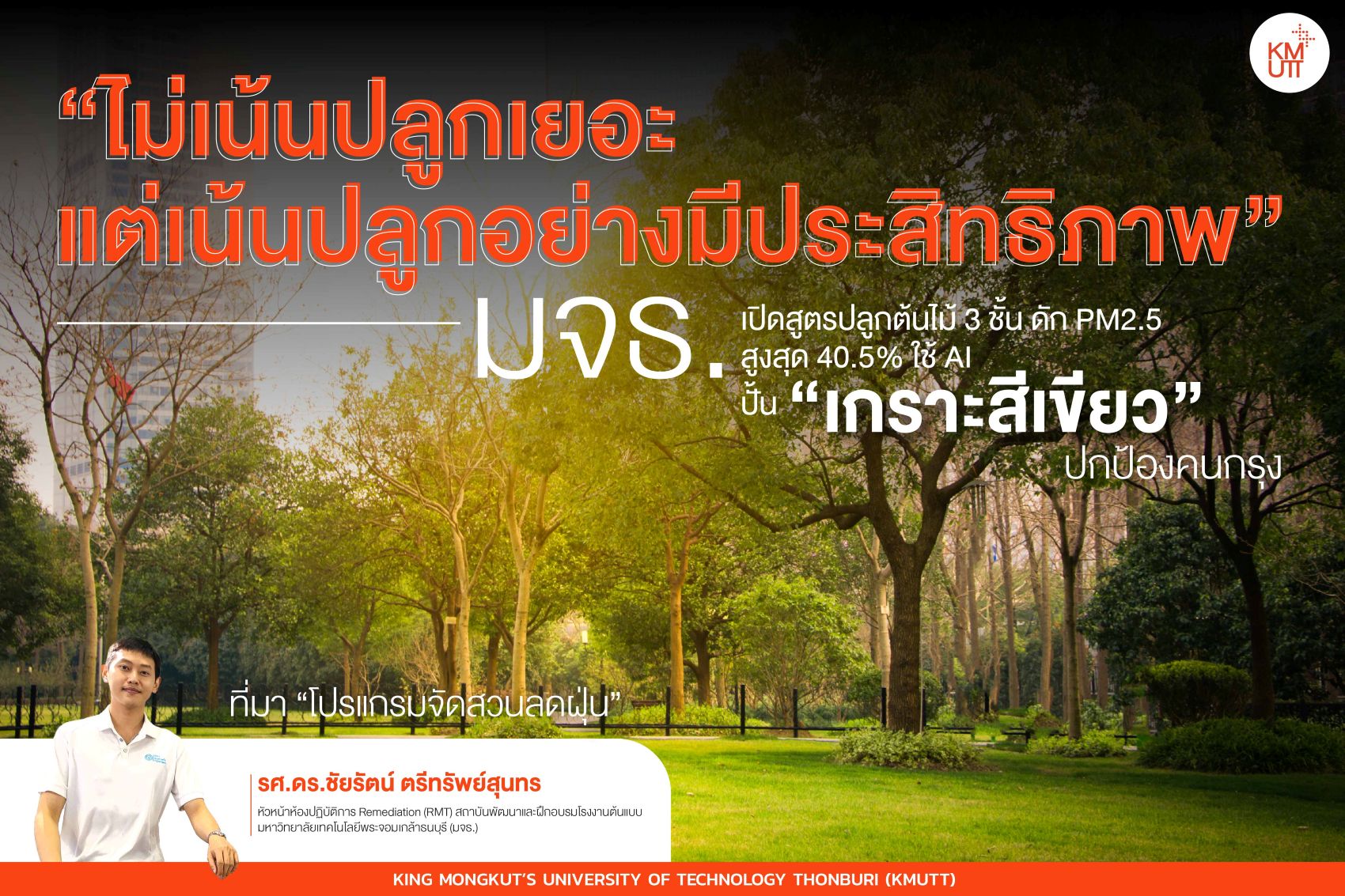
The challenge of PM2.5 in Bangkok involves urban design and management, as data indicates that sources of PM2.5 include diesel vehicles at 46%, biomass burning at 22%, secondary particles at 14%, gasoline vehicles at 11%, and other sources at 7%. Consequently, the role of "trees" has evolved from areas designed for shade and aesthetics to "green spaces that reduce dust" by integrating plant knowledge and phytoremediation processes with AI technology, sensor systems, and three-dimensional simulation software. This integration aims to determine which tree species to plant and how to arrange them to create a "green wall" that traps urban dust with maximum efficiency.
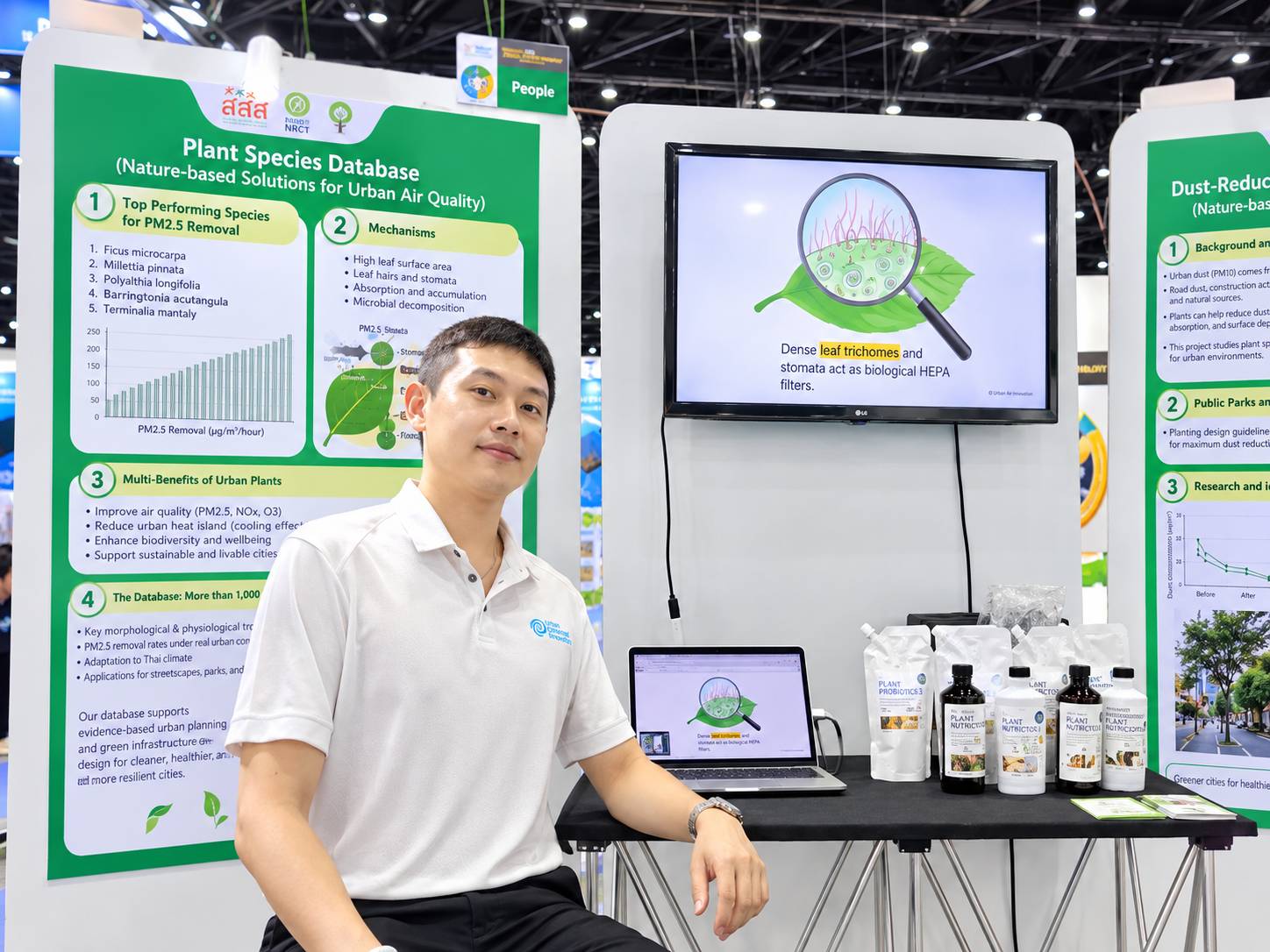
This initiative led to Assoc. Prof. Dr. Chairat Treesubsuntorn, a lecturer in the Integrated Biotechnology and Innovation program at the Faculty of Biotechnology and Technology, and head of the Remediation (RMT) Laboratory at the Pilot Plant Development and Training Institute, King Mongkut's University of Technology Thonburi (KMUTT), along with the research team, developed "Dust-Reducing Garden Design Program" to predict the efficiency of dust-reducing gardens. The program comprises 73 Thai plant species, categorized into 51 ornamental plants, 13 trees, and 9 shrubs.Each plant species exhibits varying dust-reduction efficiency. This efficiency depends on leaf characteristics, including stomatal density, leaf hairs, surface roughness, and wax layers. Plants with high potential include Delonix regia (Kallaphruek), Neon, and Magnolia, as well as Polypodium aureum (Fern Chao Luang), Polypodiaceae (Fern Mai Makham), Pothos, Clivia group, and Zamioculcas zamiifolia (Guak Morakot). Furthermore, nighttime leaf moisture acts as a natural adhesive, enhancing dust adhesion and potentially increasing dust-trapping efficiency under certain conditions. However, when plants face accumulated dust and continuous stress, this efficiency can decrease.
"Trees experience significant stress when exposed to high levels of accumulated dust. They respond by closing their stomata to conserve water and sometimes become confused, mistaking daytime for nighttime. When stress reaches a critical point, they shed their leaves and cease functioning immediately. Therefore, our research does not stop at asking "which tree species traps dust effectively" but must also address how to maintain plants' dust-trapping efficiency continuously under real urban environmental conditions," said Assoc. Prof. Dr. Chairat.
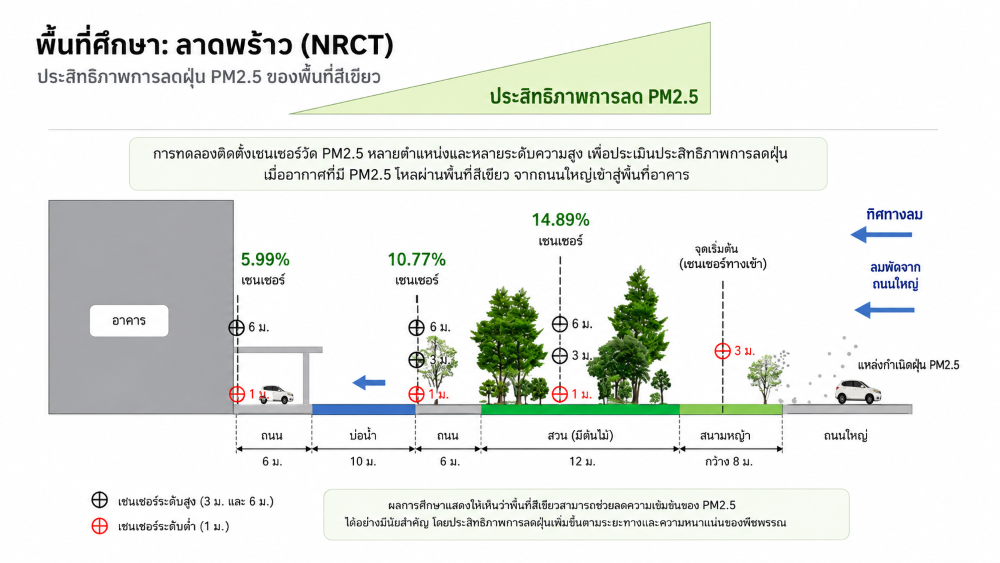
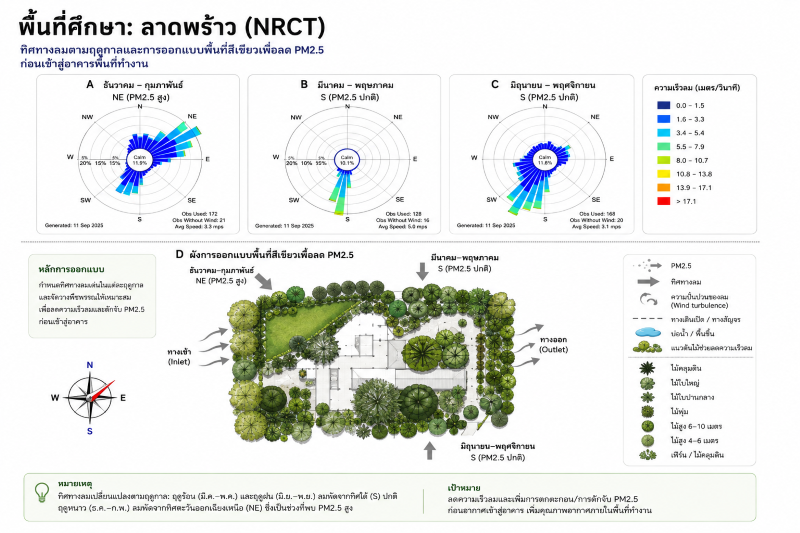
A pivotal moment in the research occurred when the team discovered that selecting tree species alone was insufficient because "planting patterns and tree arrangement" directly affect dust-trapping efficiency. Consequently,they developed a multi-level plant arrangement (Multi-Tiered Planting Configuration) by combining ground cover, shrubs, and tall-canopy trees to capture and slow air movement at various levels. Study results indicate that a 3-tier configuration, with appropriate spacing for each level, can reduce dust by up to 40.5% during the dusty season, increase relative humidity by approximately 9.9%, and reduce turbulent wind speed, thereby increasing the likelihood of dust settling or being trapped on plants. In contrast, single-layer or thin barrier arrangements yield results of approximately 6–8.2%, reflecting that addressing urban PM2.5 is not merely about the "number of trees" but that "green space design" is equally important.
The research team further advanced plant knowledge by developing Predictive Multi-Layer Green Space Design Simulator a Predictive Multi-Layer Green Space Design Simulator, a three-dimensional environment simulation software that compiles a database of dust-reduction efficiency for 73 plant species, integrating air and dust movement calculations based on wind direction and adjustable initial dust concentration. Users can freely select plant species, density, canopy layers, wind direction, and garden layout before actual planting. The program automatically predicts dust-reduction efficiency using equations derived from actual laboratory research results. Currently, the program is ready for practical use and public dissemination.
Additionally, alongside using AI to analyze air quality data from 70 sensors across Bangkok over four consecutive years (2021-2024), it was found that parks in Bangkok Metropolitan Administration, such as Benchakitti Park and Lumpini Park, have an average PM2.5 concentration of 20.40 micrograms per cubic meter, compared to 26.81 micrograms per cubic meter in roadside areas. This reflects the potential of green spaces as part of the city's air quality infrastructure.
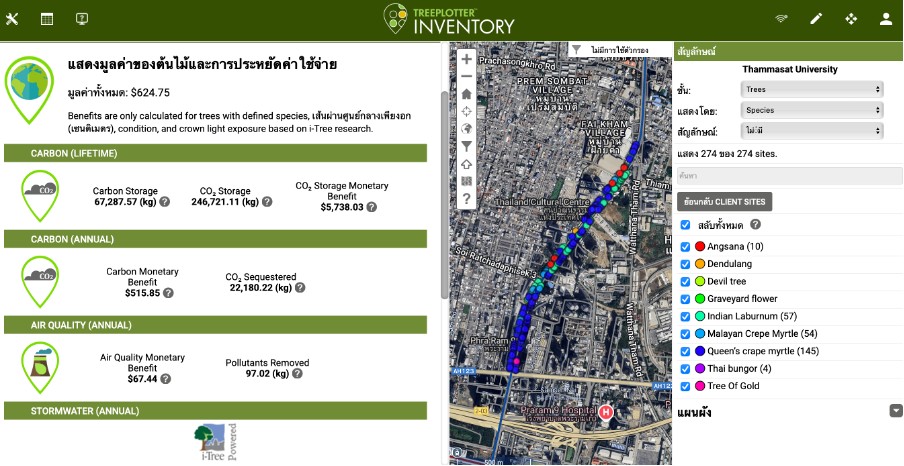
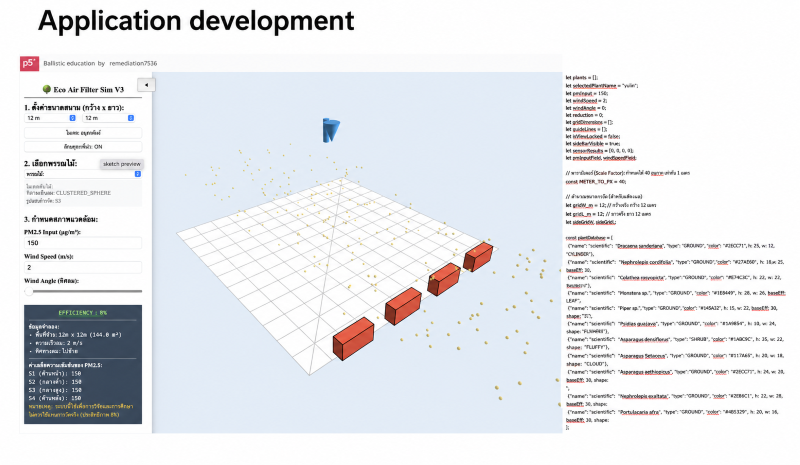
"The use of data and AI enables us to design green spaces not merely based on intuition regarding where to plant what for aesthetic purposes, but through analysis to determine which plant species to use, at what density, and how to arrange the canopy layers, given that dust originates from this direction, wind blows in this manner, and buildings have this form, in order to reduce the dispersion of dust to areas with the highest human usage. Technology thus confirms that green spaces are not solely a matter of aesthetics but can be designed as environmental infrastructure for the city," said Assoc. Prof. Dr. Chairat Treesubsuntorn.
Currently, the research results have entered the testing phase in real-world areas through collaboration between King Mongkut's University of Technology Thonburi, Bangkok Metropolitan Administration, Environmental Department, and Din Daeng District Office, with a pilot project launched along Ratchadaphisek Road in the Fortune Town area to survey physical conditions and utilize plant data to assist in designing green spaces using AI in relation to wind direction, pollution sources, and building forms. If this approach can be scaled up, areas where the public has a high exposure to dust, such as roadsides, schools, hospitals, bus stops, or sidewalks, may be designed to have plant lines that systematically function to reduce dust dispersion.
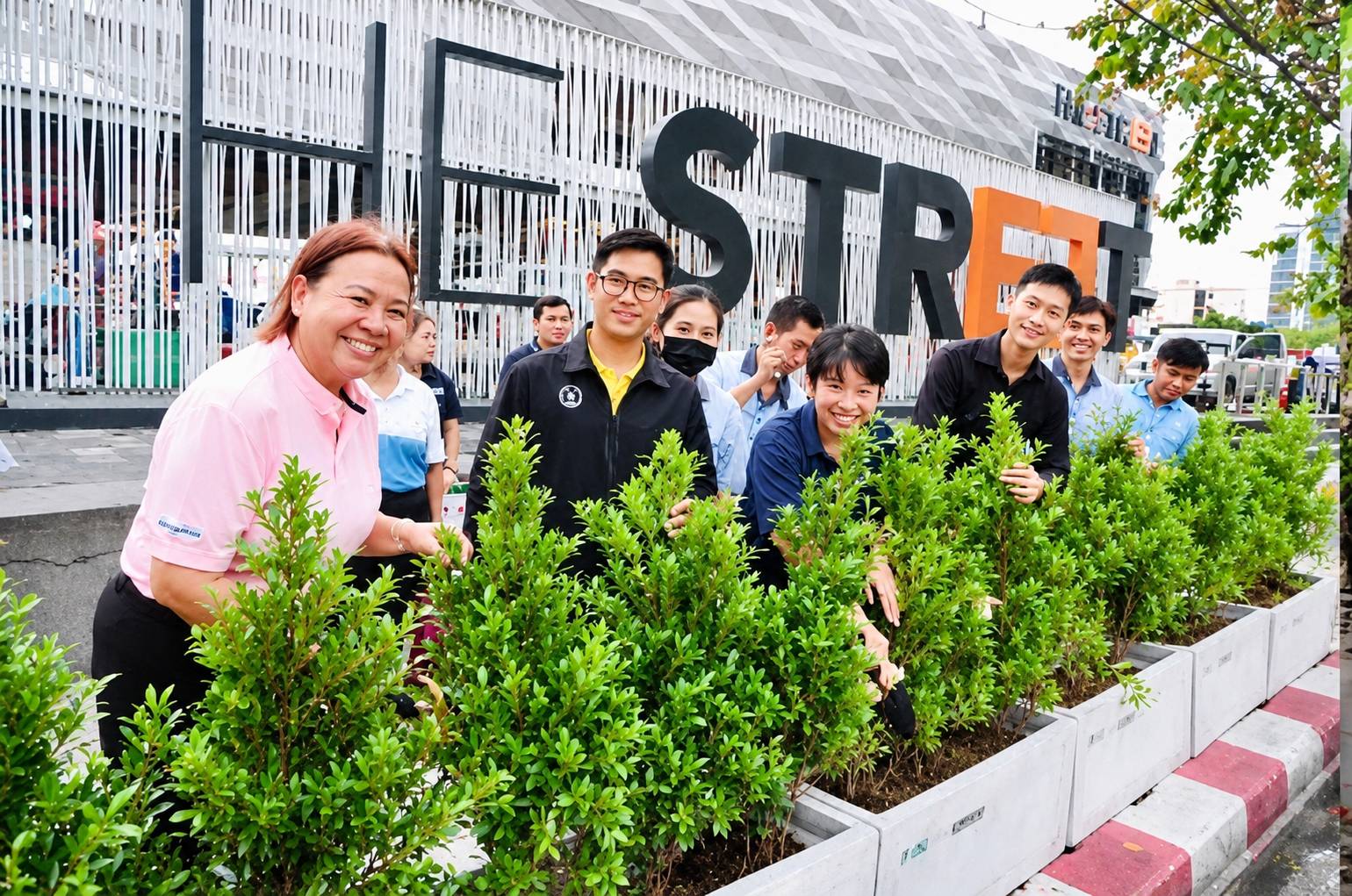
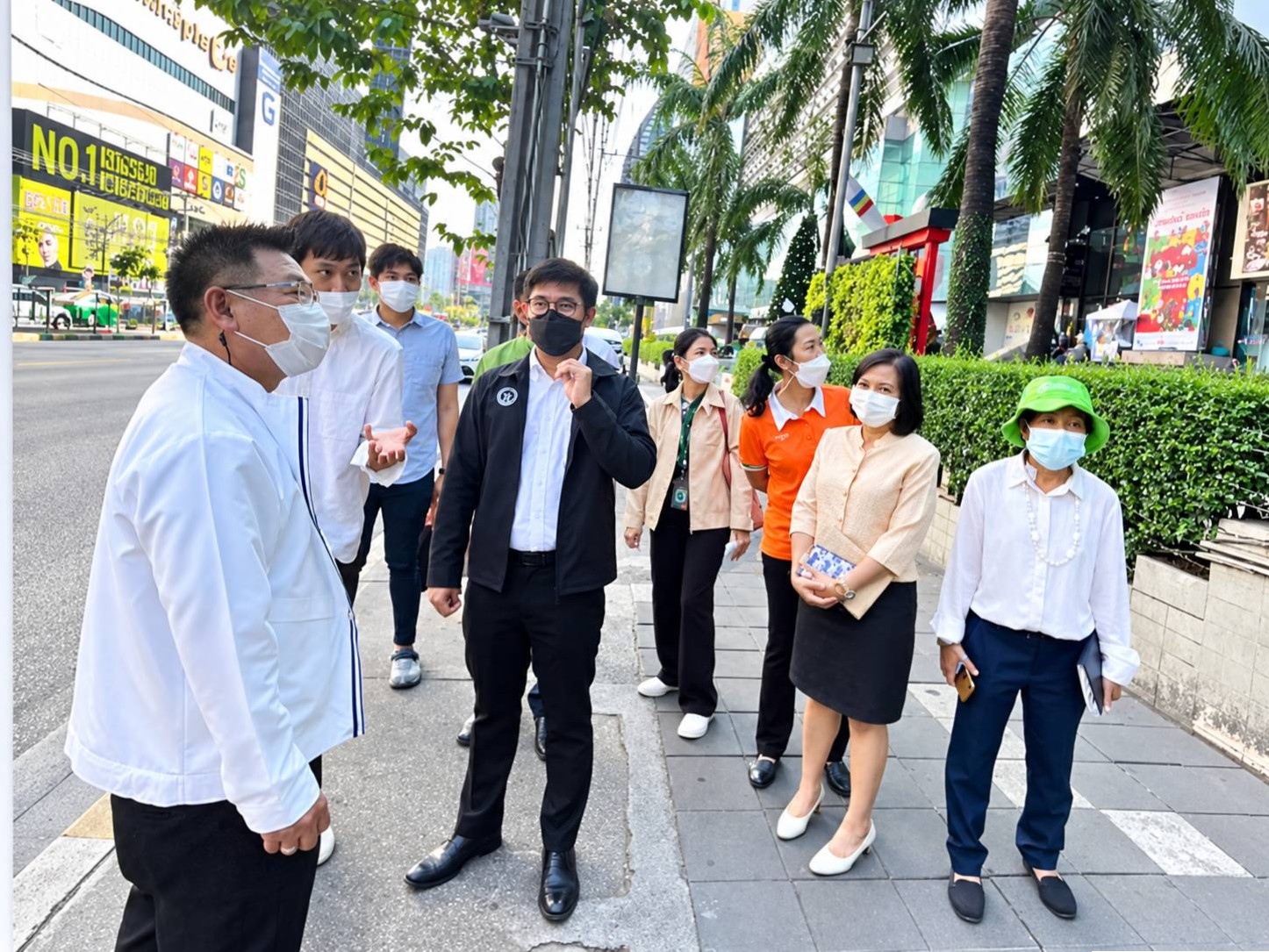
"What we wish to see is a network of 'Clean Zones' distributed throughout the city, ‘Clean Zones’ where each area is designed according to its own context, because the challenge is not merely increasing the number of trees but making green spaces have clear functions. This approach does not replace controlling pollution at the source but serves as an additional layer of prevention to reduce public dust exposure and elevate trees from landscape elements to become 'green infrastructure' for the city. "green infrastructure"" for the city," said Assoc. Prof. Dr. Chairat Treesubsuntorn.
The development of green spaces has shifted from measuring success by "the number of trees" to considering "the efficiency of trees" and the resulting impacts on urban residents. Therefore, integrating nature with science and technology may be another important tool for designing modern cities, ensuring that green spaces not only provide shade and aesthetics but also play a role in addressing pollution and creating an environment conducive to the long-term health of the public.
Related News

KMUTT Students Develop "SIRINAPHA: Baan-Pla Link (House-Fish Link)" Using Satellite and AI to Assist Local Fishermen in Identifying Fishing Areas
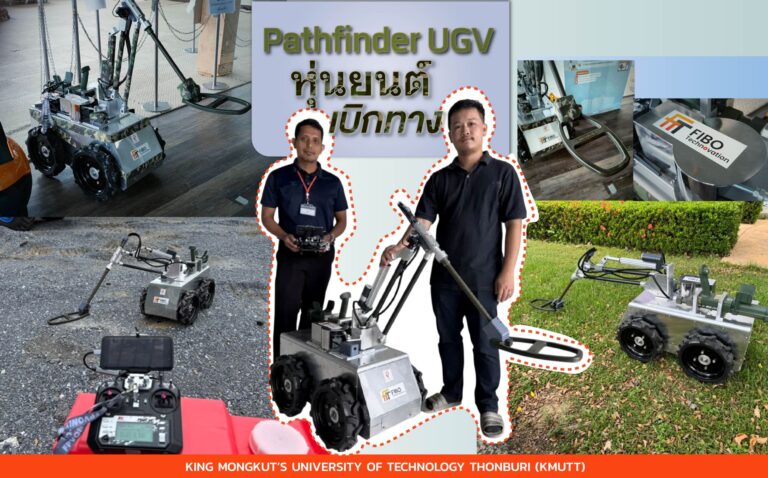
Pathfinder UGV: Pioneering Robot for FIBO KMUTT – Frontier Innovation and New Hope for Protecting Thai Soldiers' Lives and National Security