

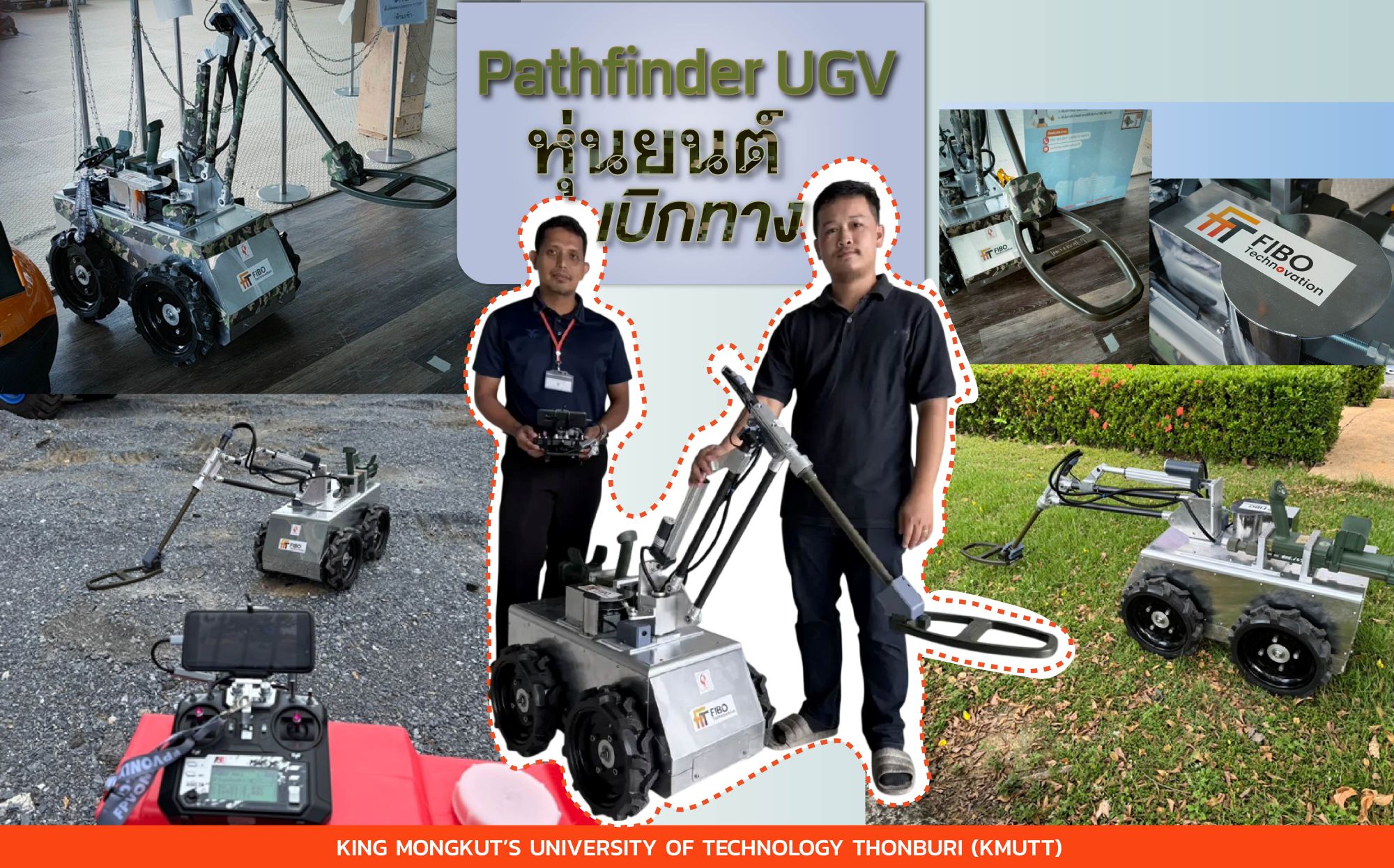
While most Thais live their daily lives normally in safe cities and communities, many border patrol officers, explosive ordnance disposal (EOD) personnel, and civilians along the border must live with the risk of “landmines” and “unexploded ordnance from past conflicts” hidden underground. This is an invisible risk; every step taken into such areas requires utmost caution, as a single mistake could mean the loss of life, limbs, or property for the personnel and innocent civilians in the area.
Addressing this challenge, researchers and developers of FIBO Technovation, namely Mr. Boonlert Manichai, Mr. Supakorn Chancharoensee, Mr. Atithi Jullakananuthat, Mr. Theerapat Khemwesaranawut, Mr. Thatsaporn Boonthai, and Mr. Isarin Sae-Suangneun fromthe Institute of Field Robotics (FIBO), King Mongkut’s University of Technology Thonburi, jointly developed “Pathfinder UGV” or “Pioneering Robot” a remote-controlled ground robot innovation designed to perform tasks in hazardous areas instead of humans, reducing risks to personnel’s lives and enhancing efficiency in detecting and locating landmines and unexploded ordnance that have not yet been cleared and destroyed.
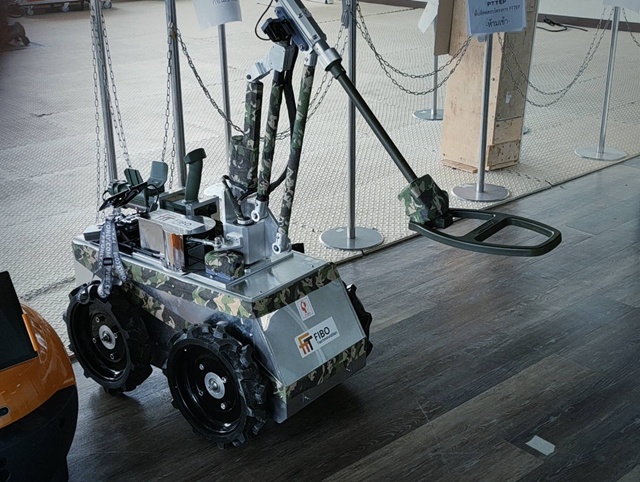
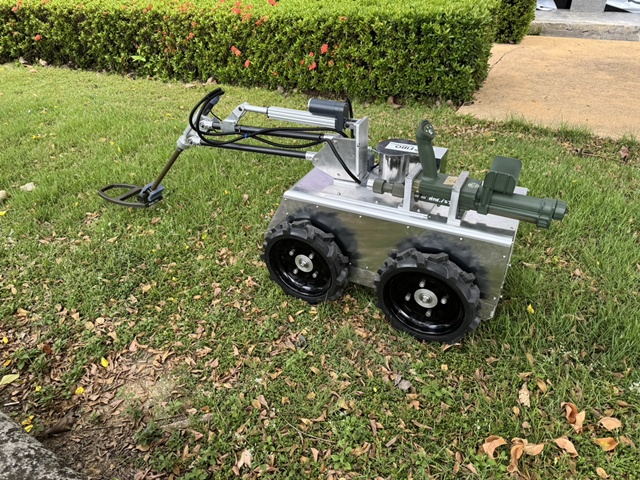
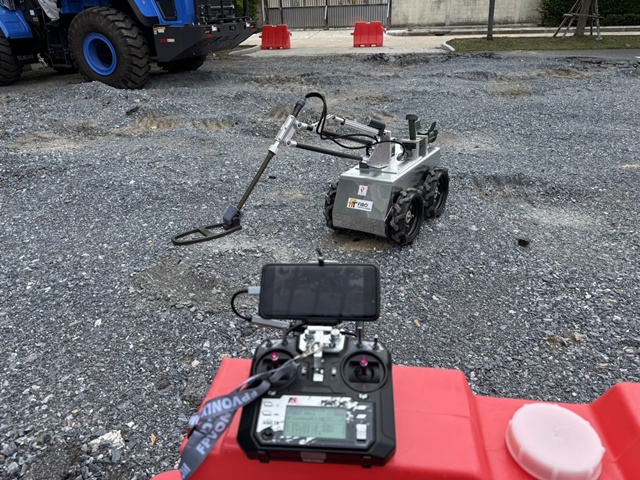
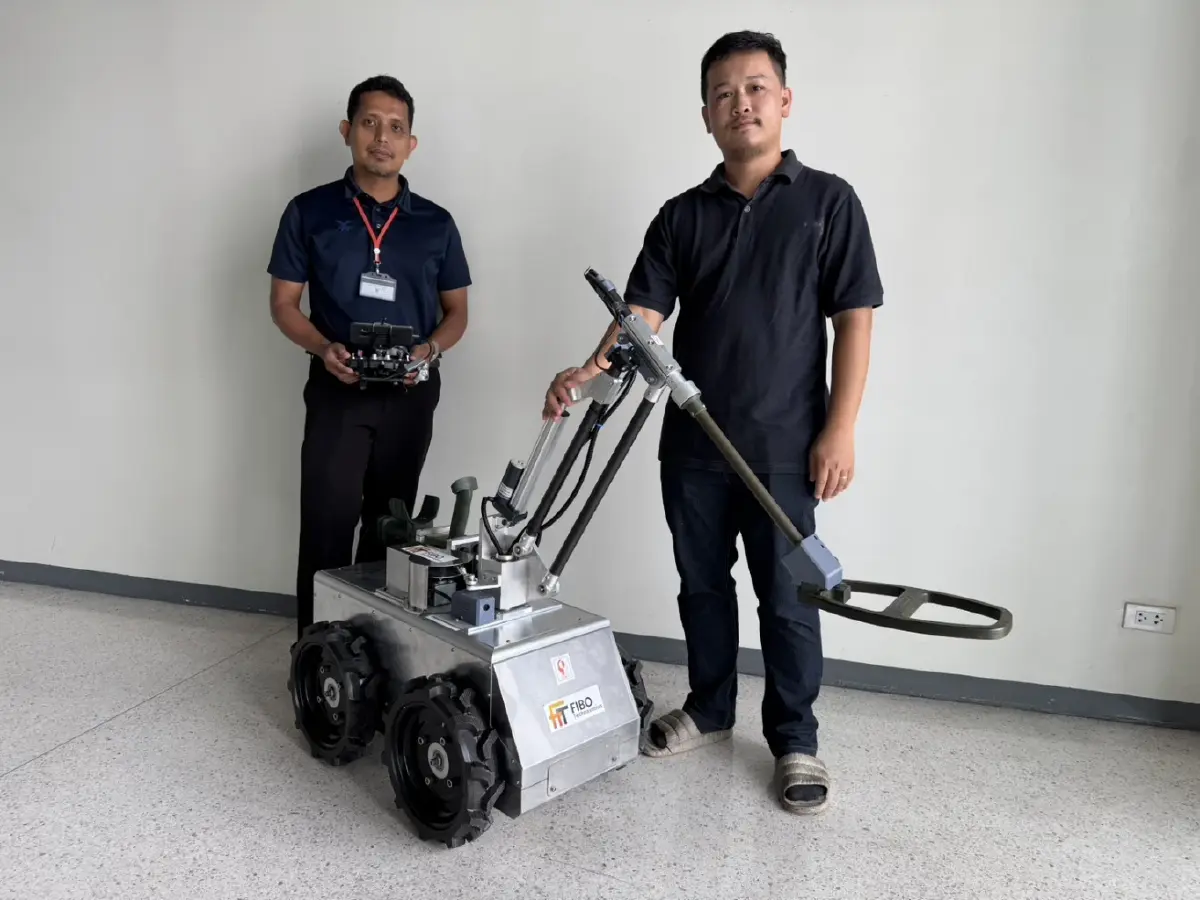
Mr. Boonlert stated that the research team has been developing the Pioneering Robot continuously. They initially studied quadruped robots with high agility but found that the development and maintenance costs were excessively high for practical use in risky areas. Consequently, they shifted their concept to developing wheeled robots that are simple, robust, and better suited to mission requirements. “Our goal is not to create the most complex robot, but to build tools that genuinely reduce risks for personnel. We designed the Pathfinder UGV under the concept of a robot ready to perform missions in hazardous areas at an appropriate cost. If damage occurs, it can be repaired or replaced quickly because it uses domestically available equipment and technology. Importantly, if the robot breaks, we can build a new one, but the lives of personnel cannot be replaced. This is the reason we developed this technology to allow the robot to accept risks instead of humans in hazardous areas.”the robot to accept risks instead of humans in hazardous areas.”
The development of the Pathfinder UGV began with the requirements of theNational Mine Action Center (TMAC) TMAC), which sought a tool for detecting landmines and unexploded ordnance that is practical for field use and costs no more than 100,000 baht. The research team designed the robot to best meet personnel’s usage needs in terms of agility, accuracy, and safety. It is equipped with a metal detector that can be adjusted according to the mission, along with an automatic leveling system for the sensor head that ensures efficient scanning even in rough terrain. The robot can detect underground metal at a depth of approximately 0.5 to 1 meter, covering a front area width of about 1 meter, and transmits real-time images from its camera to the operator’s smartphone. The operator can work from a distance of approximately 20 to 30 meters from the risky area, a range that ensures their safety from blast injuries. “We designed every component based on the actual working conditions of personnel, from the vehicle width of only 50 centimeters, which matches the width of a human to facilitate movement through forest paths, to the alert system when suspicious objects are detected. The goal is for the robot to serve as the vanguard in surveying hazardous areas, enabling personnel to work more safely and efficiently,” Mr. Supakorn stated.
Currently, the Pathfinder UGV has passed testing and reached Technology Readiness Level (TRL) 7 and System Readiness Level (SRL) 7, meaning it can be used and tested in real-world environments, including readiness for technology transfer and user training. The research team jointly tested with the National Mine Action Center (TMAC) in conditions similar to actual operations, including grassy fields, rocky surfaces, and areas with tree roots, using simulated metal bomb casings as detection targets. The test results showed that the robot can detect and locate objects with an accuracy level of 80-90%. “The results are a positive sign that the system can genuinely support field missions. However, we continue to develop further, particularly by improving the wheel system to better cross tree roots or large obstacles, and enhancing communication system stability in high-humidity areas to ensure the robot is ready for use in increasingly challenging environments in the future,” Mr. Supakorn stated regarding future development.
The robot can detect and locate objects with an accuracy level of80-90%. 80-90%
“The results obtained are a positive sign that the system can genuinely support field missions. However, we continue to develop further, particularly by improving the wheel system to better cross tree roots or large obstacles, and enhancing communication system stability in high-humidity areas to ensure the robot is ready for use in increasingly challenging environments in the future,” Mr. Supakorn stated regarding future development.
Mr. Boonlert stated that the value of the Pathfinder UGV lies not only in the robot or technology itself but in the impact on people’s lives and national security. “With a production cost of approximately 100,000 baht per unit, we can develop technology that reduces reliance on imported systems costing millions of baht from abroad. Simultaneously, by using domestically available equipment, we can repair, replicate, and extend the technology rapidly, which benefits both Thailand’s robotics industry and its technology supply chain. However, the most important aspect is reducing risks for personnel who must operate in hazardous areas. Every time the robot is sent to inspect an area beforehand, it means increased chances of human safety, reduced family anxiety, minimized organizational losses, and enhanced confidence among civilians in risky areas. Furthermore, this technology can be extended to search and rescue missions, disaster area surveys, or other security missions in the future. Thus, it represents research investment that generates returns simultaneously in economic, social, and national security dimensions.”
Pathfinder UGV is another example of Thai research that builds upon real national challenges to develop technology that protects lives through Thai knowledge and development. The value of this innovation does not lie in the robot itself, but in the increased safety of personnel and communities in high-risk areas. This reflects Thailand’s potential to independently develop security technology. It is an innovation that truly cares for Thai people and the nation.
Related News

KMUTT Students Develop "SIRINAPHA: Baan-Pla Link (House-Fish Link)" Using Satellite and AI to Assist Local Fishermen in Identifying Fishing Areas

"Not Focusing on Quantity but on Efficiency": KMUTT Unveils a 3-Tier Tree Planting Formula to Trap Up to 40.5% of PM2.5, Using AI to Forge a "Green Shield" to Protect Bangkok Residents