

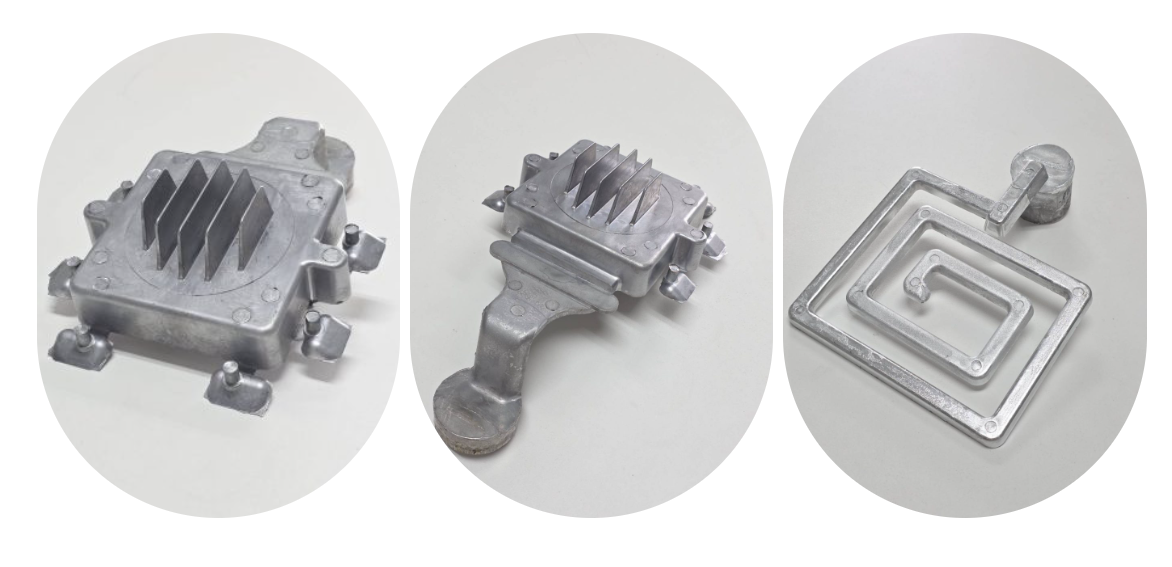
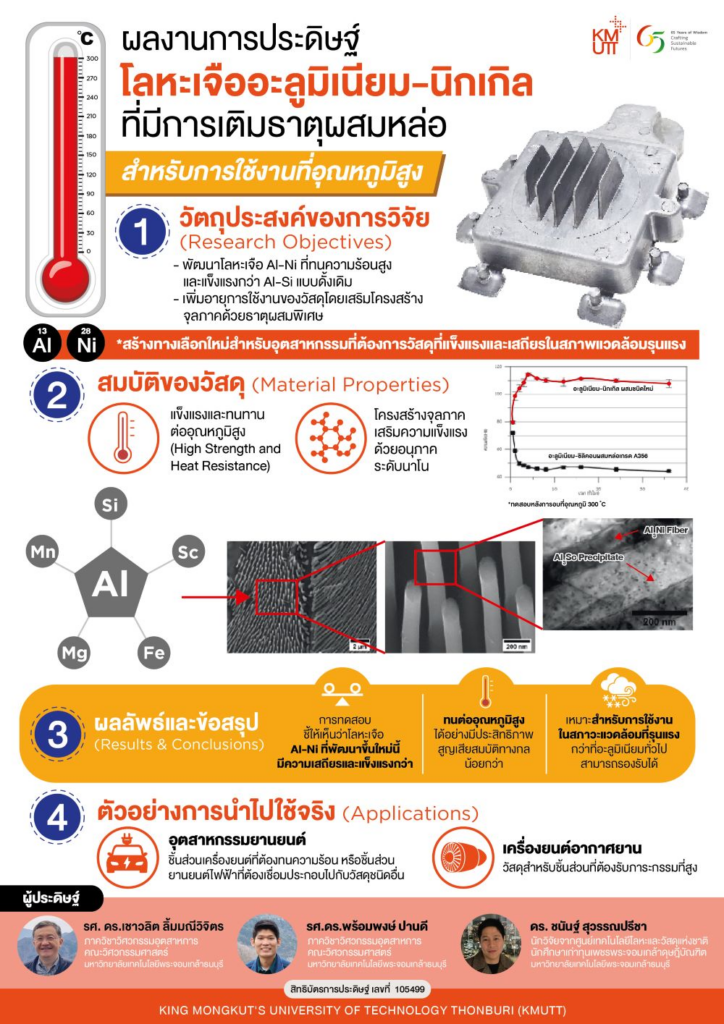
A research team from King Mongkut’s University of Technology Thonburi (KMUTT) has developed a new type of aluminum alloy with high heat resistance and superior strength compared to traditional Aluminum-Silicon alloys. By utilizing a blend of Aluminum-Nickel and rare earth elements like Scandium (Sc), this innovation extends material lifespan and offers a new alternative for industries requiring high-performance materials stable in extreme environments. The technology is poised for application in modern automotive industries, particularly for Electric Vehicles (EVs) and Giga Casting technology.
For over 10 years, Assoc. Prof. Dr. Chaowalit Limmaneevichitr and Assoc.Prof.Dr. Phromphong Pandee, researchers from the Department of Production Engineering, Faculty of Engineering at KMUTT, alongside Dr. Chanun Suwanpreecha (a Petchra Pra Jom Klao Doctoral Scholarship alumnus and current researcher at the National Metal and Materials Technology Center – MTEC), have collaborated on this advancement. Their work focuses on designing a fiber structure of strong phases combined with a metal matrix reinforced by nano-scale particles that maintain strength even at high temperatures.
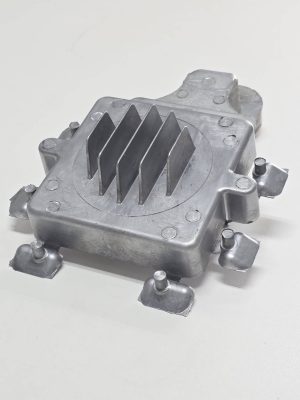
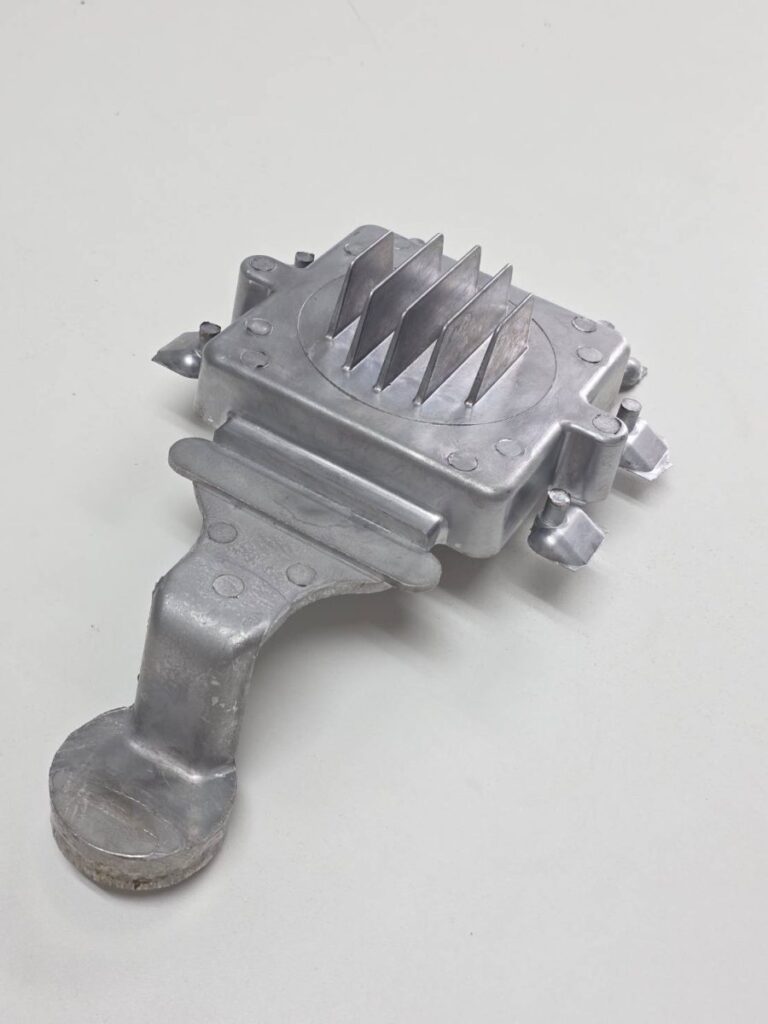
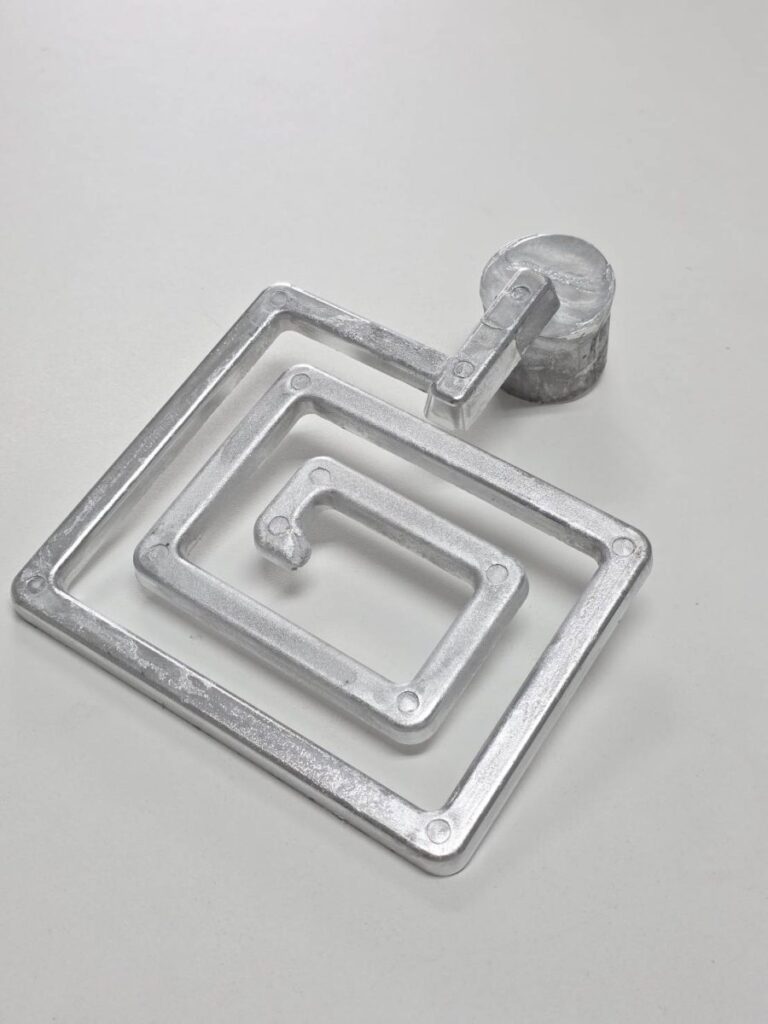
Assoc. Prof. Dr. Chaowalit explained the research origin: “A major point of interest in materials science is inventing alloys that can withstand high heat while remaining lightweight and strong. Aluminum (Al) is high-strength and lightweight compared to metals like steel and copper. However, its limitation is its lack of heat resistance. Traditional aluminum grades lose performance very quickly when exposed to high temperatures, making them unsuitable for such environments.”
The “Secret Recipe”: Nickel and Scandium
To solve this, the team replaced Silicon with Nickel (Ni) in the traditional aluminum alloy. They discovered that this creates fibers of the compound Aluminum-Nickel (Al3Ni) within the structure, acting as a high-heat-resistant reinforcing core. However, using Nickel alone did not yield the desired results. The team needed a “secret recipe” a “seasoning” for the metal which led them to Rare Earth elements like Scandium (Sc).
“Scandium is a ‘secret recipe’ that has never been infused into this grade of aluminum before. It possesses a very low diffusion coefficient in aluminum and low solid solubility. Adding Scandium creates nano-sized particles (roughly 1,000 times smaller than a micrometer) dispersed throughout the aluminum. These nano-particles of Aluminum-Scandium (Al3Sc) reinforce both the $Al_3Ni$ fibers and the aluminum matrix, resulting in a material with exceptionally high strength and heat resistance,” added Assoc. Prof. Dr. Chaowalit.
Applications in Giga Casting and Modern Engines
This heat-resistant aluminum is targeted for high-temperature engineering parts, such as:
- High-compression diesel engine cylinder heads where combustion temperatures are rising.
- Jet engine components where standard aluminum might crack or deform.
- Solid-state welding processes for joining different grades of aluminum or joining aluminum to steel in automotive manufacturing.
Specifically for EVs, there is a demand to reduce structural weight to compensate for heavy batteries, thereby increasing driving range. Furthermore, the material supports Giga Casting, a new trend in the EV industry (famously used by Tesla and other major manufacturers). This technology uses massive casting machines to produce large structural components as a few single pieces rather than welding hundreds of smaller parts together (e.g., reducing 171 parts to just 2).
“Reducing parts saves time, production costs, and increases structural strength due to fewer joints. Materials used in Giga Casting must have high strength and the ability to be welded with other materials. This heat-resistant aluminum meets those needs perfectly,” said Assoc. Prof. Dr. Chaowalit.



From Lab to National Technology Ownership
While successful in the laboratory, published in world-class journals, and officially patented, the team acknowledges challenges in practical scaling. Long-term property testing and industrial partnerships are the next crucial steps.
“We want to work with the industry to test this material on a larger scale. For Thailand to transition from a contract manufacturer to a technology owner and brand creator, it is vital for the government (research institutes/universities) and the private sector to work together. Universities create new knowledge and patents, while the private sector must dare to invest and test these researches in clear applications. Working together from the initial research question will ensure the innovation is ready for use much faster.”
This research reflects a determined effort by Thais to create “Material Technology” that can compete globally. If successfully adopted, this material could mark the beginning of Thailand’s shift from an “order-taker” to a “technology creator” in the future.
Related News

‘Plant-Based Caviar’: KMUTT Students’ Food Innovation Clinches National Gold, Ready for Global Market Expansion

KMUTT Mechanical Engineering Students and Faculty Clinch Gold Medal from NRCT with Microchannel Heat Sink Innovation for Future Data Centers



