In an era where massive amounts of data from data centers and AI systems must be processed within fractions of a second, the “heat” generated during the process has become a major obstacle to technological development. Excessive heat accumulation causes processing units to lose efficiency, slows down components, and can lead to permanent damage. Therefore, efficient thermal management is the key to advancing high-level processing technology.
Faculty and students from the Department of Mechanical Engineering, Faculty of Engineering at King Mongkut’s University of Technology Thonburi (KMUTT), have collaboratively developed a new cooling system innovation. Their project, “Open Microchannel Heat Sink for Innovative Data Center Cooling System,” won the Gold Medal at the 2025 International Invention and Innovation Contest, organized by the National Research Council of Thailand (NRCT).

This achievement is the work of senior students: Mr. Thanakorn Thammasiraruk, Mr. Kesorn Thong-on, and Mr. Tulathorn Det-supha, who continued their development under the guidance of Dr. Pakorn Wongpromma and Prof. Dr. Somchai Wongwises as research advisors. The objective was to design a microchannel heat sink capable of faster and more efficient heat dissipation, particularly for high-energy systems such as CPUs, data centers, and AI processing chips.
The heart of this technology is the design of an Open Microchannel flow path with grooved side walls. This increases the surface area in contact with the refrigerant, leading to a better phase change from liquid to vapor. This phase change significantly increases the heat transfer rate.
“The main goal of this research group is to develop a heat sink with higher efficiency. Our previous research featured a heat sink with very small flow channels, known as microchannels. Typically, these channels are rectangular with flat side surfaces along the edges. However, we came up with the idea to further improve performance by redesigning the grooves to have curved side surfaces to increase the heat exchange area. We found that changing the side surface to a curved shape significantly affects efficiency, cooling up to 120% better than traditional designs,” said Mr. Thanakorn Thammasiraruk, discussing the concept of the research.
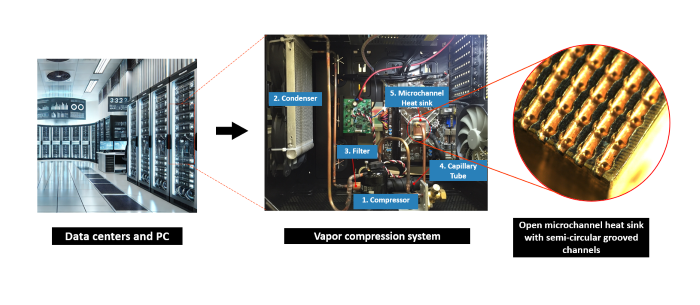
The ability to dissipate large amounts of heat rapidly not only extends the lifespan of the equipment but also directly impacts processing stability. For instance, if a CPU cannot reduce its temperature in time, the processor’s speed may drop. Therefore, this innovation enhances the capability of devices in terms of both speed and durability.
“The refrigerant we chose is also a crucial part. We selected R-513A because it has a very low GWP (Global Warming Potential) compared to others. We felt that since we were experimenting, we should use a refrigerant that is as environmentally friendly as possible,” explained Mr. Kesorn Thong-on, regarding the researchers’ environmental awareness.
Mr. Tulathorn Det-supha added that the next goal for this research is to apply it to CPUs, which generate the most heat in computers. In the future, it may be used in supercomputers or high-heat computing systems that require high-efficiency cooling to allow processing at full capacity.
“The strength of this team is their courage to think, experiment, and build upon existing work systematically especially the new cooling groove design that truly increases efficiency. This could lead to a shift in industry design trends in the future. Currently, the team is in the process of filing a patent and plans to collaborate with the industry for testing in near-real-world conditions,” added Dr. Pakorn Wongpromma.
“With current technology, we predict that in the future, data especially AI will require more processing and memory. It is unavoidable that we will need high-performance data servers or processing units, which comes at the cost of generating more heat. We see this as a potential problem in the future, so we started looking for solutions in advance. Our heat sink will be one of those solutions,” Mr. Thanakorn Thammasiraruk concluded.
Related News

‘Plant-Based Caviar’: KMUTT Students’ Food Innovation Clinches National Gold, Ready for Global Market Expansion

KMUTT Ratchaburi Launches “Village Education Volunteers (VEV)” Model: A Mechanism to Stop School Dropouts Toward Thailand Zero Dropout Goal