

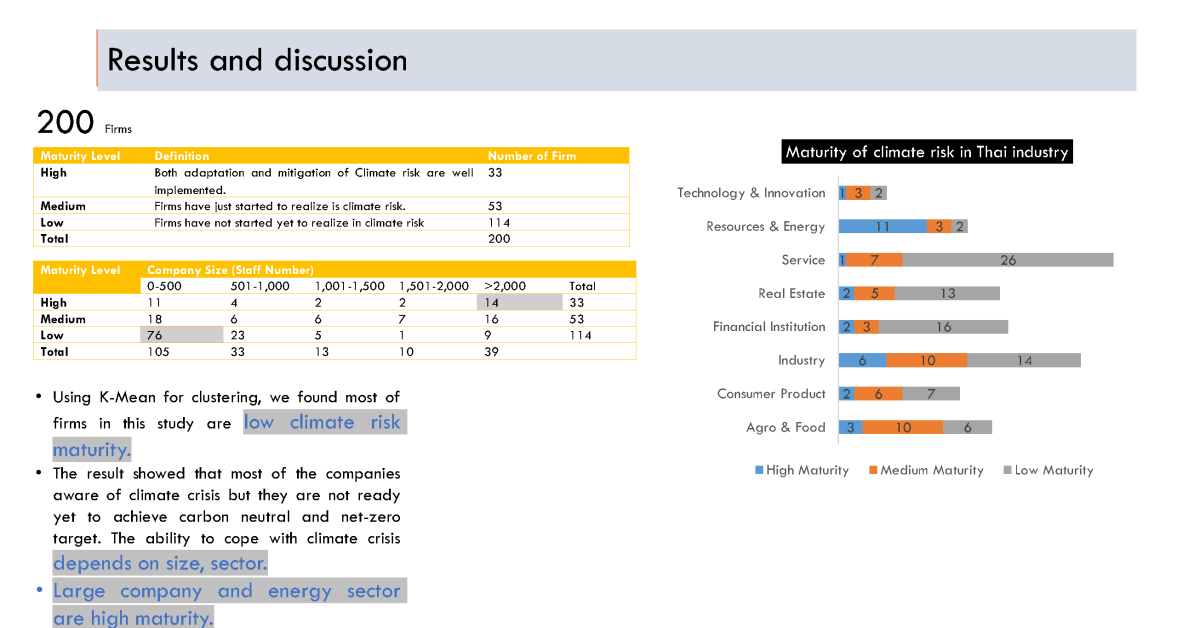
A researcher from King Mongkut’s University of Technology Thonburi (KMUTT) states that Thai industries must prepare for significant impacts as the Climate Change Act takes effect. Research findings reveal that only large-scale industries, energy sectors, and financial institutions are currently prepared for climate risk management. Meanwhile, other sectors, particularly Small and Medium Enterprises (SMEs), have yet to recognize its importance, viewing it as an added investment and burden. The researcher emphasizes that any business failing to accelerate its adaptation to climate change risks its future survival.

Asst. Prof. Dr. Patipan Sae-Lim, Associate Dean for Planning and Quality Assurance and a lecturer at the Graduate School of Management and Innovation (GMI), KMUTT, stated that climate change is an urgent global issue requiring international cooperation. Thailand has joined the Paris Agreement, aiming to limit the global average temperature increase to well below 2 degrees Celsius above pre-industrial levels. The challenge lies in whether Thai industries can control Greenhouse Gas (GHG) emissions to align with this agreement, especially with the Climate Change Act scheduled for enforcement in 2025 (B.E. 2568), which will be a critical turning point for environmental management in the Thai industrial sector.
The research project, “Are We Ready for Climate Change? Climate Change Mitigation and Adaptation Maturity in Thai Industry,” aims to survey the readiness of Thai industries in handling climate change and to develop a statistical measurement model to gauge the level of adaptation and mitigation maturity. Furthermore, it analyzes success factors and presents practical academic policies. This study collected data from eight industrial groups listed on the Stock Exchange of Thailand (SET), supported by research funding from The Asahi Glass Foundation (AF), Japan, in 2022. This marks the first time the foundation has granted funding in the field of Social Sciences, branching out from its traditional focus on science, biology, and the environment.
“We are the first project to receive the Asahi research grant for social research regarding climate change, studying the intersection of business management and science. This 2-year study (2022-2024) collected data from 200 companies across eight industrial groups. We found that while the Thai industrial sector is aware of climate change, interest remains very low. Despite Thailand’s targets for Carbon Neutrality by 2050 and Net Zero by 2065, the private sector has not fully prioritized this. Two years ago, many companies believed climate change did not affect their businesses directly,” said Asst. Prof. Dr. Patipan.
Currently, businesses and industries are beginning to prioritize climate change more seriously as it directly impacts operations, specifically company financial statements due to the Climate Change Act effective this year. This has prompted many industries to prepare for the transition and manage internal risks from disasters such as floods, earthquakes, fires, and PM2.5 dust. However, readiness is concentrated in industries with direct CO2 emissions, such as the oil and gas industry and the automotive industry. These large organizations have the resources to invest and innovate. In contrast, sectors like agriculture and services still show low readiness, viewing it as an added cost and an administrative burden.
Asst. Prof. Dr. Patipan further highlighted a significant shift: financial institutions have shown remarkable adaptation over the past two years. This led to further research applying Machine Learning to climate risk disclosure in financial institutions’ annual reports. As financial institutions are key economic drivers through green loans, using mathematical tools to detect “Greenwashing” (claiming environmental friendliness without actual action) will help classify truly eco-friendly industries according to the Thailand Taxonomy. This project is currently ongoing.
“The measurement prototype used to analyze climate risk management in Thai industry is a statistical model employing mathematical tools to measure readiness. It is divided into two parts: Climate Adaptation and Climate Mitigation. This allows us to cluster industries into low, medium, or high readiness groups. This research reveals the gap between Thailand’s Carbon Neutrality/Net Zero goals and the current reality, both in terms of readiness and data disclosure. If industries are not ready today, Thailand’s goals may not be realized, prompting the question of whether the government needs additional measures or policies,” explained Asst. Prof. Dr. Patipan.
Asst. Prof. Dr. Patipan concluded that this research provides a new perspective: corporate risk management alone is insufficient; global issues must be considered. The grant from The Asahi Glass Foundation served as a vital starting point for serious study and attracted interest from regulatory bodies to expand research with financial institutions.
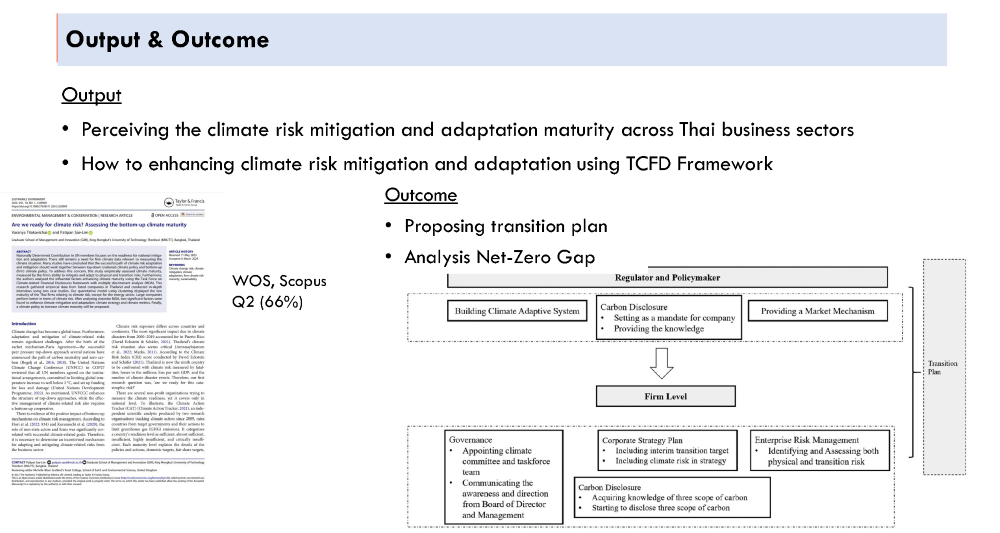
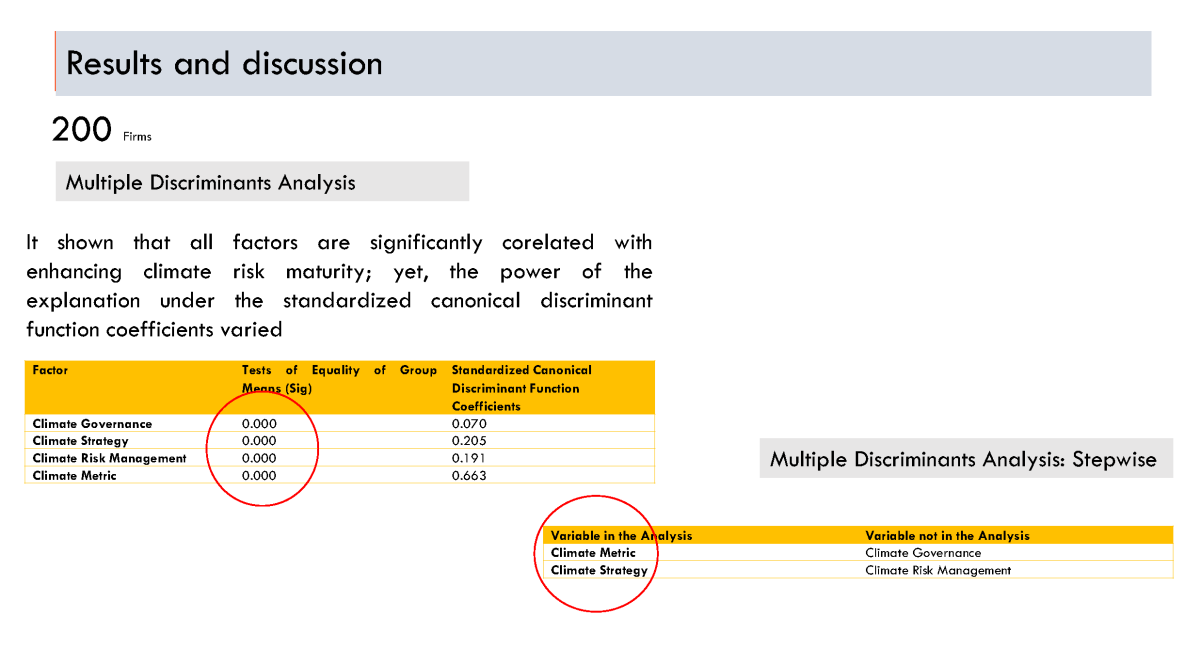
The research suggests that while Thai society is more aware of climate change, it lacks clear driving force. The government must employ both mandatory measures and incentives simultaneously, while establishing a single, clear responsible agency to reduce redundancy and facilitate business. Furthermore, climate change should be integrated into education curricula starting from kindergarten to foster awareness from a young age.
“While many countries try to solve this, none have handled it perfectly. Some choose to relocate production bases rather than sincerely reducing emissions—even countries like Finland or Norway. Therefore, besides entrepreneurs becoming more alert, relevant agencies and the government must have a clear direction and act seriously. If we do not act today, emission reduction will be delayed further. In the future, industries that adapt to climate risk management first will naturally have a greater advantage,” is the policy recommendation from the research.
The deepest challenge identified is that climate change management is inherently difficult and may not reach Net Zero targets without global cooperation. Relocating production or relying solely on carbon credits does not actually reduce overall emissions. This requires global cooperation, which is difficult because carbon emitted today will impact the world in the next 30-40 years. Historically, developed countries bear more responsibility for past emissions compared to developing nations, leading to questions in Asia about why they must commit to Net Zero. However, achieving Net Zero cannot be done by one country alone; it must be a global effort where prepared nations lead the way without leaving anyone behind.
The first success factor for driving Thailand toward Net Zero is leadership, which must be clear and committed. Without it, the Net Zero goals will never become a reality.
Related News

‘Plant-Based Caviar’: KMUTT Students’ Food Innovation Clinches National Gold, Ready for Global Market Expansion

KMUTT Mechanical Engineering Students and Faculty Clinch Gold Medal from NRCT with Microchannel Heat Sink Innovation for Future Data Centers



