

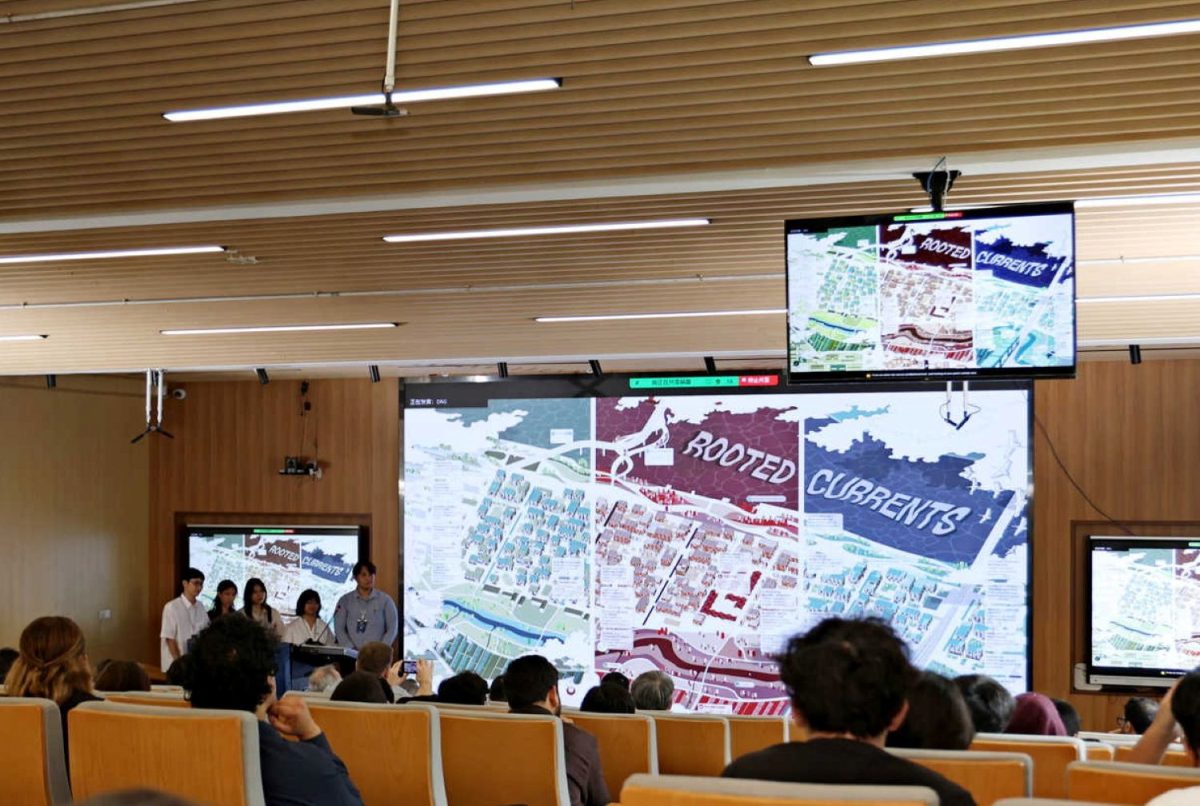
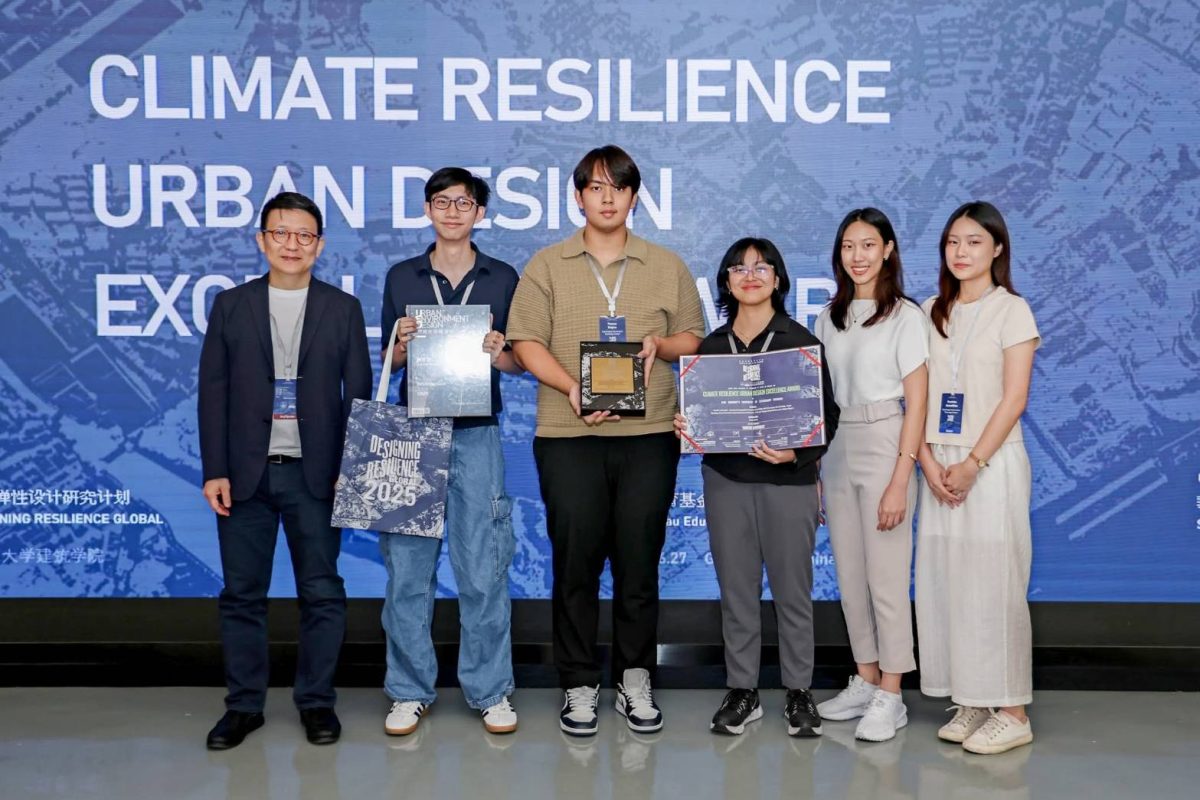
Amidst a warming world and rising sea levels, many cities across the globe are being tested and must find the answer to the question: “How can cities coexist sustainably with nature?” This is the very question that 12 senior students from the School of Architecture and Design (SoA+D) at King Mongkut’s University of Technology Thonburi (KMUTT) set out to answer. Their research resulted in a project titled “Rooted Currents,” which won the international Climate Resilience Urban Design Excellence Award at the Designing Resilience Globally (DRG) 2025 competition in Guangzhou, China. Their concept stands out by not attempting to control nature, but rather to “coexist with water currents and cultural foundations,” leading to a living urban master plan that stands firm in today’s world.
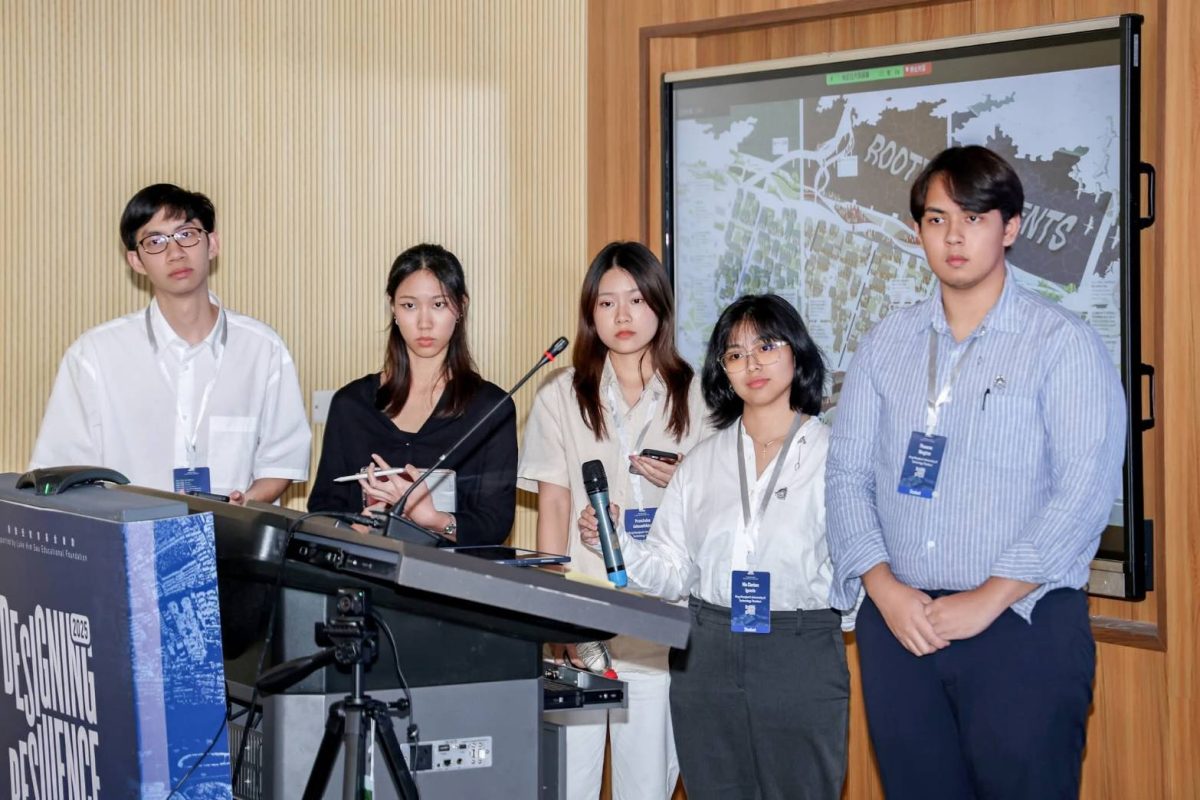
“Rooted Currents” is the result of a collaborative effort between Assoc. Prof. Dr. Martin Schoch and 12 students: Phanthira Ajarapiput, Amornpong Assawapongpookit, Pranchalee Atchasutthikhun, Mia Clarisse Ignacio, May Thet Khaing, Sarapat Kumkhong, Niracha Limsirisakul, Korphai Nontapaoraya, Ei Thandar Oo, Nattaphop Wilawanwajee, Panuratsamee Wongtree, and Phreuknapol Thongbai. Together, they took the real-world challenge of Guangzhou, China, to design a new urban plan that balances living with water.
“We believe that a good city is not the strongest, but the one that is resilient and can learn from nature. Our team intended to design the city to grow alongside the ecosystem and the people’s way of life, rather than growing against the currents of nature,” shared Phanthira, explaining the starting point of the “Rooted Currents” idea.
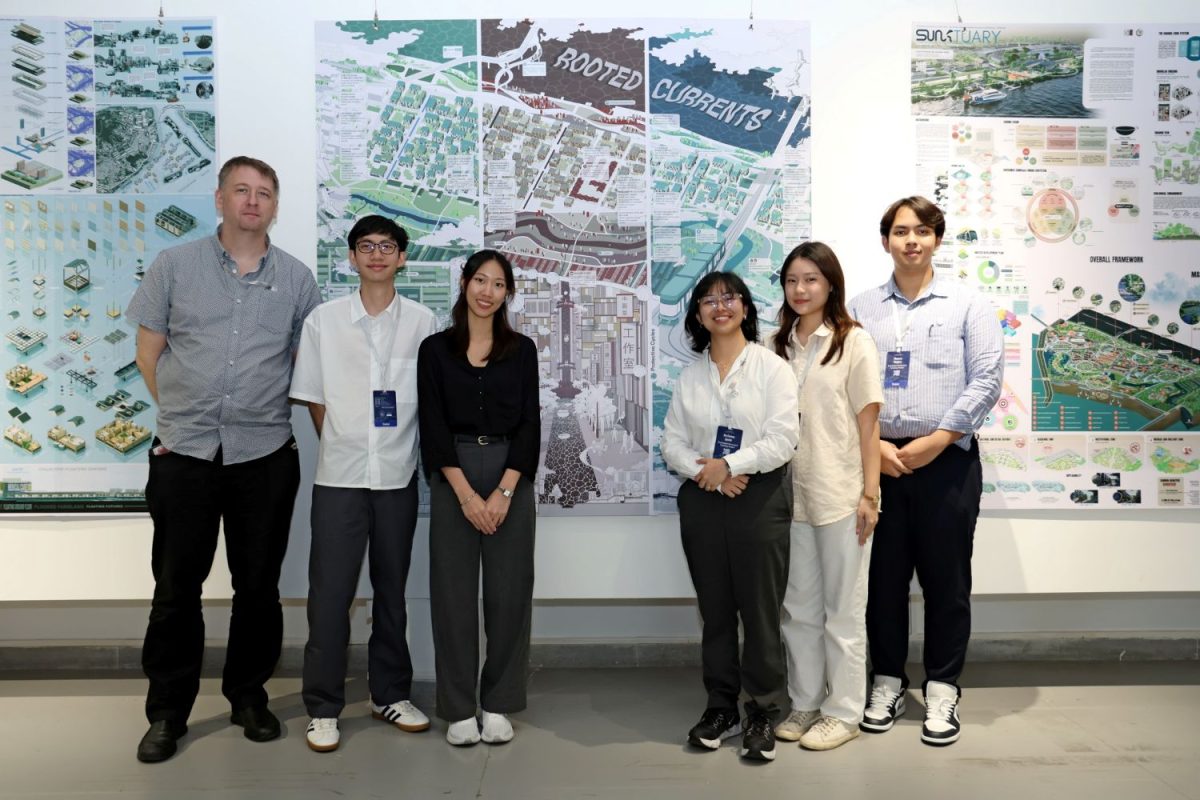
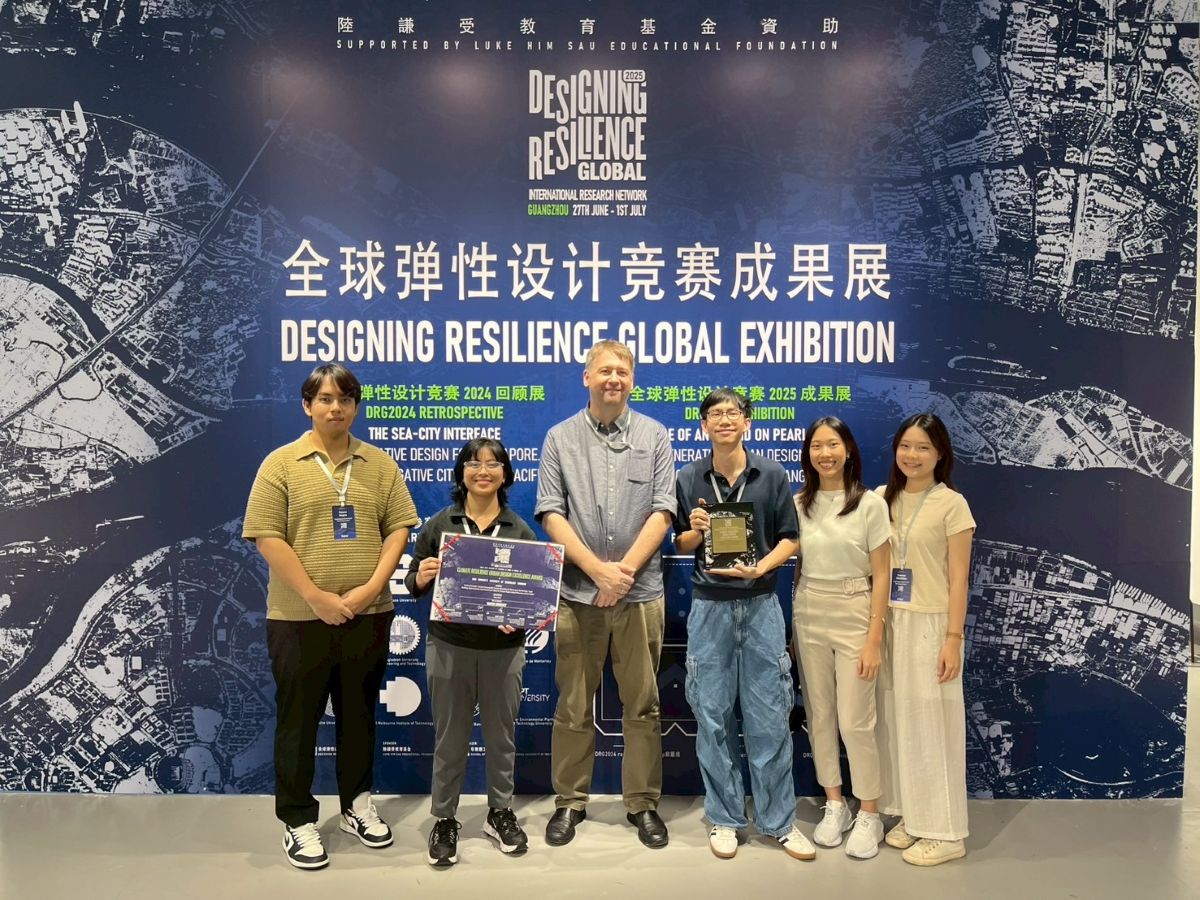
The heart of the project is connecting “People – Culture – Water” to function as a single system. This concept differentiated them from other teams and led the committee to award them first place. This idea is driven by three main strategies that achieve “Urban Resilience” across all dimensions:
Strategy 1: Sustained Living This involves creating a “15-minute city” walkable neighborhood plan, reducing private car usage and increasing access to public services. “The goal is for people of all ages to live life to its full quality by connecting housing, learning, health, and green spaces together,” Nattaphop explained, adding that designing appropriate transportation infrastructure makes the city “compact but not crowded” and ready for long-term changes.
Strategy 2: Embraced Heritage This views traditional culture as a living system rather than a static monument. “We want the younger generation to experience history with their bodies and feelings, not just by reading signs. We believe that when the past can breathe, the city has a soul,” Pranchalee said, describing the method of reviving historical areas through storytelling routes, seasonal festivals, and contemporary adaptive reuse of original architecture.
Strategy 3: Protected Cycles This re-envisions water as a “regenerative power” rather than a “threat.” Using green-blue infrastructure, such as water retention areas, rain gardens, and wetland restoration, public spaces function like a sponge. “We designed the city to learn to flow with the currents rather than always trying to block them. By accepting the rhythm of water, the city becomes safer and regains ecological value,” said Mia Clarisse Ignacio, a student from the Philippines, regarding the urban management strategy.
Throughout the process, the team had to link data on environment, economy, culture, and transportation into a single master plan, which was difficult and complex, leading to several issues. “If you fix a problem at one point, it affects many others, and the city loses balance. We had to have many full-team meetings to check our understanding and shared direction. Being brave enough to communicate directly when encountering problems helped us solve them together so the work could proceed,” Panuratsamee shared, regarding the principles of communication and group work that unified individuals with diverse interests under time constraints.
Meanwhile, Korphai spoke about the working perspective: “The team always tries to design from a ‘human scale’ first, ensuring that everyone—from children and workers to the elderly—feels that this city is ‘truly a space designed for everyone.’” Sarapat emphasized that “Sustainability is not just about technology but about the relationship between people and space. When the relationship is well-designed, the city naturally becomes resilient.”
This victory was not only due to the unique concept and the students’ intense work but also the crucial role of their advisor, Assoc. Prof. Dr. Martin Schoch. “I gave them challenging tasks and opened up space for them to make decisions. My duty was to help ask the right questions, create diverse learning perspectives, and lead them to see both opportunities and constraints in the real world. When students understand the world as it truly is, their design can solve real problems. Don’t look at water as an enemy because we can never defeat nature. We must learn the rhythm of nature and adjust the rhythm of the city to be in harmony, making the city safer and more livable together.”
“Rooted Currents” is not just an urban plan on paper but a concept for building a city that coexists harmoniously with nature and the culture of its people—like a city with firm roots that can adapt to a changing world. Future cities should grow in balance across economic, cultural, and environmental aspects, with “people’s lives” at the center.
Related News

‘Plant-Based Caviar’: KMUTT Students’ Food Innovation Clinches National Gold, Ready for Global Market Expansion

KMUTT Mechanical Engineering Students and Faculty Clinch Gold Medal from NRCT with Microchannel Heat Sink Innovation for Future Data Centers



