Ratchaburi province serves as a clear reflection of the “out-of-school children” crisis in Thailand. Statistics from 2024 revealed that over 13,000 children were missing from the educational system. Driven by socioeconomic pressures, many children are forced into a “life of necessity”—helping parents earn a living or caring for the elderly—making formal education a secondary priority.
For over 20 years, King Mongkut’s University of Technology Thonburi (KMUTT) Ratchaburi has worked in remote areas under the Royal Initiative of Her Royal Highness Princess Maha Chakri Sirindhorn. Initially focusing on supporting Border Patrol Police schools, KMUTT discovered that the root of educational issues extends beyond the classroom into the community and family contexts. The COVID-19 pandemic further exacerbated this “Learning Loss” due to a lack of devices and internet access. In response, KMUTT Ratchaburi transitioned from a “supporter” to an “innovator of community-based educational mechanisms.”
The VEV Model: Inspired by Public Health Success
Following the advice of Dr. Krissanapong Kirtikara, Advisor to KMUTT, the university adapted the successful model of “Village Health Volunteers” (VHV or Aor-Sor-Mor) into “Village Education Volunteers” (VEV or Aor-Sor-Mor. Educational). This mechanism recruits local individuals with educational backgrounds to act as teaching assistants and bridges between schools, communities, and families.
Asst. Prof. Rattana Rungsirisakul, a lecturer at KMUTT Ratchaburi, explained that VEVs are trained in pedagogical techniques and the use of Thai language manuals for non-teachers. Their role includes:
- Door-to-door tracking: Identifying at-risk children through local networks.
- Home visits: Monitoring students’ well-being and supporting their learning.
- Flexible Learning: Implementing the “1-School-3-Models” concept, which offers formal, non-formal, and informal education to accommodate children who must work.

National Expansion and Career-Based Curriculum
The VEV success in Suan Phueng District has expanded into a systematic project supported by the Equitable Education Fund (EEF) and Sansiri PLC. Furthermore, KMUTT Ratchaburi collaborated with the Ratchaburi Primary Educational Service Area Office 1 to develop a “Competency-Based Career Curriculum.” This curriculum integrates daily life and livelihoods—such as poultry farming or soap making—into the learning process using the K-S-A (Knowledge, Skill, Attitude) framework.
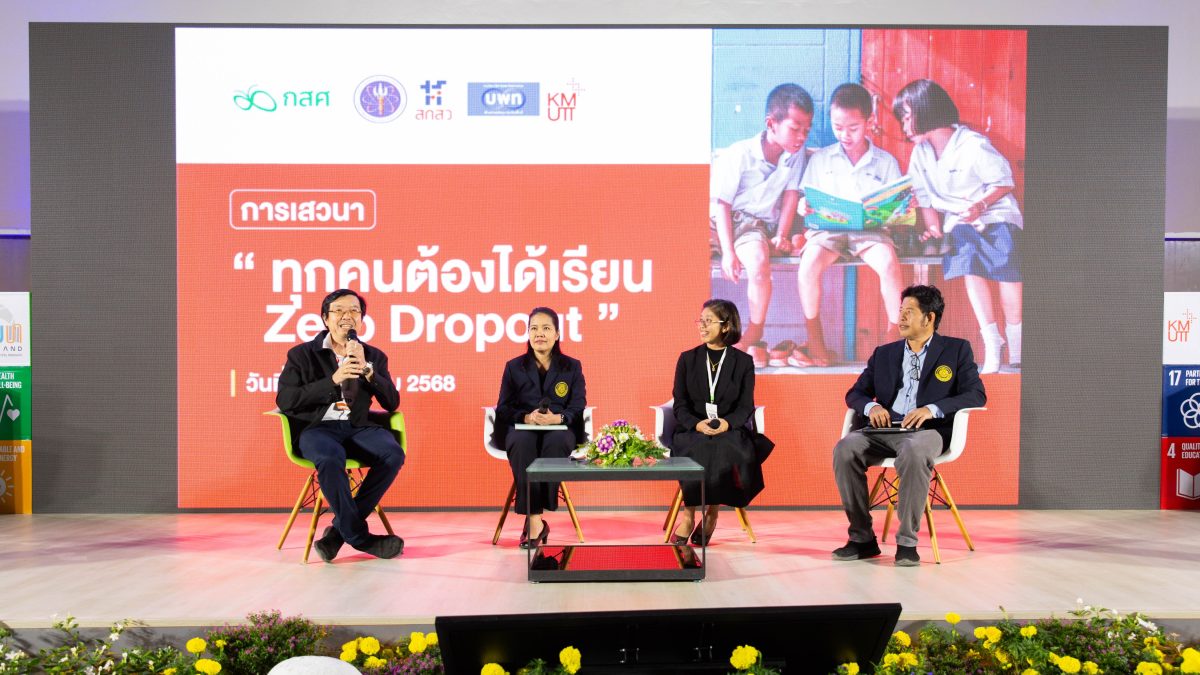
“Zero Dropout does not mean zero children leaving school,” emphasized Asst. Prof. Rattana. “It means every child must be under a monitoring mechanism. We must know where they are and ensure they receive the most appropriate educational opportunity.”
Related News

‘Plant-Based Caviar’: KMUTT Students’ Food Innovation Clinches National Gold, Ready for Global Market Expansion

KMUTT Mechanical Engineering Students and Faculty Clinch Gold Medal from NRCT with Microchannel Heat Sink Innovation for Future Data Centers