

The global seafood market is on a trajectory of massive growth, with its value projected to rise from 11.44 trillion THB in 2024 to nearly 20.19 trillion THB by 2032. While Thailand stands as a major exporter, the industry faces a significant “bottleneck”: Intralogistics. Traditional methods rely on manual labor to push carts weighing up to one ton, risking injury and inefficiency, while fixed rail systems lack the flexibility to adapt to changing production lines.
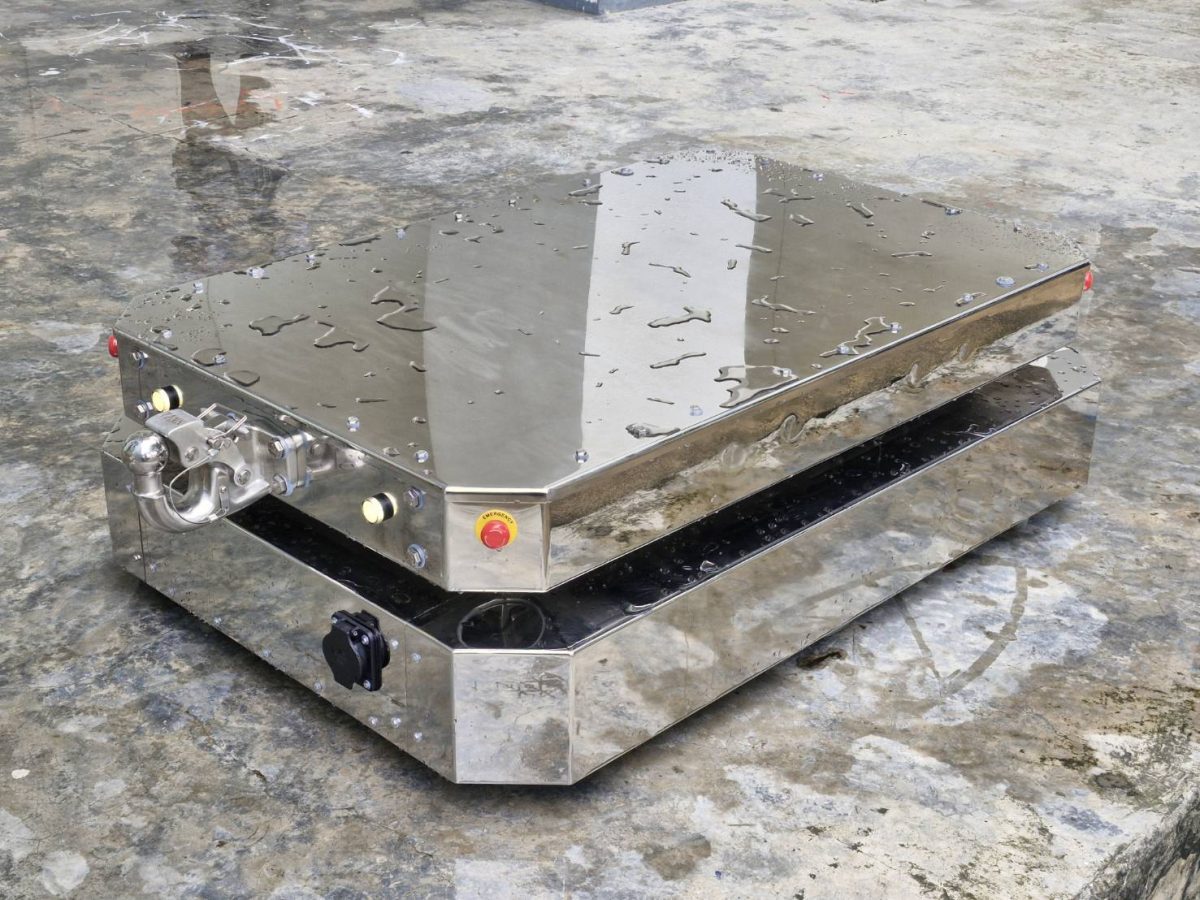
To bridge this gap, Asst. Prof. Dr. Supachai Vongbunyong, Director of the Institute of Field Robotics (FIBO) at KMUTT, led the development of “CARVER,” an Autonomous Mobile Robot (AMR). Developed in collaboration with BRAINWORKS IMAGINEERING and supported by the Program Management Unit for Competitiveness (PMUC), CARVER is designed to transform factory floor logistics.
Advanced Navigation and Industrial-Grade Design
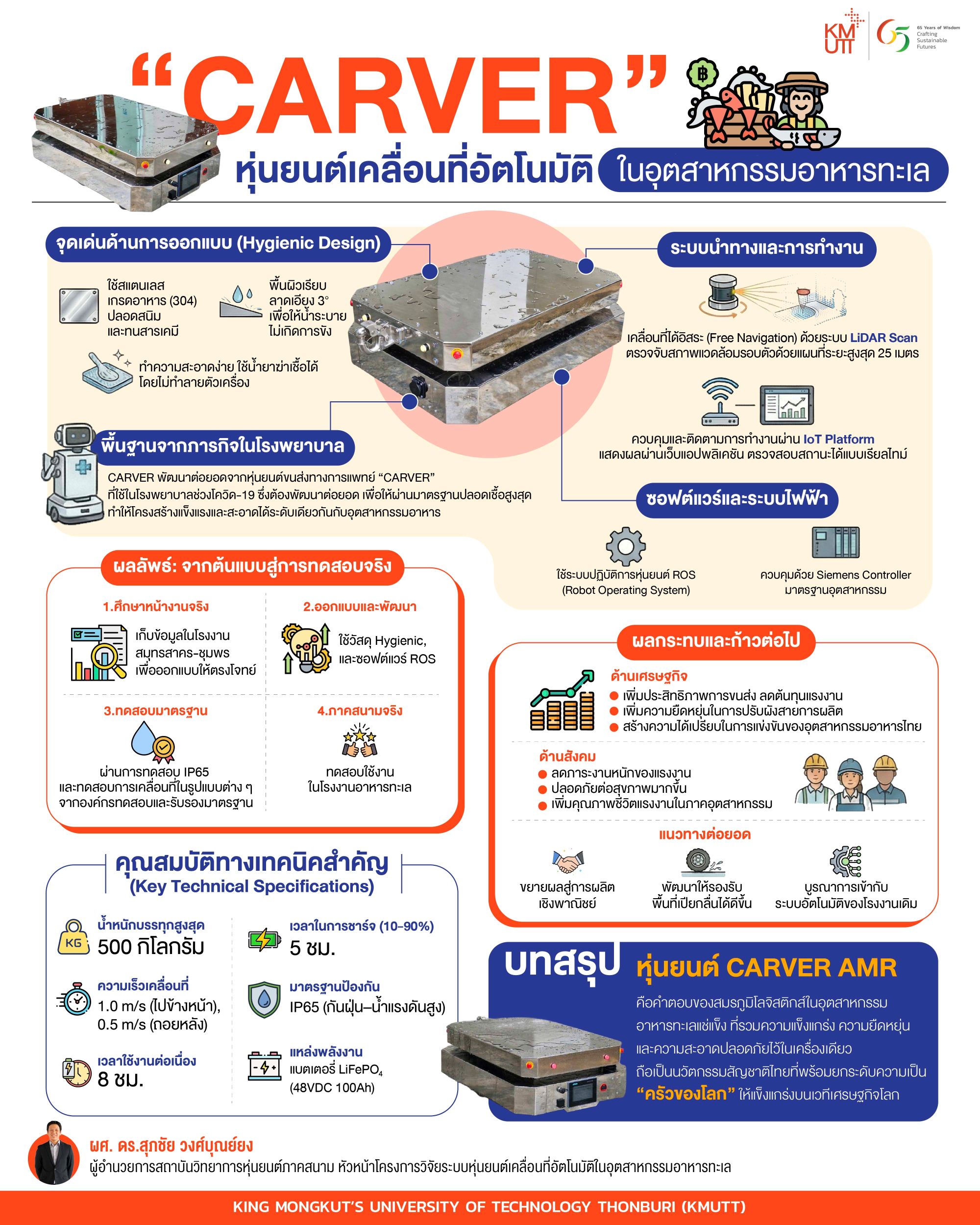
CARVER utilizes Free Navigation technology powered by LIDAR sensors, allowing it to map its surroundings and navigate autonomously without the need for magnetic strips or QR codes.
- Performance: The prototype (CARVER-CLY-AMR-500) can carry up to 500 kg, reaching speeds of 1 m/s (unloaded) and 0.5 m/s (fully loaded). It operates for 8 hours on a single charge.
- Hygienic Design: Following food safety standards, the body is constructed from Food Grade 304 Stainless Steel. The top surface features a 3-degree slope to prevent water accumulation, and all corners are rounded to eliminate bacteria-traps.
- Durability: With an IP65 rating, the robot is fully dust-tight and resistant to high-pressure water jets, essential for the humid and salty environments of seafood processing plants.
From Prototype to the “Kitchen of the World”
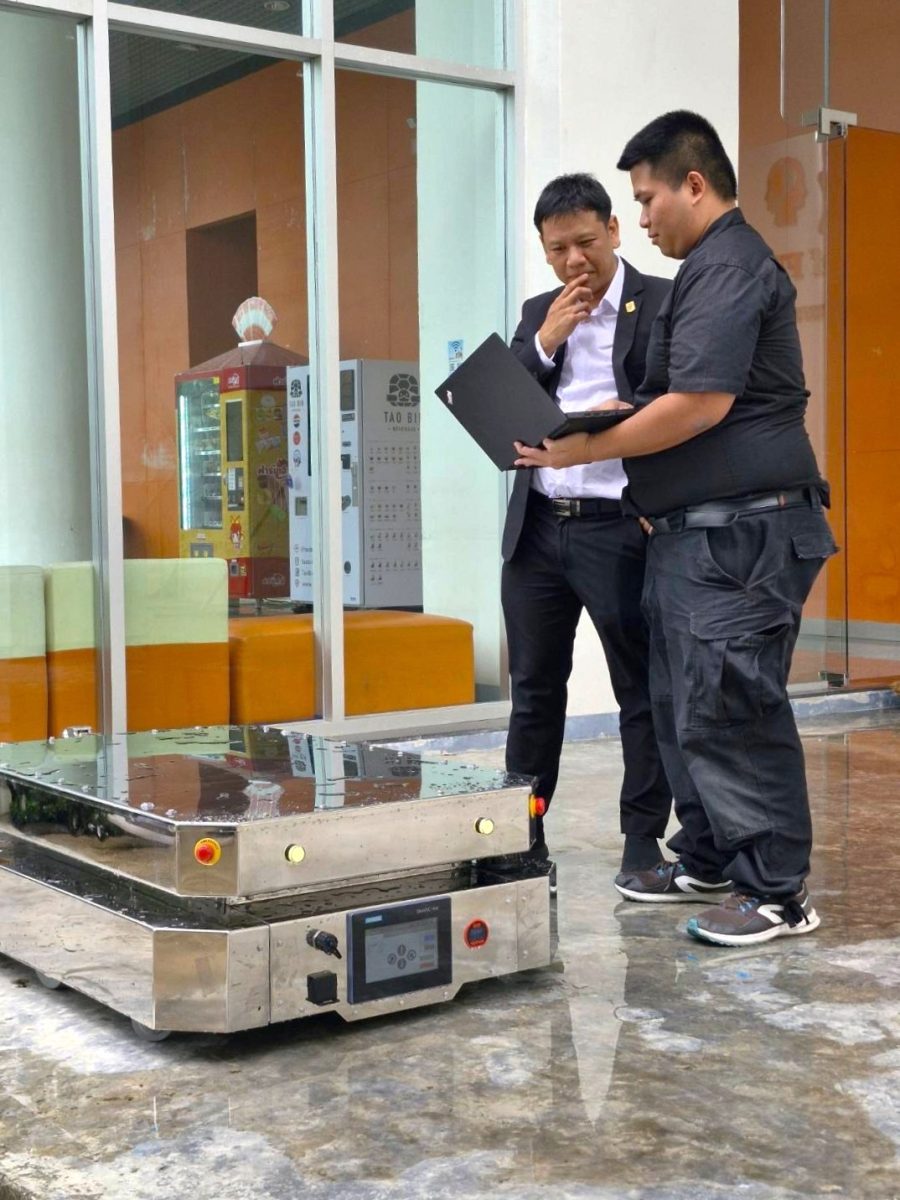
The research team conducted rigorous field tests in Chumphon and Samut Sakhon provinces, integrating CARVER into real production lines alongside human workers. This “real-world” feedback allowed for immediate adjustments to improve wheel traction on slippery floors and system integration with factory management software.
Beyond boosting economic efficiency, CARVER aims to improve social well-being by reducing physical strain on workers and creating opportunities for Upskilling—shifting labor from heavy lifting to high-value roles in robot maintenance and system control. This innovation strengthens Thailand’s position as a global leader in food exports, or the “Kitchen of the World,” through homegrown deep technology.

Related News

‘Plant-Based Caviar’: KMUTT Students’ Food Innovation Clinches National Gold, Ready for Global Market Expansion

KMUTT Mechanical Engineering Students and Faculty Clinch Gold Medal from NRCT with Microchannel Heat Sink Innovation for Future Data Centers



