

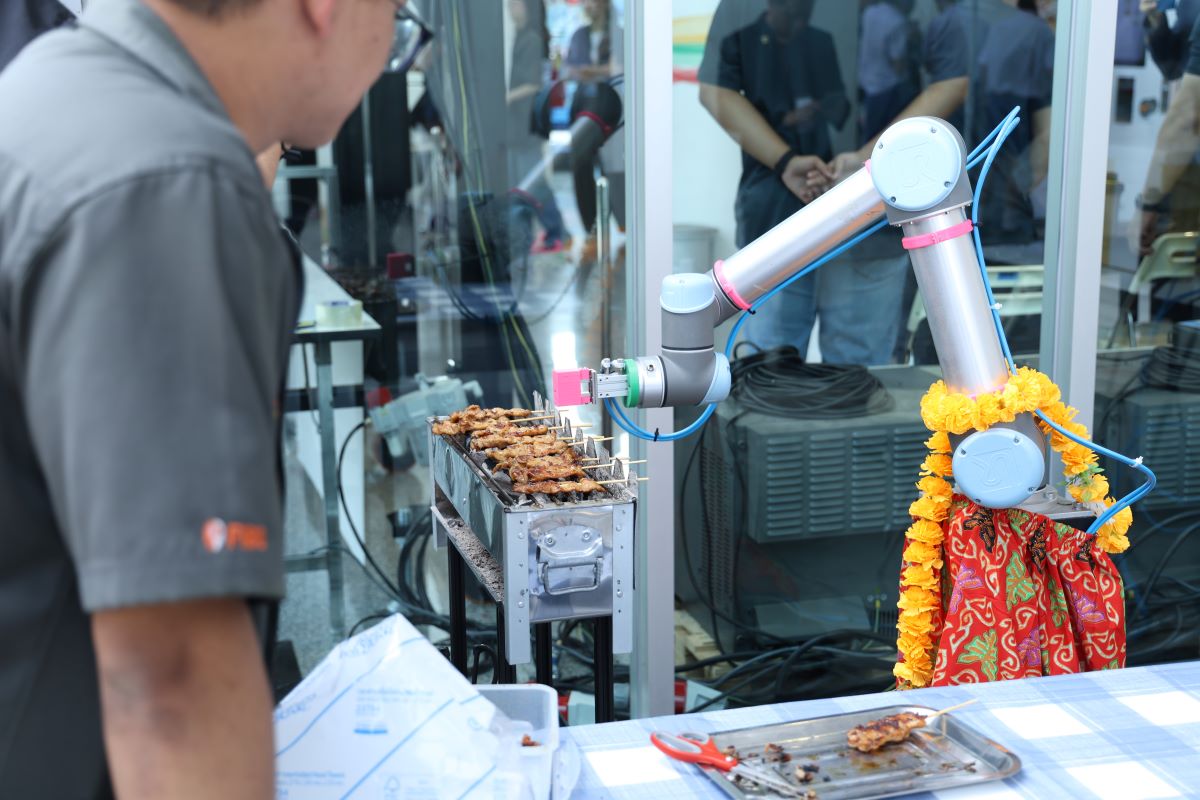
“Ping Ping”: The Pork-Grilling Robot is an innovative project designed and developed by Mr. Waritthorn Khongnu (Den) and Mr. Chawaphon Wachiraniramit (Ai-un), third-year students at the Institute of Field Robotics (FIBO), King Mongkut’s University of Technology Thonburi (KMUTT). Their inspiration came directly from the ubiquitous local street food stalls selling grilled pork (Moo Ping).
Waritthorn explained that the project began by analyzing the traditional manual steps of grilling pork to see how it could be automated. This included picking, grasping, moving, flipping, and determining the doneness of the meat. For the Demo 1 version, the team focused first on the flipping mechanism, divided into two main components: the control system and the design of the grippers and grill structure, while considering various operational constraints.
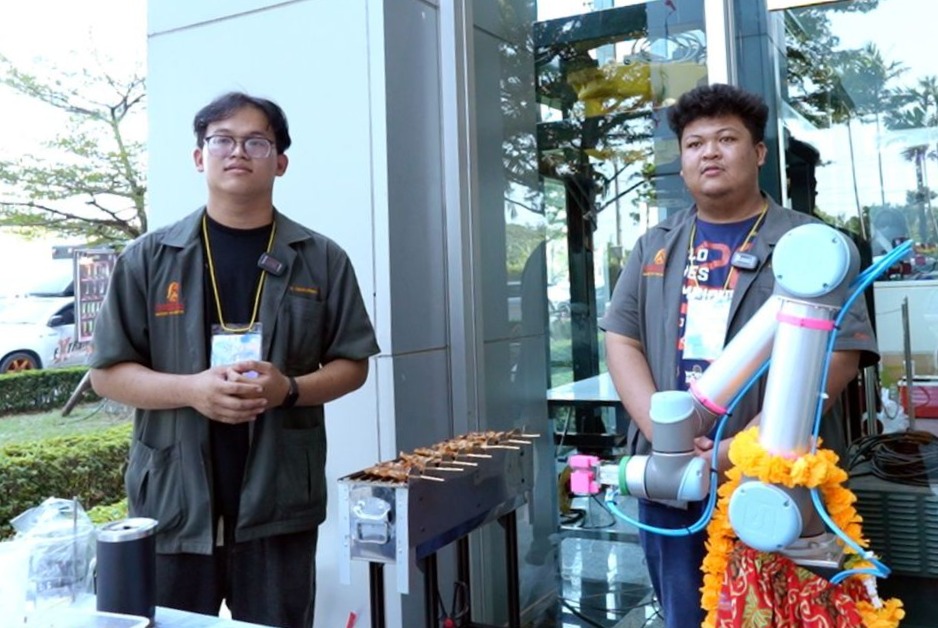
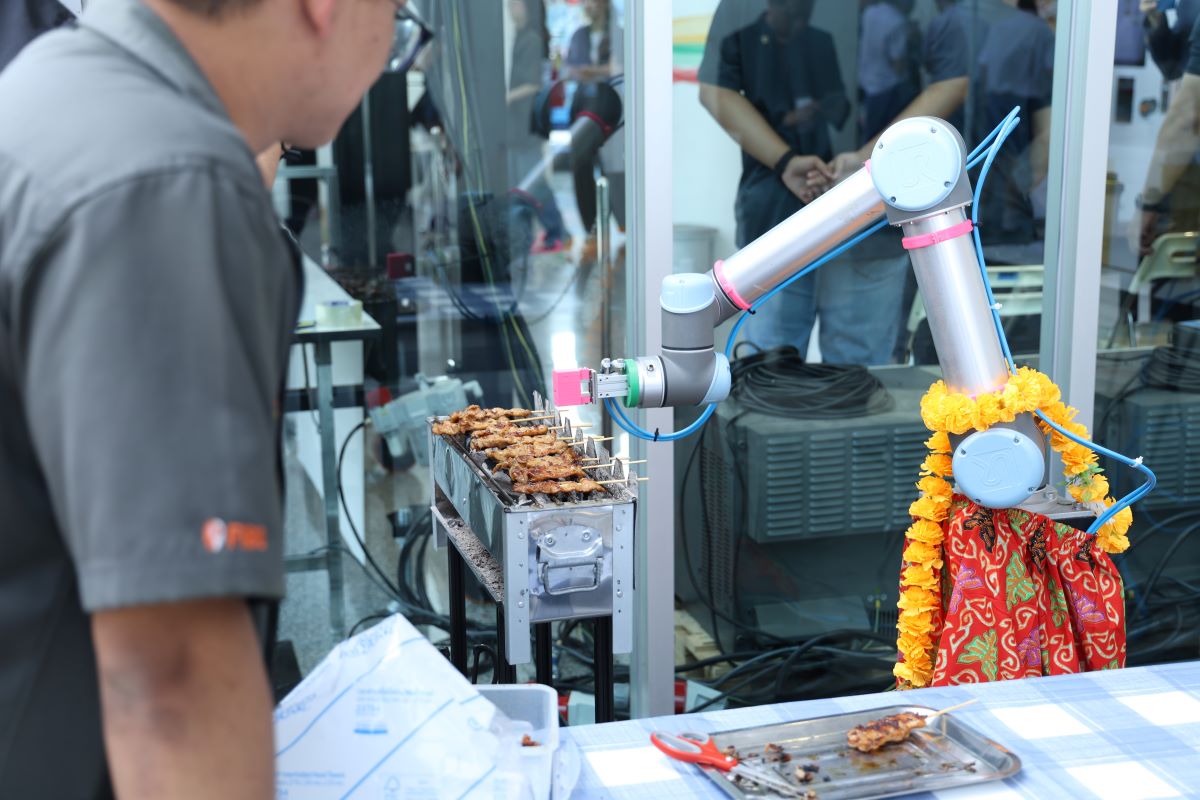
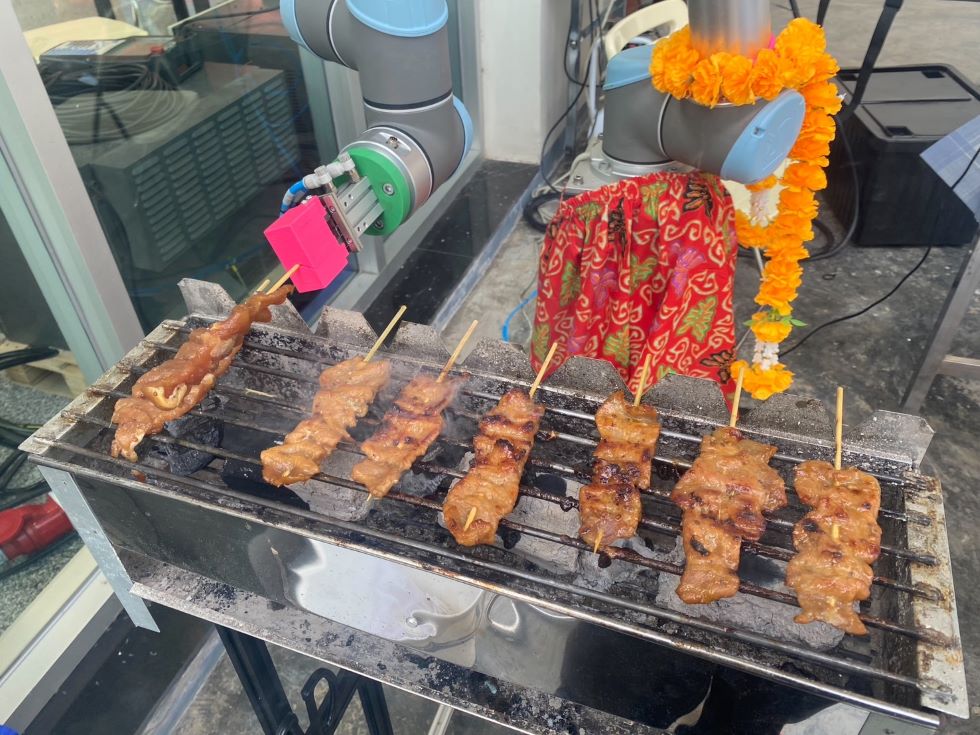
The mechanism of “Ping Ping” involves using a Collaborative Robot (Cobot) a robot designed to work safely alongside humans to assist in flipping the skewers. The robot flips each skewer one by one, while a human operator monitors which pieces are fully cooked to remove them. For skewers that are still raw, the robot continues its rhythmic flipping. In Demo 1, the robot can flip 8 skewers at a time and currently flips only one side due to the small size of the prototype grill. Because each skewer varies in size and preparation, they do not cook at the same time; thus, the system is designed to flip rhythmically, skewer by skewer, emphasizing human-robot cooperation to reduce the workload and increase efficiency.
Future Roadmap: AI and Full Automation
Regarding future development, Chawaphon (Ai-un) stated that for Demo 2, the goal is to enable the robot to identify which skewers need flipping and detect their doneness autonomously. The team is currently researching how the robot can assess doneness, as the most cooked part of the pork is the bottom side facing the heat, which is not visible from above. Future plans also include a system for the robot to unload cooked meat onto a tray and load raw skewers onto the grill, as well as increasing the flipping speed and improving the heat control system for better efficiency.
Waritthorn added, “Developing Ping Ping served as a challenge that allowed us to experiment with projects alongside our professors. It enabled us to apply our classroom knowledge, test various equipment, learn how to solve real-world problems, gain work experience, and enhance our analytical skills.”
“Robotics Thai-Thae”: Learning Through Play and Culture
The pork-grilling robot was one of the student works showcased at the 30th Anniversary of FIBO, held under the theme “Robotics Thai-Thae” (Authentic Thai Robotics) from February 6-8, 2025. Asst. Prof. Dr. Supachai Vongbunyong, Director of FIBO, explained that the theme aimed to create a fun, temple-fair atmosphere to encourage students to design robots that vibrantly reflect Thai culture. Grilled food, a staple of Thai street culture, became a primary challenge for the development team.
Using foundational robotics knowledge and FIBO’s laboratory equipment, the students created a robot that is not just a creative idea for an exhibition but a powerful learning tool. It allows them to practice function design, technology selection, cost estimation, and problem-solving in real-time—experiences that go far beyond classroom theory or paper-based projects.
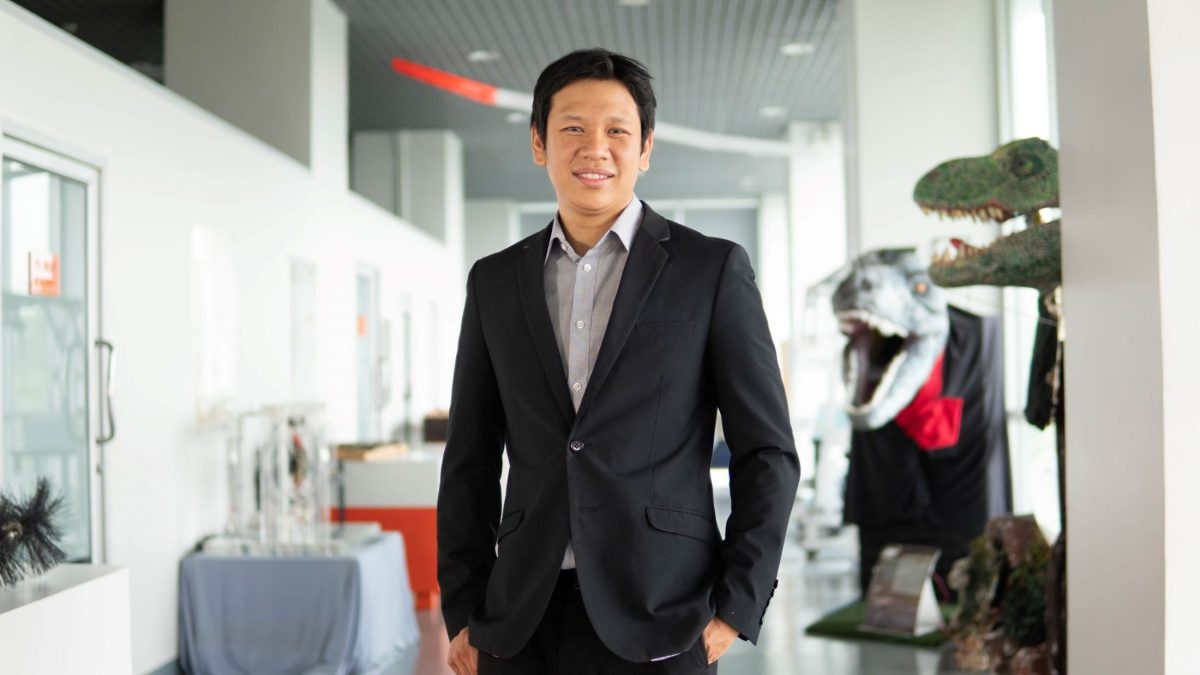
Asst. Prof. Dr. Supachai emphasized:
“Technology is not just about the technicalities; it must meet real-world usage needs and be worth the investment. While the prototype pork-grilling robot is not yet ready for general commercial use, it represents the first step in applying robotics and AI to the food industry. It could be expanded for use in premium restaurants or to create new marketing experiences. This follows FIBO’s previous food technology successes, such as the noodle-blanching robot, ice-cream scooping robot, and drink-making robot, which have transitioned manual labor into daily automation.”
Beyond Ping Ping, many other student works from undergraduate to doctoral levels were exhibited, attracting interest from entrepreneurs seeking to further develop these ideas or collaborate with students. Examples include the “Ratcharot” frame and the “Sai Mu” (Superstitious) robot for inscribing talismans. These works reaffirm FIBO’s role not just as an institute for producing robotics and automation engineers, but as a nursery for creativity and hands-on practice. Students learn from real societal challenges, training them to think, solve problems, and develop technology that meets actual needs, equipping them with the Upskill, Reskill, and Newskill necessary for the modern world.
Related News

‘Plant-Based Caviar’: KMUTT Students’ Food Innovation Clinches National Gold, Ready for Global Market Expansion

KMUTT Mechanical Engineering Students and Faculty Clinch Gold Medal from NRCT with Microchannel Heat Sink Innovation for Future Data Centers



