

King Mongkut’s University of Technology Thonburi (KMUTT) is dedicated to fostering sustained and inclusive economic growth, contributing to full and productive employment, and ensuring decent work for all—key components of the United Nations’ Sustainable Development Goal 8. As a leading institution in science, technology, and innovation, KMUTT is committed to aligning its educational and research initiatives with the broader goals of promoting sustainable economic growth and building a workforce that is capable of meeting the challenges of a rapidly changing global economy.
Driving Economic Growth Through Innovation and Research
KMUTT plays a central role in driving economic growth by focusing on research, innovation, and technology transfer. The university’s emphasis on applied research in fields like engineering, biotechnology, energy, and materials science directly contributes to the development of industries that are vital to the country’s economic growth. KMUTT’s Knowledge Exchange (KX) Building serves as a hub for innovation, connecting students, faculty, startups, and SMEs to collaborate on solving real-world problems, thereby accelerating the commercialization of research and fostering entrepreneurship.
By nurturing an entrepreneurial ecosystem, KMUTT encourages startups and small and medium enterprises (SMEs) to innovate and grow, leading to the creation of new jobs and fostering economic diversification. The university’s commitment to fostering industry-academia partnerships ensures that research outcomes are translated into practical solutions that contribute to the economic development of both local and national industries.
Ensuring Full and Productive Employment for All
KMUTT recognizes that full and productive employment is a key driver of sustained economic growth. The university places a strong focus on preparing students for the workplace by equipping them with the necessary skills, knowledge, and experience to succeed in a competitive job market. KMUTT’s Work-Integrated Learning (WIL) program is one of the university’s flagship initiatives, ensuring that students gain practical experience and develop critical skills that align with the needs of the labor market. Through partnerships with industry leaders, KMUTT helps students bridge the gap between academic learning and real-world employment opportunities.
Furthermore, KMUTT actively supports lifelong learning and professional development programs that allow individuals to upskill and reskill throughout their careers. This approach ensures that the workforce remains adaptable, productive, and prepared for the challenges of an evolving global economy, in line with SDG Goal 8.
Promoting Decent Work for All
KMUTT is committed to promoting decent work that provides fair wages, safe working conditions, and opportunities for career advancement. The university’s programs are designed to ensure that graduates not only gain technical expertise but also develop strong ethical standards, leadership skills, and a sense of social responsibility. This holistic approach prepares students to work in sustainable industries and contribute to creating decent jobs that are aligned with human rights and labor standards.
KMUTT also engages in community development and capacity building, working with local businesses and public sector organizations to improve the quality of work environments. By developing skills for the future, the university supports the creation of decent work opportunities in sectors such as renewable energy, green technology, and sustainable manufacturing, which are crucial to a future-driven economy that is both prosperous and equitable.
Inclusive and Sustainable Economic Growth
In line with the principles of inclusivity and sustainability, KMUTT’s approach to economic development ensures that growth benefits all sectors of society. The university’s focus on diverse and inclusive education means that all students, regardless of their background, gender, or socio-economic status, have equal opportunities to pursue careers in innovative fields. KMUTT also strives to reduce barriers to employment and entrepreneurship by providing scholarships, mentorship programs, and access to networks that empower underrepresented groups to participate in the economy.
KMUTT is committed to advancing the green economy, promoting sustainable business practices, and creating new green jobs that contribute to environmental protection while driving economic growth. Through initiatives such as the Green Heart Program and its work in renewable energy, the university is equipping its students and the wider community with the knowledge and skills needed to contribute to a sustainable future.
In 2024, KMUTT remains dedicated to SDG Goal 8, ensuring that its educational programs, research, and community engagement contribute to sustained, inclusive, and sustainable economic growth. By focusing on innovation, entrepreneurship, decent work, and lifelong learning, KMUTT is preparing its students to become leaders in productive employment, while fostering economic opportunities that benefit society as a whole. The university’s commitment to building a skilled, adaptable, and ethical workforce ensures that its graduates play a critical role in shaping a prosperous and sustainable future for all.
8.2 EMPLOYMENT PRACTICE
1. Related information on our university as a body paying all staff and faculty at least the living wage, defined as the local living wage (if government defines this) or the local poverty indicator for a family of four (expressed as an hourly wage).
At King Mongkut’s University of Technology Thonburi (KMUTT), the university’s mission is not only to provide academic excellence and foster innovation but also to ensure that its staff and faculty are treated with fairness and respect. A key aspect of this is the commitment to paying all employees a living wage, which is a fundamental element of ensuring a fair and equitable work environment. KMUTT adheres to the principle that every staff member and faculty should receive compensation that reflects their role and the cost of living in their respective locations.
The rate of starting salary for personnel has Effective from October 1, 2014 onwards.
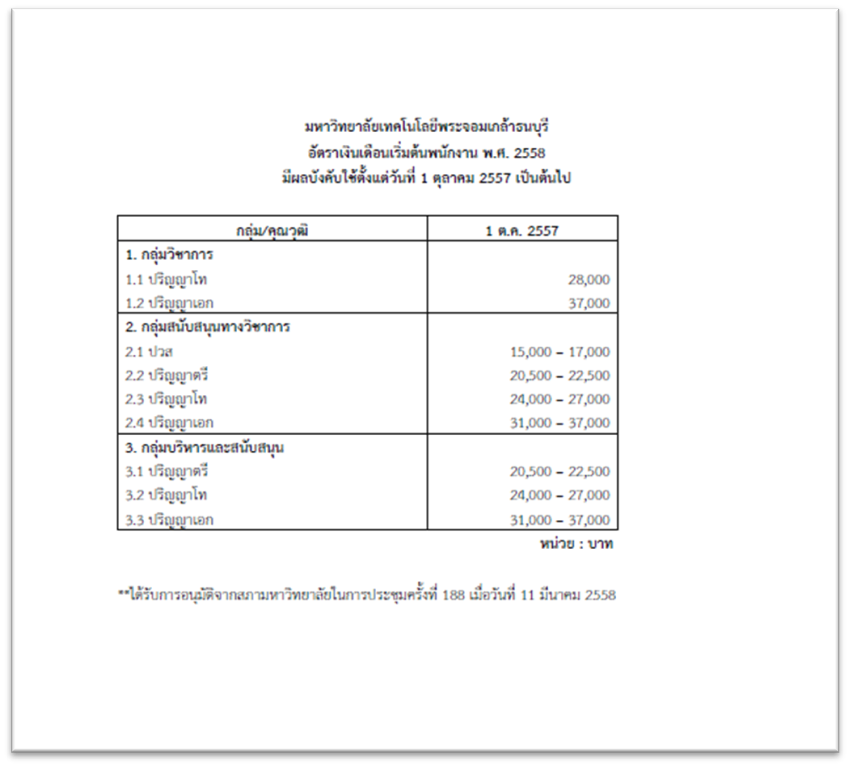
| Group/Qualification | 1 Oct 2014 |
| Academic Group 1.1 Master’s Degree 1.2 Doctoral Degree | 28,000 37,000 |
| Academic Support Group 2.1 Vocational Certificate 2.2 Bachelor’s Degree 2.3 Master’s Degree 2.4 Doctorate Degree | 15,000 – 17,000 20,500 – 22,500 24,000 – 27,000 31,000 – 37,000 |
| Management and Support Group 3.1 Bachelor’s Degree 3.2 Master’s Degree 3.3 Doctorate Degree | 20,500 – 22,500 24,000 – 27,000 31,000 – 37,000 |
Additional evidence link:
2. Related information on our university as a body recognizing unions & labour rights (freedom of association & collective bargaining) for all, including women & international staff.
King Mongkut’s University of Technology Thonburi has Regulations on Compensation of King Mongkut’s University of Technology B.E. 2019 that to provide benefits for employees, university employees and unions in accordance with the Labour Protection Act (No. 7) B.E. 2019.
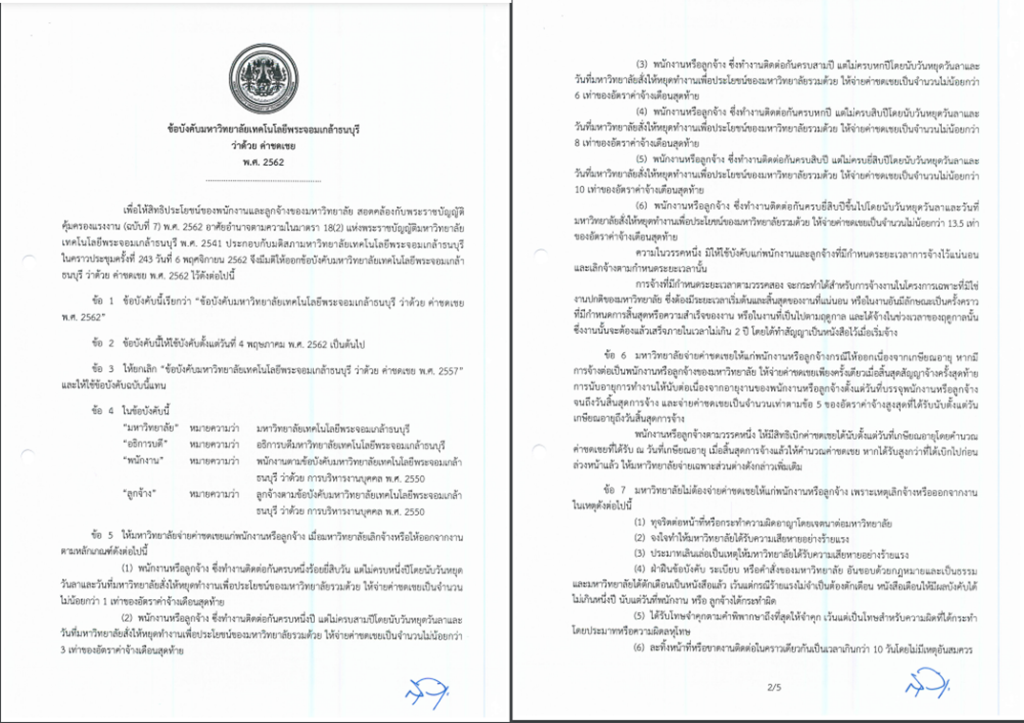
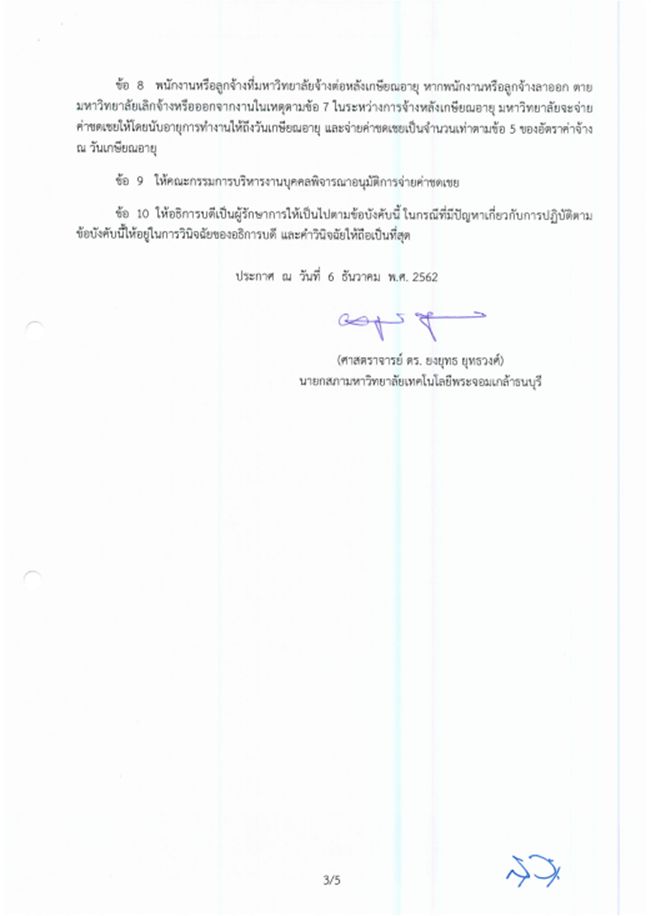
At King Mongkut’s University of Technology Thonburi (KMUTT), the university takes a proactive approach to ensure the fair treatment and well-being of its employees, especially in situations where the university may need to terminate or dismiss them from their position. The university has set forth clear regulations regarding compensation for employees or workers who face termination or dismissal, ensuring that all processes are carried out with transparency and in compliance with established criteria.
These regulations are carefully crafted to protect the rights of employees while maintaining the integrity and operational needs of the university. When a situation arises that involves terminating or dismissing an employee, the Human Resources Management Committee is tasked with reviewing the case and making recommendations regarding compensation. The committee ensures that the payment is consistent with fair labor practices, reflecting the individual’s service and contribution to the university during their time of employment.
The President of KMUTT serves as the administrator of these regulations, providing leadership and oversight in the implementation of these procedures. This ensures that any decisions related to compensation are made in accordance with the university’s commitment to ethical management and employee welfare. The presence of a clearly defined process not only provides security and peace of mind for employees but also reinforces KMUTT’s commitment to fairness and respect for all its staff, creating a positive and trustworthy work environment.
Why These Regulations Matter:
- Employee Security and Fairness: These compensation regulations provide a level of security for employees, ensuring that they are not left financially vulnerable in the event of termination. By adhering to these clear and structured criteria, KMUTT demonstrates its commitment to fairness and justice.
- Transparency in Decision-Making: With the Human Resources Management Committee overseeing the decision-making process, employees can be assured that decisions regarding termination and compensation are based on objective criteria and are subject to review, ensuring that personal biases do not influence the outcome.
- Commitment to Ethical Employment Practices: The regulations reflect KMUTT’s broader commitment to ethical employment practices, supporting the development of a workplace environment that values respect, equality, and accountability for all employees.
- Leadership and Accountability: With the President overseeing the implementation of these policies, KMUTT ensures that all actions taken are in line with the university’s high standards of governance, promoting accountability and responsibility at all levels of the institution.
By clearly defining how compensation is handled in cases of employee dismissal, KMUTT not only upholds legal and ethical standards but also fosters a supportive and trustworthy work environment that enhances employee morale and contributes to the long-term success of the university.
Additional evidence link:
1.https://hrm.kmutt.ac.th/upload/iblock/e18/e18943e0acdde2d4b678e05a2801398e.pdf
3. Related information on our university as a body having a policy on ending discrimination in the workplace (including discrimination based on religion, sexuality, gender, age).
King Mongkut’s University of Technology Thonburi (KMUTT) is dedicated to promoting an environment of inclusivity and fairness in the workplace. The university adheres to a strict policy on workplace discrimination, ensuring that discrimination based on religion, gender, age, or any other form of prejudice is actively prevented. This policy is part of KMUTT’s broader commitment to fostering a respectful, ethical, and professional workplace for all its employees, students, and stakeholders.
Commitment to Morality, Ethics, and Transparency
KMUTT’s policy on morality and transparency in administration is foundational to its approach to governance and organizational management. The university has made it a priority to prevent corruption, enhance moral and ethical standards, and promote transparency in all aspects of its operations. This includes the establishment of clear guidelines and practices that ensure equal treatment and a non-discriminatory environment for everyone, regardless of their background, gender, age, or beliefs.
Fostering Personal and Professional Development
KMUTT’s mission extends beyond academic excellence—it also focuses on personal growth and ethical development for its personnel. The university is committed to ensuring that all employees, whether faculty or staff, are equipped with the skills, values, and professional ethics necessary to contribute positively to the academic community. This holistic approach to employee development emphasizes the importance of learning, professionalism, and a strong sense of morality and ethics, ensuring that everyone adheres to the university’s high standards of integrity and ethical conduct.
Promoting Good Governance and Transparency
In line with its commitment to good governance, KMUTT ensures that all organizational management practices are carried out with the highest standards of honesty, transparency, and accountability. This focus on good governance permeates every level of the university’s operations, ensuring that decision-making processes are transparent and that actions taken by university leadership are always in the best interest of both the institution and its broader community. KMUTT aims to create a workplace environment where integrity is prioritized, fostering trust among staff, students, and the public.
Encouraging Ethical Leadership and Equal Opportunities
By promoting a culture of ethics, morality, and professionalism, KMUTT ensures that every individual is treated fairly, with respect for their rights and dignity. The university actively discourages any form of discrimination and provides mechanisms for addressing grievances related to unequal treatment. This encourages all staff and faculty to lead by example, setting standards for students and the community. KMUTT’s commitment to diversity and inclusion ensures that the university remains a safe, welcoming, and equitable environment for all.
KMUTT’s policy on workplace discrimination, coupled with its commitment to morality, ethics, and transparency, underscores the university’s dedication to building a professional, respectful, and inclusive work environment. By aligning its operations with good governance principles and ensuring equal opportunities for all, KMUTT is setting a strong example of ethical leadership in academia and contributing to the development of a society built on integrity, equality, and social responsibility.
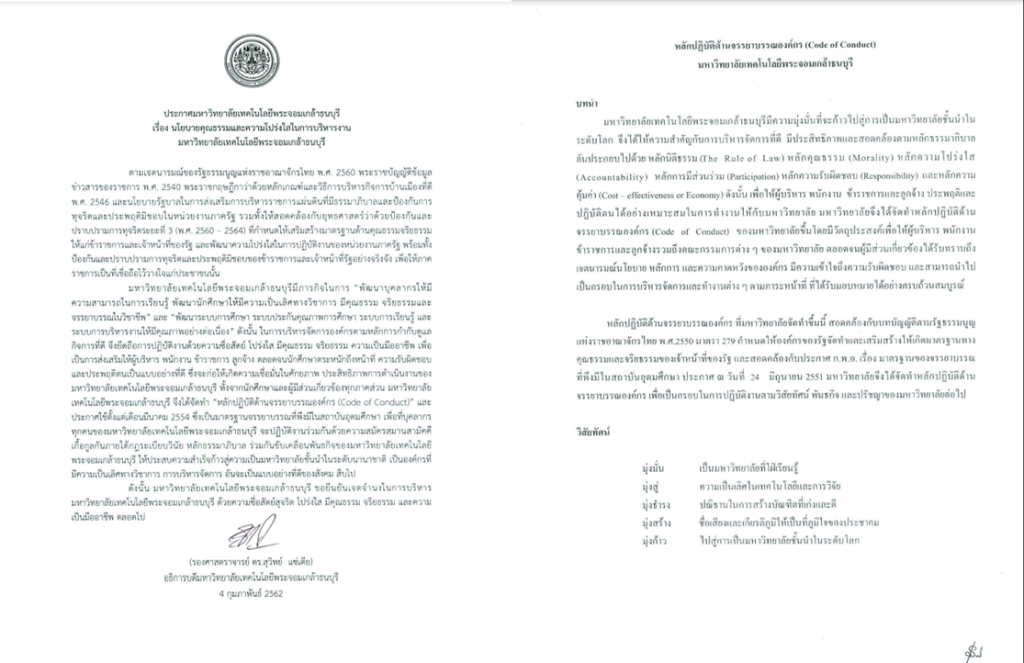
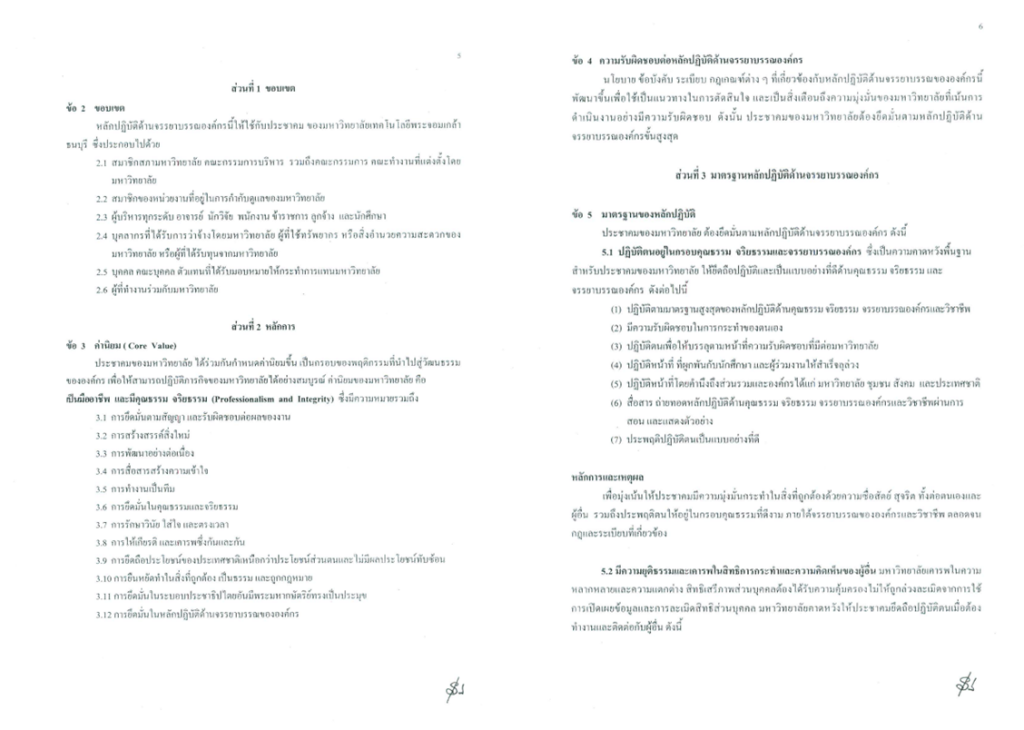
Code of Conduct
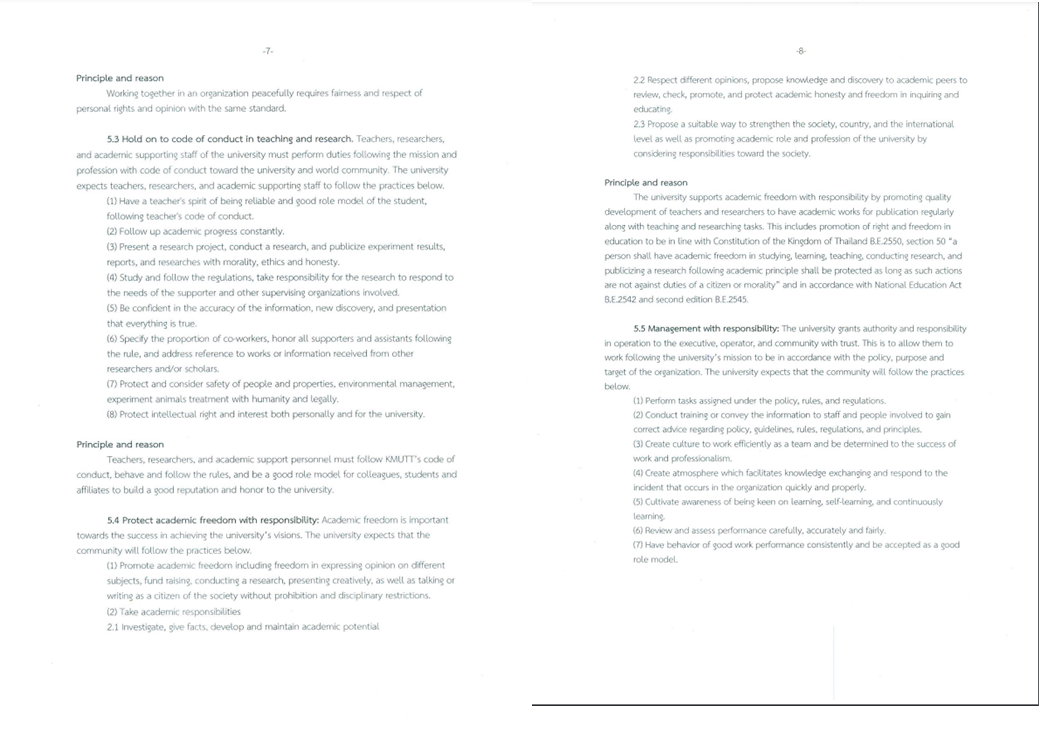
“Article 5.2 Fairness and respect the rights, actions and ideas of others. The University respects diversity and differences. Personal freedom must be protected from being violated using information disclosure and violation of personal rights. The University expects the community to adhere to this practice when working and dealing with others. Principles and reasons: Working together in an organization to be orderly, conflict-free and happy requires fairness and respect for personal rights and opinions with equal standards.”
Additional evidence link:
1. https://hrm.kmutt.ac.th/upload/iblock/6fa/6fa08e313d9b4eda5486de128c113935.pdf
2. https://hrm.kmutt.ac.th/upload/iblock/8b0/8b0b7e38f7bbbbb4b0ce623b7a3e10fa.pdf
4. Related information on our university as a body having a policy commitment to no forced labour, no modern slavery and no human trafficking, and no child labour.
At King Mongkut’s University of Technology Thonburi (KMUTT), the university is deeply committed to upholding the highest standards of human rights, dignity, and fairness. As part of its core values, KMUTT maintains a firm stance against forced labour, modern slavery, human trafficking, and child labour, ensuring that these practices are not present within its operations or associated activities. The university’s policy reflects its dedication to ethical conduct, supporting the well-being of every individual in its community and adhering to national and international labour standards.
Commitment to Human Rights and Ethical Labour Practices
KMUTT’s approach is rooted in its core values of respect, equality, and justice. The university recognizes that the protection of human rights is essential for fostering a healthy and thriving academic environment. This commitment is reflected in the university’s policies and practices, which promote fair working conditions and uphold the rights of all employees and students. KMUTT rejects any form of exploitation, whether in its academic setting, research initiatives, or collaborations with external partners.
KMUTT ensures that all staff, faculty, and students are treated with respect and dignity, free from any form of compulsory or exploitative work. The university firmly stands by the principle that no individual should be coerced into working under duress or deprived of their freedom. This commitment is reinforced by the university’s adherence to national labour laws and international conventions, such as those set forth by the International Labour Organization (ILO), which advocate for the prohibition of forced labour and modern slavery.
No Modern Slavery or Human Trafficking
In line with its commitment to human rights, KMUTT actively works to prevent modern slavery and human trafficking within its operations. This includes ensuring that employees are hired voluntarily, are compensated fairly, and work in an environment that is free from any form of coercion or exploitation. KMUTT upholds strict ethical standards when engaging with suppliers, partners, or collaborators to ensure that all those associated with the university operate in accordance with these principles.
Furthermore, KMUTT promotes awareness and education regarding the risks and impact of human trafficking and modern slavery through various outreach programs and training initiatives. These programs are aimed at fostering a greater understanding of these issues within the university community and ensuring that everyone is empowered to recognize and report any form of exploitation or trafficking.
No Child Labour Policy
KMUTT has a strict no child labour policy, ensuring that no underage individuals are employed or engaged in any work that violates their rights. The university provides a safe and supportive environment where youth can engage in learning and personal development, free from the pressures or exploitation that can come with child labour. By adhering to this policy, KMUTT ensures that the university’s educational and research initiatives are in line with ethical standards and contribute to the empowerment and well-being of young individuals.
The university also works with various organizations to raise awareness about the importance of protecting children’s rights and preventing child labour both within Thailand and globally. This aligns with KMUTT’s broader commitment to supporting the United Nations Sustainable Development Goals (SDGs), particularly Goal 8 (Decent Work and Economic Growth) and Goal 16 (Peace, Justice, and Strong Institutions).
Ensuring Accountability and Transparency
To support these commitments, KMUTT has implemented rigorous monitoring mechanisms to ensure compliance with its no forced labour, no modern slavery, no human trafficking, and no child labour policies. The university promotes transparency and accountability by conducting regular reviews of its policies, operations, and partnerships to ensure that all activities are conducted ethically and in compliance with both national and international labour laws. These measures help prevent any unintended association with exploitative practices and ensure that KMUTT continues to operate as a fair and responsible institution.
King Mongkut’s University of Technology Thonburi has a policy commitment against force labor, modern slavery, human trafficking, and child labor. There is regulation of KMUTT as follows:
“Regulations KMUTT On Personnel Management B.E. 2550
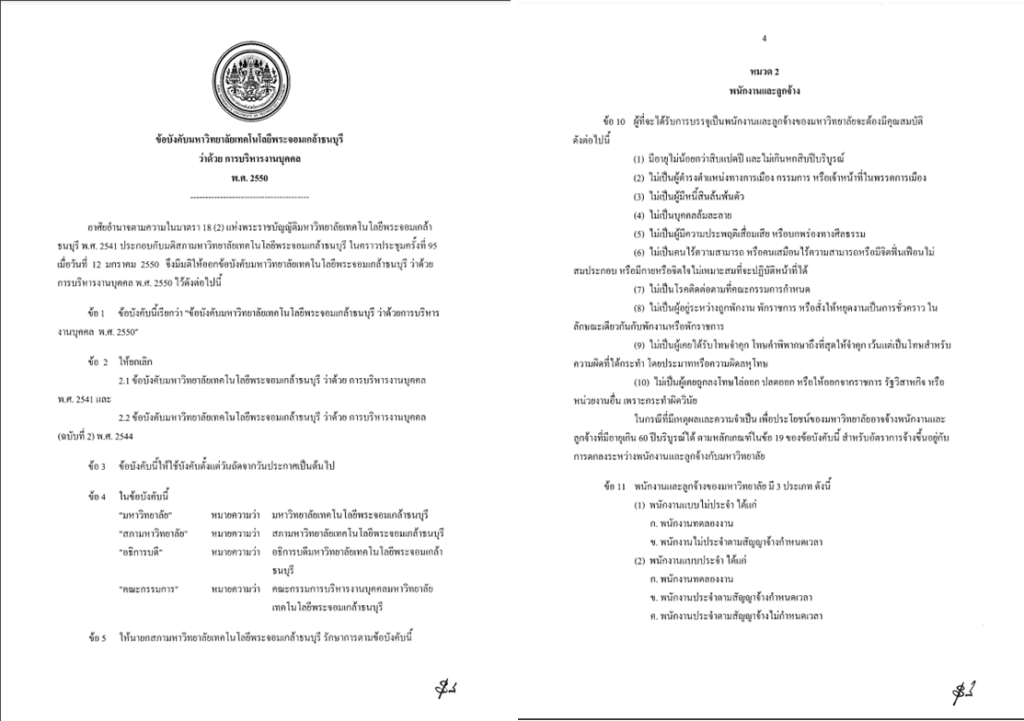
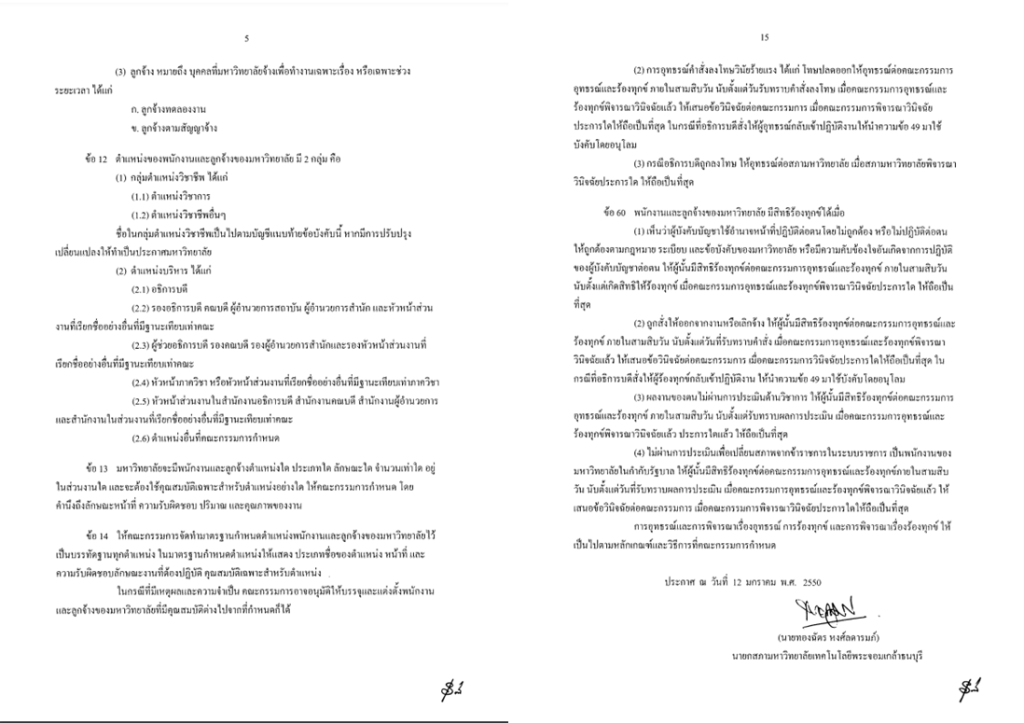
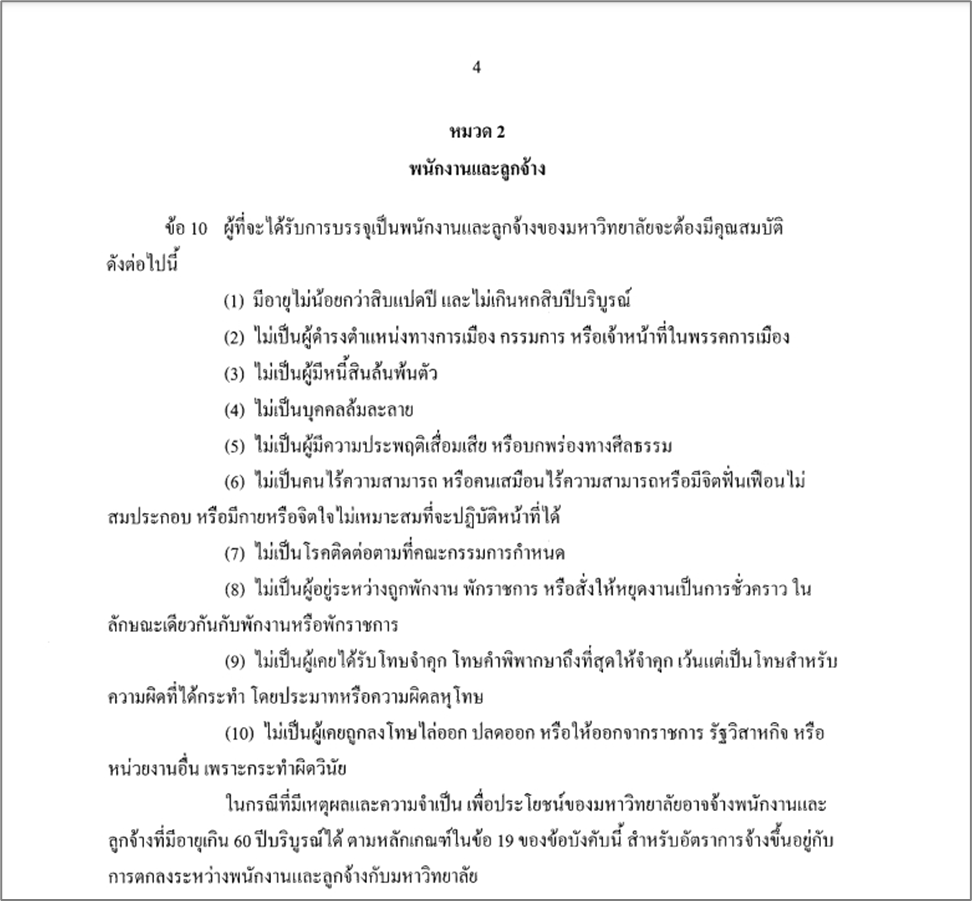
Item 2 No. 10 Persons who will be packaged as personnel and employees. There must be at least 18 years old”
“Section 2: Staff and Employees Section
No. 10: Persons who will be appointed as staff and employees of the University must have the following qualifications:
1. Be at least 18 years old and not more than 60 years old.
2. Not be a political office holder, committee member or official of a political party .
3. Not be insolvent .
4. Not be a bankrupt .
5. Not be a person with corrupt behavior or moral deficiencies .
6. Not be an incompetent or quasi-incompetent person or mentally unstable or physically or mentally unfit to perform duties
7. Not have a contagious disease as determined by the committee.
In cases where there is a necessary reason for the benefit of the University, staff and employees who are over 60 years old may be hired according to the criteria in Section 19 of these regulations. The employment rate depends on the agreement between the staff and employees and the University.”
Additional evidence link:
1. https://hrm.kmutt.ac.th/upload/iblock/1f0/1f0eeabaf488d8be06184d5cbff49fd2.pdf
5. Related information on our university as a body having a policy on pay scale equity including a commitment to measurement and elimination of gender pay gaps.
King Mongkut’s University of Technology Thonburi (KMUTT) is dedicated to fostering an inclusive, equitable, and fair working environment for all its employees. As part of this commitment, the university has implemented a pay scale equity policy designed to ensure that employees are compensated fairly for their work, regardless of gender or other potentially discriminatory factors. This policy is grounded in the belief that all workers, whether faculty or staff, should receive equal pay for equal work, and that any gender pay gaps that may exist are actively measured, addressed, and eliminated.
Pay Scale Equity Policy at KMUTT
KMUTT recognizes that achieving pay equity is a crucial step in promoting gender equality and fostering a healthy, productive work environment. The university’s pay scale equity policy aims to ensure that all employees receive fair compensation based on their skills, experience, performance, and responsibilities, rather than on gender or any other irrelevant characteristic. The university’s compensation system is designed to be transparent, objective, and free from bias, ensuring that all employees are treated with the same level of respect and fairness.
The policy focuses on establishing consistent pay scales for various job categories and positions within the university. By aligning pay levels with clear performance metrics and job evaluations, KMUTT ensures that compensation is based on merit and professional qualifications, rather than personal characteristics such as gender.
Measuring and Addressing Gender Pay Gaps
As part of KMUTT’s commitment to gender equity, the university conducts regular audits to measure any potential gender pay gaps that may exist within its workforce. These audits analyze the pay structure across different departments, job roles, and levels of responsibility to identify discrepancies in compensation between male and female employees.
If a gender pay gap is identified, KMUTT takes immediate action to address it. This may involve adjusting salaries, restructuring compensation packages, or implementing new policies and practices to ensure that all employees are compensated equitably. The university also promotes transparency in its pay practices, providing employees with access to information about the pay scale and the criteria used to determine compensation.
Commitment to Continuous Improvement
KMUTT is committed to continuous improvement in its approach to pay scale equity. The university regularly reviews and updates its compensation policies to ensure that they remain in line with current best practices, legal standards, and the evolving needs of the workforce. This includes staying informed about any relevant national or international legislation on gender pay equity and workplace discrimination, ensuring that the university is always in compliance with the latest standards.
In addition, KMUTT engages in ongoing dialogue with its employees to raise awareness about pay equity and gender equality. Through training programs and workshops, the university ensures that all staff and faculty are educated on the importance of fair pay practices and how they can contribute to the university’s mission of achieving pay equity.
Supporting Women in the Workforce
As part of its broader commitment to gender equality, KMUTT also supports women in leadership roles and works to ensure that female employees have equal opportunities for advancement, career development, and leadership positions. The university has established mentorship programs and professional development initiatives specifically designed to support women’s career growth and empowerment.
KMUTT’s efforts to eliminate gender biases in its hiring, promotion, and pay practices are aimed at creating an environment where women and men have equal opportunities to succeed and excel in their respective roles. By addressing any barriers that may exist for women in the workplace, KMUTT ensures that all employees have the tools and opportunities they need to thrive.
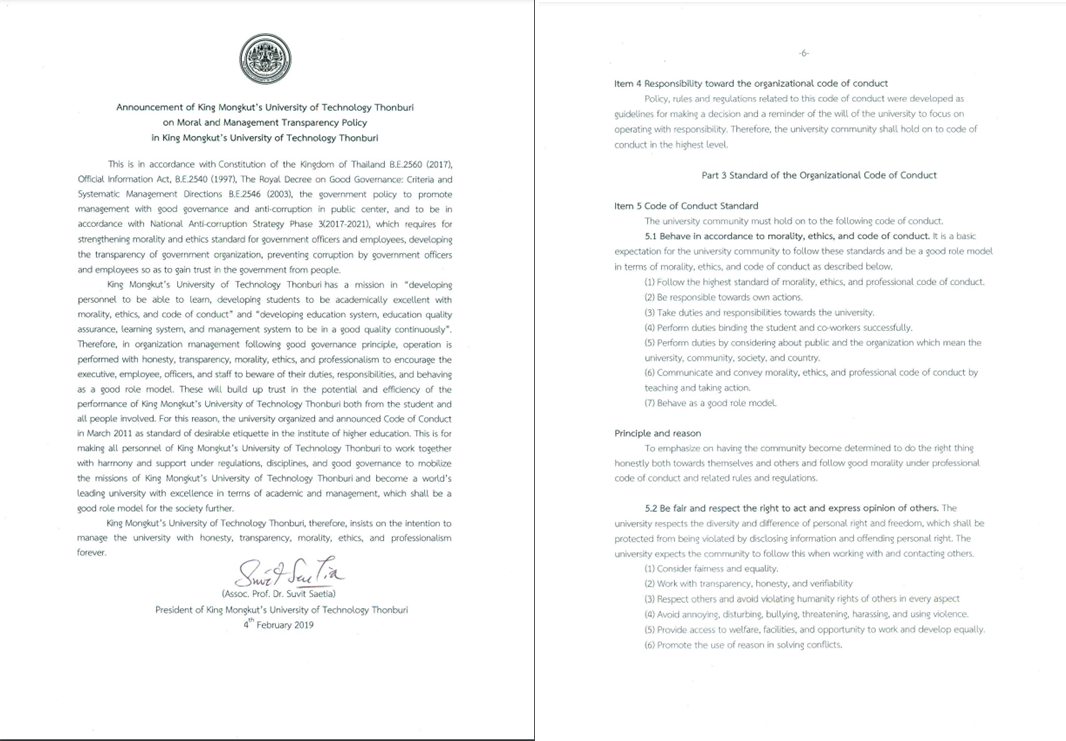
King Mongkut’s University of Technology Thonburi has policy on guaranteeing equivalent rights of worker when outsourcing activities to third parties. There is the Announcement of KMUTT on Moral and Management Transparency Policy in KMUTTas follows:
“Part 3. Standards of the Organizational Code of Conduct
No. 5.2 Be fair and respect the rights, act, and express opinions of others, whether internal personnel or outsourcing employees”
Additional evidence link:
1.https://hrm.kmutt.ac.th/upload/iblock/12e/12ee21d748ac5e0607a2ffb899dcd4c4.pdf
6. Related information on our university as a body having a policy on pay scale equity including a commitment to measurement and elimination of gender pay gaps.
King Mongkut’s University of Technology Thonburi (KMUTT) is deeply committed to fairness and equality in its workplace, ensuring that all employees, whether faculty, staff, or administrative personnel, are compensated equitably. Central to this commitment is the university’s pay scale equity policy, which emphasizes the importance of pay equity across all roles within the institution, with a particular focus on the measurement and elimination of gender pay gaps.
Ensuring Equal Pay for Equal Work
At KMUTT, the principle of equal pay for equal work is fundamental. The university upholds a pay scale system designed to ensure that employees are paid according to their skills, qualifications, and job responsibilities, without any bias or discrimination based on gender, age, race, or any other factor. This system aims to foster a transparent and equitable workplace, where each individual is valued for their contribution to the university, and compensation is aligned with the value of their work, rather than any personal characteristics.
Addressing Gender Pay Gaps
KMUTT acknowledges that gender pay gaps can exist, particularly in higher education and research institutions where historical biases may still influence pay structures. To tackle this issue head-on, the university has implemented measures to identify, measure, and eliminate any gender-based pay disparities that may arise in its pay scales. This includes conducting regular audits and gender pay gap analyses, which compare the salaries of male and female employees in similar roles, ensuring that any differences in pay are identified and rectified.
If the analysis reveals a gender pay gap, KMUTT takes immediate steps to adjust the pay scales to ensure equity. This might involve restructuring compensation packages, adjusting salaries, or implementing new policies to promote gender equity in compensation. The university is committed to removing barriers that may prevent equal compensation for all, regardless of gender.
Commitment to Transparency and Accountability
KMUTT is dedicated to promoting transparency in its pay structures, providing employees with access to clear information about the salary bands for various positions and the criteria used to determine compensation. This openness helps build trust within the university community and ensures that employees understand how their pay is determined. Additionally, the university regularly reviews its pay practices to ensure that they are competitive and aligned with best practices in higher education and industry standards.
To reinforce this commitment, KMUTT maintains an accountability system where senior management and HR departments work collaboratively to ensure that pay decisions are based on merit and objective criteria, rather than personal biases. By adhering to strict guidelines, the university ensures that it remains accountable for its efforts in eliminating gender pay gaps and fostering an inclusive work environment.
Promoting Gender Equality Beyond Pay
KMUTT’s efforts to address gender pay equity extend beyond just pay scales. The university is also focused on creating an environment that fosters equal opportunities for all employees, regardless of gender, in terms of career development, leadership roles, and professional growth. The university’s policies and practices encourage female faculty and staff to pursue leadership positions, participate in professional development programs, and have access to mentorship and career advancement opportunities.
The university also actively works to ensure work-life balance for all employees by providing flexible working arrangements and promoting policies that support gender equality in both professional and personal life. By creating a supportive environment that values both professional excellence and personal well-being, KMUTT fosters a culture of gender inclusivity and empowerment.
Ongoing Monitoring and Continuous Improvement
KMUTT is committed to continuously monitoring and improving its pay equity practices. The university regularly updates its policies to ensure they are in line with current best practices, national standards, and international guidelines. Additionally, KMUTT conducts annual reviews of its gender pay equity initiatives, evaluating the effectiveness of its policies and identifying areas for further improvement.
This continuous commitment to improvement ensures that KMUTT stays at the forefront of promoting gender equality and fair compensation, setting an example for other institutions to follow.
King Mongkut’s University of Technology Thonburi does not have any gender divide in payroll. There is policy on pay scale equity including a commitment to measurement and elimination of gender pay gaps.
The rate of salary starting employee 2015, there is effective since on October 1, 2014, onwards.
It has been approved by the University Council and has been adhered to continuously.
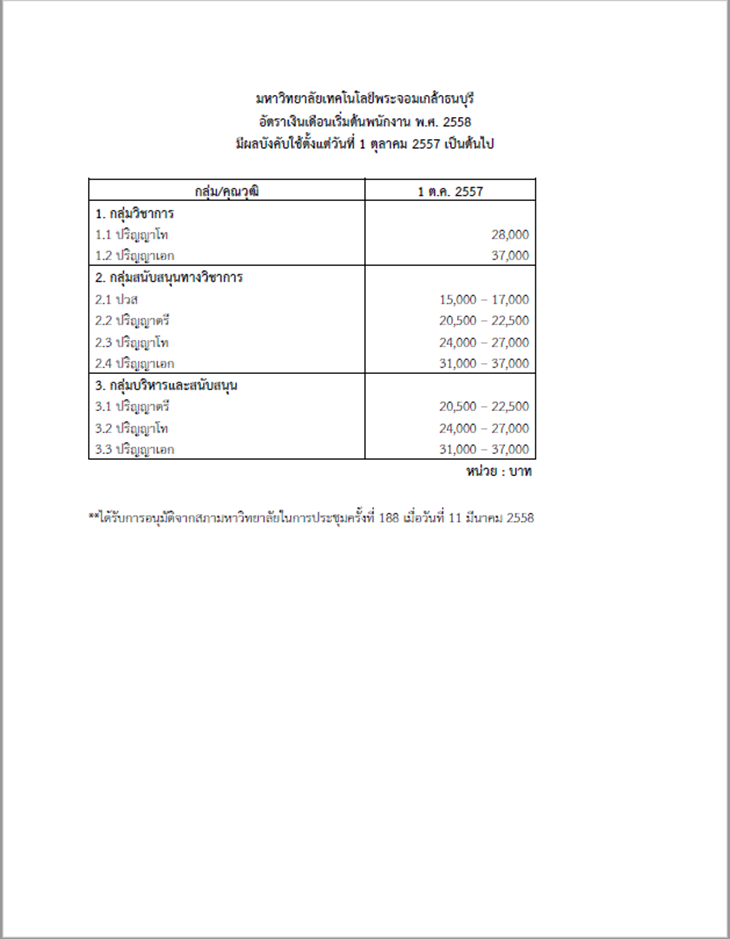
| Group/Qualification | 1 Oct 2014 |
| Academic Group 1.1 Master’s Degree 1.2 Doctoral Degree | 28,000 37,000 |
| Academic Support Group 2.1 Vocational Certificate 2.2 Bachelor’s Degree 2.3 Master’s Degree 2.4 Doctorate Degree | 15,000 – 17,000 20,500 – 22,500 24,000 – 27,000 31,000 – 37,000 |
| Management and Support Group 3.1 Bachelor’s Degree 3.2 Master’s Degree 3.3 Doctorate Degree | 20,500 – 22,500 24,000 – 27,000 31,000 – 37,000 |
Additional evidence link:
7. Related information on our university as a body on measuring/tracking pay scale gender equity.
At King Mongkut’s University of Technology Thonburi (KMUTT), the university is committed to gender pay equity and ensures that compensation for academic positions is fair, transparent, and free from gender-based divisions. The university’s approach to pay scale measurement includes clear guidelines for paying academic staff without any gender discrimination, aligning with its broader mission to create an inclusive, equitable, and fair working environment for all employees.
Guidelines for Paying Academic Positions Without Gender Division
KMUTT’s criteria for paying academic positions are designed to ensure equal pay for equal work. The university follows a structured pay scale system that is based solely on job roles, qualifications, performance, and experience, not on gender. The academic positions pay guidelines are crafted to uphold fair compensation practices across all academic staff levels, without any bias related to gender, ensuring that both male and female faculty members are paid equitably for performing similar responsibilities and tasks.
This policy reflects KMUTT’s commitment to gender-neutral pay and equal treatment in the workplace, reinforcing the university’s role in setting a standard for gender equity in education and beyond. By removing gender-based distinctions in pay scales, the university ensures that compensation is based on the value of the work rather than the gender of the individual performing the work.
Monitoring Wage Payments for Equity and Equality
KMUTT takes a proactive approach to ensure the consistent application of its pay scale equity policy. The university closely monitors wage payments to ensure that all academic staff receive fair compensation in line with the established guidelines. This includes regular audits and reviews to assess whether the pay practices align with the university’s standards for equality.
The university ensures that any discrepancies in pay between male and female academic staff are addressed promptly. KMUTT’s commitment to equal pay for equal work is not only a matter of policy but also a matter of continuous improvement—constantly tracking and adjusting pay scales where necessary to ensure fairness, transparency, and compliance with the university’s gender equity goals.
The Criteria for Paying Academic Positions
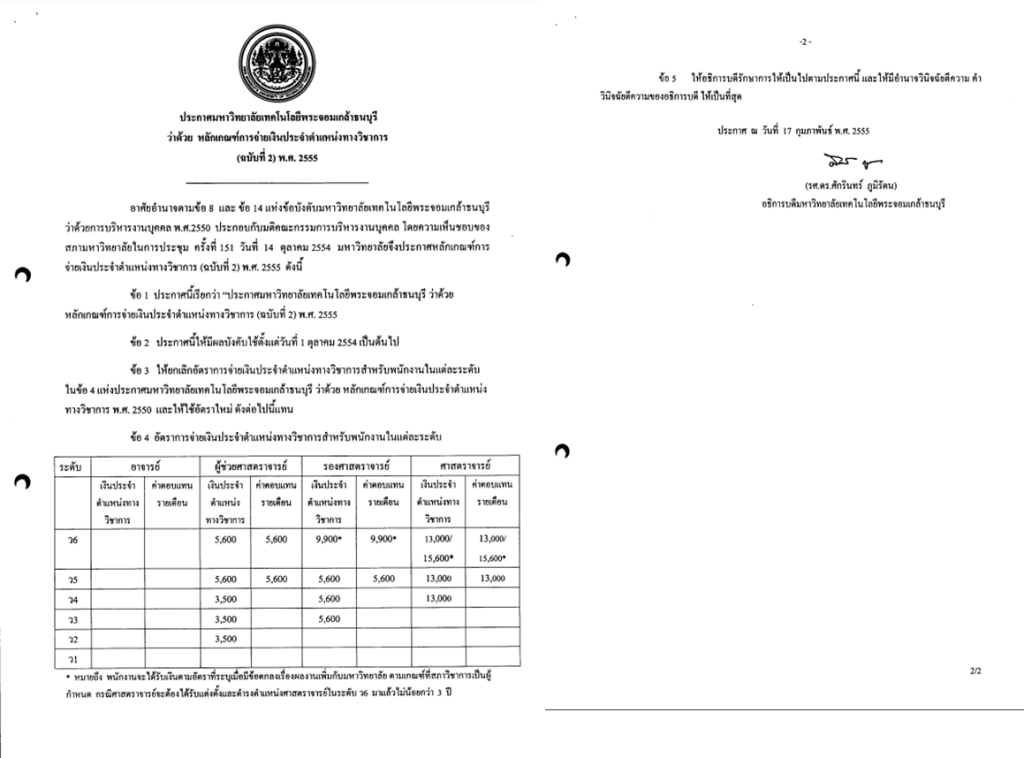
KMUTT follows the “Criteria for Paying Academic Positions” as outlined in the Announcement of KMUTT on the Criteria for the Payment of Academic Position Salaries (No. 2), which was enacted on 1 October 2011. This framework is based on Section 8 and Section 14 of the Personnel Administration Act B.E. 2550, with approval from the University Council.
These criteria outline the standards and processes for determining the salary structure for academic staff, with clear parameters for job classification, salary grades, and evaluation of qualifications. By adhering to these criteria, KMUTT ensures that salary decisions are made with consistency, clarity, and equity, while keeping gender considerations neutral in the process. These established guidelines help prevent any form of gender discrimination in academic salary setting, fostering an environment of fairness and transparency.
Commitment to Equal Opportunity and Professional Growth
In addition to ensuring pay equity, KMUTT is committed to providing equal opportunities for career growth and advancement to all academic staff. The university actively supports gender inclusivity by offering professional development programs, mentorship opportunities, and leadership training to all faculty members, ensuring that gender does not play a role in accessing these opportunities.
Through these initiatives, KMUTT creates an environment where both male and female academic staff can thrive, contribute to the university’s academic excellence, and be recognized and rewarded based on their merit and achievements, not their gender.
Announcement of King Mongkut’s University of Technology Thonburi on the criteria for the payment of academic position salaries (No. 2) B.E. 2555, based on the authority of Section 8 and Section 14 on personnel administration B.E. 2550, with the approval of the University Council, announcing the criteria for the payment of academic position salaries, with the announcement effective from 1 October 2011 onwards.
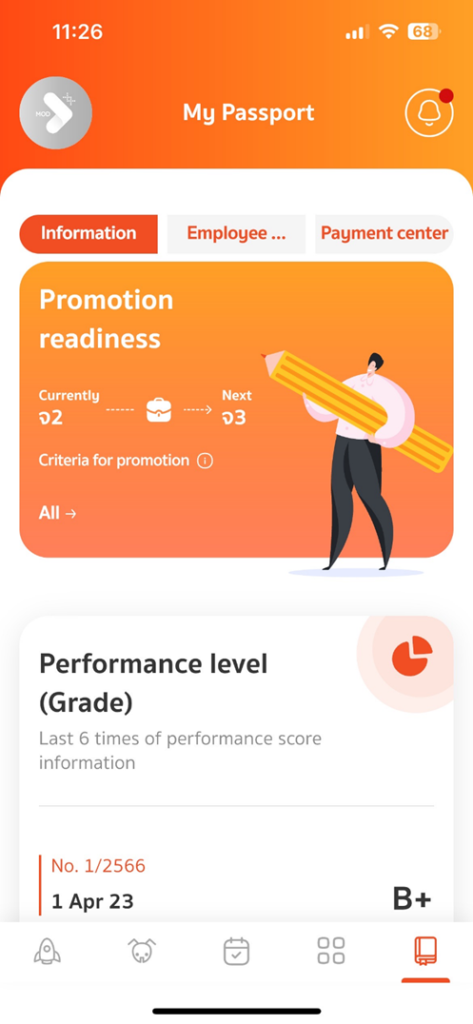
KMUTT has a real-time application for tracking benefits and salary increments for personnel that can be accessed at any time and is current.

Additional evidence link:
8. Related information on our university as a body having a process for employees to appeal on employee rights and/or pay.
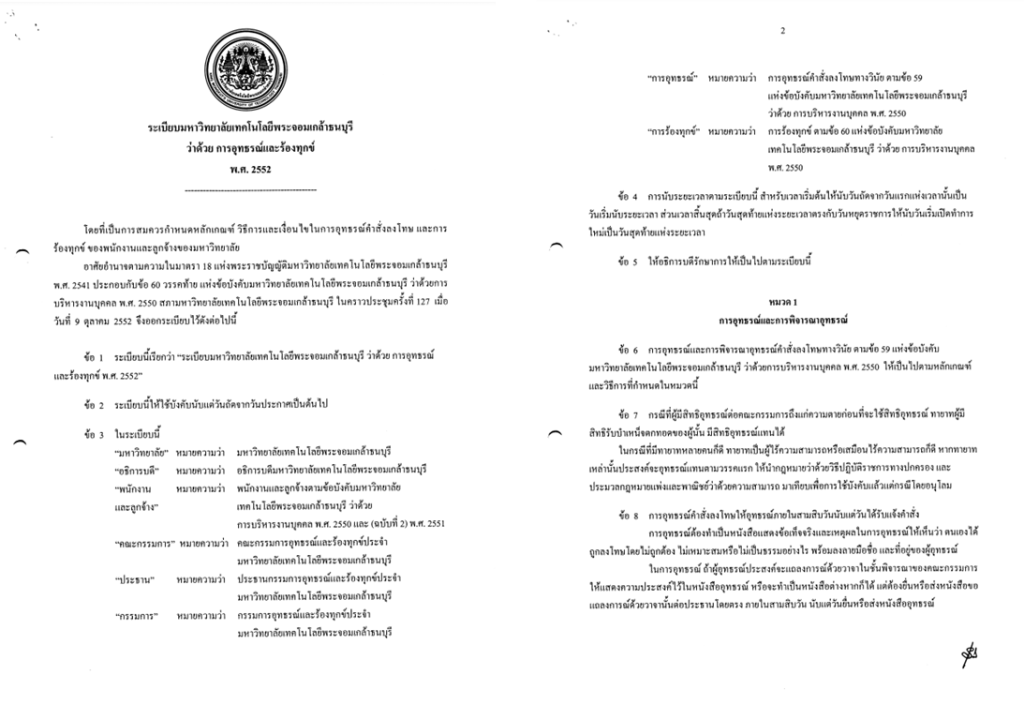
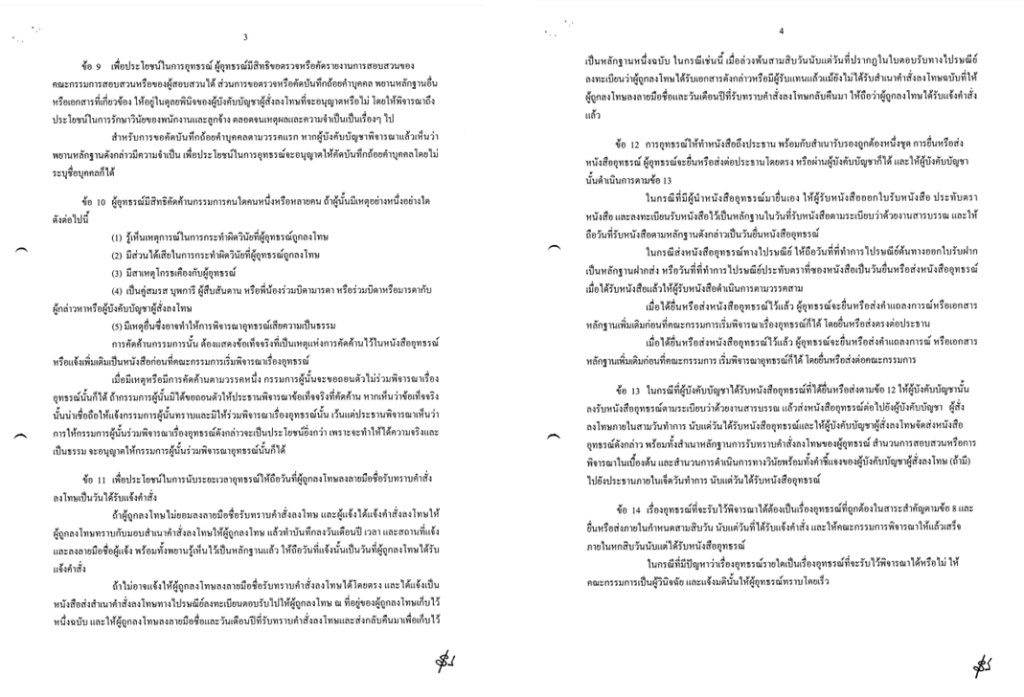
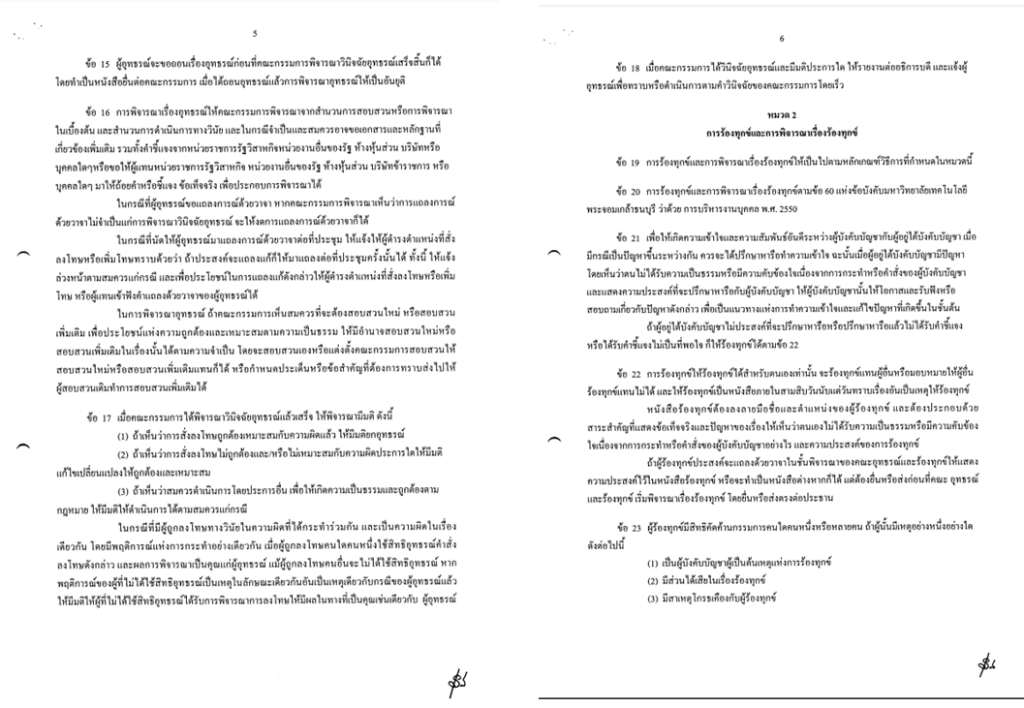
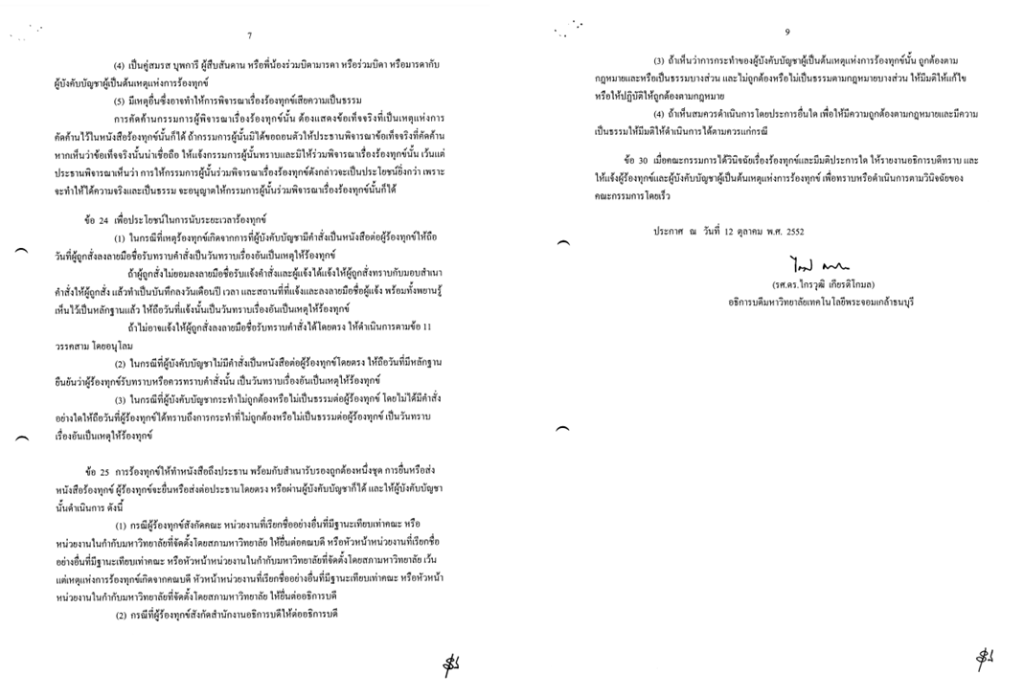
At King Mongkut’s University of Technology Thonburi (KMUTT), the university is committed to ensuring that all employees are treated with fairness and respect. To support this commitment, KMUTT has established a clear process for employees to appeal decisions related to their rights and compensation. This process is governed by the Regulations on Appeals and Grievances B.E. 2009 and the Regulations on Personnel Management B.E. 2007, which outline the rights of employees to challenge unfair treatment or decisions that may affect their employment status, pay, or working conditions.
Employee Rights to Appeal
KMUTT guarantees that all employees have the right to appeal when they believe their rights have been violated, especially in cases where they feel that their superiors have abused their authority. The regulations specifically cover situations where employees face issues such as:
- Unfair treatment by superiors or supervisors.
- Dismissal or forced leave without justified reason.
- Failure to pass academic assessments or performance reviews that affect their employment status.
- Failure to transition from a civil servant to an employee, or other significant employment status changes.
These situations may trigger an employee’s right to file a grievance or complaint, ensuring that any wrongful action is reviewed and addressed appropriately.
Filing Complaints and Grievances
The university has a dedicated Board of Appeals and Grievances that handles complaints related to employee rights and pay issues. Employees who feel they have been unfairly treated or affected by any of the situations described in the regulations can file their grievance directly with the Board. The complaint must be filed within thirty days from the date the grievance or issue occurs, ensuring that the process remains timely and effective.
By providing employees with a clear and transparent process for filing complaints, KMUTT ensures that individuals are able to seek redress and have their concerns addressed by an impartial body. This grievance process helps maintain a healthy and fair working environment where all employees feel empowered to voice their concerns without fear of retaliation.
Regulations and Procedures
The Regulations on Appeals and Grievances B.E. 2009 and the Regulations on Personnel Management B.E. 2007 outline the steps employees need to take to file a grievance:
- Submit the complaint to the Board of Appeals and Grievances within the stipulated time frame (30 days).
- The Board will review the complaint, considering the evidence and the nature of the grievance.
- If necessary, an investigation will be conducted to assess whether the complaint is valid.
- A decision will be made by the Board regarding the outcome of the grievance, which may include recommendations for corrective actions or other remedies.
KMUTT’s process ensures that grievances are taken seriously and handled in a structured and transparent manner, allowing employees to receive fair treatment in accordance with their rights.
Commitment to Fairness and Justice
KMUTT is committed to creating a workplace environment where employees can express concerns and seek justice without fear of retaliation or discrimination. The Appeals and Grievances process is part of the university’s broader commitment to ethical management and good governance. By providing employees with the ability to appeal decisions related to pay, performance assessments, or any other employment-related issues, KMUTT fosters an inclusive and respectful environment for all staff members.
The university’s regulations ensure that employees’ voices are heard and that their concerns are addressed promptly, reflecting the institution’s values of integrity, respect, and accountability. This process helps maintain a trustworthy and equitable working environment, where everyone can expect to be treated fairly, and any injustices are corrected through proper channels.
King Mongkut’s University of Technology Thonburi has a process for employees to appeal on employee rights and/or pay. There is regulations of KMUTT on Appeals and Grievances B.E.2009, The Regulations On Personnel Management B.E. 2007
Additional evidence link:
1. https://hrm.kmutt.ac.th/upload/iblock/a69/a6969723e7ca6ab02dfe15de8667276f.pdf
2. https://modlink.kmutt.ac.th/2024/05/23/modlink-my-passport/